科技行业

Search documents
【招银研究|宏观深度】火与冰:美国经济与就业缘何背离?
招商银行研究· 2025-11-19 09:25
Core Viewpoint - The article discusses the significant divergence between the U.S. economy and employment since the third quarter, with economic recovery contrasting sharply with a rapid cooling in the job market. This situation has prompted the Federal Reserve to restart interest rate cuts, with future rate paths heavily dependent on the evolving relationship between economic performance and employment trends [2][3][4]. Economic Recovery Factors - The economic recovery is attributed to two main factors: the decline of negative narratives surrounding "tight fiscal" policies and "high tariffs," and the positive impact of the AI wave and a bull market in U.S. tech stocks, which have driven capital expenditure expansion in the corporate sector and wealth effects in the household sector [3][9]. - The fiscal expansion is highlighted by the introduction of the "Big and Beautiful Act," which has led to a significant increase in tax cuts, contributing to a rise in the fiscal deficit to $440 billion in the third quarter, a substantial increase from the previous quarter [9][12]. - The high tariffs imposed by the Trump administration have resulted in a notable increase in tariff revenue, estimated at around $30 billion per month, which has helped alleviate fiscal pressure despite its limited impact on inflation [12][19]. Employment Market Dynamics - The cooling of the job market is driven by both demand and supply factors. High interest rates have suppressed traditional industries, while tariffs have impacted corporate profits. Additionally, the AI technology has shown a contractionary effect on employment in the tech sector, leading to a continuous decline in hiring demand [3][29]. - From March to July, approximately 1.4 million immigrant workers exited the labor market, contributing to a simultaneous contraction in both demand and supply, resulting in a significant drop in new job additions while the unemployment rate remained stable [29][30]. - The article notes that the current employment growth is primarily affected by industries sensitive to interest rates, tariffs, and technology, with the tech sector exemplifying a "strong growth, weak employment" scenario [35][38]. Federal Reserve's Policy Outlook - The Federal Reserve is experiencing increasing internal divisions regarding future interest rate paths, with hawks focusing on the "strong economy" and doves emphasizing "weak employment." The current inflation rate is fluctuating between 2-3%, providing narrative space for both sides [4][43]. - Political factors and financial stability are identified as key variables influencing future Federal Reserve decisions. The upcoming changes in leadership within the Federal Reserve may enhance the influence of the Trump administration, potentially leading to a more dovish policy stance [4][55]. - The article predicts that by the end of 2026, the policy interest rate may drop to around 3%, corresponding to 3-4 rate cuts of 25 basis points each [4][56]. Market Implications - The article anticipates a continued bull steepening trend in U.S. Treasury yields, with the 10-year Treasury yield expected to decline from 4.3% to around 4.0% by 2026, while the yield curve will maintain its steepening characteristic [4][61]. - The U.S. dollar is projected to experience a phase of initial weakness followed by a potential recovery, with an overall oscillating trend expected, as the dollar index is forecasted to decline from 101 in 2025 to 99 by 2026 [4][69].


“任正非很高深,我根本学不会”:其实任正非所说都是基本的常识
Sou Hu Cai Jing· 2025-11-19 06:55
Core Insights - The essence of Ren Zhengfei's philosophy is grounded in basic common sense, emphasizing the importance of customer-centricity and product relevance in business [3][4][11] - Companies must aim for a correct direction while maintaining organizational vitality to adapt to changing market conditions, particularly in the context of emerging technologies like AI [5][11] - The concept of "Red-Blue confrontation" within Huawei promotes self-criticism and diverse perspectives in decision-making, which is crucial for strategic preparedness and adaptation [7][11] Group 1 - The importance of having a product and customer focus in business operations, as without customers, there is no commercial existence [4] - Companies should recognize that while the direction may be broadly correct, specific strategies must be adaptable to changing circumstances [5] - The necessity of organizational vitality to adjust and refine business direction in response to market dynamics [5][11] Group 2 - The "Red-Blue confrontation" mechanism serves as a tool for self-criticism and encourages a multi-faceted approach to decision-making, enhancing strategic resilience [7] - Effective management should focus on leveraging employees' strengths rather than attempting to rectify their weaknesses, fostering a culture of development [9] - Huawei's approach to employee compensation balances short-term rewards with long-term company interests, ensuring sustainable growth and investment in R&D [11]

微软和亚马逊盘前领跌科技七巨头股 因Redburn下调两支股票评级
Xin Lang Cai Jing· 2025-11-18 11:28
Core Insights - Microsoft and Amazon underperformed compared to other members of the tech giants due to Rothschild & Co Redburn's downgrade of their stock ratings for the first time since coverage began in June 2022 [1] - Nvidia's stock is expected to continue its downward trend ahead of its quarterly earnings report later this week [1] - The Bloomberg Tech Giants Index has risen 20% this year, following a 67% surge in 2024 and more than a doubling in 2023 [1] Company Performance - Microsoft and Amazon's stock ratings were downgraded, impacting their pre-market trading performance [1] - Nvidia is anticipated to see a decline in stock price as it approaches its earnings report [1] - Meta and Tesla experienced slight declines of 0.5% and 0.3% respectively, while Alphabet and Apple saw increases of approximately 0.6% [1] Market Trends - The overall performance of the Bloomberg Tech Giants Index indicates a strong upward trend, with significant gains over the past two years [1] - The tech sector continues to show volatility, with mixed performances among the major companies [1]


AI导致硅谷十万大裁员?
腾讯研究院· 2025-11-18 08:33
Group 1 - The core viewpoint of the article is that the perception of mass layoffs in Silicon Valley is often one-sided, focusing only on recent events without considering historical context [3][9][10] - The article highlights that layoffs in the tech industry have been ongoing for four years, and the number of layoffs this year is the lowest in that period, being less than half of the layoffs in 2023 [3][5] - It emphasizes that while layoffs are occurring, hiring is also taking place, leading to a stable or even increasing employee count in major tech companies like Alphabet, Microsoft, and Netflix [5][6] Group 2 - The article points out that from the end of 2019 to 2023, major tech companies added over 900,000 jobs, indicating that hiring during the pandemic was significant, with Amazon alone adding 273,000 jobs in the second half of 2021 [7] - It argues that the perception of AI causing layoffs is flawed, as there is no direct evidence linking AI to job losses, and many companies cite other reasons for their layoffs [9][10] - The article discusses the decline in programmer employment over the past 20 years, attributing it to various factors rather than solely to AI, and notes that the UK has seen growth in programming jobs during the same period [13][14] Group 3 - The adoption rate of AI in enterprises is still low, with estimates ranging from 10% to 20%, indicating that AI has not yet had a significant direct impact on overall employment [18][19] - While AI may not currently threaten overall job numbers, its influence on specific job roles is already evident, and the long-term implications of AI on the economy and employment should be taken seriously [20]




深夜!全线跳水,超550点大跌!发生了什么?
天天基金网· 2025-11-18 01:07
牛市来了还没上车?上天天基金APP搜索777注册即可领500元券包,优选基金10元起投!限 量发放!先到先得! 美东时间11月17日周一,美股收跌,道指跌超550点,科技股领跌。英伟达将在周三盘后发 布三季度业绩;巴菲特大幅抛售苹果,建仓谷歌母公司 Alphabet,Alphabet 大涨超3%;油 价微跌,金价走弱。 美股大跌,市场等待经济数据 截至收盘,道指跌557.24点,跌幅为1.18%;纳指跌192.52点,跌幅为0.84%;标普500指 数跌61.70点,跌幅为0.92%。 投资者正密切关注周四发布的9月非农就业数据,这是在美国政府停摆导致经济数据发布中断 后,首次公布的就业报告。美联储计划在周三公布10月28 — 29日的会议纪要, 或 揭示决 策者之间 罕见的 意见分歧。 "新美联储通讯社"Nick Timiraos 撰文称,在12月的FOMC会议上,可能会出现至少三票反 对的情况——若保持利率不变,三位由特朗普任命的理事可能会投出反对票;若决定降息25 个基点,则可能遭遇另一组至少三位官员的反对。 美联储副主席理查德·杰斐逊表示,他观察到就业市场面临的下行风险有所增加,而通胀的上 行风险近期 ...

US midday market shock: Dow down 400 points, tech leads broad sell-off
Invezz· 2025-11-17 19:49
Wall Street took a sharp punch to the gut on Monday as major indices tumbled in midday trading, with the Dow Jones down roughly 400 points and the tech-heavy Nasdaq plunging nearly 2 percent. The broa... ...


大家又想起了次贷危机
Sou Hu Cai Jing· 2025-11-17 12:08
Group 1 - The current market is facing two main issues: the Federal Reserve's measures to address structural pressures in the money market and the risk hedging demands arising from the massive financing wave among AI giants [1] - A key indicator, the tri-party repo rate, has repeatedly breached the Federal Reserve's target range, indicating localized liquidity shortages within the financial system, primarily due to the Fed's quantitative tightening policy [2][3] - Companies are increasingly turning to the bond market for financing, particularly in the tech sector, as they seek to raise capital for AI investments despite having strong cash flows [4][5] Group 2 - The demand for new corporate bonds is high, but the widening credit spreads indicate that investors are seeking higher risk premiums, reflecting growing concerns about credit risk [5] - The trading volume of credit default swaps (CDS) related to Oracle surged from $200 million to approximately $4.2 billion year-on-year, highlighting a significant increase in risk hedging activity [6] - The focus has shifted to tech companies, with banks being the largest buyers of CDS as they seek to hedge against rising credit risks in the sector [7] Group 3 - The balance between technological revolution and financial market dynamics is crucial, with the Federal Reserve needing to find equilibrium between monetary pressures and available tools [8] - The long-term implications of government debt and corporate bond expansion driven by AI investments pose significant risks to the global financial system [8]

耶伦警告:美国面临沦为“香蕉共和国”的危险
Di Yi Cai Jing· 2025-11-17 11:33
Group 1: Economic Risks and AI Investment - The current AI investment boom is masking significant risks in the U.S. economy [1][4] - Oxford Economics predicts that the investment growth rate in information processing equipment and software will reach 20%-40% by mid-2025, marking the fastest growth since the late 1990s [4] - If the tech sector underperforms, the U.S. economy could become vulnerable, as tech investments are expected to contribute all growth in fixed investment by mid-2025, while other sectors may decline [4] Group 2: Federal Reserve Independence - There is a crisis regarding the independence of the Federal Reserve, with concerns that political pressures could undermine its credibility in controlling inflation [2][3] - The Trump administration's attempts to influence the Federal Reserve's policies, including threats to dismiss board members, pose a risk to its independence [2][3] - Yellen warns that if the Trump administration successfully removes a Federal Reserve board member, it could set a precedent that jeopardizes the institution's autonomy [3] Group 3: Impact on Talent and Innovation - The ongoing conflict between U.S. universities and the Trump administration is leading to a loss of scientists and researchers, which could hinder technological advancement [4] - The U.S. economy's growth heavily relies on its leadership in new technologies and the ability to create new enterprises [4]
大摩重磅展望:2026年是“风险重启之年”,美股盈利走强+AI投资周期共振,标普500或升至7800点!
Sou Hu Cai Jing· 2025-11-17 11:33
Core Viewpoint - Morgan Stanley's 2026 Global Strategy Outlook predicts a strong year for risk assets driven by a unique combination of fiscal, monetary, and regulatory policies, alongside robust corporate earnings growth, with the S&P 500 expected to lead global markets [1][4]. Policy Environment - The report highlights a rare "policy triumvirate" where fiscal policy, monetary policy, and regulatory easing will work in a pro-cyclical manner, creating a favorable environment for risk assets [4][5]. - Specific fiscal measures include the anticipated passage of the "One Big Beautiful Bill Act (OBBBA)" which is expected to reduce corporate taxes by $129 billion in 2026-27 [4]. - The Federal Reserve is projected to cut interest rates by 50 basis points in the first half of 2026 to stabilize the macroeconomic environment [4]. - Regulatory easing is expected to prioritize the energy and financial sectors [4]. AI Investment - AI-related capital expenditures are identified as a key growth driver, with a projected total of nearly $3 trillion in data center-related capital spending, of which less than 20% has been deployed so far [7]. - There is a significant financing gap of up to $1.5 trillion that will need to be filled through various credit channels [7][9]. Market Predictions - The S&P 500 index target for the end of 2026 is raised to 7,800, reflecting a 15% increase from current levels, supported by strong earnings growth and AI-driven efficiency improvements [1][10]. - The report forecasts S&P 500 earnings per share (EPS) to grow by 12% in 2025 and 17% in 2026, driven by improved corporate pricing power and a stable interest rate environment [9][10]. Credit Market Outlook - The credit market is expected to see significant differentiation, with high-yield bonds likely outperforming investment-grade bonds due to increased demand from AI-related financing [22]. - Investment-grade corporate bond issuance is projected to increase by 60%, primarily driven by AI and data center financing needs [22]. Commodity Preferences - In the commodities sector, Morgan Stanley favors metals over energy, with gold being the top choice, setting a target price of $4,500 per ounce, indicating a potential upside of about 9% [3][23]. - The report anticipates challenges in copper supply due to mining disruptions, predicting a shortfall of 600,000 tons by 2026 [26]. Global Market Insights - The outlook for the Japanese market is positive, with a target for the TOPIX index set at 3,600, benefiting from inflation recovery and corporate governance reforms [13]. - European markets face structural challenges, with growth primarily driven by valuation expansion rather than earnings improvement [18].

当心踩踏!资管巨头警告:新兴市场热门交易已过度拥挤
智通财经网· 2025-11-17 01:40
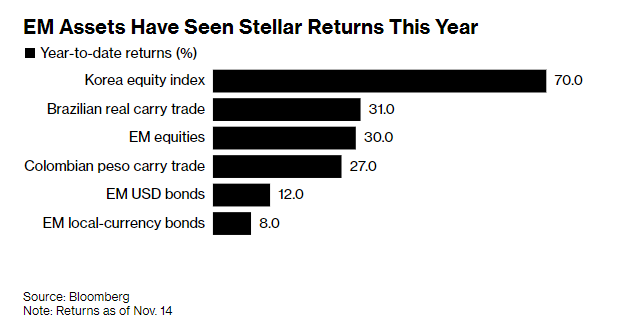
Core Insights - Emerging market trades, particularly long positions in Brazilian real and AI-related stocks, are raising concerns due to overcrowding risks [1][3] - Asset management firms are warning that valuations of Latin American currencies have deviated from fundamentals, indicating potential risks [1][6] - The MSCI Emerging Markets Index has seen a nearly 30% increase this year, marking its best performance since 2017, but past trends suggest a possible significant downturn could follow [3][4] Group 1: Emerging Market Concerns - Many emerging market sectors are showing signs of overheating, driven by factors such as Fed rate cuts and a softening dollar [3] - A recent HSBC survey indicated that 61% of investors are overweight in emerging market local currency bonds, a significant shift from a net underweight in June [3] - The potential for profit-taking as the year ends may lead to increased volatility in the foreign exchange market [3][4] Group 2: Specific Market Risks - Asian stock investors experienced risks associated with high valuations and crowded trades, particularly in AI stocks [4] - The Korean Composite Stock Price Index (Kospi) saw a significant drop despite a previous surge, highlighting the risks of concentrated positions in AI-related trades [4] - Lazard Asset Management's portfolio manager expressed caution after the tech stock sell-off, noting that low-quality companies have been outperforming high-quality ones, which historically does not last [5] Group 3: Currency and Bond Market Dynamics - Brazilian real has been a standout asset for carry trades, but recent indicators suggest a shift towards bearish sentiment [6] - Other Latin American currencies, such as Chilean, Mexican, and Colombian pesos, are also showing signs of overvaluation [6] - Frontier market bonds have benefited from a trend of investors moving away from U.S. assets, but concerns about liquidity in markets like Egypt and Ghana are emerging [7]