
煤化工

Search documents
“十四五”时期国资系统监管企业资产总额年均增长10.5% 国有企业质量效益全面提升
Sou Hu Cai Jing· 2026-01-19 22:38
Core Viewpoint - The meeting held by the State-owned Assets Supervision and Administration Commission (SASAC) highlighted the significant improvements in the quality and efficiency of state-owned enterprises (SOEs) during the 14th Five-Year Plan period, with total assets of regulated enterprises increasing from 235 trillion yuan to 387 trillion yuan, reflecting an average annual growth of 10.5% [1] Group 1: Enhancements in Enterprise Competitiveness - By November 2025, local regulated enterprises achieved a value-added of 6.9 trillion yuan and completed fixed asset investments of 5.3 trillion yuan, contributing positively to economic growth and public welfare [2] - SASAC Director Zhang Yuzhuo emphasized the continuous strengthening of technological innovation in SOEs, with 16 local SASACs establishing evaluation systems for R&D input and output [2] - Traditional industries are undergoing quality upgrades while emerging industries are being nurtured, with provinces like Henan and Shandong implementing strategic plans for industrial transformation and development [2] Group 2: Reform and Governance Improvements - The deepening of SOE reforms has led to optimized governance structures and improved market mechanisms, with local governments actively promoting reform initiatives [3] - The effectiveness of state asset supervision has been enhanced, with the establishment of a national property information database and comprehensive coverage of property registration systems [3] - Over the past five years, SOEs have seen increased vitality and competitiveness, contributing significantly to national strategies and infrastructure development [3] Group 3: Focus on Quality and Efficiency - The quality and efficiency of SOEs are crucial for the overall economic and social development of China, with a focus on creating value and improving operational metrics [4] - Key objectives for the 15th Five-Year Plan include enhancing value creation, technological innovation, and industrial upgrading capabilities [4][5] - Emphasis is placed on reform breakthroughs, strengthening party leadership, and ensuring that governance aligns with the new missions of SOEs [5] Group 4: Future Development Directions - For 2026, SOEs are expected to focus on quality enhancement and steady growth, with initiatives to create new consumption scenarios and implement key projects to stimulate demand [6] - The role of SOEs in technological innovation will be reinforced, with support for leading technology enterprises and the establishment of a favorable innovation ecosystem [6] - There will be a push for optimizing the layout and structure of the state economy, promoting the high-end, intelligent, and green development of traditional industries [6] Group 5: Implementation of Reform Plans - Local SASACs are urged to implement further reforms to modernize the corporate governance of SOEs and enhance market-oriented operational mechanisms [7] - There is a focus on professional, systematic, legal, and efficient supervision of state assets, alongside measures to prevent systemic risks [7]
化工日报-20260119
Guo Tou Qi Huo· 2026-01-19 12:06
Report Industry Investment Ratings - Urea: Not specified - Methanol: Not specified - Styrene: Not specified - Propylene: Not specified - Plastic: ☆☆☆ (Indicating short - term multi/empty trend in a relatively balanced state, poor operability on the current disk, mainly for observation) [1] - PVC: Not specified - Caustic Soda: ★☆☆ (Indicating a bearish bias, with a downward - driving trend but poor operability on the disk) [1] - PX: Not specified - PTA: Not specified - Ethylene Glycol: Not specified - Short - fiber: ☆☆☆ (Indicating short - term multi/empty trend in a relatively balanced state, poor operability on the current disk, mainly for observation) [1] - Glass: Not specified - Soda Ash: ★☆☆ (Indicating a bearish bias, with a downward - driving trend but poor operability on the disk) [1] - Bottle Chip: Not specified Core Viewpoints - The overall chemical market shows complex trends, with different products facing various supply - demand situations and price trends. Some products face supply shortages, while others are affected by cost, demand, and policy factors [2][3][5] - There are risks such as demand shrinkage due to downstream profit pressure and supply - demand imbalance in the market, and at the same time, there are also potential investment opportunities in some products [2][5] Summary by Directory Olefins - Polyolefins - Propylene futures declined, with tight supply in the short term and limited support from the demand side due to high raw material costs. There is a risk of demand shrinkage [2] - Plastic and polypropylene futures were volatile. For polyethylene, inventory was smoothly reduced, but demand support is expected to weaken. For polypropylene, although there is policy support, demand has been pre - consumed, and the upward - driving force for supply - demand fundamentals is insufficient [2] Pure Benzene - Styrene - Pure benzene prices rose due to port de - stocking and refinery production cuts. The short - term market is expected to be volatile and strong [3] - Styrene futures rose. The market is in a tight - balance state, with expected port de - stocking, low enterprise inventory, and export support [3] Polyester - PX and PTA prices are expected to decline due to weak cost support and inventory accumulation. There may be investment opportunities in the second quarter, but it depends on downstream demand [5] - Ethylene glycol is affected by new domestic production and overseas shutdowns. There may be short - term improvement in the second quarter, but it is under long - term pressure [5] - Short - fiber enterprises have high loads and low inventory, but downstream orders are weak. The absolute price fluctuates with raw materials [5] - Bottle chip production has decreased, and the processing margin has improved, but there is still long - term capacity pressure [5] Coal Chemical Industry - Methanol prices continued to decline. Although there is port de - stocking, demand has decreased, and the market is expected to be volatile and stalemate. There is support from reduced imports in the first quarter [6] - Urea production has increased, and downstream demand has also risen. The short - term market may decline slightly, but it is likely to be strong within a range as agricultural demand starts [6] Chlor - alkali - PVC prices weakened. Production capacity utilization has declined, and cost has increased. It is expected to reduce production capacity this year, and the price center may rise [7] - Caustic soda is in a weak state, with high inventory pressure. The industry is generally in a loss, and the profit of chlor - alkali integration is expected to be compressed [7] Soda Ash - Glass - Soda ash prices fluctuated widely. Inventory pressure is still high, supply pressure is large, and downstream demand is weak. A high - short strategy is recommended [8] - Glass prices declined due to ignition plans. The industry is de - stocking, but there may be an increase in supply. The order situation is poor, and there may be seasonal inventory accumulation [8]
兖矿能源(600188) - 兖矿能源集团股份有限公司2025年第四季度主要运营数据公告
2026-01-19 09:30
股票代码:600188 股票简称:兖矿能源 编号:临 2026-002 兖矿能源集团股份有限公司 2025 年第四季度主要运营数据公告 本公司董事会及全体董事保证本公告内容不存在任何虚假记 载、误导性陈述或者重大遗漏,并对其内容的真实性、准确性和完 整性承担法律责任。 经兖矿能源集团股份有限公司("公司")内部统计,2025 年 第四季度,公司及其附属公司煤炭业务、煤化工业务主要运营数据如 下表: | (六)聚甲醛 | | | | | | | | --- | --- | --- | --- | --- | --- | --- | | 1.产量 | 1.67 | 1.78 | -5.93 | 7.06 | 6.50 | 8.60 | | 2.销量 | 2.02 | 1.76 | 14.94 | 7.06 | 6.49 | 8.73 | | (七)全馏分液体石蜡 | ③ | | | | | | | 1.产量 | 10.77 | 11.61 | -7.15 | 44.74 | 11.61 | 285.52 | | 2.销量 | 10.58 | 11.10 | -4.73 | 44.64 | 11.10 | 302. ...

兖矿能源(01171) - 2025年第四季度主要运营数据公告
2026-01-19 09:29
香港交易及結算所有限公司及香港聯合交易所有限公司對本公告之內容概不負責, 對其準確性或完整性亦不發表任何聲明,並明確表示概不就因本公告全部或任何部 份內容而產生或因倚賴該等內容而引致之任何損失承擔任何責任。 兗礦能源集團股份有限公司 YANKUANG ENERGY GROUP COMPANY LIMITED * (在中華人民共和國註冊成立的股份有限公司) (股份代碼:01171) 2025 年第四季度主要運營數據公告 此公告乃由兗礦能源集團股份有限公司(「本公司」)自願作出。 | (四)醋酸乙酯 | | | | | | | | --- | --- | --- | --- | --- | --- | --- | | 1.產量 | 5.12 | 5.89 | -13.04 | 23.79 | 28.46 | -16.40 | | 2.銷量 | 5.03 | 6.00 | -16.12 | 23.86 | 28.39 | -15.96 | | (五)己內醯胺 | | | | | | | | 1.產量 | 8.55 | 9.58 | -10.78 | 35.70 | 33.66 | 6.08 | | 2.銷量 | 9 ...
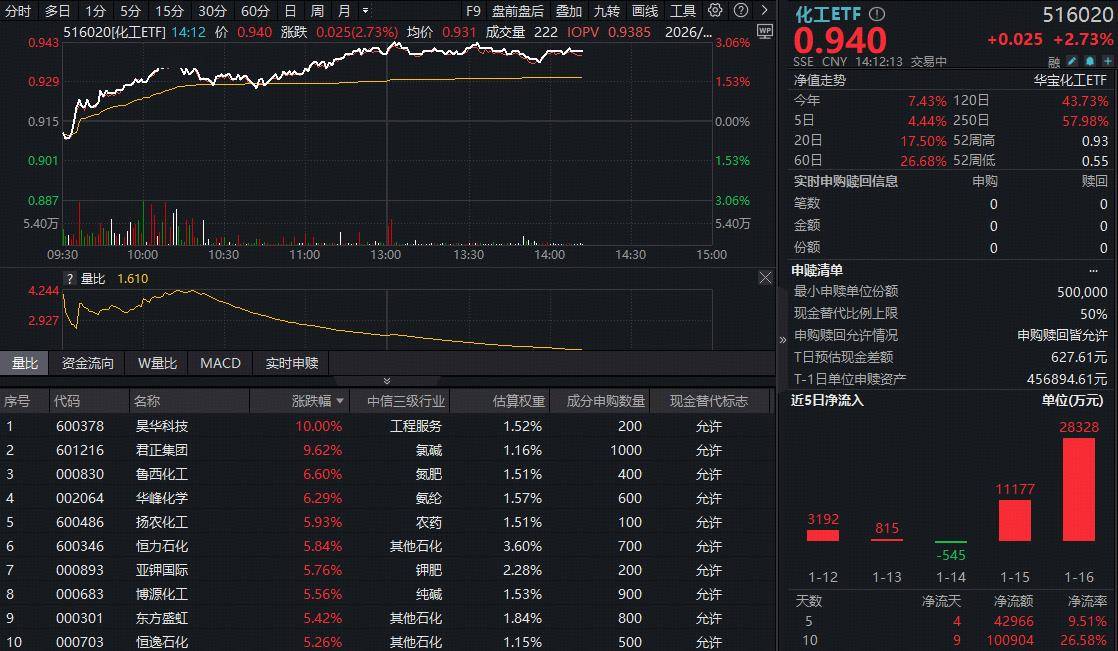
ETF盘中资讯|氟化工龙头涨停,化工板块午后继续猛攻!机构:供需双底确立,2026年或迎“戴维斯双击”
Sou Hu Cai Jing· 2026-01-19 06:33
Group 1 - The chemical sector continues to show strength, with the Chemical ETF (516020) experiencing a price increase of 2.73% as of the latest update [1][2] - Key stocks in the sector include Haohua Technology, which reached the daily limit, and Junzheng Group, which surged over 9%, along with other notable gains from companies like Luxi Chemical and Huafeng Chemical [1][2] - Since 2025, the Chemical ETF has shown a cumulative increase of 47.53%, significantly outperforming major indices such as the Shanghai Composite Index (22.38%) and the CSI 300 Index (20.25%) [1][3] Group 2 - The chemical industry has seen negative growth in capital expenditure since 2024, but the "anti-involution" trend and the clearing of outdated overseas capacities are expected to lead to a contraction in supply [4] - The "14th Five-Year Plan" emphasizes expanding domestic demand, which is anticipated to drive growth in chemical product demand, especially with the onset of a U.S. interest rate cut cycle [4] - A potential turning point for the chemical industry is expected in 2026, with a shift from valuation recovery to earnings growth, referred to as the "Davis Double Play" [4] Group 3 - The Chemical ETF (516020) tracks the CSI Sub-Industry Chemical Theme Index, with nearly 50% of its holdings concentrated in large-cap leading stocks, including Wanhua Chemical and Salt Lake Co., allowing investors to capitalize on strong investment opportunities [5] - The ETF also includes exposure to various sub-sectors such as phosphate and nitrogen fertilizers, fluorochemicals, and others, providing a comprehensive investment approach within the chemical sector [5] - The fund does not charge a sales service fee, with specific subscription and redemption fee structures outlined for investors [5][6]


宝丰能源涨2.01%,成交额7.71亿元,主力资金净流入1796.43万元
Xin Lang Zheng Quan· 2026-01-19 03:36
Core Viewpoint - Baofeng Energy has shown significant stock performance and financial growth, indicating strong market interest and operational success in the coal-to-olefins sector. Group 1: Stock Performance - On January 19, Baofeng Energy's stock rose by 2.01%, reaching 21.28 CNY per share, with a trading volume of 771 million CNY and a turnover rate of 0.50%, resulting in a total market capitalization of 156.05 billion CNY [1] - Year-to-date, Baofeng Energy's stock price has increased by 8.41%, with a 9.86% rise over the last five trading days, 17.89% over the last 20 days, and 23.01% over the last 60 days [1] Group 2: Financial Performance - For the period from January to September 2025, Baofeng Energy achieved a revenue of 35.545 billion CNY, representing a year-on-year growth of 46.43%, and a net profit attributable to shareholders of 8.950 billion CNY, which is a 97.27% increase compared to the previous year [2] - Since its A-share listing, Baofeng Energy has distributed a total of 17.348 billion CNY in dividends, with 8.121 billion CNY distributed over the last three years [3] Group 3: Shareholder Information - As of September 30, 2025, Baofeng Energy had 65,400 shareholders, an increase of 3.70% from the previous period, with an average of 112,206 circulating shares per shareholder, a decrease of 3.57% [2] - Among the top ten circulating shareholders, Hong Kong Central Clearing Limited holds 177 million shares, a decrease of 25.624 million shares from the previous period, while Huatai-PB CSI 300 ETF and Chemical ETF are also among the top shareholders [3]

中辉能化观点-20260119
Zhong Hui Qi Huo· 2026-01-19 03:23
1. Report Industry Investment Ratings - Crude Oil: Cautiously bearish [1] - LPG: Cautiously bearish [1] - L: Bearish continuation [1] - PP: Bearish continuation [1] - PVC: Bearish continuation [1] - PX/PTA: Range - bound [3] - Ethylene Glycol: Cautiously bearish [3] - Methanol: Cautiously chase up [3] - Urea: Cautiously chase up [4] - Natural Gas: Cautiously bearish [7] - Asphalt: Cautiously bearish [7] - Glass: Bearish continuation [7] - Soda Ash: Bearish continuation [7] 2. Core Views of the Report - The overall market of energy and chemical products is affected by multiple factors such as geopolitical situation, supply - demand relationship, and cost. Most products face downward pressure due to factors like supply overhang, seasonal weak demand, or geopolitical easing [1][3][7]. - Some products show a game between weak reality and strong expectation, such as methanol, where the supply - demand situation is relatively loose, but there are expectations for future changes [3]. - For fertilizers like urea, although there are some positive factors like export and spring fertilization expectations, the downstream demand in the festival season is weakening, and the supply pressure is rising [4]. 3. Summaries Based on Related Catalogs Crude Oil - **Market Performance**: On January 16, WTI rose 0.44%, Brent rose 0.58%, and SC fell 2.81%. As of January 9, US crude oil inventory increased by 3.4 million barrels to 422.4 million barrels [10][11]. - **Core Logic**: Geopolitical situation in the Middle East has eased but remains uncertain. There is a supply surplus in the off - season, with increasing global crude oil inventory and inventory of US crude oil and refined products. OPEC+ is in an expansion cycle [1][12]. - **Strategy Recommendation**: In the long - term, OPEC+ is expanding production to lower prices, and the oil price is in a low - price range. Pay attention to non - OPEC+ production changes. In the short - term, there is a rebound, but it is under pressure in the medium - and long - term. Focus on the range of SC [430 - 445] [14]. LPG - **Market Performance**: On January 16, the PG main contract closed at 4,144 yuan/ton, down 2.36% month - on - month. Spot prices in Shandong, East China, and South China changed to varying degrees [16][17]. - **Core Logic**: It is mainly anchored to the cost - end oil price, which is under pressure in the long - term. The supply and demand are relatively stable, with downstream chemical demand showing resilience. As of January 16, the warehouse receipt volume decreased by 36 lots [18]. - **Strategy Recommendation**: In the long - term, the upstream crude oil supply exceeds demand, and the price center is expected to continue to decline. In the short - term, the cost - end oil price is uncertain, and the fundamentals are bearish. Focus on the range of PG [4,100 - 4,200] [19]. L - **Market Performance**: The L05 contract price and related data changed. The L05 basis was 0 yuan/ton, and the L59 spread was - 35 yuan/ton [21][22]. - **Core Logic**: The upstream and mid - stream are destocking, and it is expected to fluctuate weakly following the cost in the short - term. In 2025, from January to November, Iran accounted for 8.7% of China's imports. The shutdown ratio increased to 14%, and production is expected to increase slightly [23]. - **Strategy Recommendation**: Follow the cost operation, focus on the range of L [6,650 - 6,800] [23]. PP - **Market Performance**: The PP05 contract price and related data changed. The PP05 basis was - 117 yuan/ton, and the PP59 spread was - 43 yuan/ton [25][26]. - **Core Logic**: The warehouse receipts are at a high level in the same period, and the supply is slightly increasing. It will fluctuate weakly following the cost in the short - term. The supply and demand are weak, and the demand is in the off - season in January. The PDH profit is compressed, increasing the expectation of maintenance [27]. - **Strategy Recommendation**: Follow the cost operation, focus on the range of PP [6,450 - 6,600] [27]. PVC - **Market Performance**: The V05 contract price and related data changed. The V05 basis was - 218 yuan/ton, and the V59 spread was - 124 yuan/ton [29][30]. - **Core Logic**: The social inventory is increasing at a high level. Although there is an expectation of rush - exporting in the short - term, the long - term supply and demand are expected to weaken, and the high - inventory structure is difficult to reverse. The domestic operation rate has increased to 80%, and the internal and external demand is in the seasonal off - season [31]. - **Strategy Recommendation**: Follow the cost operation, focus on the range of V [4,700 - 4,900] [31]. PX/PTA - **Market Performance**: The TA05 contract price and related data changed. The TA05 basis was - 58 yuan/ton, and the TA5 - 9 spread was 44 yuan/ton. The PTA spot processing fee was 401.6 yuan/ton [32]. - **Core Logic**: The valuation is not low. The supply - side devices are under planned maintenance with a relatively high intensity. The downstream demand is seasonally weak. The cost - end PX supply and demand are in a weak balance. There is a slight inventory accumulation from January to February, but the expectation is positive from the perspective of production and demand [33]. - **Strategy Recommendation**: The short - term driving force is limited. Pay attention to the opportunity of buying on dips for TA05. Focus on the range of TA05 [5,020 - 5,120] [34]. Ethylene Glycol - **Market Performance**: The EG05 contract price and related data changed. The EG05 basis was - 101 yuan/ton, and the EG5 - 9 spread was - 104 yuan/ton [35]. - **Core Logic**: The valuation is relatively low. The domestic device load has increased. The downstream demand is seasonally weak. The port inventory is rising, and there is an expectation of inventory accumulation from January to February. It lacks upward driving force and follows the cost to fluctuate [36]. - **Strategy Recommendation**: Pay attention to the opportunity of short - selling on rebounds. Focus on the range of EG05 [3,730 - 3,820] [37]. Methanol - **Market Performance**: The methanol comprehensive profit was - 215.5 yuan/ton, and the East China basis strengthened [40]. - **Core Logic**: The valuation is not low. The domestic methanol device operation rate has declined from a high level. The overseas devices are slightly under - loaded. The supply pressure is expected to ease in January. The demand is slightly weakening. There is a game between weak reality and strong expectation [40]. - **Strategy Recommendation**: The supply pressure is expected to ease in January, and the demand is suppressed by the weak olefin market. Close long positions. Focus on the range of MA05 [2,225 - 2,285] [42]. Urea - **Market Performance**: The urea main contract price and related data changed. The Shandong small - particle urea basis was - 31 yuan/ton, and the UR5 - 9 spread was 29 yuan/ton [43]. - **Core Logic**: The absolute valuation is not low. The supply - side operation rate is rising, and the warehouse receipts are at a high level in the same period. The short - term demand is strong, but the downstream demand is entering the festival off - season. There is a ceiling and a floor for the price under relevant policies [44]. - **Strategy Recommendation**: The winter storage has limited positive effects, the supply pressure is rising, and the demand is seasonally weak. Focus on the range of UR05 [1,780 - 1,810] [46]. Natural Gas - **Market Performance**: On January 16, the NG main contract closed at 3.128 US dollars/million British thermal units, up 0.26% month - on - month. The US Henry Hub spot price and other prices changed [48][49]. - **Core Logic**: The supply is relatively abundant, the demand is stable, and the price is under pressure. The domestic LNG retail profit increased. The US natural gas rig count decreased [50]. - **Strategy Recommendation**: In winter, although the demand has support, the supply is relatively abundant, and the price is under pressure. Focus on the range of NG [3.355 - 3.991] [50]. Asphalt - **Market Performance**: On January 16, the BU main contract closed at 3,130 yuan/ton, down 1.17% month - on - month. Spot prices in Shandong, East China, and South China changed to varying degrees [52][53]. - **Core Logic**: The export of Venezuelan crude oil is uncertain, the raw material is tight, and the Middle East geopolitical situation has eased, leading to a decline in oil prices. The profit has decreased, the supply has increased, and the inventory has risen [54]. - **Strategy Recommendation**: The valuation has returned to normal, but there is still room for compression. The supply - side uncertainty has increased. Pay attention to geopolitical risks. Focus on the range of BU [3,100 - 3,200] [55]. Glass - **Market Performance**: The FG05 contract price and related data changed. The FG05 basis was - 66 yuan/ton, and the FG59 spread was - 110 yuan/ton [57][58]. - **Core Logic**: The enterprise inventory is slowly decreasing from a high level, and the market is weakly oscillating. The supply and demand are both weak, the profit of three processes has turned negative, and the weak demand suppresses the upside [59]. - **Strategy Recommendation**: Follow the cost operation, focus on the range of FG [1,080 - 1,130] [59]. Soda Ash - **Market Performance**: The SA05 contract price and related data changed. The SA05 basis was - 43 yuan/ton, and the SA59 spread was - 63 yuan/ton [61][62]. - **Core Logic**: The production enterprise operation rate has increased, the factory inventory has accumulated against the season, and the market has returned to weak oscillation. The demand for heavy soda ash is insufficient, and the supply is under pressure [63]. - **Strategy Recommendation**: Follow the cost operation, focus on the range of SA [1,180 - 1,230] [63].
甲醇产业链梳理
2026-01-19 02:29
Summary of Methanol Industry Conference Call Industry Overview - The methanol industry in China has an annual production capacity of approximately 95 million tons, primarily utilized for MTO/MTP (over 50%), fuel (around 20%), and chemical raw materials (about 30%) [2][4] - Coal-based methanol accounts for over 80% of production, with natural gas and coke oven gas making up a smaller share, while green methanol has a negligible presence, limited to a few demonstration units [2][6] Key Insights and Arguments - The development of green methanol is slow due to technological bottlenecks in CO2 capture and renewable hydrogen production, along with high investment costs. It mainly targets marine fuel and EU exports, holding a small market share [2][7] - From 2019 to 2024, China's methanol export volume is minimal, with heavy reliance on imports [2][8] - Under the dual carbon policy, actual methanol production in China is declining, and new projects are restricted. Geopolitical and economic factors have led to reduced downstream demand, indicating a peak followed by a downward trend in supply and demand [2][9] - Current methanol market prices are around 2,200 RMB per ton, with producers facing losses of 200-300 RMB per ton. The cost of green methanol is high (approximately 4,000 RMB per ton), influenced by green hydrogen prices, making profitability challenging [2][11][12] Production Costs and Profitability - Coal-based methanol technology is mature and cost-effective, with coal accounting for about 70% of total costs. Depreciation constitutes 10%-20% of costs [2][13] - Most coal-based methanol projects are expected to incur losses from 2024 to 2025, with only a few coke oven gas projects potentially profitable. For instance, at an average price of 700 RMB per ton in 2025, many projects will struggle to break even [2][10] - The breakeven point for methanol production is typically between 70%-80% capacity utilization [2][27] Future Market Trends - Methanol prices have fluctuated between 1,800 and 2,700 RMB from 2019 to 2023, with future prices expected to remain volatile due to unstable market demand and strict energy consumption regulations [2][18] - The exit of outdated, high-energy-consuming production capacities is anticipated to gradually improve industry profitability, although many older facilities continue to operate to address employment concerns [2][20] Green Methanol Development - Green methanol production faces challenges due to high costs and limited industrial scale. Current production methods include biomass and renewable energy-based processes, with the latter being more advantageous due to stable electricity supply [2][28] - The domestic market for green methanol is limited, and its pricing is comparable to traditional methanol, despite higher production costs [2][30] Regional Insights - In Xinjiang, many coal chemical projects have been halted due to environmental and regulatory pressures, with ongoing challenges related to water resource consumption for coal chemical projects [2][16][17] Conclusion - The methanol industry in China is at a critical juncture, facing challenges from environmental policies, market dynamics, and technological limitations. The transition towards greener production methods is slow, and while there is potential for profitability improvement, significant hurdles remain.
金能科技1月16日获融资买入1537.32万元,融资余额2.60亿元
Xin Lang Cai Jing· 2026-01-19 01:35
Group 1 - The core viewpoint of the news is that Jineng Technology has shown significant trading activity, with a notable increase in financing and a high level of margin trading, indicating strong investor interest [1][2] - On January 16, Jineng Technology's stock rose by 1.11%, with a trading volume of 76.25 million yuan. The financing buy-in amount was 15.37 million yuan, while the net financing buy was 5.31 million yuan, leading to a total financing and margin balance of 260 million yuan [1] - The financing balance of Jineng Technology accounts for 4.81% of its circulating market value, which is above the 80th percentile of the past year, indicating a high level of leverage [1] Group 2 - As of January 9, the number of shareholders of Jineng Technology decreased by 10.24% to 35,100, while the average circulating shares per person increased by 11.41% to 24,161 shares [2] - For the period from January to September 2025, Jineng Technology reported a revenue of 12.693 billion yuan, representing a year-on-year growth of 4.47%. However, the net profit attributable to the parent company was -78.23 million yuan, a decrease of 141.22% compared to the previous year [2] - Since its A-share listing, Jineng Technology has distributed a total of 1.434 billion yuan in dividends, with 482 million yuan distributed over the past three years [2]

蹚出能源革命“三晋新路”
Ke Ji Ri Bao· 2026-01-19 01:03
Core Viewpoint - Shanxi Province is implementing a comprehensive energy transformation plan, leveraging technology to transition from a coal-dominated economy to a diversified energy system, aligning with national energy revolution goals [1][2][3]. Group 1: Energy Transition and Innovation - The Shanxi government has issued an implementation opinion to accelerate energy technology innovation, providing a "Shanxi plan" for national energy transformation [1]. - Shanxi has become the first national pilot for comprehensive energy reform, focusing on energy technology innovation and system reform [1][2]. - As of now, Shanxi has established 369 intelligent coal mines and 75 green mining demonstration mines, with advanced coal production capacity accounting for 84% [2]. Group 2: New Energy Development - The province is constructing a new energy system, promoting the integration of traditional and renewable energy sources, and developing bases for clean energy and unconventional natural gas [2][3]. - The new energy base project in Jinbei will have a total construction scale of 10 million kilowatts, capable of delivering 27 billion kilowatt-hours of clean electricity annually to the Beijing-Tianjin-Hebei region [3]. Group 3: Modern Coal Chemical Industry - Shanxi is enhancing the coal chemical industry, with advanced coking capacity reaching 96.6%, and is focusing on high-value utilization of coal as a chemical raw material [4][5]. - The province is developing multiple energy technology innovation platforms and creating various coal chemical industry chains to transition coal from a single fuel to high-end chemical raw materials [4][5]. Group 4: Digital Transformation and Computing Power - Shanxi is leveraging its coal and green energy advantages to build a computing power ecosystem, integrating computing power with various industries [6]. - The province's computing power center revenue grew by 69.5% in the first half of 2025, with significant increases in the manufacturing and information technology sectors [6]. Group 5: Policy and Strategic Direction - The provincial government is committed to deepening the energy revolution and developing new productive forces in line with national directives [7].