计算机

Search documents
科创、海外市场策略深度报告:春季行情之后,AI投资向何处走?
ZHESHANG SECURITIES· 2026-02-27 15:31
Core Insights - The report discusses the seasonal patterns in industry trend investments driven by economic cycles, emphasizing that "no industry, no bull market" is a key principle. The current bull market, which began in September 2024, is primarily driven by the AI upstream infrastructure represented by computing power [1][2][10] - The report outlines that the first wave of investment typically starts around mid-year, with a second wave at year-end, followed by high volatility in March to April of the following year. The sustainability of these trends depends on whether high economic conditions can continue into the next year [2][3][11] Seasonal Patterns in Industry Trend Investments - Historical analysis from 2013 to 2015 in the computer sector, 2019 to 2021 in semiconductors, and 2020 to 2021 in new energy shows clear seasonal patterns in investment opportunities driven by economic cycles [2][13] - The first wave of investment usually begins around mid-year, driven by the clarity of quarterly reports, while the second wave starts at year-end due to valuation shifts. High volatility typically occurs in March to April of the following year [11][13] AI Investment Trends and Main Lines - The current bull market cycle is characterized by AI upstream computing power, with significant seasonal patterns. The first wave of investment occurred from May to September 2025, followed by a second wave from November 2025 to February 2026 [3][43] - Looking ahead to March and April, the report anticipates a phase of volatility in computing power investments, influenced by valuation and crowding constraints. The sustainability of the computing power market in 2026 will depend on the continuation of high economic conditions [3][46] - The report suggests that the leading sub-sectors within AI upstream computing may shift in 2026 compared to 2025, with specific sub-sectors needing validation during the earnings season around May [12][46] Capital Expenditure Insights - The report highlights significant projected increases in capital expenditures from major cloud service providers for 2026, with Amazon expected to spend $200 billion (a 50% increase), Google between $175 billion and $185 billion (almost doubling), and Meta between $115 billion and $135 billion (close to doubling) compared to 2025 [46][48]
两会政策预期升温,A股3月何去何从?
Guo Ji Jin Rong Bao· 2026-02-27 13:59
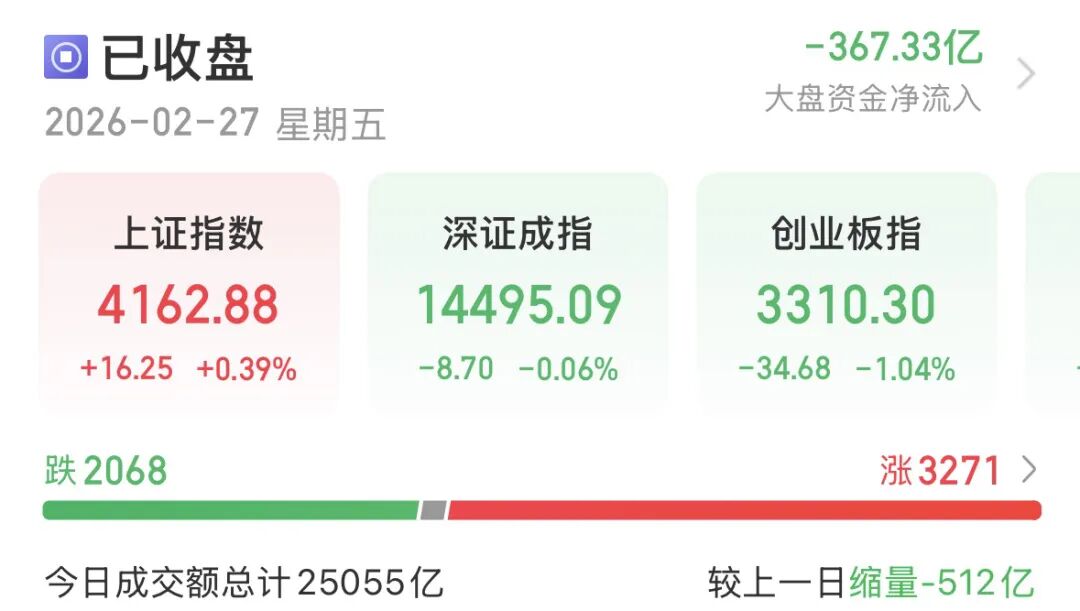
Group 1 - The market is experiencing structural fluctuations as policy expectations intensify ahead of the Two Sessions, with potential adjustments in high-valuation sectors if performance diverges from valuations [2][12][13] - Resource stocks, particularly steel, coal, and non-ferrous metals, are leading the market, while technology stocks are experiencing a pullback due to previous gains and profit-taking [3][11][12] - The trading volume in the three markets has decreased by 504 billion, reaching 2.51 trillion, indicating a shift in market sentiment [3][11] Group 2 - The A-share market is showing signs of rotation between resource and technology sectors, with resource stocks benefiting from improved supply-demand dynamics and government policies supporting industrial metal demand [11][12] - The upcoming month of March is expected to see a "first rise then fall" trend, influenced by policy expectations from the Two Sessions and the release of annual reports [13][14] - Investment strategies should focus on balancing offense and defense, with attention on sectors like commercial aerospace, AI applications, and resource price increases [15]

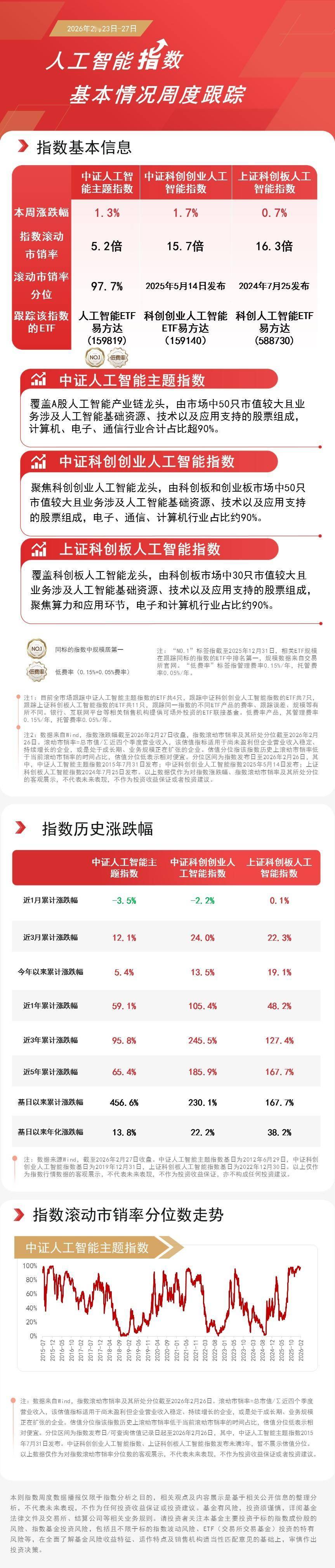
AI硬件方向局部活跃,科创创业人工智能ETF易方达(159140)、人工智能ETF易方达(159819)标的指数本周涨超1%
Sou Hu Cai Jing· 2026-02-27 11:35
Group 1 - The core viewpoint of the news highlights the active performance of AI hardware sectors such as HBM, circuit boards, and copper-clad laminates in the first week after the holiday, with various AI-related indices showing positive growth [1][5][6] - The CSI AI Theme Index increased by 1.3%, the CSI Sci-Tech Innovation and Entrepreneurship AI Index rose by 1.7%, and the SSE Sci-Tech Innovation Board AI Index saw a 0.7% increase [1][3] - The AI ETF managed by E Fund (159819) attracted over 100 million yuan in the first three trading days of the week [1] Group 2 - The CSI Sci-Tech Innovation and Entrepreneurship AI Index focuses on leading companies in AI, comprising 50 stocks with significant market capitalization involved in AI foundational resources, technology, and application support, with approximately 90% from the electronics, communication, and computer sectors [5] - The SSE Sci-Tech Innovation Board AI Index includes 30 major stocks from the Sci-Tech Innovation Board, also focusing on AI foundational resources and applications, with a similar industry composition [6] - The rolling price-to-sales ratio for the CSI AI Theme Index is 5.2 times, while the corresponding ratios for the other indices are 15.7 times and 16.3 times respectively [3]

国产模型进入需求时代,看好应用与基础资源:2026年第8周计算机行业周报-20260227
Changjiang Securities· 2026-02-27 10:43
Investment Rating - The report maintains a "Positive" investment rating for the software and services industry [7] Core Insights - The computer sector experienced a rebound, with an overall increase of 4.21%, ranking second among major industries in the Yangtze River region, and accounting for 8.04% of total market turnover. The AI authenticity concept is gaining traction [2][4] - Domestic model capabilities are leading investment opportunities, focusing on three main investment themes: new super entry points, domestic foundational resources, and AI agents [2][6] - The domestic model market is entering a demand era, with leading firms like Zhipu and MiniMax showing significant stock performance post-IPO, with Zhipu's stock up 523.92% and MiniMax's up 487.88% relative to their issue prices [6][47] Summary by Sections Market Performance - The computer sector saw a 4.21% increase last week, with the Shanghai Composite Index fluctuating around the 4100-point mark, closing at 4082.07 points, reflecting a 0.41% rise [4][14] Key Recommendations - Focus on applications and foundational resources as domestic models enter a demand era. The report suggests monitoring the commercialization of new entry points and large models, domestic chips (CPU+GPU), and the restructuring of software by agents [6][47] Investment Opportunities - The report highlights the potential in AI content review and the robot industry, particularly following the impressive performances of robots at the Spring Festival Gala, indicating a shift from concept to practical application in the humanoid robot sector [28][34] - The launch of Tesla's Cybercab marks a significant step in the commercialization of autonomous driving, with plans for large-scale production and deployment [35][40]
联想取得作业资源竞争识别方法专利
Jin Rong Jie· 2026-02-27 10:26
Group 1 - Lenovo (Beijing) Co., Ltd. has obtained a patent titled "Method, Device, and Electronic Equipment for Identifying Competition in Homework Resources," with authorization announcement number CN113886046B, and the application date is September 2021 [1] - Lenovo (Beijing) Co., Ltd. was established in 1992 and is located in Beijing, primarily engaged in the manufacturing of computers, communications, and other electronic devices [1] - The registered capital of Lenovo (Beijing) Co., Ltd. is 5.65 billion HKD [1] Group 2 - Lenovo (Beijing) Co., Ltd. has invested in 107 companies and participated in 5,000 bidding projects [1] - The company has 1,747 trademark records and 5,000 patent records, along with 238 administrative licenses [1]

2026年3月A股及港股月度金股组合:节后表现值得期待-20260227
EBSCN· 2026-02-27 10:22
Overall Research - The A-share market showed a mixed performance in February, with major indices mostly rising, particularly the CSI 1000 which increased by 2.9%, while the Sci-Tech 50 saw a decline of 1.6% [1] - The Hong Kong stock market experienced a pullback in February, with the Hang Seng Index falling by 3.7% and the Hang Seng Technology Index dropping by 10.6% [1] - The report anticipates a seasonal rebound in market trading activity post-Chinese New Year, setting a positive foundation for future market performance [1] A-share Insights - The report suggests focusing on growth and cyclical sectors, with growth benefiting from sustained industry enthusiasm and increased risk appetite among investors during the spring market [2] - Key sectors to watch include humanoid robots and the AI industry chain, which are expected to see significant catalytic events [2] - Cyclical sectors are anticipated to benefit from strong commodity prices and supportive policies, with recommendations to focus on resource products and offline service sectors [2] Hong Kong Stock Insights - The Hong Kong market is expected to remain volatile, with strong expectations for recovery in the spring, but concerns about earnings realization and foreign capital inflow persist [3] - Major internet companies are experiencing slower-than-expected profit recovery, which is impacting the overall economic environment [3] - The report recommends a "barbell strategy" for portfolio allocation, combining high-dividend defensive sectors with growth sectors such as semiconductor equipment and AI computing [3] - The report highlights the potential for a structural market recovery driven by domestic capital inflow and policy support [3] A-share Recommended Stocks - The recommended stocks for March 2026 include: - Zhongji Xuchuang (中际旭创) - Communication - Keda Xunfei (科大讯飞) - Computer - Shenghong Shares (盛弘股份) - Power Equipment - Jereh Group (杰瑞股份) - Machinery - Nanjing Bank (南京银行) - Banking - Hualing Steel (华菱钢铁) - Steel - Chuanheng Shares (川恒股份) - Basic Chemicals - China Jushi (中国巨石) - Building Materials - Sun Paper (太阳纸业) - Light Industry Manufacturing - Haier Smart Home (海尔智家) - Home Appliances [3][6] Hong Kong Recommended Stocks - The recommended stocks for March 2026 include: - Hon Teng Precision (鸿腾精密) - Communication - Huiju Technology (汇聚科技) - Power Equipment - Sinopec Oilfield Service (中石化油服) - Oil and Petrochemicals [4][7]





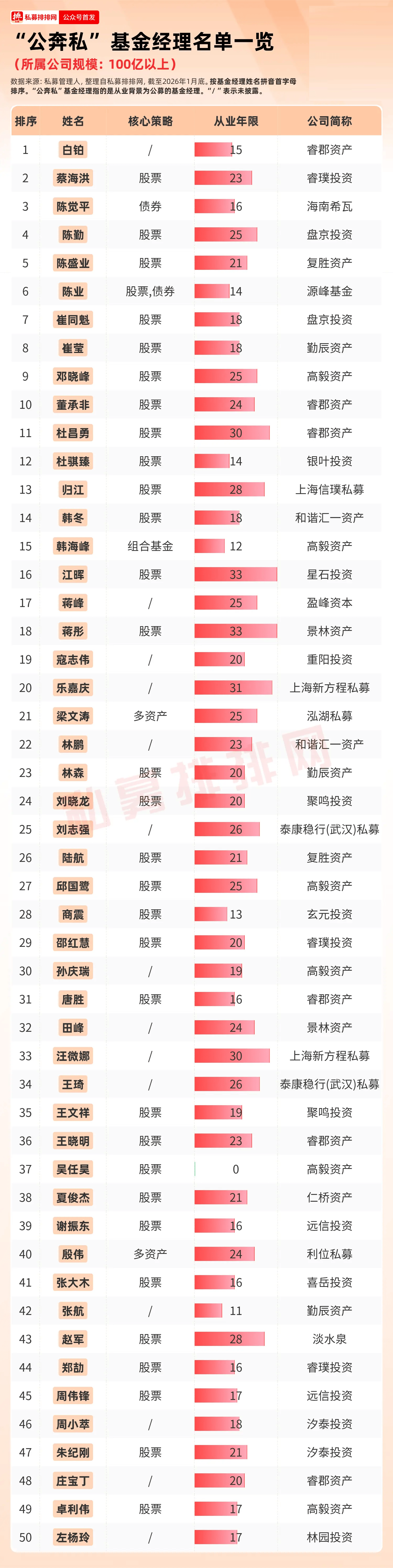
87位头部“公奔私”基金经理最新观点、动向出炉!
Sou Hu Cai Jing· 2026-02-27 09:27
Core Insights - The trend of public fund managers transitioning to private equity ("公奔私") has become a significant faction within the private equity industry, driven by personal career advancement and changes in platform dynamics [1] - As of January 2026, there are 859 public fund managers who have transitioned to private equity, with 87 of them (10.13%) being from leading private equity firms [1] Group 1: Billion-Level Private Equity Managers - There are 50 "公奔私" fund managers under billion-level private equity firms, with the majority (31) focusing on stock strategies [2] - Among these managers, 29 have at least 20 years of experience, and 5 have over 30 years, including notable figures from various firms [2] - High Yi Asset and Rui Jun Asset each have 6 "公奔私" fund managers, while Qin Chen Asset and Rui Pu Investment have 3 each [2] Group 2: High Yi Asset Insights - High Yi Asset is a well-known private equity firm established in 2013, with a strong founding team [8] - The firm has 6 fund managers who previously held significant positions in public funds, including founder Qiu Guolu and CIO Deng Xiaofeng [8] - Deng Xiaofeng's investment in Zijin Mining is highlighted as a successful long-term case, with the stock price increasing approximately 12 times from around 3 yuan to 37.78 yuan by February 2026 [8] Group 3: Research and Performance - In January 2026, High Yi Asset conducted research on 24 A-share stocks, with 17 showing price increases, the highest being Wangsu Science and Technology with over 60% growth [9] - Jinglin Asset also has a strong presence of former public fund managers, with notable figures like Jiang Tong, who has over 30 years of experience [11] - In January 2026, 5 out of 8 stocks researched by Jinglin Asset saw price increases of over 10% [11] Group 4: Insights from Other Managers - In the准百亿 private equity sector, there are 37 "公奔私" fund managers, with 18 focusing on stock strategies [14] - Notable managers include Yuan Wei from Hua'an Hexin and Li Bei from Banxia Investment, both of whom have extensive experience in the industry [19] - Li Bei has expressed a shift in investment focus, predicting a significant opportunity in the real estate sector within the next six months [19]
元星电子取得管线探测用电流传感器专利
Sou Hu Cai Jing· 2026-02-27 08:29
Group 1 - Shandong Yuanxing Electronics Co., Ltd. and Shandong Fu'ao Electric Power Equipment Co., Ltd. have obtained a patent for a "current sensor for pipeline detection," with the authorization announcement number CN120122222B, and the application date is March 2025 [1] - Shandong Yuanxing Electronics Co., Ltd. was established in 1999, located in Zibo City, primarily engaged in the manufacturing of computers, communications, and other electronic equipment, with a registered capital of 50 million RMB [1] - The company has invested in 5 enterprises, participated in 42 bidding projects, holds 64 patent records, and possesses 30 administrative licenses [1] Group 2 - Shandong Fu'ao Electric Power Equipment Co., Ltd. was established in 2005, also located in Zibo City, primarily engaged in the manufacturing of electrical machinery and equipment, with a registered capital of 50 million RMB [1] - The company has participated in 22 bidding projects, has 2 trademark records, holds 31 patent records, and possesses 35 administrative licenses [1]
联想取得均热板以及电子设备专利,提升散热性能
Jin Rong Jie· 2026-02-27 08:28
Core Viewpoint - Lenovo (Beijing) Co., Ltd. has obtained a patent for a "heat spreader and electronic device," indicating ongoing innovation in technology and product development [1] Company Overview - Lenovo (Beijing) Co., Ltd. was established in 1992 and is located in Beijing, primarily engaged in the manufacturing of computers, communications, and other electronic devices [1] - The company has a registered capital of 5.65 billion HKD [1] - Lenovo has made investments in 107 companies and participated in 5,000 bidding projects [1] Intellectual Property - The newly granted patent, with the announcement number CN223957833U, was applied for on February 2025 [1] - The patent details a heat spreader design that includes a first cover and a second cover, creating an enclosed space [1] - Lenovo holds a total of 5,000 patent records, alongside 1,747 trademark records [1]
京东方取得显示基板及显示面板专利可延长漏电路径
Sou Hu Cai Jing· 2026-02-27 07:08
Group 1 - BOE Technology Group Co., Ltd. has obtained a patent titled "Display Substrate and Display Panel," with authorization announcement number CN115623881B, applied for on April 2021 [1] - BOE Technology Group Co., Ltd. was established in 1993 and is located in Beijing, primarily engaged in the manufacturing of computers, communications, and other electronic devices. The company has a registered capital of 3,741,388.0464 million RMB [1] - The company has invested in 73 enterprises, participated in 306 bidding projects, and holds 777 trademark records and 5,000 patent records, along with 47 administrative licenses [1] Group 2 - Chengdu BOE Optoelectronics Technology Co., Ltd. was established in 2007 and is located in Chengdu, primarily engaged in the manufacturing of instruments and meters. The company has a registered capital of 2,500,000 million RMB [1] - Chengdu BOE Optoelectronics Technology Co., Ltd. has participated in 926 bidding projects, holds 5,000 patent records, and possesses 528 administrative licenses [1]