
钢铁行业

Search documents
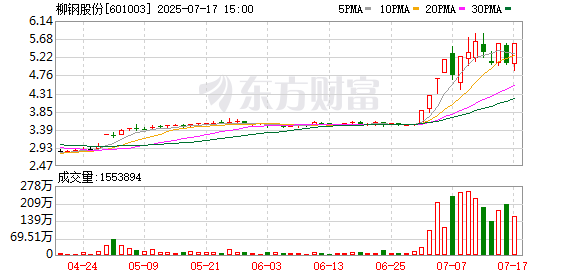
柳钢股份涨停,沪股通净买入1356.61万元
Zheng Quan Shi Bao Wang· 2025-07-17 12:12
Group 1 - LiuGong Co., Ltd. (601003) experienced a trading halt today with a daily turnover rate of 6.06% and a transaction amount of 834 million yuan, showing a price fluctuation of 14.85% [2] - The stock was listed on the Shanghai Stock Exchange's daily trading report due to a price deviation of 9.71%, with a net purchase of 13.57 million yuan from the Shanghai-Hong Kong Stock Connect [2] - The top five trading departments accounted for a total transaction amount of 300 million yuan, with a net purchase of 149 million yuan [2] Group 2 - Over the past six months, the stock has appeared on the trading report eight times, with an average price increase of 1.98% the day after being listed and an average increase of 9.37% in the following five days [3] - The stock saw a net inflow of 309 million yuan from major funds today, with a significant inflow of 312 million yuan from large orders [3] - The latest margin trading data shows a total margin balance of 122 million yuan, with a financing balance of 121 million yuan and a margin balance of 743,800 yuan [3] Group 3 - The company's Q1 report indicated a revenue of 17.12 billion yuan, a year-on-year decrease of 14.36%, while net profit reached 260 million yuan, a year-on-year increase of 594.67% [3] - The company’s half-year performance forecast estimates a net profit between 340 million yuan and 400 million yuan, representing a year-on-year change of 530% to 641% [3]


瑞达期货热轧卷板产业链日报-20250717
Rui Da Qi Huo· 2025-07-17 11:14
Report Summary 1. Report Industry Investment Rating No information provided. 2. Core View of the Report The hot - rolled coil production remains at a relatively high level, the terminal demand has strong resilience, the inventory decreases while the apparent demand increases. Coupled with the positive policy expectations in the macro - aspect, it supports the hot - rolled coil futures to stop falling and rebound. Technically, for the HC2510 contract, the 1 - hour MACD indicator shows that DIFF and DEA are running above the 0 - axis, and the green column turns red. The operation suggestion is short - term long - biased trading, paying attention to rhythm and risk control [2]. 3. Summary by Relevant Catalogs 3.1 Futures Market - HC main contract closing price is 3,292 yuan/ton, up 39 yuan; HC main contract position is 1,610,257 lots, up 60,284 lots [2]. - HC contract top 20 net position is - 14,016 lots, up 7,882 lots; HC10 - 1 contract spread is - 16 yuan/ton, up 2 yuan [2]. - HC Shanghai Futures Exchange warehouse receipt is 62,501 tons, unchanged; HC2510 - RB2510 contract spread is 159 yuan/ton, up 12 yuan [2]. 3.2 Spot Market - The price of 4.75 hot - rolled coils in Hangzhou, Guangzhou, and Wuhan is 3,330 yuan/ton, up 20 yuan, 30 yuan, and 20 yuan respectively; in Tianjin, it is 3,210 yuan/ton, up 10 yuan [2]. - HC main contract basis is 38 yuan/ton, down 19 yuan; Hangzhou hot - rolled coil - rebar spread is 60 yuan/ton, unchanged [2]. 3.3 Upstream Situation - The price of 61.5% PB iron ore fines at Qingdao Port is 769 yuan/wet ton, up 13 yuan; the price of Hebei quasi - first - grade metallurgical coke is 1,265 yuan/ton, unchanged [2]. - The price of 6 - 8mm scrap steel in Tangshan is 0 yuan/ton, down 2,210 yuan; the price of Hebei Q235 billet is 0 yuan/ton, down 2,970 yuan [2]. - Domestic iron ore port inventory is 13,765.89 tons, down 112.51 tons; sample coking plant coke inventory is 59.77 tons, down 1.94 tons [2]. - Sample steel mill coke inventory is 637.97 tons, up 0.42 tons; Hebei billet inventory is 103.62 tons, up 6.09 tons [2]. 3.4 Industry Situation - The blast furnace operating rate of 247 steel mills is 83.13%, down 0.31%; the blast furnace capacity utilization rate is 89.87%, down 0.40% [2]. - Sample steel mill hot - rolled coil production is 321.14 tons, down 2 tons; sample steel mill hot - rolled coil capacity utilization rate is 82.04%, down 0.51% [2]. - Sample steel mill hot - rolled coil factory inventory is 77.31 tons, down 0.5 tons; 33 - city hot - rolled coil social inventory is 265.6 tons, down 2.15 tons [2]. - Domestic crude steel production is 8,318 tons, down 336 tons; steel net export volume is 920.8 tons, down 89.2 tons [2]. - Automobile production is 2.7941 million vehicles, up 0.1456 million vehicles; automobile sales is 2.9045 million vehicles, up 0.2181 million vehicles [2]. 3.5 Downstream Situation - Air - conditioner production is 2,838.31 million units, down 109.69 million units; household refrigerator production is 904.74 million units, up 53.74 million units [2]. - Household washing machine production is 950.79 million units, up 9.59 million units [2]. 3.6 Industry News - On July 17, Mysteel reported that the actual hot - rolled coil production was 321.14 tons, a week - on - week decrease of 2 tons; the steel mill inventory was 77.31 tons, a week - on - week decrease of 0.5 tons; the social inventory was 265.6 tons, a week - on - week decrease of 2.15 tons; the total inventory was 342.91 tons, a week - on - week decrease of 2.65 tons; the apparent demand was 323.79 tons, a week - on - week increase of 1.28 tons [2]. - According to the Passenger Car Association, from July 1 - 13, the retail sales of the national passenger car market were 0.571 million vehicles, a year - on - year increase of 7% and a month - on - month decrease of 5%. The cumulative retail sales this year were 11.473 million vehicles, a year - on - year increase of 11% [2].
华宝期货晨报成材:关注周度数据变化整理运行-20250717
Hua Bao Qi Huo· 2025-07-17 09:30
Group 1: Report Industry Investment Rating - Not provided in the given content Group 2: Core Viewpoints of the Report - For the finished product, short - term observation is recommended, and try shorting at high prices after a rise [2] - For raw materials, the view is to take a short - term wait - and - see approach or try shorting on rebounds [2] Group 3: Summary by Related Catalogs Finished Product - In early July, the average daily output of crude steel from key steel enterprises was 2.097 million tons, a 1.5% decrease from the previous period; the steel inventory was 15.07 million tons, a 2.4% decrease from the previous ten - day period and a 4.6% decrease from the same ten - day period last month [2] - This week, the average含税 cost of steel billets from mainstream sample steel mills in Tangshan was 2,775 yuan/ton, a week - on - week increase of 16 yuan/ton. Compared with the current ex - factory price of common square billets of 2,950 yuan/ton on July 16, the average profit of steel mills was 175 yuan/ton [2] - The finished product continued to adjust and consolidate yesterday. After continuous rebounds, steel prices slowed down in the past two trading days. The latest real - estate data was weak, and demand restrained prices. There are still important domestic meetings recently, and the rebound driven by sentiment is not over [2] Raw Materials - The view is to take a short - term wait - and - see approach or try shorting on rebounds [2]
重庆钢铁: 关于实际控制人之全资子公司增持公司股份计划实施完成的公告
Zheng Quan Zhi Xing· 2025-07-17 09:16
权分布不具备上市条件,未导致公司控股股东及实际控制人发生变化。 特此公告。 重庆钢铁股份有限公司董事会 | 上海宝信软件股份有限公司 | | | | 375,201 0.0042 | | | --- | --- | --- | --- | --- | --- | | 团有限公司控制 | | | | | | | 重庆宝丞炭材有限公司 315,783 0.0036 | | | | | 受中国宝武钢铁集 | | 团有限公司控制 | | | | | | | 中钢集团洛阳耐火材料研究 | | | | | 受中国宝武钢铁集 | | 院有限公司 | | | | 团有限公司控制 | | | 受中国宝武钢铁集 | | | | | | | 宝钢工程技术集团有限公司 261,692 0.0030 | | | | | | | 团有限公司控制 | | | | | | | 受中国宝武钢铁集 | | | | | | | 79,953 0.0009 宝武重工有限公司 | | | | | | | 团有限公司控制 | | | | | | | 合 计 2,465,311,944 27.85 / | | | | | | | 二、增持计划的实施结果 ...

柳钢股份今日涨停 国泰海通三亚迎宾路席位净买入1.09亿元
news flash· 2025-07-17 08:52
柳钢股份(601003)今日涨停,成交额8.34亿元,换手率6.06%,盘后龙虎榜数据显示,沪股通专用席 位买入2580.45万元并卖出1223.84万元,国泰海通三亚迎宾路(佛山西)席位净买入1.09亿元。 ...
美国商务部长卢特尼克:我们对原材料钢不征收关税,只对成品钢征税。
news flash· 2025-07-15 16:17
Group 1 - The U.S. Secretary of Commerce, Gina Raimondo, stated that tariffs will not be imposed on raw materials steel, but only on finished steel products [1]
广发期货《黑色》日报-20250715
Guang Fa Qi Huo· 2025-07-15 02:46
1. Report Industry Investment Rating - No industry investment rating information is provided in the report. 2. Core Views Steel - The steel market showed a relatively strong trend on Monday. The spot market was generally stable over the weekend and then followed the futures to adjust prices upwards at the end of the trading session on Monday. The current market sentiment is positive, and commodities are sensitive to supply - side news, with commodities rising in rotation. The weekly data indicates that the apparent demand is in a seasonal decline, production is following the decline in demand, and inventory remains flat. In July, the supply - demand balance is relatively stable with few contradictions. In the industrial sector, due to the improved market sentiment, traders' restocking and positive - spread trading have led to an improvement in spot demand. However, the demand is likely to decline in the second half of the year, the supply remains loose, and there is insufficient driving force for price increases. Although the low inventory in reality and improved market sentiment support valuation - repair trading, the actual demand has limited upward potential. The next macro - observation window is the Politburo meeting at the end of July. In terms of operations, observe whether the current prices of rebar around 3100 and hot - rolled coils around 3300 can be effectively broken through. If so, pay attention to the next pressure levels of 3220 yuan (rebar) and 3350 yuan (hot - rolled coils) [1]. Iron Ore - The iron ore 09 contract showed an oscillating upward trend yesterday. Fundamentally, the global iron ore shipments decreased last week, with a slight increase of 3.8% in shipments from Australia and Brazil (a 3.8% decrease in Australian shipments and a 23.9% increase in Brazilian shipments). The arrivals at 45 ports increased by 13.7% last week, and based on the shipment data, the average future arrivals are expected to rise. On the demand side, due to the increase in the impact of steel mill maintenance and the environmental - protection restrictions in Tangshan last week, the molten iron output dropped from a high level, decreasing by 1.04 to 239.81 tons per day. Currently, steel exports remain strong, and the short - term molten iron output shows resilience. Although the terminal demand faces the risk of weakening in the off - season, the rush for exports provides some support. Pay attention to the marginal changes in molten iron output. In terms of inventory, the port inventory decreased slightly last week, the port clearance volume increased slightly, and the steel mills' equity ore inventory increased slightly. Looking forward, the molten iron output in July will continue to decline, with an average expected to be around 238 tons. The steel mills' profits will continue to improve. Although the steel mill restrictions in Tangshan from July 4 - 15 reduced the demand for iron ore, the restrictions are coming to an end and production will resume. The "anti - involution" meeting brings new supply - side policy expectations. The apparent demand for the five major steel products remained high last week. In the short term, iron ore will operate in a relatively strong oscillating manner. It is recommended to go long on the iron ore 2509 contract on dips for unilateral trading, and conduct 9 - 1 positive - spread trading for arbitrage [4]. Coke - The coke futures showed an oscillating and relatively strong trend yesterday, and the spot market was stable with a slight upward trend. After the fourth round of price cuts on June 23, a phased bottom was formed, and market expectations began to improve. Mainstream coking enterprises plan to initiate the first round of price increases, and mainstream steel mills are expected to accept it on Friday, with an increase of 50/55 yuan per ton, which is expected to be postponed for implementation. On the supply side, as the inspection team left, some rectified coal mines started to resume production, and the coking production restrictions were lifted simultaneously. However, due to the losses of some enterprises, it is difficult to increase production. On the demand side, Tangshan carried out environmental - protection restrictions, and the operations of independent coking plants and blast furnaces decreased slightly. The molten iron output in July may remain at around 238 tons per day, continuing the downward trend. In terms of inventory, the coking plant inventory decreased rapidly, the steel mill inventory increased as they actively restocked, and the port inventory increased. The overall inventory is at a medium level. Due to the low price, the downstream steel mills' active restocking demand is conducive to the future price increase of coke. In terms of strategies, the spot market is in the stage of bottom - building and rebound. The coke futures are at a premium to the spot, providing hedging opportunities. The "anti - involution" document brings supply - side policy expectations. For spot - futures trading, it is recommended to hedge the coke 2601 contract on rallies. For speculative trading, it is recommended to go long on the coke 2509 contract on dips after a pull - back. For arbitrage, 9 - 1 positive - spread trading is recommended [6]. Coking Coal - The coking coal futures showed an oscillating and relatively strong trend yesterday, and the spot prices were stable with a slight increase. In the spot market, the domestic coking coal auctions have recovered recently, with most coal mines having better trading results and an obvious increase in the number of rising coal varieties. The spot market generally shows a bottom - building and rebound trend. On the supply side, although coal mines started to resume production after the inspection team left, and the regional supply is expected to increase, due to good sales, coal mines mainly focus on price support. The overall coal mine production recovery is slow, and coal mines are still in short supply. In terms of imported coal, the Mongolian coal price rebounded slightly, the port trading improved, the inventory pressure decreased, the seaborne coal price increased, and the import profit continued to be inverted. Recently, steel mills have carried out restocking purchases. On the demand side, the coking plant operations decreased slightly, and the downstream blast furnace molten iron output decreased again. However, the downstream restocking intensity increased. During the July 4 - 15 Tangshan restrictions, the downstream demand decreased slightly, and the molten iron output in July may remain at around 238 tons per day. In terms of inventory, the coal mine inventory continued to decrease from a high level, the port inventory decreased from a high level, the port inventory increased, and the downstream inventory increased from a low level. The overall inventory is at a medium level. In terms of strategies, the spot fundamentals have improved. After the basis is repaired, spot traders have hedging needs. The spot rebound and downstream restocking still have a certain degree of sustainability. The recent inspection of General Secretary Xi Jinping in Shanxi boosts confidence. For unilateral trading, it is recommended to go long on the coking coal 2509 contract on dips after a pull - back. For arbitrage, 9 - 1 positive - spread trading is recommended [6]. 3. Summary by Relevant Catalogs Steel Steel Prices and Spreads - Rebar: The spot prices in East China, North China, and South China were 3210 yuan/ton, 3190 yuan/ton, and 3300 yuan/ton respectively. The prices of the 05, 10, and 01 contracts were 3176 yuan/ton, 3138 yuan/ton, and 3170 yuan/ton respectively [1]. - Hot - rolled coils: The spot prices in East China, North China, and South China were 3300 yuan/ton, 3200 yuan/ton, and 3300 yuan/ton respectively. The prices of the 05, 10, and 01 contracts were 3287 yuan/ton, 3276 yuan/ton, and 3288 yuan/ton respectively [1]. Cost and Profit - Steel billet price was 2960 yuan/ton with no change, and the slab price was 3730 yuan/ton with no change. The cost of Jiangsu electric - furnace rebar was 3333 yuan/ton, an increase of 29 yuan/ton; the cost of Jiangsu converter rebar was 3058 yuan/ton, an increase of 9 yuan/ton. The profits of East China rebar, North China rebar, and South China rebar were 160 yuan/ton, 130 yuan/ton, and 270 yuan/ton respectively. The profits of East China hot - rolled coils, North China hot - rolled coils, and South China hot - rolled coils were 240 yuan/ton, 150 yuan/ton, and 230 yuan/ton respectively [1]. Production - The daily average molten iron output was 239.8 tons, a decrease of 1.2 tons or 0.5%. The production of the five major steel products was 872.7 tons, a decrease of 12.4 tons or 1.4%. The rebar production was 216.7 tons, a decrease of 4.4 tons or 2.0%, including an increase of 1.1 tons or 4.2% in electric - furnace production and a decrease of 5.5 tons or 2.8% in converter production. The hot - rolled coil production was 323.1 tons, a decrease of 5.0 tons or 1.5% [1]. Inventory - The inventory of the five major steel products was 1339.6 tons, a decrease of 0.4 tons or 0.0%. The rebar inventory was 540.4 tons, a decrease of 4.8 tons or 0.9%. The hot - rolled coil inventory was 345.6 tons, an increase of 0.6 tons or 0.2% [1]. Transaction and Demand - The building materials trading volume was 10.6 tons, an increase of 0.5 tons or 5.0%. The apparent demand of the five major steel products was 873.1 tons, a decrease of 12.2 tons or 1.4%. The apparent demand of rebar was 221.5 tons, a decrease of 3.4 tons or 1.5%. The apparent demand of hot - rolled coils was 322.5 tons, a decrease of 1.9 tons or 0.6% [1]. Iron Ore Prices and Spreads - The warehouse - receipt costs of Karara fines, PB fines, Brazilian mixed fines, and Jinbuba fines were 768.2 yuan/ton, 794.2 yuan/ton, 804.0 yuan/ton, and 801.5 yuan/ton respectively. The 09 - contract basis of Karara fines, PB fines, Brazilian mixed fines, and Jinbuba fines decreased by 96.6%, 63.1%, 55.8%, and 57.5% respectively. The 5 - 9 spread was - 49.0 yuan/ton, a decrease of 2.0 yuan/ton or 4.3%. The 9 - 1 spread was 30.0 yuan/ton, an increase of 2.5 yuan/ton or 9.1%. The 1 - 5 spread was 19.0 yuan/ton, a decrease of 0.5 yuan/ton or 2.6% [4]. Supply - The 45 - port arrivals (weekly) were 2662.1 tons, an increase of 178.2 tons or 7.2%. The global shipments (weekly) were 2987.1 tons, a decrease of 7.8 tons or 0.3%. The national monthly import volume was 9813 tons, a decrease of 500.3 tons or 4.9% [4]. Demand - The daily average molten iron output of 247 steel mills (weekly) was 239.8 tons, a decrease of 1.0 tons or 0.4%. The daily average port clearance volume of 45 ports (weekly) was 319.5 tons, an increase of 0.2 tons or 0.1%. The national monthly pig iron output was 7411.4 tons, an increase of 153.1 tons or 2.1%. The national monthly crude steel output was 8654.5 tons, an increase of 52.6 tons or 0.6% [4]. Inventory - The 45 - port inventory (weekly) decreased by 56.8 tons or 0.4% compared with Monday. The imported ore inventory of 247 steel mills (weekly) was 8979.6 tons, an increase of 61.1 tons or 0.7%. The inventory available days of 64 steel mills (weekly) was 20.0 days, an increase of 1.0 day or 5.3% [4]. Coke Prices and Spreads - The prices of Shanxi first - grade wet - quenched coke and Rizhao Port quasi - first - grade wet - quenched coke remained unchanged at 1094 yuan/ton and 1270 yuan/ton respectively. The prices of the coke 09 contract and 01 contract were 1520 yuan/ton and 1548 yuan/ton respectively, with an increase of 6 yuan/ton or 0.4% and 21 yuan/ton or 1.4% respectively. The 09 - contract basis was - 119 yuan/ton, a decrease of 6 yuan/ton, and the 01 - contract basis was - 163 yuan/ton, a decrease of 21 yuan/ton. The J09 - J01 spread was - 44 yuan/ton, a decrease of 16 yuan/ton. The coking profit of the Steel Union (weekly) was - 63 yuan/ton, a decrease of 11 yuan/ton [6]. Production - The daily average production of all - sample coking plants was 64.1 tons, a decrease of 0.3 tons or 0.4%. The daily average production of 247 steel mills was 47.2 tons, a decrease of 0.3 tons or 0.6% [6]. Demand - The molten iron output of 247 steel mills was 239.8 tons, a decrease of 1.0 tons or 0.4% [6]. Inventory - The total coke inventory was 931.0 tons, an increase of 0.3 tons or 0.0%. The coke inventory of all - sample coking plants was 93.1 tons, a decrease of 9.0 tons or 8.84%. The coke inventory of 247 steel mills was 637.8 tons, an increase of 0.3 tons or 0.0%. The steel mills' available days were 11.6 days, an increase of 0.1 day or 1.0%. The port inventory was 200.1 tons, an increase of 9.0 tons or 4.7% [6]. Supply - Demand Gap - The coke supply - demand gap was - 4.8 tons, with no change [6]. Coking Coal Prices and Spreads - The prices of coking coal (Shanxi warehouse - receipt) and coking coal (Mongolian coal warehouse - receipt) were 1020 yuan/ton and 894 yuan/ton respectively, with no change in the former and an increase of 5 yuan/ton or 0.6% in the latter. The prices of the coking coal 09 contract and 01 contract were 920 yuan/ton and 1548 yuan/ton respectively, with an increase of 7 yuan/ton or 0.8% and 18 yuan/ton or 1.84% respectively. The 09 - contract basis was - 26 yuan/ton, a decrease of 2 yuan/ton, and the 01 - contract basis was - 70 yuan/ton, a decrease of 13 yuan/ton. The JM09 - JM01 spread was - 44 yuan/ton, a decrease of 11 yuan/ton. The sample coal mine profit (weekly) was 290 yuan/ton, a decrease of 2 yuan/ton or 0.7% [6]. Production - The raw coal production was 868.1 tons, an increase of 2.9 tons or 0.34%. The clean coal production was 443.5 tons, an increase of 1.2 tons or 0.34% [6]. Demand - The daily average production of all - sample coking plants was 64.1 tons, a decrease of 0.3 tons or 0.4%. The daily average production of 247 steel mills was 47.2 tons, a decrease of 0.3 tons or 0.6% [6]. Inventory - The clean coal inventory of Fenwei coal mines was 176.4 tons, a decrease of 14.3 tons or 7.5%. The coking coal inventory of all - sample coking plants was 892.4 tons, an increase of 44.2 tons or 5.24%. The available days were 10.5 days, an increase of 0.6 days or 5.74%. The coking coal inventory of 247 steel mills was 782.9 tons, a decrease of 6.7 tons or 0.8%. The available days were 12.5 days, with no change. The port inventory was 304.3 tons, an increase of 17.4 tons [6].
山金期货黑色板块日报-20250715
Shan Jin Qi Huo· 2025-07-15 02:25
Report Summary 1. Investment Rating No investment rating for the industry is provided in the report. 2. Core Viewpoints - The black commodities in the market are currently trading on the basis of weak reality and strong expectations. With the arrival of high - temperature weather, the demand for steel products is expected to weaken further, and the inventory is likely to rise slightly. For iron ore, although it may maintain a slightly stronger oscillatory trend in the short - term due to news, the overall downward long - term cycle and supply - demand factors pose pressure on its price [2][4]. 3. Summary by Sections 3.1 Threaded Steel and Hot - Rolled Coil - **Supply and Demand**: Last week, the production of threaded steel decreased, factory inventory increased, social inventory continued to decline, and the total inventory also decreased. The apparent demand decreased month - on - month, indicating a situation of weak supply and demand. The 247 - steel - mill blast furnace operating rate was 83.46%, with a decrease of 0.36 percentage points compared to the previous period. The daily average hot - metal output of 247 steel mills was 239.81 million tons, a decrease of 1.04 million tons (- 0.43%) compared to the previous week. The national building materials steel mill threaded steel production was 216.66 million tons, a decrease of 4.42 million tons (- 2.00%) compared to the previous week, and the hot - roll production was 323.14 million tons, a decrease of 5.00 million tons (- 1.52%) [2][3]. - **Price and Basis**: The closing price of the threaded - steel main contract was 3138 yuan/ton, up 0.16% from the previous day and 2.52% from the previous week; the closing price of the hot - rolled coil main contract was 3276 yuan/ton, up 0.09% from the previous day and 2.66% from the previous week. The threaded - steel main basis was 72 yuan/ton, a decrease of 15 yuan from the previous period, and the hot - rolled coil main basis was 24 yuan/ton, a decrease of 3 yuan from the previous period [3]. - **Inventory**: The social inventory of five major steel products was 914.01 million tons, a decrease of 2.12 million tons (- 0.23% - 1.44%) compared to the previous week. The social inventory of threaded steel was 359.49 million tons, a decrease of 5.25 million tons, and the social inventory of hot - rolled coils was 267.75 million tons, an increase of 1.14 million tons (0.43%) [3]. - **Operation Suggestion**: Temporarily maintain a wait - and - see attitude. Short - term long positions can be considered after a full adjustment, and investors with empty positions should not chase the rising price [2]. 3.2 Iron Ore - **Supply and Demand**: The profitability of steel mills is acceptable, with nearly 60% of sample steel mills making a profit. The hot - metal output of 247 steel mills last week was 239.8 million tons, a decrease of 1.0 million tons compared to the previous week. With the end of the downstream consumption peak and steel - mill production restrictions, the hot - metal output is expected to decline further. The global iron - ore shipment is at a relatively high level and is rising seasonally. The port inventory decline rate has slowed down, and the proportion of trade - mine inventory is relatively high, exerting pressure on the futures price [4]. - **Price and Basis**: The settlement price of the DCE iron - ore main contract was 766.5 yuan/dry ton, up 0.33% from the previous day and 4.86% from the previous week. The basis of Macfarlane powder (Qingdao Port) against the DCE iron - ore main contract was - 33.5 yuan/ton, a decrease of 2.5 yuan from the previous period [5]. - **Inventory and Shipment**: The Australian iron - ore shipment was 1569.9 million tons, a decrease of 0.97% compared to the previous week; the Brazilian iron - ore shipment was 709.9 million tons, an increase of 22.63% compared to the previous week. The total arrival volume at the six northern ports was 1147.9 million tons, a decrease of 18.70% compared to the previous week. The total port inventory was 13765.89 million tons, a decrease of 0.81% compared to the previous week [5]. - **Industry News**: The total global iron - ore shipment was 2987.1 million tons, a decrease of 7.8 million tons compared to the previous period. The total shipment from Australia and Brazil was 2558.8 million tons, an increase of 93.8 million tons compared to the previous period. In early July, the social inventory of five major steel products in 21 cities increased by 0.8% compared to the previous period, ending 11 consecutive periods of decline [6].
大摩闭门会-供给侧改革反内卷,是新瓶装旧酒吗?- 纪要
2025-07-15 01:58
Summary of Key Points from Conference Call Industry and Company Involved - The conference call primarily discusses the **Chinese economy** and the **supply-side reform** initiatives, particularly focusing on the **steel**, **cement**, and **photovoltaic glass** industries. Core Insights and Arguments 1. **Impact of Tariffs on U.S. Economy**: Despite the U.S. imposing tariffs on multiple countries, the market's reaction has been muted. However, the long-term effects on U.S. corporate profits and inflation are expected to be significant post-Q3 2023, necessitating vigilance from companies regarding potential risks [1][3][21]. 2. **Differences in Supply-Side Reform 2.0**: The current supply-side reform differs from the 2015-2018 reforms in its broader scope, complexity due to international factors, and emphasis on institutional adjustments for long-term stability [1][4][5][17]. 3. **Economic Performance in H1 2025**: China's economy showed resilience with a GDP growth exceeding 5%, driven by export activities and policy support. However, challenges are anticipated in H2 2025 due to supply-demand imbalances and deepening deflation [1][8][9]. 4. **Sector-Specific Production Cuts**: The steel industry plans to cut production by approximately 30 million tons, while the cement industry has a reduction plan set to begin in November 2024. The coal industry is unlikely to be involved in this round of reforms due to electricity safety concerns [1][10][11][12]. 5. **Challenges in the Photovoltaic Industry**: The photovoltaic glass sector is currently facing losses, with leading companies beginning to reduce production. The industry struggles with low concentration and weak demand, making comprehensive supply-side reform a lengthy process [1][13][30][31]. 6. **External Demand Pressures**: China faces external demand pressures from high tariffs, potential declines in exports to the U.S., and a global trade cycle downturn, which could impact economic growth and inflation [1][18][19]. 7. **Stock Market Outlook**: The Chinese stock market has entered a volatile phase since June, with recommendations to focus on A-shares while maintaining caution towards Hong Kong stocks. The long-term impact of supply-side reforms is expected to be positive for the overall stock market [2][20][25][27][28]. 8. **Future Economic Predictions**: The macroeconomic outlook for 2025 and 2026 suggests a potential deflationary environment, but successful supply-side reforms could lead to upward risks in economic growth [1][29]. Other Important but Possibly Overlooked Content 1. **Institutional Adjustments Needed**: The current reform emphasizes the need for institutional changes, including local government fiscal systems and social security frameworks, to achieve sustainable development [1][5][36]. 2. **Market Reaction to Policy Changes**: The market's response to new tariff policies has been characterized by investor fatigue, indicating a desire for clarity and stability in trade relations [1][22]. 3. **Long-Term Investment Strategies**: The call suggests a cautious approach to investments in the short term, with a focus on individual A-share opportunities, while the overall market is expected to improve in terms of investment returns over the next 6 to 12 months [1][24][28].
太钢不锈:预计2025年上半年净利润同比增长151.80%-223.74%
news flash· 2025-07-14 09:28
太钢不锈(000825)公告,2025年1月1日至2025年6月30日,归属于上市公司股东的净利润预计为3.5亿 元–4.5亿元,比上年同期的1.39亿元增加151.80%-223.74%。扣除非经常性损益后的净利润预计为2.73亿 元–3.73亿元,上年同期为亏损5721万元。基本每股收益预计为0.061元/股–0.079元/股,上年同期为 0.024元/股。 ...
