石化

Search documents
周波在大连调研
Xin Lang Cai Jing· 2026-01-09 23:52
Group 1 - The core message emphasizes the need to anchor on world-class goals and continuously promote the high-end, green, and intelligent development of the Dalian green petrochemical cluster [1][2] - The focus is on reducing oil dependency while increasing chemical production and specialty products, aiming for technological innovation to empower industrial upgrades [2] - There is a strong emphasis on accelerating the transformation and application of scientific achievements, particularly in high-end new materials and green low-carbon technologies [2] Group 2 - Companies are encouraged to concentrate on high-end segments of the industrial chain and continuously break through technological bottlenecks [1] - The importance of providing quality services to stimulate corporate vitality and effectively address enterprise needs is highlighted [2] - The goal is to lay a solid foundation for the high-quality development of the Dalian green petrochemical cluster during the 14th Five-Year Plan period [2]
上海:到2028年,新增年产值10亿元以上制造业企业100家
Xin Lang Cai Jing· 2026-01-09 10:26
Core Viewpoint - The Shanghai Municipal Government has issued a three-year action plan (2026-2028) to support the transformation and upgrading of advanced manufacturing, aiming to enhance the modern industrial system and promote collaborative development among enterprises of various sizes [1]. Group 1: Main Goals - By 2028, the plan aims to add 100 manufacturing enterprises with an annual output value exceeding 1 billion yuan, totaling over 600 such enterprises, and to drive the addition of 500 industrial enterprises above designated size in the supply chain [2]. Group 2: Implementation Actions - **Optimizing Traditional Advantage Industries**: The plan encourages traditional industries like petrochemicals and steel to innovate and expand into new materials, with financial support for qualifying projects [3]. - **Accelerating Leading Industry Strategies**: Support for integrated circuit companies to achieve breakthroughs across the entire industry chain, fostering internationally competitive leading enterprises [3]. - **Promoting Key and Emerging Industries**: Focus on developing new electronic information, smart connected vehicles, and advanced materials, while encouraging investment in emerging fields like low-altitude economy and commercial aerospace [3]. Group 3: Innovation and Technology - **Releasing Innovation Vitality**: Financial incentives for companies increasing basic research investments, with varying levels of support based on annual research expenditure [4]. - **Accelerating Core Technology Research**: Support for enterprises focusing on cutting-edge technologies such as laser manufacturing and quantum technology [4]. Group 4: Quality and Efficiency Enhancement - **Promoting Technological Transformation**: Financial support for projects aimed at upgrading production and R&D processes, with a cap on total support [4]. - **Deepening Digital Transformation**: Initiatives to enhance AI applications in manufacturing, aiming for full coverage of smart factory applications by 2028 [4]. Group 5: Resource and Support Actions - **Strengthening Talent Development**: Support for attracting high-level talent in key sectors, with financial incentives for successful candidates [5]. - **Enhancing Financial Support**: Encouragement for financial institutions to offer favorable loan products for manufacturing, with interest subsidies for key components and materials [5]. - **Expanding Logistics Support**: Development of industrial logistics facilities to integrate with manufacturing needs, enhancing transportation infrastructure [5]. Group 6: Market Development and Services - **Expanding Domestic and International Markets**: Establishing platforms for supply chain connections and promoting internet marketing for industrial enterprises [5]. - **Optimizing Enterprise Services**: Coordinating to address enterprise needs and ensuring that policies are effectively communicated and implemented [5].
上海:推动石化企业“去油增化”,布局新型功能材料
Zheng Quan Shi Bao Wang· 2026-01-09 10:18
Core Viewpoint - The Shanghai Municipal Government has issued a three-year action plan (2026-2028) to support the transformation and upgrading of advanced manufacturing industries, focusing on optimizing traditional advantageous industries [1] Group 1: Industry Transformation - The plan emphasizes the need for petrochemical companies to shift from oil-based products to new functional materials [1] - Steel and non-ferrous metal companies are encouraged to strengthen their production of specialty steel and expand the production of lightweight alloys [1] - Light industry companies, such as cosmetics and food manufacturers, are urged to lead new consumption trends through ecological design and to produce more domestic products [1] Group 2: Financial Support - Companies that meet the criteria for first sets of major technical equipment and first batches of new materials will receive financial support [1] - The support can be up to 30% of the product sales contract amount, with a maximum limit of 20 million yuan [1]
伊朗迈赫尔通讯社编译版:960亿美元出口外汇未能回流对伊朗经济造成压力
Shang Wu Bu Wang Zhan· 2026-01-09 08:07
Core Insights - Despite an increase in non-oil exports such as petrochemicals, steel, and minerals, the actual situation in Iran's foreign exchange market reveals significant imbalances and shortages [1] - Approximately $96 billion in export foreign exchange revenue has not returned to the national economy, weakening the country's ability to withstand sanctions and reducing effective supply in the foreign exchange market [1] - Structural issues, including a lack of an international payment system and transparent fund settlement infrastructure, contribute to the problem of foreign exchange not returning to the economy [1] Group 1 - The Iranian integrated foreign exchange trading system (NIMA) has failed to provide monitoring of foreign exchange fund flows for the central bank, serving only as an information registration tool [1] - Illegal exporters exploit cheap energy subsidies and labor to export final products while retaining foreign exchange revenues outside the national economy, negatively impacting economic security [1] - A significant portion of these foreign exchange resources is either stuck in specific trade destinations or has left the country as capital outflow, leading to a lack of quality foreign exchange for essential imports [1] Group 2 - The export of important national resources does not translate into sufficient funds returning to meet import needs, resulting in inflation and production stagnation, placing a heavy burden on society [1] - The government faces a dilemma of either accepting currency devaluation or confronting shortages of goods [1] - A solution to this deadlock lies in shifting from a passive foreign exchange management approach to an active one, with strict enforcement of rial currency governance to effectively regulate foreign exchange fund flows [1]
光大证券:两大石化集团实施战略重组 提升成品油、贸易全产业链竞争力
Zhi Tong Cai Jing· 2026-01-09 03:37
智通财经APP获悉,光大证券发布研报称,中国石化集团(00386)与中国航油集团实施重组,本次合并有 助于中国石化集团打通航煤生产、销售、加注全产业链,提升成品油业务竞争力,下属上市公司有望受 益于中国石化集团的一体化全产业链优势。 事件 2026年1月8日,经报国务院批准,中国石油化工集团有限公司与中国航空油料集团有限公司实施重组。 中国石化集团是世界级炼化巨头,业务覆盖油气、炼化全产业链 中国石油化工集团有限公司是中国最大的成品油和石化产品供应商,世界第一大炼油公司、第二大化工 公司,加油站总数位居世界第二。公司主要包括四大业务板块,分别为油气和新能源板块、炼油和销售 板块、化工和新材料板块以及资本和金融板块。旗下直接拥有上市公司包括中国石化股份有限公司、中 石化炼化工程、石化油服和石化机械,其中中国石化股份有限公司现有全资子公司、控股和参股子公 司、分公司等共100余家,包括油气勘探开发、炼油、化工、产品销售以及科研、外贸等企业和单位。 2024年以来,全球经济复苏承压,地缘政治风险上升,国际油价震荡下行,市场供需矛盾突出,公司克 服生产经营不利局面,实现了各业务的高质量发展。2024年,中国石化集团实 ...

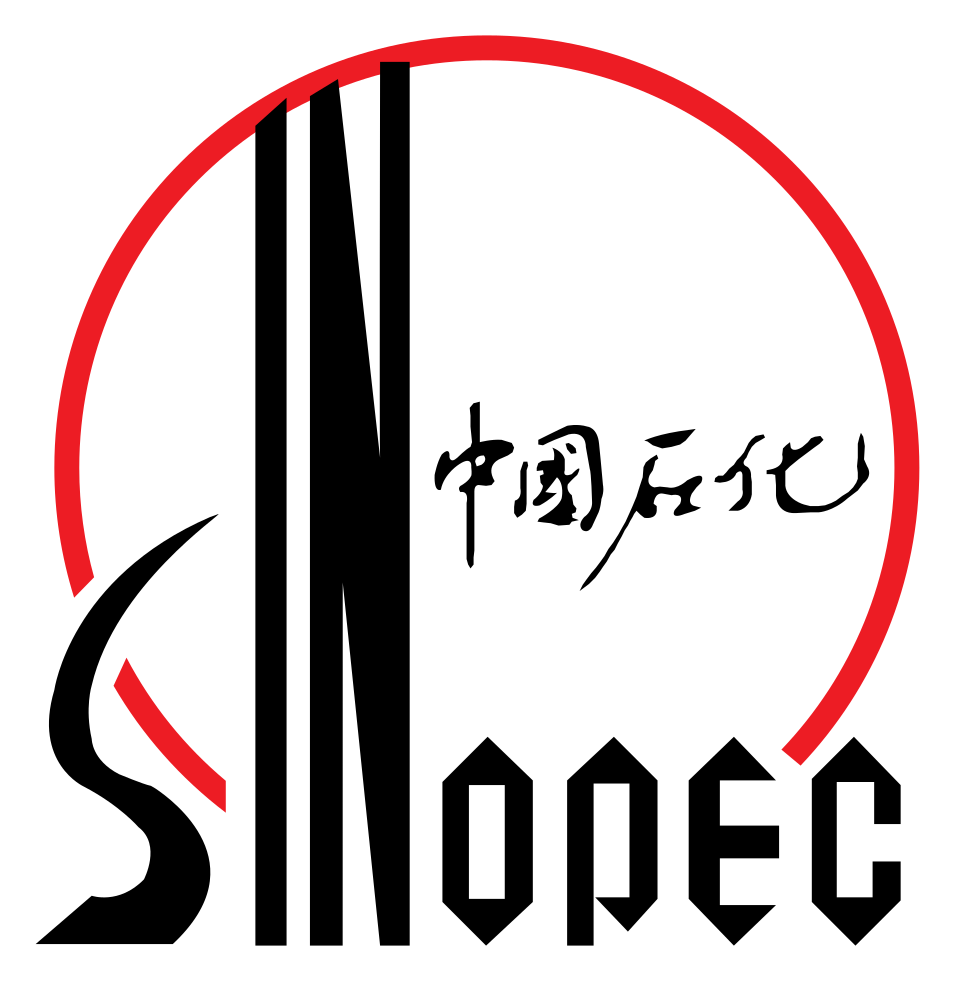
石化ETF(159731)近4个交易日内合计“吸金”超3235万元,资金低位布局特征显著
Sou Hu Cai Jing· 2026-01-09 03:23
石化ETF(159731),场外联接(华夏中证石化产业ETF发起式联接A:017855;华夏中证石化产业ETF发起式联接C:017856)。 以上内容与数据,与有连云立场无关,不构成投资建议。据此操作,风险自担。 | 股票代码 | 股票简称 | 涨跌幅 | 权重 | | --- | --- | --- | --- | | 600309 | 万华化学 | -0.94% | 10.47% | | 601857 | 中国石油 | -0.41% | 7.63% | | 000792 | 盐湖股份 | -1.05% | 6.44% | | 600028 | 中国石化 | 0.82% | 6.44% | | 600938 | 甲国海海 | 0.60% | 5.22% | | 600160 | 巨化股份 | -0.92% | 4.51% | | 000408 | 藏格矿业 | -0.95% | 3.82% | | 600143 | 金发科技 | 9.99% | 3.69% | | 600426 | 华鲁恒升 | 0.76% | 3.31% | | 600989 | 宝丰能源 | -1.78% | 3.27% | (以上所列 ...






油城变形记:新质生产力的东营样本
Feng Huang Wang Cai Jing· 2026-01-08 00:04
Core Insights - Shandong has entered the 10 trillion GDP club, with a focus on high-quality economic development, particularly in the city of Dongying, which is undergoing a significant transformation from a traditional oil-based economy to a diversified industrial base [1][2]. Group 1: Economic Transformation - Dongying, historically known for its oil production, is shifting from reliance on oil to new industries such as new materials, green electricity, and zero-carbon manufacturing [1][3]. - The petrochemical industry in Dongying achieved a revenue of 676.45 billion yuan in 2024, accounting for about 25% of the province's total, with the chemical industry now surpassing refining in terms of industrial growth [4]. Group 2: Innovation and New Industries - Dongying is witnessing a rise in new industries, with companies like Lihua Yi entering high-end new materials and Tianhong Chemical focusing on circular economy practices [4][6]. - The city has developed a significant new materials industry, with revenue growth of 108.1% during the 14th Five-Year Plan period [7]. Group 3: Government and Policy Support - The local government has implemented strategic plans to support the new materials industry and green energy initiatives, including the establishment of a CCUS demonstration project [7][11]. - Dongying's government is actively attracting high-end talent and promoting vocational education to support its industrial transformation [12]. Group 4: Future Outlook - The city aims to build a modern industrial system characterized by new quality productivity, focusing on traditional industry renewal and the growth of emerging industries [14]. - Dongying's transformation illustrates that resource-based cities can thrive by embracing new productive forces and diversifying their industrial base [15].
“十五五”规划系列四:地方“十五五”规划建议稿9大看点
GOLDEN SUN SECURITIES· 2026-01-07 09:45
Group 1: Economic Strategy and Focus Areas - Local governments emphasize "strengthening foundations and comprehensive efforts," with a focus on industrial strength rather than expanding domestic demand as prioritized by the central government[2] - Economic provinces prioritize building a modern industrial system, with Jiangsu, Shandong, and Zhejiang leading in this focus, while Guangdong and Shanghai emphasize regional development initiatives[3] - Over 10 regions are pushing for enterprises to "go global," with specific industries highlighted such as technology services in Beijing and cultural trade in Jiangsu[5] Group 2: Consumption and Investment - Consumption strategies focus on enhancing service consumption and developing new business models, with cities like Beijing and Zhejiang promoting unique consumption experiences[20] - Local governments are establishing international consumption centers, with cities like Shenzhen and Hangzhou aiming to become key consumption hubs[21] - Investment stability is emphasized through project management, with regions like Zhejiang advocating for a project-driven development approach[5] Group 3: Industrial Development and Innovation - Regions are focusing on innovation-driven growth, with a strong emphasis on green and low-carbon development, particularly in traditional industries[6] - Specific industries such as marine economy, aerospace, and low-altitude economy are gaining attention in various provinces, showcasing regional strengths[6] - Local governments are implementing reforms to enhance market access and promote high-level platforms for business development[7] Group 4: Risk Management and Regional Coordination - Risk management strategies are centered on real estate, local debt, and financial institutions, with a focus on controlling new risks and optimizing supply[10] - Regions are actively aligning with national strategies, emphasizing the importance of regional cooperation and development, particularly in major economic zones[11] - Local policies are being adjusted to prevent unhealthy competition and ensure a balanced economic environment, with a focus on standardizing investment and procurement practices[7]
湖南石化年产百万吨重整联合装置投产
Zhong Guo Hua Gong Bao· 2026-01-07 04:37
Core Viewpoint - The successful commissioning of Hunan Petrochemical's 1 million tons/year continuous reforming unit project marks a significant advancement in gasoline production and quality, utilizing proprietary technology and domestic catalysts [1][2] Group 1: Project Overview - The project has achieved design standards in key operational indicators after 72 hours of monitoring, indicating a successful initial operation [1] - It employs Sinopec's self-developed Super Low-Pressure Continuous Reforming (SLCR) technology and domestic reforming catalyst PS-VI, processing straight-run naphtha and mixed naphtha to produce high-octane gasoline components and by-products [1] Group 2: Production and Process Management - The project includes three units: continuous reforming, aromatics extraction, and high-purity gas separation (PSA), forming a closed-loop industrial chain that enhances product value [1] - During construction, Hunan Petrochemical coordinated closely with contractors to ensure timely completion of project phases and improved management of project quality and progress [1] Group 3: Safety and Operational Readiness - The company conducted seven full-process simulation drills to refine operational details and ensure a smooth startup process [2] - A special task force monitored the startup progress in real-time, with key personnel maintaining a 24-hour presence on-site to enforce safety controls [2]
2026年有望成为周期反转的转折点,聚焦石化ETF(159731)长期布局机会
Xin Lang Cai Jing· 2026-01-07 03:22
Core Viewpoint - The chemical industry is currently at the bottom of a four-year down cycle, with indicators suggesting a potential turning point in 2026, as various metrics indicate the industry has nearly bottomed out [1]. Group 1: Industry Performance - As of January 7, 2026, the China Petroleum and Chemical Industry Index has decreased by 0.35%, with mixed performance among constituent stocks [1]. - The China Chemical Products Price Index (CCPI) was reported at 3930 points on December 31, 2025, a 39% decline from the peak in 2021, indicating the industry is at a historical low [1]. - The basic chemical sector achieved a net profit of 112.7 billion yuan in the first three quarters of 2025, reflecting a year-on-year increase of 7.5%, suggesting initial stabilization in the sector [1]. Group 2: Capital Expenditure and Supply Cycle - Capital expenditure in the industry has decreased by 18.3% year-on-year, marking seven consecutive quarters of negative growth since Q4 2023, indicating the end of the supply expansion phase [1]. - The use of construction projects to fixed assets and capital expenditure to operating income ratios suggests a turning point in the chemical capacity cycle [1]. Group 3: ETF Performance - The Petrochemical ETF (159731) has seen a net value increase of 48.72% over the past two years, with a maximum monthly return of 15.86% since inception [2]. - The ETF has outperformed its benchmark with an annualized excess return of 2.17% over the past year [2]. - The top ten weighted stocks in the China Petroleum and Chemical Industry Index account for 56.73% of the index, with Wanhua Chemical and China Petroleum being the largest constituents [2].