
船舶

Search documents
钧天航宇取得辐射散热器及航天器专利
Sou Hu Cai Jing· 2025-11-29 11:00
Core Insights - Beijing JunTian Aerospace Technology Co., Ltd. and JunTian Aerospace (Shanghai) Technology Co., Ltd. have obtained a patent for "Radiation Heat Exchanger and Spacecraft" with authorization announcement number CN119284207B, applied on October 2024 [1] Company Overview - Beijing JunTian Aerospace Technology Co., Ltd. was established in 2021 and is located in Beijing, focusing on manufacturing in the railway, shipping, aerospace, and other transportation equipment sectors. The registered capital is 8.335714 million RMB [1] - The company has invested in 4 other enterprises, holds 15 trademark registrations, and has 67 patents, along with 2 administrative licenses [1] - JunTian Aerospace (Shanghai) Technology Co., Ltd. was founded in 2023 and is based in Shanghai, primarily engaged in technology promotion and application services. The registered capital is 20 million RMB [1] - This company has 36 patent registrations [1]
吉利取得混合动力车辆DCDC输出电压控制方法及系统专利
Sou Hu Cai Jing· 2025-11-29 04:24
Group 1 - The core point of the article is the acquisition of a patent for a "DCDC output voltage control method and control system for hybrid vehicles" by three companies: Jiguangwan (Ningbo) Intelligent Technology Co., Ltd., Jiguangwan Technology Co., Ltd., and Zhejiang Geely Holding Group Co., Ltd. The patent was granted with announcement number CN114144327B, and the application date was August 2021 [1][2]. Group 2 - Jiguangwan (Ningbo) Intelligent Technology Co., Ltd. was established in 2013, located in Ningbo, primarily engaged in the automotive manufacturing industry, with a registered capital of 282.8 million RMB. The company has invested in one enterprise, participated in 178 bidding projects, and holds 1,045 patents [1]. - Jiguangwan Technology Co., Ltd. was founded in 2012, also located in Ningbo, focusing on manufacturing for railways, ships, aerospace, and other transportation equipment, with a registered capital of 500 million RMB. The company has invested in 10 enterprises, participated in 63 bidding projects, and holds 1,138 patents [1]. - Zhejiang Geely Holding Group Co., Ltd. was established in 2003, based in Hangzhou, primarily engaged in the automotive manufacturing industry, with a registered capital of 1.03 billion RMB. The company has invested in 37 enterprises, participated in 523 bidding projects, and holds 5,000 patents and trademarks, along with 274 administrative licenses [2].

株洲中车时代电气取得一种测试夹具自动化管理系统及方法专利
Jin Rong Jie· 2025-11-29 03:23
国家知识产权局信息显示,株洲中车时代电气股份有限公司取得一项名为"一种测试夹具自动化管理系 统及方法"的专利,授权公告号CN115965039B,申请日期为2021年10月。 天眼查资料显示,株洲中车时代电气股份有限公司,成立于2005年,位于株洲市,是一家以从事铁路、 船舶、航空航天和其他运输设备制造业为主的企业。企业注册资本141154.0112万人民币。通过天眼查 大数据分析,株洲中车时代电气股份有限公司共对外投资了37家企业,参与招投标项目5000次,专利信 息3672条,此外企业还拥有行政许可151个。 声明:市场有风险,投资需谨慎。本文为AI基于第三方数据生成,仅供参考,不构成个人投资建议。 本文源自:市场资讯 作者:情报员 ...

11月27日晚间公告 | 一汽解放、宁德时代增资解放时代;*ST松发签订不超16亿美元造船合同
Xuan Gu Bao· 2025-11-27 12:05
Group 1: Suspension and Resumption of Trading - *ST Lian Shi's restructuring plan has been approved by the court and is now in the execution phase; failure to execute the plan may lead to delisting risk. The stock has resumed trading [1] Group 2: Mergers and Acquisitions - Haichang New Materials plans to acquire 51% of Xinwei Communications for 235 million yuan; the target company specializes in the R&D, production, and sales of GNSS antenna positioning core components [2] - Yuanli Co., Ltd. intends to purchase 100% of Tongsheng Co., Ltd. for 470 million yuan; Tongsheng is a high-tech enterprise engaged in the R&D, production, and sales of silica [2] Group 3: Share Buybacks and Increases - Mindray Medical's actual controller and chairman, Li Xiting, plans to increase his stake in the company by 200 million yuan [3] - Maide Medical's chairman and actual controller, Lin Junhua, proposed a share buyback of 20 million to 40 million yuan [3] Group 4: Investment Cooperation and Operational Status - *ST Songfa's subsidiary, Hengli Shipbuilding (Dalian) Co., Ltd., signed shipbuilding contracts effective November 27, 2025, with a total contract value of approximately 1.1 to 1.6 billion USD [4] Group 5: Evening Announcements - FAW Jiefang plans to increase capital in collaboration with CATL and Telai [5] - Hunan Gold's subsidiary, Xinshao Siwei, has obtained a mining license for tungsten, magnetite, and silver [5] - Chalco International's subsidiary won a bid for a 2.909 billion yuan project for upgrading electrolytic cells [5] - Huafeng Technology's adjusted fundraising target is no more than 972 million yuan for expansion projects [5] - Dongxin Co., Ltd. signed a strategic cooperation framework agreement with a leading domestic cloud computing service provider [5] - Yahua Group expects its lithium salt comprehensive production capacity to reach nearly 130,000 tons by the end of 2025 [5] - Dangsheng Technology's lithium iron manganese phosphate business is experiencing rapid growth with a significant increase in shipment volume [5] - Huahai Chengke's advanced packaging technology is positively impacting the packaging materials industry chain [5] - CRRC plans to spin off its subsidiary CRRC Qisuo for listing on the Growth Enterprise Market [5] - Fule New Materials' self-developed "electronic skin" product has completed multiple iterations and achieved mass supply [5]

八大国资440亿巨额增资中国商飞
Di Yi Cai Jing Zi Xun· 2025-11-27 11:17
2025.11.27 本文字数:1473,阅读时长大约2分钟 此次增资完成后,中国商飞的股权结构迎来重要调整。其中,国务院国资委以近250亿元的注资领投, 持股比例跃升至53.08%,确立了绝对控股地位。 | | | 童企业 · 中国商用飞机有限责任公司 | | | 图书记录 图 | HOT 供震偏市 APP | | --- | --- | --- | --- | --- | --- | --- | | 基本信息 772 | 司法信息 22 | 经营诊断 999* | 知识产权 999+ | 企业发展 39 | 经营状况 998+ | 历史信息: | | | 股东信息。 Qx15更可以置推 | | | 后 查看股权结构 | 持股比例 ▼ | 业下载数据 ◎ 豐企童 | | 国际 | | 股东名称 | | 排股比例 | 认值出资额 中 | 认缴出资日期 0 | | 1 | 国务院国有资产监督管理委员会 大股东 = 武器胶制人 最佳曼晶人 | | 殷权结构 > | 53.07998% 持股详情 > | 4,994,709,8586万(元) | 2018-12-19 | | 2 | 上海国盛(集团)有限公司 | | ...

八大国资440亿巨额增资中国商飞
第一财经· 2025-11-27 10:29
封图 | 第一财经 任玉明摄影 2025.11. 27 本文字数:1473,阅读时长大约2分钟 据21世纪经济报道,近日,国产大飞机的制造主体中国商飞获得了成立以来最大规模的资本加持。 爱企查App显示,中国商用飞机有限责任公司近日发生工商变更,注册资本由约501.01亿元人民币大幅增至约940.98亿元人民币,增幅约88%。 中国商用飞机有限责任公司成立于2008年3月,法定代表人为贺东风。股东信息显示,该公司由国务院国有资产监督管理委员会、上海国盛(集团)有限 公司、中国航空工业集团有限公司等共同持股。 | ○ ミレモ 日演 レモ不真過大量 | 查企业 ▼ 中国商用飞机有限责任公司 × 查一下 | | | ◎ 老户特惠 | HOT 供需集市 日API | | | --- | --- | --- | --- | --- | --- | --- | | 基本信息 772 | 经营诊断 999+ 司法信息 22 | 知识产权 999+ | 企业发展 39 | 经营状况 999+ | | SVIP 历史信息 56 | | 工商注册 2 Q 发生变更时提醒我 | | | | | | | | 工商注册 | 历史工商注 ...
【图解】税收数据反映10月份我国新质生产力持续发展壮大
Zhong Guo Jing Ji Wang· 2025-11-27 03:26
Group 1 - The core viewpoint of the article highlights the robust growth of China's new productive forces, particularly in high-end manufacturing, innovative industries, and the integration of digital and physical sectors, which injects new vitality into economic development [4][5][6]. Group 2 - In high-end manufacturing, sales revenue in October increased by 7.3% year-on-year, consistently outperforming the average level of the manufacturing industry, with its share nearing half of the manufacturing sector [5]. - The three major manufacturing sectors reported sales revenue growth of 27.2%, 24.4%, and 10.1% respectively, indicating strong performance [5]. - The innovative industries experienced a year-on-year sales revenue growth of 13.6% in October, maintaining a double-digit growth rate [6]. - High-tech service and manufacturing sectors also contributed to this growth, with significant increases in sales revenue [6]. - The integration of digital and physical sectors showed an 8.5% year-on-year growth in sales revenue, reflecting ongoing advancements in the digital economy [7]. - The core industries of the digital economy saw sales revenue growth of 9.6%, with digital product services and digital technology applications growing by 10.2% and 13.1% respectively [8].

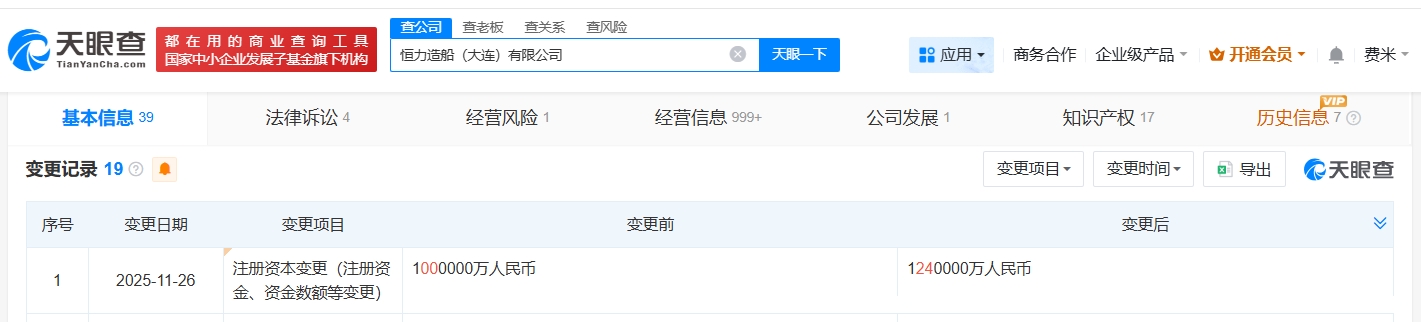
恒力重工集团旗下大连造船公司增资至124亿元
Mei Ri Jing Ji Xin Wen· 2025-11-27 02:55
Group 1 - Hengli Shipbuilding (Dalian) Co., Ltd. has increased its registered capital from 10 billion RMB to 12.4 billion RMB, representing a 24% increase [1] - The company was established in July 2022 and is wholly owned by Hengli Heavy Industry Group Co., Ltd. [1][3] - The business scope of Hengli Shipbuilding includes non-metallic ship manufacturing, shipbuilding, and ship repair [1][3] Group 2 - The legal representative of Hengli Shipbuilding is An Jinxiang [1][3] - The company is located in the Dalian Changxing Island Economic and Technological Development Zone, Liaoning Province [3] - Hengli Shipbuilding is involved in various activities including ship sales, marine engineering equipment manufacturing, and import-export services [3]
11/26财经夜宵:得知基金净值排名及选基策略,赶紧告知大家
Sou Hu Cai Jing· 2025-11-26 15:50
Core Insights - The article provides an overview of the latest net asset value (NAV) rankings of various funds, highlighting the top-performing and underperforming funds in the market [2][3][5]. Fund Performance Summary Top 10 Funds by NAV Growth - The top-performing funds as of November 26, 2025, include: 1. 红土创新科技创新股票 (LOF) with a NAV of 1.3378 and a growth of 5.87% 2. 红土创新新科技股票 C with a NAV of 4.5610 and a growth of 5.84% 3. 红土创新新科技股票 A with a NAV of 4.5632 and a growth of 5.83% 4. 长安宏观策略混合 C with a NAV of 2.1070 and a growth of 5.83% 5. 红土精选混合 with a NAV of 3.4405 and a growth of 5.82% 6. 长安宏观策略混合 A with a NAV of 2.1400 and a growth of 5.78% 7. 天弘中证全指通信设备指数发起 C with a NAV of 2.2523 and a growth of 5.57% 8. 天弘中证全指通信设备指数发起 A with a NAV of 2.2593 and a growth of 5.57% 9. 融通产业趋势股票 with a NAV of 1.1857 and a growth of 5.56% 10. 红土创新智能制造混合型发起式 C with a NAV of 0.8728 and a growth of 5.54% [2]. Bottom 10 Funds by NAV Decline - The underperforming funds as of November 26, 2025, include: 1. 前海开源沪港深强国产业 with a NAV of 1.1640 and a decline of 2.98% 2. 国投瑞银国家安全混合 A with a NAV of 1.1460 and a decline of 2.63% 3. 国投瑞银国家安全混合 C with a NAV of 1.1279 and a decline of 2.62% 4. 东方阿尔法招阳混合 E with a NAV of 0.4100 and a decline of 2.59% 5. 中欧高端装备股票发起 C with a NAV of 0.9648 and a decline of 2.58% 6. 东方阿尔法招阳混合 A with a NAV of 0.4152 and a decline of 2.58% 7. 中欧高端装备股票发起 A with a NAV of 0.9794 and a decline of 2.58% 8. 招商瑞丰灵活配置混合发起式 C with a NAV of 1.9930 and a decline of 2.54% 9. 招商瑞丰灵活配置混合发起式 A with a NAV of 2.0970 and a decline of 2.51% 10. 前海开源鼎新 D with a NAV of 1.0496 and a decline of 2.48% [3]. Market Analysis - The Shanghai Composite Index experienced a slight decline, while the ChiNext Index showed a rebound after a low opening, closing with a moderate gain. The total trading volume reached 1.79 trillion, with a market breadth of 1,692 gainers to 3,593 losers [5]. - The leading sectors included communication equipment, which rose over 3%, while the shipping and aviation sectors faced declines exceeding 2% [5]. Fund Holdings Analysis Top Holdings of 红土创新科技创新股票 (LOF) - The fund's top holdings include: 1. 工业富联 with a daily increase of 4.10% 2. 中际旭创 with a daily increase of 13.25% 3. 新易盛 with a daily increase of 8.66% 4. 天孚通信 with a daily increase of 6.24% 5. 胜宏科技 with a daily increase of 4.51% - The top ten holdings account for 56.55% of the total portfolio, indicating a focus on the artificial intelligence sector [7]. Top Holdings of 前海开源沪港深强国产业 - The fund's top holdings include: 1. 亚星酒钱 with a daily decrease of 6.68% 2. 中科海讯 with a daily decrease of 5.08% 3. 中船防务 with a daily increase of 8.68% - The top ten holdings account for 75.36% of the total portfolio, reflecting a focus on the military industry [7].

固定收益点评:出口能否保持韧性?
GOLDEN SUN SECURITIES· 2025-11-26 07:52
1. Report Industry Investment Rating No information provided in the content. 2. Core View of the Report - Despite the impact of Sino - US trade frictions this year, China's exports have maintained resilience. From January to October 2025, the US - dollar - denominated export value increased by 5.30% year - on - year, higher than 5.21% in the same period last year. However, the export growth rate may decline slightly next year, with the annual export year - on - year growth rate expected to slow to around 2% and showing a trend of being lower in the first half and higher in the second half [1][3][8]. 3. Summary According to the Directory 3.1 Current Export Support Items - **Regional Perspective**: Amid trade frictions, China's export share to the US and Japan has decreased year by year, while the share to ASEAN, India, Russia, Africa, and Latin America has increased. From January to October 2025, exports to the US dragged down the overall export growth rate by 2.02 percentage points, while ASEAN, Africa, and the EU became the main drivers of export growth, with export growth rates of 14%, 26%, and 8% respectively, and export pulling rates of 2.51%, 1.52%, and 1.14% respectively [11]. - **Product Category Perspective**: Capital goods such as mechanical and electrical products, high - tech products, integrated circuits, automobiles (including chassis), ships, and mechanical equipment are the main categories driving export growth. From January to October 2025, exports of ships, integrated circuits, automobiles (including chassis), and liquid crystal flat - panel display modules achieved double - digit high growth. In contrast, exports of mobile phones, labor - intensive goods, and real - estate - related post - cycle goods showed negative growth, indicating a possible change in China's industrial structure [15]. 3.2 Reasons for Export Resilience 3.2.1 Enterprise Outbound Expansion Drives Exports - From January to October 2025, capital goods exports maintained a high growth rate, with ships and general mechanical equipment driving export growth by 0.4 and 0.1 percentage points respectively. There is a positive correlation between the year - on - year growth of listed companies' overseas revenues and exports, as well as between China's outward direct investment flow and total export year - on - year growth. From 2015 - 2024, the average annual compound growth rate of exports driven by outward investment was significantly higher than that of overall exports (7.6% vs 5.2%), with an average proportion of 5.7% in overall exports and an average pull of 0.7 percentage points on overall exports. Investment in different countries also corresponds to the growth rate differences of exports of different product types to these countries [2][21][27]. 3.2.2 Re - export Trade Affects Export Country Structure - During the trade friction, the US imposed significantly higher tariffs on China than on ASEAN countries, prompting Chinese enterprises to seek Southeast Asian re - export trade to avoid high tariffs. From 2018 - 2019 and during the current trade friction, China's exports to the US decreased significantly, while exports to ASEAN and US imports from ASEAN increased significantly, indicating that re - export trade may have offset the decline in exports to the US to some extent and supported the overall export growth rate [43]. 3.2.3 Demand Growth in Some Importing Countries Supports High Export Growth - Benefiting from the mild economic recovery in the EU, the EU's import growth rate has rebounded. Since the second half of 2024, driven by interest rate cuts, defense, and infrastructure investment, the EU's GDP growth rate has remained at around 1.5%, and the year - on - year growth rate of the industrial production index has been in the positive range since February 2025, driving the EU's import growth rate from - 5% in 2024 to 4% this year. Vietnam's GDP growth rate has continued to rise this year, with the cumulative GDP growth rate in the first three quarters reaching 7.85%. Investment and consumption have also maintained high growth rates, driving China's cumulative exports to Vietnam from January to October to increase by 22.3% year - on - year [47][50]. 3.2.4 Increase in China's Import Share in Africa and Other Regions - From 2019 - 2024, the average annual compound growth rate of Africa's imports was only 5%, but the average annual growth rate of Africa's imports from China reached 10%. China's share in Africa's imports increased from 17.1% in 2019 to 21.6% in 2024, with an average annual increase of 0.9 percentage points. The reasons for the share increase include large - scale infrastructure investment in Africa, high price competitiveness of Chinese export products, zero - tariff policies for 53 African countries, and successful market expansion by Chinese exporters [54]. 3.3 Export Outlook - Although exports have maintained resilience due to multiple factors, the export growth rate may decline slightly next year. The factors supporting export resilience may weaken, and the support for next year's exports may decrease. Using a fitting model to estimate next year's export growth rate, it is expected to slow to around 2% [3][59][62].