
集成电路

Search documents
市场热点出现切换!科技股退潮,消费股接棒
Sou Hu Cai Jing· 2026-02-06 09:21
本周A股随着国际金银价格大幅波动而波动,周一上证指数出现百点下跌,但此后几天A股表现平稳,周K线仅仅小幅下跌,大盘箱体震荡格局并没有改 变。 值得注意的是,市场热点出现切换趋势,科技股有退潮迹象,消费股正在接棒,这种热点转换有利于大盘稳定。 主要指数周K线收出小阴线 上证指数周一低开低走,以4079.71点开盘,直接跌破4100点大关,开盘后大盘无力回天不断下滑,最终以接近最低点4015.75点报收,下跌102.2点,跌幅 达2.48%,这是一年多来罕见的百点下跌。 上证指数周K线图 导致周一暴跌的原因就是国际金银价格跳水。黄金、白银今年1月份是全球最热的品种,黄金从4338.34美元暴涨到5598.75美元,白银涨幅更大,但上周五 出现暴跌,黄金跌破5000美元大关,白银更是暴跌26%,由此,导致周一黄金、白银股票均跌停开盘,随后是有色金属板块大跌,进一步扩大到化工、石 油、煤炭等资源股,当天跌停股票超过百只,基本上都是黄金、白银等资源股。 周一虽然跌幅大,但板块集中,并非全面性回调,周二上证指数最低跌至4002.78点,也是全周最低点,随后大盘开始回升,周三回升到全周最高点 4104.62点,但4100点 ...


每日研究一家上市公司——第六十五家三安光电(湖北)
Sou Hu Cai Jing· 2026-02-06 08:48
Core Viewpoint - Sanan Optoelectronics is a leading player in the compound semiconductor industry, particularly in the LED chip and third-generation semiconductor sectors, with a strong focus on technological innovation and a comprehensive industrial layout [5][20][54]. Company Overview - Sanan Optoelectronics Co., Ltd. was established in November 2000 and listed on the Shanghai Stock Exchange in 2008, focusing on the research, production, and sales of compound semiconductor materials and devices [5][6]. - The company has transformed from a single LED chip manufacturer to a platform enterprise covering both LED chips and integrated circuits, establishing a business structure that balances mature cash flow with high-growth new businesses [5][7]. Historical Performance - The stock price reached a historical high of 44.72 yuan in 2021, driven by industry trends, performance improvements, and significant investments in Mini/Micro LED technology [10][11]. - The stock price has since declined, with the latest price at 15.38 yuan as of February 6, 2026, reflecting a 26.58% increase since 2025 [2]. Market Position - Sanan Optoelectronics holds a global market share of 28%-32% in the LED chip sector, leading both domestically and internationally [20]. - The company is also a key player in the Mini/Micro LED market, achieving over 120% year-on-year growth in chip shipments in 2023 [20]. Business Segments - The main business segments include LED epitaxial chips, integrated circuit products, and power electronic devices, with LED epitaxial chips accounting for approximately 65% of total revenue in the first half of 2025 [21][22]. - The company is recognized for its advanced technology in the third-generation semiconductor field, particularly in silicon carbide and gallium nitride RF chips [20][22]. Financial Performance - For the first three quarters of 2025, the company reported total revenue of 138.17 billion yuan, a year-on-year increase of 16.55%, but faced a net profit decline of 64.15% to 88.61 million yuan [29][30]. - The gross profit margin improved to 13.65%, although it remains below the industry average [30]. Competitive Advantages - Sanan Optoelectronics boasts strong technological innovation capabilities, with over 4,200 patents and significant R&D investment, amounting to 13.23 billion yuan in 2024 [24][54]. - The company has established a full industrial chain in the silicon carbide sector, enhancing its cost control and quality assurance [24][25]. Shareholder Structure - The controlling shareholder is Xiamen Sanan Electronics Co., Ltd., with a significant portion of shares pledged, raising concerns about share stability [38][39]. - Institutional investors hold over 50% of the company's shares, indicating strong market confidence [45]. Investment Outlook - The company is positioned for long-term growth in the compound semiconductor sector, despite facing short-term challenges related to competition and profitability [54][63]. - The focus on high-value products and new business developments is expected to drive future revenue growth [54].

艾森股份:拟20亿元投资建设华东制造基地项目
Xin Lang Cai Jing· 2026-02-06 07:46
Core Viewpoint - The company announced plans to establish a wholly-owned subsidiary, Nantong Aisen Chip Material Technology Co., Ltd., in Nantong Economic and Technological Development Zone, with an investment of 2 billion yuan to build a semiconductor material manufacturing base in East China [1] Group 1: Investment Details - The project involves a total planned land area of approximately 159 acres [1] - The manufacturing line is designed to produce 23,000 tons of semiconductor materials annually, with construction divided into two phases, reaching full production by 2035 [1] - Funding for the project will come from the company's own resources and self-raised funds [1] Group 2: Agreements and Risks - The company has signed an investment agreement with the local management committee [1] - The investment does not constitute a related party transaction or a major asset restructuring [1] - Potential risks include policy changes, challenges in fundraising, and the possibility of returns not meeting expectations [1]
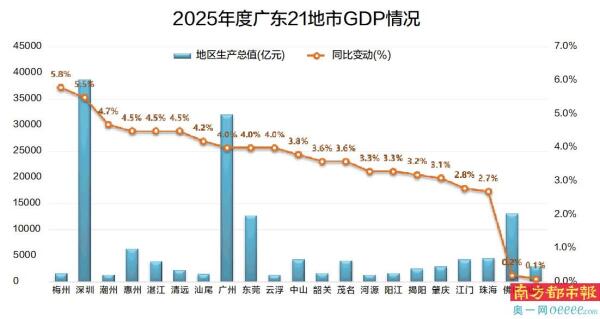
深圳经济总量居首 梅州GDP增速第一
Nan Fang Du Shi Bao· 2026-02-06 06:00
Economic Overview - As of February 5, 2025, all economic data for 21 cities in Guangdong has been released, with Shenzhen leading the province with a GDP of 3.87 trillion yuan [3] - The overall GDP growth rate for Guangdong is 3.9%, with Meizhou leading at 5.8%, followed by Shenzhen at 5.5% and Chaozhou at 4.7% [3] Industrial Growth - Zhanjiang leads the province in industrial added value growth at 10.7%, with Huizhou and Meizhou both at 8.6% [4] - Zhanjiang's industrial sector contributes over 40% to its economic growth, with significant increases in communication equipment and computer manufacturing [4] - Meizhou's industrial added value growth is 8.6%, with notable increases in non-ferrous metal smelting and electronic equipment manufacturing [5] Investment and Consumption - Industrial technological transformation investment in Yangjiang exceeds 60%, with several cities maintaining high investment levels in key and high-tech industries [7] - Guangzhou's retail sales of consumer goods show significant growth, particularly in furniture and communication equipment [8] - The consumption policies, such as trade-in programs, have positively impacted the consumer market across various cities [8] Foreign Trade - Shenzhen's total import and export volume reaches a record high of 4.55 trillion yuan, with exports at 2.74 trillion yuan [9] - Zhaoqing leads the province in export growth at 21.1%, with significant contributions from electromechanical products [10] - Guangzhou's foreign trade also shows strong performance, with a total volume of 1.2 trillion yuan and a 10.4% year-on-year growth [11] Agriculture - Agricultural production remains strong, with cities like Maoming and Zhanjiang exceeding 110 billion yuan in total agricultural output [13] - Zhuhai's agricultural output grows by 6.6%, leading the province, particularly in fisheries [13] - Yangjiang's agricultural output also shows positive growth, with a 6.4% increase [13]
冯忠华会见华润集团董事长王祥明总经理王崔军
Guang Zhou Ri Bao· 2026-02-06 01:42
冯忠华代表市委、市政府对王祥明、王崔军一行表示欢迎,感谢华润集团长期以来对广州发展的大力支 持。冯忠华说,华润集团与广州合作渊源深厚、基础坚实,近年来双方合作不断深化、呈现良好势头。 当前广州正深入贯彻习近平总书记对广东、广州系列重要讲话和重要指示精神,认真落实省委、省政府 工作要求,坚定扛起经济大市挑大梁的责任担当,坚持工商并举,加快构建具有国际竞争力的现代化产 业体系,高质量推进城市更新和城中村改造,着力建设现代化人民城市,全力以赴在"十五五"关键一程 跑出加速度、干出新业绩。新征程上双方深化合作空间广阔,希望华润集团加大在广州的投资布局力 度,加快既定合作项目建设,围绕集成电路、生物医药、城市更新等重点领域谋划更多合作项目,推进 更深层次、更高水平务实合作,共同开创高质量发展新局面。广州将一如既往做好服务保障,全力支持 企业在穗更好更快发展。 王祥明表示,广州作为粤港澳大湾区核心引擎城市,战略地位突出、发展动能强劲,与华润集团多元化 业务布局高度契合。近年来,广州市对华润在穗发展给予了大力支持,为集团深耕本地市场创造了良好 环境。面向"十五五",华润将持续加大在穗投资力度,聚焦城市更新、商业综合体、生物 ...
上海给未来五年加了什么buff?5个指标提前剧透
第一财经· 2026-02-06 00:49
Core Viewpoint - Shanghai aims for an average GDP growth rate of 5% over the next five years, a slight increase from the previous 4.9% during the "14th Five-Year Plan" period, indicating significant potential for growth despite a challenging external environment [3][4]. Group 1: Economic Growth Targets - The GDP is projected to exceed 7 trillion yuan by 2030, positioning Shanghai among the top three global cities, following New York and Los Angeles [4]. - Key indicators for the "15th Five-Year Plan" include an average annual growth rate of 10% for the three leading industries, a labor productivity exceeding 520,000 yuan per person, and a digital economy's core industry value-added accounting for over 20% of GDP by 2030 [4][5]. Group 2: Strategic Development Plans - Shanghai's "15th Five-Year Plan" outlines a modern industrial system characterized by "2+3+6+6," focusing on advanced manufacturing and the development of world-class high-end industrial clusters [5][6]. - The three leading industries—integrated circuits, biomedicine, and artificial intelligence—are expected to drive significant economic growth, with a focus on enhancing equipment capabilities and fostering innovation [6][11]. Group 3: Innovation and R&D - In 2025, R&D expenditure as a percentage of GDP reached approximately 4.5%, with a target of 12% for basic research investment intensity [6][13]. - The plan emphasizes the importance of enhancing labor productivity through talent development, technological innovation, and systemic reforms to create a conducive business environment [15][16]. Group 4: Future Industry Focus - The "15th Five-Year Plan" identifies six emerging pillar industries, including new-generation electronic information and intelligent connected vehicles, alongside six future industries such as quantum technology and brain-computer interfaces [11]. - The strategy aims to establish a dynamic adjustment mechanism to accelerate the development of future industries and ensure alignment with global technological advancements [11].
奔向“全球主平台” 钱塘与“296X”企业家共谱“智造新篇”
Mei Ri Shang Bao· 2026-02-05 22:33
Group 1 - The core initiative of the Qiantang District People's Congress is to invite representatives from the "296X" advanced manufacturing cluster to participate, showcasing the district's commitment to collaboration with enterprises in achieving the goal of becoming a global advanced manufacturing base [1] - The focus on innovation is highlighted by the emphasis on storage chips as a foundation for digital economy and AI, with companies like Zhejiang Lijichun Storage leading efforts in AI storage and high-bandwidth storage to support the "296X" cluster [1] - The Qiantang District government aims to deepen the construction of the "China Chip Valley" and push the semiconductor industry scale to exceed 85 billion yuan, indicating a strong push for local manufacturing capabilities [2] Group 2 - The development of companies like Junchen Robotics illustrates the district's strategy to enhance productivity through AI technology, achieving over 50% efficiency improvement in inspection processes and potentially reducing labor by 90% in production lines [2] - Qiantang District plans to increase its industrial fund scale to over 48 billion yuan, providing targeted financial support to address development challenges in high-investment industries like integrated circuits and AI [3] - The initiative to invite entrepreneurs to the congress reflects Qiantang's approach to gather insights from the industry, fostering a collaborative environment between government and enterprises to drive high-quality development [3]
三大先导产业规模突破2万亿元上海加快培育发展新质生产力
Zhong Guo Zheng Quan Bao· 2026-02-05 20:27
上海市第十六届人大四次会议于2月3日上午开幕,上海市市长龚正作《政府工作报告》。根据报告,一 年来,上海市经济社会发展稳中有进、进中提质,经济持续回升向好。2025年,上海市生产总值达到 5.67万亿元、增长5.4%,好于预期。地方一般公共预算收入达到8500亿元、增长1.5%。 产业发展方面,报告显示,2025年,上海新质生产力加快发展,集成电路、生物医药、人工智能三大先 导产业规模突破2万亿元。今年上海将聚焦建设现代化产业体系,持续巩固壮大实体经济根基,在石 化、钢铁等行业持续开展数智技术、绿色技术改造和产线升级,在集成电路、生物医药、人工智能等领 域加快实施一批重大产业项目,积极支持智能网联新能源汽车、海洋经济、低空经济、航空航天、卫星 互联网等产业发展,培育特色数字产业集群,大力推动服务业扩能提质、集聚发展。 ● 本报记者 李梦扬 加快构建现代化产业体系 报告表示,2025年,上海聚力落实国家重大战略任务,"五个中心"建设扎实推进。加快构建现代化产业 体系,有力推进集成电路装备、零部件、材料、EDA软件等全产业链攻关,深入实施"模塑申城"工程, 完善高端医疗器械、智能终端、智算云、具身智能、商业航天等 ...
三大先导产业规模突破2万亿元 上海加快培育发展新质生产力
Zhong Guo Zheng Quan Bao· 2026-02-05 20:27
● 本报记者李梦扬 加快构建现代化产业体系 产业发展方面,报告显示,2025年,上海新质生产力加快发展,集成电路、生物医药、人工智能三大先 导产业规模突破2万亿元。今年上海将聚焦建设现代化产业体系,持续巩固壮大实体经济根基,在石 化、钢铁等行业持续开展数智技术、绿色技术改造和产线升级,在集成电路、生物医药、人工智能等领 域加快实施一批重大产业项目,积极支持智能网联新能源汽车、海洋经济、低空经济、航空航天、卫星 互联网等产业发展,培育特色数字产业集群,大力推动服务业扩能提质、集聚发展。 报告表示,2025年,上海聚力落实国家重大战略任务,"五个中心"建设扎实推进。加快构建现代化产业 体系,有力推进集成电路装备、零部件、材料、EDA软件等全产业链攻关,深入实施"模塑申城"工程, 完善高端医疗器械、智能终端、智算云、具身智能、商业航天等产业发展政策,推进大飞机规模化系列 化发展,制定实施脑机接口、量子计算、硅光、6G等领域未来产业培育方案,多措并举促进服务业创 新发展,产业基础高级化、产业链现代化水平进一步提升。 从数据来看,2025年,上海全社会研发经费支出相当于全市生产总值的比例达到4.5%左右;工业战略 性新 ...
上海给未来五年 加了什么“燃料”? 5个指标提前剧透
Xin Lang Cai Jing· 2026-02-05 17:13
Group 1 - Shanghai's GDP is projected to grow at an average annual rate of 5% over the next five years, up from 4.9% during the "14th Five-Year Plan" period, indicating significant progress despite a seemingly small increase [1][3] - The achievement of this growth target relies on three key factors: stronger support from new drivers, greater release of core functions from five centers, and substantial backing from major projects, particularly in emerging industries [1][4] - By 2030, if the 5% growth rate is maintained, Shanghai's GDP is expected to exceed 7 trillion yuan, positioning it among the top three global cities, following New York and Los Angeles [1] Group 2 - The three leading industries in Shanghai are expected to maintain an average annual growth rate of over 10% during the "15th Five-Year Plan" period [2][3] - Key indicators for Shanghai's economic development include labor productivity exceeding 520,000 yuan per person, digital economy core industries accounting for over 20% of GDP, and R&D expenditure reaching over 5% of GDP by 2030 [2] Group 3 - The "15th Five-Year Plan" outlines a modern industrial system characterized by "2+3+6+6," focusing on advanced manufacturing and the establishment of world-class high-end industrial clusters [3][5] - The plan emphasizes the digital and green transformation of traditional industries and the acceleration of the three leading industries, which include integrated circuits, biomedicine, and artificial intelligence [4][5] Group 4 - The three leading industries have a significant driving effect on Shanghai's economy, with their combined scale surpassing 2 trillion yuan [4] - Specific strategies for the three leading industries include enhancing the capabilities of the integrated circuit sector, accelerating drug development in biomedicine, and advancing AI technologies [4][6] Group 5 - Shanghai aims to maintain a reasonable industrial proportion while focusing on enhancing quality and competitiveness in manufacturing, which is crucial for supporting technological innovation and the construction of five centers [5][6] - The city plans to solidify its industrial system and leverage existing industrial foundations to foster new growth engines and optimize resource allocation [5][6] Group 6 - The "15th Five-Year Plan" proposes the development of six emerging pillar industry clusters and anticipates six future industries, including advanced materials and quantum technology [7] - The focus on future industries includes areas such as brain-computer interfaces, controlled nuclear fusion, and biomanufacturing, which are expected to have high growth potential [7] Group 7 - Labor productivity is a key indicator for economic and social development, with a continued emphasis on improving productivity during the "15th Five-Year Plan" [9][10] - Enhancing labor productivity will depend on talent development, technological innovation, and systemic reforms to create a favorable business environment [10]