
餐饮业

Search documents
第三届丝路美食发展大会举办,海丝美食研发创新中心揭牌
Bei Ke Cai Jing· 2025-08-18 07:50
Core Points - The third Silk Road Culinary Development Conference was held in Quanzhou, focusing on cultural exchange, industry cooperation, and brand promotion in the culinary sector [1][2] - The conference introduced the "Quanzhou Specialty Cuisine Promotion Series Matrix," which includes branding elements and platforms for promotion [2] - The "Maritime Silk Road Culinary Research and Innovation Center" was inaugurated to protect traditional culinary techniques and enhance regional food competitiveness [2] - The "Silk Road Culinary Development Initiative" was launched, calling for collaboration in cultural preservation, innovation, sustainable supply, talent development, brand promotion, and international cooperation [2] Industry Activities - The conference featured various events, including the Quanzhou Specialty Cuisine Brand Building and Promotion Meeting, and the 2025 Quanzhou Maritime Silk Road International Food Carnival [3] - The food carnival showcased over 200 unique dishes from more than 80 booths, highlighting culinary traditions from countries along the Belt and Road [3] - Non-heritage inheritors demonstrated their culinary skills, and attendees could participate in the Silk Road Specialty Food Invitational Competition [3]
7月经济数据点评:经济有所放缓,生产仍具韧性
Tai Ping Yang Zheng Quan· 2025-08-17 09:45
Economic Performance - In July, China's industrial added value increased by 5.7% year-on-year, down from 6.8% in the previous month and below the expected 5.8%[4] - The retail sales of consumer goods grew by 3.7% year-on-year in July, a decline from 4.8% in June and below the forecast of 4.9%[4] - Fixed asset investment (excluding rural households) rose by 1.6% year-on-year from January to July, lower than the expected 2.7% and the previous value of 2.8%[4] - The urban surveyed unemployment rate in July was 5.2%, up from 5.0% in June[4] Industrial and Investment Trends - The manufacturing sector's investment saw a significant decline, with a monthly year-on-year decrease of -0.3% in July, down 5.4 percentage points from the previous value[23] - Infrastructure investment also turned negative, with a monthly year-on-year decline of -5.1% in July, significantly lower than the previous month's performance[27] - The real estate development investment fell sharply, with a monthly year-on-year decrease exceeding four percentage points compared to the previous month[31] Consumer Behavior and Market Dynamics - The service retail sector showed resilience, with strong growth in categories like home appliances and cultural products, despite overall retail sales weakening[18] - The consumer confidence and spending power remain low, necessitating further policy measures to stimulate consumption[14] - Seasonal factors contributed to a slight increase in the unemployment rate, with the influx of new graduates into the job market exacerbating the supply-demand mismatch[33]
青海省1至7月社零总额同比增长4.9% 首超全国增速
Zhong Guo Xin Wen Wang· 2025-08-16 15:03
Core Insights - Qinghai Province's retail sales reached 57.725 billion yuan from January to July, with a year-on-year growth of 4.9%, surpassing the national growth rate by 0.1 percentage points for the first time since 2024 [1] - In July alone, retail sales totaled 10.726 billion yuan, marking a year-on-year increase of 15.8%, the highest monthly growth rate in 19 months [1] Group 1: Consumption Growth - The provincial business department implemented measures to boost consumption, including consumption monitoring, retail promotion campaigns, and a trade-in program for consumer goods, leading to significant results [1] - Retail sales growth for above-limit units increased by 7.8% from January to July, improving by 5.7 percentage points compared to the first half of the year, and exceeding the national average of 5.1% [1] - The retail sales of above-limit retail industry grew by 12.5%, achieving double-digit growth for the first time this year, while the catering industry's revenue rose by 10.6% [1] Group 2: Product Categories - Various key product categories saw growth from January to July, including home appliances, beverages, automobiles, books, Chinese and Western medicines, construction materials, food, communication devices, and daily necessities [1] - The monthly growth rate for clothing and jewelry categories turned positive for the first time this year [1] Group 3: Future Initiatives - The provincial business department plans to promote a trade-in program for consumer goods, organize various consumption promotion activities, and enhance the construction of county-level commercial systems [2] - Efforts will be made to create diverse and integrated consumption scenarios and to increase the presence of quality products in central enterprises [2]
餐饮业今年太难了:十之八九都撑不下去了!
Sou Hu Cai Jing· 2025-08-16 00:51
Core Insights - The restaurant industry is facing significant challenges, with many establishments struggling to survive due to high operational costs and fierce competition [1][5][12] Group 1: Industry Overview - By mid-2025, over 800,000 restaurant closures are expected in China, with 70% of the remaining 2 million establishments generating monthly revenues below 100,000 yuan, and 85% operating at a loss or barely breaking even [1] - A typical small restaurant incurs fixed monthly expenses of around 150,000 yuan, including rent, salaries, and utilities, leading to a daily revenue requirement of over 10,000 yuan to avoid losses [3][6] Group 2: Key Challenges - Rising costs are a major issue, with rent, labor, and ingredient prices increasing annually, making it difficult for small restaurants to maintain profitability [6][9] - Customers are increasingly price-sensitive, leading to a decline in foot traffic when restaurants raise menu prices to cope with rising costs [8] - The reliance on food delivery services has created a "vicious cycle," where restaurants often lose money on delivery orders due to high platform fees and competitive pricing pressures [9][10] Group 3: Competitive Landscape - The restaurant market is characterized by intense competition and a lack of differentiation, with many establishments offering similar menus and experiences, making it hard to retain repeat customers [12] - Chain restaurants leverage supply chain advantages to offer lower prices, further squeezing the margins of small independent restaurants [12]

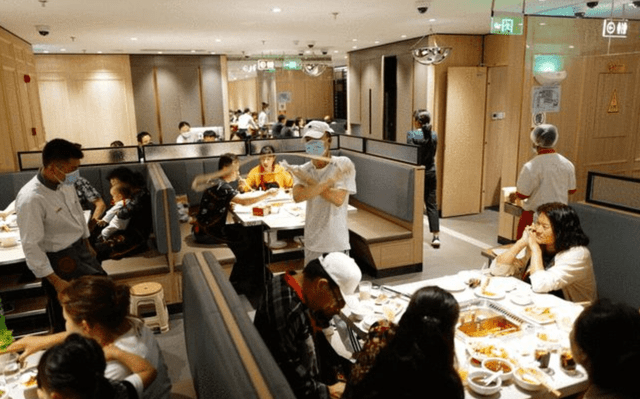
国家统计局:上半年最终消费支出对经济增长贡献率达到52%;1-7月份,全国网上零售额同比增长9.2%
Mei Ri Jing Ji Xin Wen· 2025-08-15 05:10
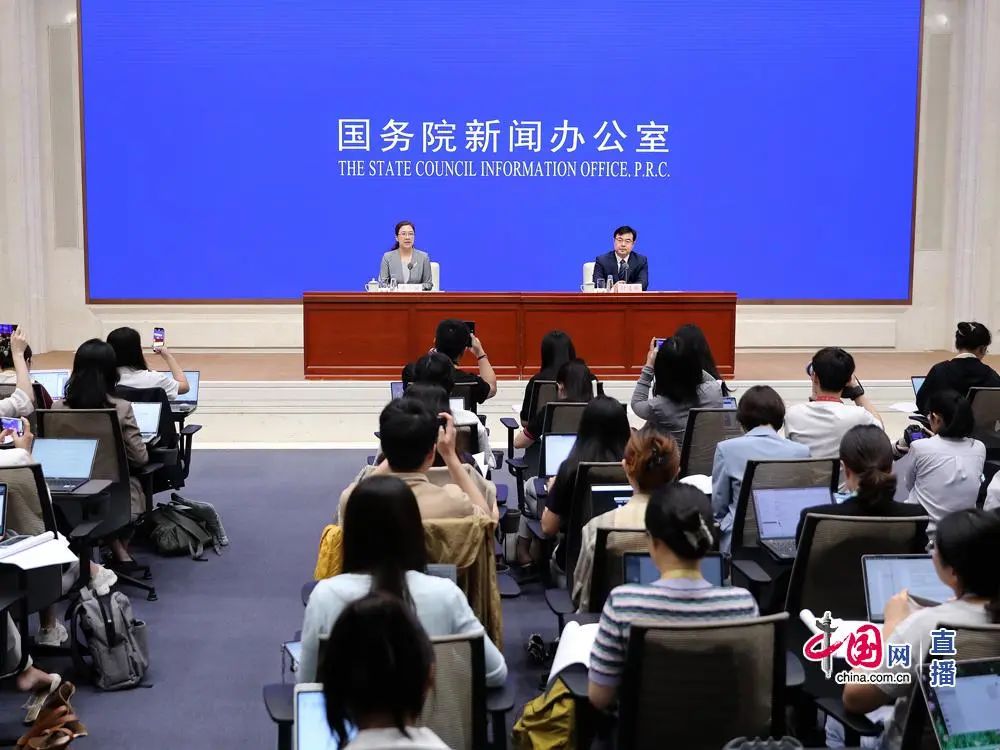
每经编辑|程鹏 今天(8月15日)上午,国务院新闻办召开新闻发布会,国家统计局公布了今年7月份经济数据。 7月份,全国规模以上工业增加值同比增长5.7%,全国服务业生产指数同比增长5.8%,社会消费品零售总额同比增长3.7%,国民经济保持稳中有进发展态 势,生产需求持续增长,就业物价总体稳定,新质生产力培育壮大,高质量发展取得新成效。 另外,8月15日,国家统计局新闻发言人付凌晖在发布会上表示,上半年最终消费支出对经济增长贡献率达到52%,比上年全年提升7.5个百分点。1-7月 份,货物进出口总额同比增长3.5%,货物周转量、旅客周转量均保持较快增长。随着全国统一大市场建设纵深推进,依法依规治理企业无序竞争,促进 核心CPI连续回升 1-7月全国网上零售额86835亿元 按消费类型分,7月份,商品零售额34276亿元,同比增长4.0%;餐饮收入4504亿元,增长1.1%。1—7月份,商品零售额252254亿元,增长4.9%;餐饮收 入31984亿元,增长3.8%。 同比增长9.2% 具体来看,工业生产较快增长,装备制造业和高技术制造业发展较好。7月份,全国规模以上工业增加值同比增长5.7%,环比增长0.38% ...
国家统计局:7月份社会消费品零售总额同比增长3.7%
Yang Shi Wang· 2025-08-15 02:30
Core Insights - In July, the total retail sales of consumer goods reached 38,780 billion yuan, with a year-on-year growth of 3.7% [1] - From January to July, the total retail sales of consumer goods amounted to 284,238 billion yuan, growing by 4.8% [1] Group 1: Overall Retail Performance - Excluding automobiles, retail sales of consumer goods in July were 34,931 billion yuan, reflecting a growth of 4.3% [1] - For the first seven months, retail sales excluding automobiles totaled 257,014 billion yuan, with a growth rate of 5.3% [1] Group 2: Urban vs Rural Consumption - In July, urban retail sales reached 33,620 billion yuan, with a year-on-year increase of 3.6%, while rural retail sales were 5,160 billion yuan, growing by 3.9% [3] - From January to July, urban retail sales totaled 246,669 billion yuan, growing by 4.8%, and rural retail sales reached 37,569 billion yuan, with a growth of 4.7% [3] Group 3: Consumption Types - In July, the retail sales of goods were 34,276 billion yuan, with a year-on-year growth of 4.0%, while catering revenue was 4,504 billion yuan, increasing by 1.1% [4] - For the first seven months, goods retail sales amounted to 252,254 billion yuan, growing by 4.9%, and catering revenue reached 31,984 billion yuan, with a growth of 3.8% [4] Group 4: Retail Formats - From January to July, retail sales in convenience stores, supermarkets, department stores, specialty stores, and brand stores grew by 7.0%, 5.2%, 1.1%, 5.8%, and 1.9% respectively [6] - The online retail sales for the first seven months reached 86,835 billion yuan, with a year-on-year growth of 9.2%, and physical goods online retail sales were 70,790 billion yuan, growing by 6.3% [6] Group 5: Breakdown of Goods Categories - In July, the sales of household appliances and audio-visual equipment surged by 28.7%, while sales of sports and entertainment products increased by 13.7% [7] - The sales of food items, clothing, and daily necessities grew by 14.7%, 1.8%, and 8.2% respectively [7]
2025年7月份社会消费品零售总额增长3.7%
Guo Jia Tong Ji Ju· 2025-08-15 02:01
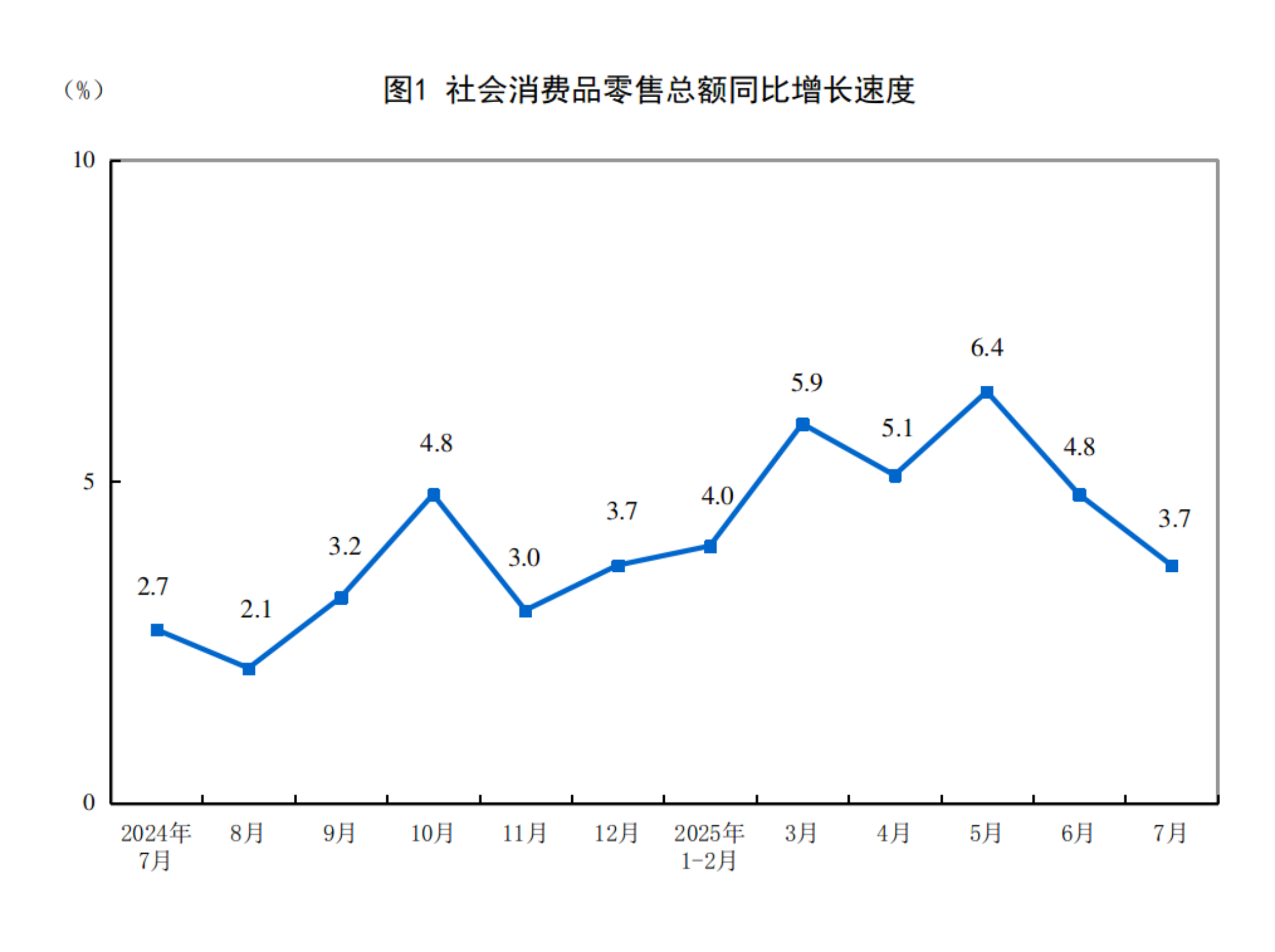
Core Insights - In July, the total retail sales of consumer goods reached 38,780 billion yuan, with a year-on-year growth of 3.7% [6] - From January to July, the total retail sales of consumer goods amounted to 284,238 billion yuan, growing by 4.8% [6] Group 1: Overall Retail Performance - Excluding automotive sales, the retail sales of consumer goods in July were 34,931 billion yuan, reflecting a growth of 4.3% [8] - For the first seven months, retail sales excluding automotive reached 257,014 billion yuan, with a growth rate of 5.3% [8] Group 2: Urban vs Rural Consumption - In July, urban retail sales were 33,620 billion yuan, showing a year-on-year increase of 3.6%, while rural retail sales were 5,160 billion yuan, growing by 3.9% [3] - From January to July, urban retail sales totaled 246,669 billion yuan, with a growth of 4.8%, and rural retail sales reached 37,569 billion yuan, growing by 4.7% [3] Group 3: Retail Formats and Online Sales - From January to July, retail sales in convenience stores, supermarkets, department stores, specialty stores, and brand stores grew by 7.0%, 5.2%, 1.1%, 5.8%, and 1.9% respectively [5] - The online retail sales for the first seven months were 86,835 billion yuan, with a year-on-year growth of 9.2%, and physical goods online retail sales were 70,790 billion yuan, growing by 6.3% [5] - Online retail sales accounted for 24.9% of the total retail sales of consumer goods [5] Group 4: Breakdown by Product Categories - In July, the retail sales of food, clothing, and daily necessities showed significant growth, with food sales increasing by 8.6% and daily necessities by 8.2% [8] - The sales of home appliances and audio-visual equipment surged by 28.7%, while sales of cultural and office supplies grew by 13.8% [8] - Conversely, sales in the petroleum and products category declined by 8.3% [8]
服务消费释放新动能 头部企业发力新增量
Zheng Quan Shi Bao· 2025-08-14 22:11
Core Insights - Service consumption is becoming an important direction for consumer upgrades as people's quality of life improves, shifting focus from "having" to "quality" [1] Group 1: Restaurant Industry Innovations - Haidilao has increased its nighttime dining services, transforming its Sanlitun location into a night snack-themed restaurant, resulting in a noticeable increase in nighttime customer flow, particularly among young people [2] - Major restaurant companies are actively innovating through product, scene, and model innovations to cultivate new service consumption growth, contributing to the industry's sustainable development [2] - McDonald's China aims to leverage its brand value to boost business growth while supporting consumption recovery, aligning with national policies to stimulate domestic demand [2][3] - Haidilao has opened over 50 night snack-themed restaurants in major cities, catering to diverse consumer needs [3] - The brand "CuoCuo" under the Xiaobai Group has collaborated with international IPs to enhance its market presence, leading to positive feedback and improved operational data [3] Group 2: Tourism Industry Upgrades - Travel and hospitality companies are innovating to meet diverse consumer demands, focusing on multi-faceted and refined services [4] - Hainan Airlines emphasizes service upgrades centered around passengers, utilizing digital empowerment to create new revenue streams and enhance domestic demand [4] - Huazhu Group is exploring new growth points in service consumption by offering tailored services for different consumer segments, including the elderly and marathon participants [4] Group 3: New Consumption Trends - The shift from product consumption to service consumption is accelerating as China's GDP per capita exceeds $13,000, indicating a rapid growth phase for service consumption [7] - National policies are increasingly supporting service consumption, with initiatives aimed at enhancing service quality in key areas such as dining, accommodation, and home services [7] - In the first half of the year, final consumption expenditure contributed 52.0% to economic growth, with a notable increase in service consumption driving economic vitality [7]


人民日报海外版整版聚焦吉林:各族人民相亲相爱 携手共建美好家园
Ren Min Wang· 2025-08-14 00:46
Group 1: Tourism Growth - In 2024, Yanbian Prefecture received 45.11 million tourists, a 70% increase year-on-year, and achieved tourism revenue of 74.6 billion yuan, up 71% from the previous year, with both metrics doubling since 2015 [7][12] - The region's appeal as a tourist destination is attributed to its unique natural resources, rich ethnic culture, and convenient transportation [7][8] - The local government plans to invite 1,000 families from across the country to experience the harmonious community life in Yanbian [8][9] Group 2: Cultural Integration - Yanbian promotes ethnic integration through community activities, fostering friendships across different ethnic groups, as seen in local community centers [8][9] - The "Red Pomegranate Home" initiative in Danying Community serves as a platform for cultural exchange and education, emphasizing the importance of unity among different ethnicities [8][9] - The region has implemented various cultural programs to enhance the sense of belonging and cultural confidence among its diverse population [14][15] Group 3: Economic Development - Yanbian has initiated 47 agricultural projects in border villages with an investment of 720 million yuan, enhancing local economic conditions [12] - The average annual income per person in East Alar Village is 18,000 yuan, with collective income exceeding 6 million yuan [11][12] - The region is focusing on developing border trade and tourism, with over 150,000 tourists visiting border villages this year [12][13] Group 4: Environmental and Cultural Initiatives - Yanbian is actively working on ecological protection and cultural promotion, including the establishment of the Northeast Tiger and Leopard National Park [13][14] - The local government is enhancing cultural identity through various artistic performances and community events, which have gained popularity among residents and visitors alike [14][15] - The province aims to integrate cultural education into youth programs to foster a sense of national unity and pride [15][16]
友好集团(600778)8月13日主力资金净流出3139.97万元
Sou Hu Cai Jing· 2025-08-13 13:16
Group 1 - The core viewpoint of the article highlights the financial performance and stock market activity of Youhao Group, indicating a mixed performance with a slight increase in stock price but a decline in revenue [1][3] - As of August 13, 2025, Youhao Group's stock closed at 7.27 yuan, up 1.82%, with a turnover rate of 23.89% and a trading volume of 743,600 hands, amounting to a transaction value of 563 million yuan [1] - The latest quarterly report shows total revenue of 485 million yuan, a year-on-year decrease of 6.11%, while net profit attributable to shareholders reached 20.58 million yuan, a year-on-year increase of 52.39% [1] Group 2 - The company has a current liquidity ratio of 0.442 and a quick ratio of 0.270, indicating potential liquidity challenges, with a high debt ratio of 92.96% [1] - Youhao Group has made investments in 30 enterprises and participated in 596 bidding projects, showcasing its active engagement in business expansion [2] - The company holds 167 trademark registrations and has obtained 6 administrative licenses, reflecting its commitment to intellectual property and regulatory compliance [2]
