
外贸

Search documents
5353.4亿元!无锡今年1到8月外贸进出口规模创新高
Yang Zi Wan Bao Wang· 2025-09-26 01:48
Core Insights - Wuxi's foreign trade import and export scale reached a historical high in the first eight months of this year, with a total of 535.34 billion yuan, marking a year-on-year increase of 7.2% [1] - The city has maintained a foreign trade import and export total exceeding 100 billion USD for three consecutive years since 2021, with over 50% of trade involving countries participating in the Belt and Road Initiative [1] - Wuxi has attracted over 7,200 foreign-funded enterprises, contributing to 30% of the city's industrial output value and tax revenue, and 60% of foreign trade imports and exports [1] Foreign Investment - From 2021 to 2024, Wuxi's actual foreign investment reached 15.19 billion USD, accounting for 14.6% of the province's total [1] - In 2024, Wuxi's per capita foreign investment utilization is projected to be 459 USD, the highest in the province [1] - The city has implemented a QFLP pilot program, leading the province in the number of projects and actual foreign capital utilized over the past four years [1] Policy and Innovation - Wuxi has initiated innovative reforms and pilot programs to enhance its open economy, including becoming a national import trade innovation demonstration zone and a pilot city for cross-border trade facilitation [2] - The city has established a "white list" system for importing research and development materials in the biopharmaceutical sector, ensuring the stability of supply chains [2] - Wuxi has introduced ten facilitation measures for foreign nationals, creating a better environment for investment and business [2] Future Development - Wuxi aims to expand international cooperation by focusing on three areas: exploring emerging markets, deepening bilateral investment, and securing national policies to enhance its open platform capabilities [2] - The city is committed to becoming a strong hub for dual open connectivity with global influence [2]
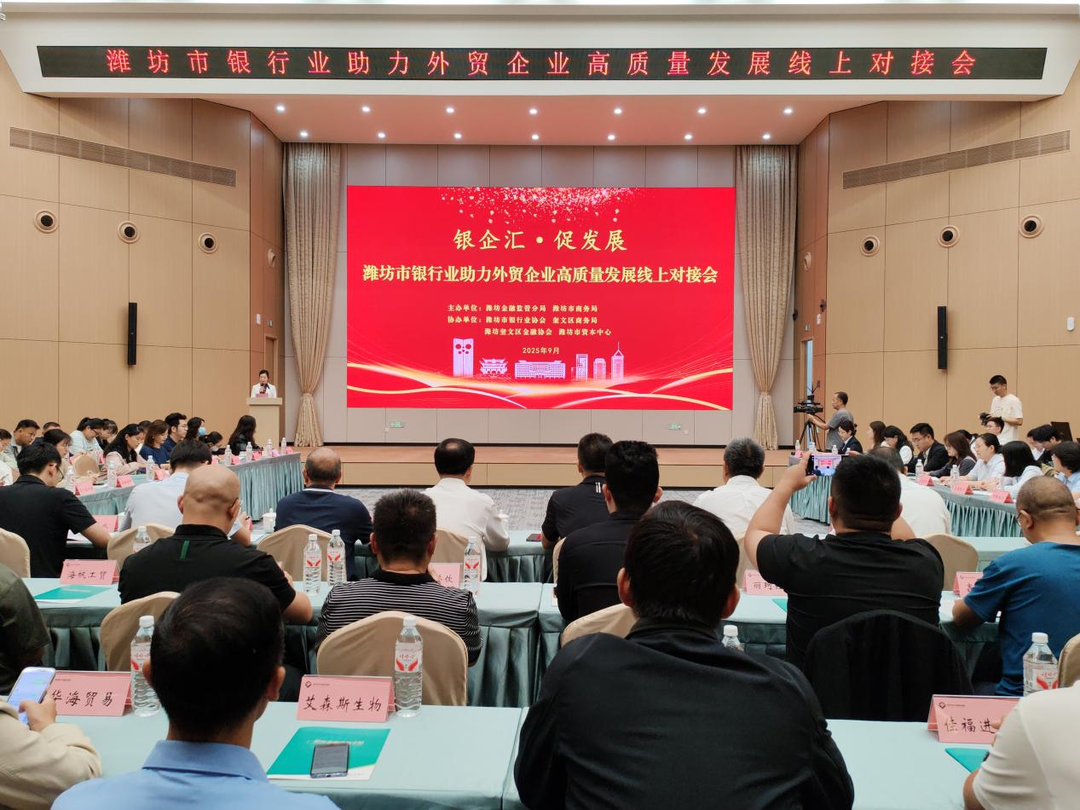
潍坊银行业助力外贸企业高质量发展洽谈对接会成功举行
Qi Lu Wan Bao Wang· 2025-09-25 23:07
Core Insights - The event aimed to enhance the financial support for foreign trade enterprises in Weifang, focusing on high-quality development through a combination of online and offline interactions [1][3] Group 1: Event Overview - The online matchmaking event was organized by various financial and business regulatory bodies in Weifang, including the Weifang Financial Regulatory Bureau and the Weifang Business Bureau [1] - The event featured participation from 5 banks and over 50 foreign trade enterprises, with more than 1500 online attendees [3] Group 2: Objectives and Outcomes - The primary goal was to facilitate policy explanations and provide financial services, addressing issues related to financing, settlement, and overall financial support for foreign trade enterprises [3] - Feedback indicated that the format of the event effectively matched the needs of banks and enterprises, helping to identify and resolve challenges in cross-border operations [3]

上海静安区注册外贸公司有哪些优惠政策:2025年详解
Sou Hu Cai Jing· 2025-09-25 01:31
Tax Reductions and Financial Support - Foreign trade companies registered in Jing'an District can enjoy certain tax benefits, such as VAT reductions during the startup phase and income tax incentives based on actual business performance [3] - There are special funds available for small and medium-sized foreign trade enterprises, with subsidies ranging from tens of thousands to hundreds of thousands of RMB based on annual revenue or export scale [3] Rent Subsidies and Office Support - Some business buildings or industrial parks in Jing'an District offer rent reduction policies to attract foreign trade companies, including rent subsidies for the first year of registration [5] - Certain parks provide free basic infrastructure services, such as meeting rooms and storage space, to lower initial operating costs for enterprises [5] Cross-Border Trade Facilitation Measures - Jing'an District provides conveniences in customs and logistics for foreign trade companies, including priority customs clearance and fast inspection services through partnered logistics providers [5] - A one-stop comprehensive service platform for foreign trade is available in some concentrated office areas to assist companies with documentation and settlement processes, thereby shortening business cycles [5] Talent Recruitment and Training Subsidies - The district offers social security subsidies or training allowances for companies hiring qualified foreign trade, foreign language, or cross-border e-commerce talents [7] - Regular foreign trade practical training and industry exchange meetings are organized, with participating companies eligible for fee reductions [7] Special Industry Support Policies - Targeted policies exist for foreign trade enterprises involved in emerging fields like cross-border e-commerce and digital trade, including rewards for achieving certain sales volumes through e-commerce platforms [7] - Projects that utilize technologies like blockchain to enhance trade efficiency may also receive technical application subsidies [7] Other Supporting Services - Jing'an District has a mature business environment, allowing foreign trade companies to easily connect with financial, legal, and consulting services [7] - Some institutions provide free or low-cost trade risk assessments and contract reviews for companies in the district, along with subsidies for exhibition fees or promotional costs for those participating in international exhibitions [7]

“924”一周年经济回顾与展望:如何重塑增长和提振就业
Lian He Zi Xin· 2025-09-24 11:09
Economic Overview - The "924" policy has shown resilience in the Chinese economy amidst complex domestic and international environments, with macroeconomic policies stabilizing growth and prices[4] - The need to reassess the 5.0% growth target based on economic momentum and to prioritize employment in policy adjustments is emphasized[5] Consumption and Retail - Social retail sales grew by 4.6% year-on-year as of August 2025, a 1.2 percentage point increase from August 2024, aligning with the 5.0% economic growth target[6] - Specific retail categories such as home appliances and communication equipment saw significant growth, with increases of 28.4% and 22.3% respectively compared to the previous year[6] Investment Trends - Fixed asset investment growth was only 0.5% year-on-year as of August 2025, a decline of 2.9 percentage points from August 2024, primarily due to a 12.9% drop in real estate investment[9] - Infrastructure and manufacturing investments also saw declines of 2.5 and 4 percentage points respectively, indicating limited effectiveness of investment policies[9] Trade Performance - Total goods import and export volume increased by 2.5% year-on-year as of August 2025, with exports rising by 5.9%, a 1.2 percentage point increase from the previous year[10] - Exports of electromechanical products grew by 9.2%, accounting for 60.2% of total exports, showcasing resilience in external trade[10] Capital Market Stability - The Shanghai Composite Index rose by 39% year-on-year to 3821.83 points as of September 23, 2025, while the ChiNext Index surged by 103%[12] - The ten-year government bond yield decreased by 0.16 percentage points to 1.877%, reflecting a stable capital market environment[12] Employment and Structural Challenges - The urban unemployment rate averaged 5.18% from January to August 2025, a slight increase from the previous year, indicating challenges in job creation[17] - The youth unemployment rate for ages 16 to 24 rose to 16.43%, highlighting the need for targeted employment strategies[17] Policy Recommendations - Future policies should shift focus from "scale stimulus" to "employment priority" to achieve high-quality economic development[22] - Fiscal policies must prioritize job creation, with proposals for special funds to support new employment initiatives and tax incentives for businesses hiring new employees[27][28]
从企业到个人,山东13条措施加力稳就业
Da Zhong Ri Bao· 2025-09-24 01:20
Core Viewpoint - Shandong Province has introduced 13 measures to stabilize employment, focusing on supporting unemployed individuals, college graduates, entrepreneurs, and disadvantaged groups [1][2] Group 1: Employment Support Measures - The new measures include four main areas: supporting enterprises to stabilize job positions, providing assistance to key groups, enhancing skills training for job matching, and optimizing services in the employment market [2] - Specific policies for enterprises include a 25% subsidy on individual social insurance contributions for key groups in small and medium-sized enterprises that sign contracts for over one year [2] - The unemployment insurance return rate for large enterprises has increased from 30% to 50%, while for small and medium-sized enterprises, it has risen from 60% to 90% [2] Group 2: Targeted Groups for Employment Assistance - The focus is on four key groups: unemployed individuals, college graduates, entrepreneurs, and low-income populations [3] - For unemployed individuals, a service system has been established to ensure timely access to support policies and services, with 406,000 unemployed individuals finding re-employment from January to August, a 3.9% increase year-on-year [3] - The "Lu Hui Le Ye" initiative aims to provide various benefits to college graduates, including academic, accommodation, and living support [3] Group 3: Skills Training and Job Matching - Shandong Province has increased the subsidy standards for vocational training, with higher subsidies for those who achieve employment within six months after training [3] - On-the-job training for employees is being widely implemented, and a "green channel" for enrollment is available for unemployed individuals wishing to enhance their skills [3] Group 4: Optimizing Employment Services - The province is enhancing employment services by integrating public employment agencies with private human resource services, conducting online and offline recruitment activities [4] - The "Stabilizing Jobs and Supporting Enterprises" initiative has helped 114,000 enterprises resolve labor needs for 613,000 positions this year [4] - A total of 59.88 billion yuan has been allocated for employment-related funding this year, with a focus on supporting enterprises, key groups, and skill enhancement [4]
直达多个欧洲港口,丰富中欧贸易路线,这条“冰上丝绸之路”让中俄欧都受益
Huan Qiu Shi Bao· 2025-09-23 22:42
Core Viewpoint - The launch of the "China-Europe Arctic Express" shipping route marks a significant development for Chinese foreign trade, providing a new maritime artery directly connecting to the European market, enhancing logistics efficiency, and reducing costs for businesses amid geopolitical tensions and tariff pressures [1][5]. Group 1: Logistics Efficiency and Cost Reduction - The new shipping route significantly shortens the delivery time to Europe, with logistics costs previously accounting for nearly half of the product value, now expected to decrease [1][3]. - For example, shipping from Yiwu to Germany via traditional sea routes takes about 40 days, while the new Arctic route is projected to be faster and more cost-effective [2][3]. - Logistics costs for many foreign trade companies can represent 20% to 30% of total costs, making any reduction impactful on profitability [3][4]. Group 2: Trade Growth and Market Access - Yiwu's trade with the EU has seen substantial growth, with imports and exports reaching 57.39 billion yuan from January to August this year, a year-on-year increase of 27.6% [1]. - The Arctic route is expected to facilitate the entry of "Made in China" products into Europe more rapidly, catering to the growing demand for timely deliveries, especially for seasonal goods [7][8]. - The new route is positioned as a viable alternative to traditional shipping methods, appealing to cross-border e-commerce and high-value goods like electric vehicle batteries [7][8]. Group 3: Geopolitical and Strategic Implications - The Arctic route enhances China-Russia maritime cooperation, contributing to the development of the "Belt and Road Initiative" and the "Ice Silk Road" concept [5][6]. - The route is seen as a strategic response to global geopolitical challenges, allowing China to strengthen its logistics network and maintain trade stability [6][7]. - The development of the Arctic shipping corridor is part of a broader Russian initiative to modernize infrastructure and increase cargo capacity in the region, with projections of over 100 million tons of annual cargo by 2030 [6].
前8个月广东东莞市外贸进出口破万亿元
Zhong Guo Xin Wen Wang· 2025-09-23 13:12
Core Points - In the first eight months of this year, Dongguan's foreign trade import and export reached 1.03 trillion yuan, a year-on-year increase of 14.6% [1] - Exports amounted to 629.68 billion yuan, growing by 9% year-on-year, while imports were 395.92 billion yuan, with a significant increase of 24.9% [1] - August saw exports reach 87.36 billion yuan, marking the highest level since October 2022, with positive growth for 15 consecutive months [1] Trade with Emerging Markets - Dongguan has successfully expanded trade with emerging markets, with imports and exports to ASEAN, India, the Middle East, Mexico, and Brazil increasing by 39.5%, 18.8%, 36.2%, 6.5%, and 6% respectively, collectively accounting for 27.6% of total trade [1] Role of Private Enterprises - Private enterprises have significantly driven foreign trade, with their import and export value reaching 642.63 billion yuan, a year-on-year increase of 22.4%, representing 62.7% of Dongguan's total trade value during the same period [1] Mechanical and Electrical Products - Both imports and exports of mechanical and electrical products experienced growth, with exports totaling 439.43 billion yuan (up 13% year-on-year) and imports at 344.6 billion yuan (up 33.6% year-on-year), making up 69.8% and 87% of total exports and imports respectively [1]
(活力中国调研行)制度型开放推动海南外向型经济蓬勃发展
Zhong Guo Xin Wen Wang· 2025-09-23 05:07
Core Insights - The article highlights the robust development of Hainan's outward-oriented economy driven by institutional openness since 2020, with significant increases in foreign investment and trade activities [1][3]. Economic Growth Metrics - Hainan has attracted a total of 102.5 billion yuan in actual foreign investment since 2020, with an annual growth rate of 14.6% [1]. - The establishment of foreign enterprises in Hainan reached 8,098, growing at an annual rate of 43.7% [1]. - The province has seen an average annual growth of 31.3% in goods trade and 32.3% in service trade [1]. Policy Initiatives - The "Hainan Free Trade Port Construction Overall Plan" initiated on June 1, 2020, aims to enhance trade and investment liberalization and establish a high-level policy system [3]. - A key policy introduced is the tax exemption on processed goods for domestic sales, which has been implemented across Hainan, benefiting over 50 enterprises and covering various industries [3][4]. - The policy has resulted in a cumulative exemption of 810 million yuan in import tariffs, significantly promoting the development of Hainan's real economy [3]. Foreign Investment Environment - Hainan has implemented the shortest negative list for foreign investment in China, reducing the number of restrictions to 24 [5]. - The province has also initiated pilot projects for foreign-owned hospitals and stem cell technology, further enhancing its attractiveness to foreign investors [5]. Trade Facilitation Measures - Hainan has adopted a "one line open, one line controlled" policy to improve trade facilitation and has implemented a negative list management system for cross-border service trade [5]. - The province is actively aligning with high-standard trade agreements such as RCEP and DEPA, enhancing its international trade competitiveness [5][6]. Future Development Goals - Hainan aims to become a significant open portal for China, focusing on high-quality development and the establishment of a modern industrial system [6]. - The province is preparing for the next phase of reform and opening up post-closure, with plans to further develop its outward-oriented economy [6].
程炼:保持外贸量增质提好态势
Jing Ji Ri Bao· 2025-09-23 00:04
Group 1: Trade Performance - In the first seven months of the year, China's goods trade import and export totaled 25.7 trillion yuan, a year-on-year increase of 3.5% [1] - In July alone, the total value of goods trade reached 3.91 trillion yuan, growing by 6.7% year-on-year [1] - High-tech and high-value-added products have become the main drivers of trade growth [1] Group 2: Structural Changes - Trade diversification has shown significant results, with rapid growth in trade with emerging markets such as Southeast Asia and Africa [1] - The number of trade entities has expanded, with private enterprises maintaining their position as the main force in foreign trade [1] - Service trade has achieved breakthrough growth, with knowledge-intensive services maintaining a surplus [1] Group 3: Regional Contributions - Zhejiang province's cross-border e-commerce ecosystem supported foreign trade development, with a total import and export value of 2.73 trillion yuan in the first half of the year, up 6.6% [1] - Fujian's foreign trade is driven by new energy and basic materials, with lithium battery exports reaching 76.461 billion yuan, a year-on-year increase of 23.96% [1] Group 4: Challenges and Future Outlook - High concentration in export markets, similar industrial structures, and severe homogenization competition remain persistent issues for China's foreign trade [2] - There is a need for multi-faceted measures to maintain stable and progressive foreign trade, enhancing quality and quantity [2] - Emphasis on increasing technological content in products and supporting strategic emerging industries through R&D and financing [2] Group 5: Service Trade and Digitalization - Encouragement for "China services" to go global, supporting the integration of service trade with goods trade [3] - Development of overseas logistics platforms and warehouses to enhance local service capabilities of Chinese brands [3] - Establishment of a digital comprehensive service platform for offshore trade to streamline data and regulatory processes [3] Group 6: Global Governance and Standards - Active participation in global economic governance to enhance China's voice in international trade rule-making [4] - Support for a multilateral trade system centered around the World Trade Organization and participation in emerging topics like digital trade [4] - Encouragement for domestic enterprises and industry associations to engage in international standardization activities [4]
中共商务部党组关于二十届中央第三轮巡视整改进展情况的通报
Zhong Yang Ji Wei Guo Jia Jian Wei Wang Zhan· 2025-09-22 10:37
Group 1 - The core viewpoint of the article emphasizes the importance of the Central Fifth Inspection Team's feedback and the subsequent rectification efforts by the Ministry of Commerce to enhance political responsibility and promote high-quality development [1][4][6] Group 2 - The Ministry of Commerce's Party Group has committed to implementing the rectification as a major political task, aligning it with the spirit of the 20th Central Committee's Third Plenary Session and the Central Economic Work Conference [2][3] - A rectification work leading group was established, with the Party Group Secretary taking the lead, ensuring accountability and regular progress updates [3] - A systematic approach to rectification was adopted, including the creation of problem lists, task lists, and responsibility lists to ensure thorough management and follow-up on issues [3][4] Group 3 - The Ministry has reported steady growth in the consumer market and record-high foreign trade totals, indicating resilience amid external uncertainties [4] - Specific measures to strengthen domestic circulation include enhancing the national unified market, promoting legislation in the domestic trade sector, and improving standard systems [7][8][9] Group 4 - Efforts to expand domestic demand and consumption include various initiatives such as trade-in programs for consumer goods and the promotion of service consumption [8][9] - The Ministry is focused on stabilizing foreign trade and optimizing its structure through high-quality development measures and supportive policies [10][11] Group 5 - The Ministry is actively working to prevent and mitigate risks associated with international trade, including enhancing legal frameworks and providing guidance for overseas investments [13][14] - A commitment to comprehensive and strict governance of the Party is evident, with measures in place to strengthen political responsibility and improve the management of personnel [16][18] Group 6 - Long-term rectification efforts are being integrated with the new requirements from the 20th Central Committee, focusing on building a unified national market and enhancing international cooperation [21] - Future work arrangements include reinforcing political construction, ensuring accountability in governance, and improving the quality of the leadership team [23][24]