自动驾驶

Search documents
四大证券报精华摘要:2月6日
Zhong Guo Jin Rong Xin Xi Wang· 2026-02-06 00:38
Group 1: Mechanical Industry - In 2025, the mechanical industry is expected to show a high-level slowdown with steady progress, achieving a growth rate of around 5.5% for the year [1] - The first quarter of 2025 had a good start, while the second quarter experienced a slowdown due to tariff fluctuations, but quickly stabilized [1] Group 2: Stock Market Trends - A-shares and Hong Kong stocks showed divergence, with Hong Kong's main index rising in the afternoon, particularly in the consumer sector [1] - Several public funds believe that Hong Kong stocks remain undervalued globally, with structural investment opportunities expected [1] Group 3: Autonomous Driving Industry - Waymo, a subsidiary of Alphabet, completed a financing round of over 100 billion yuan, marking a critical turning point for scaling autonomous driving [2] - Domestic leaders in autonomous driving, such as Xiaoma Zhixing and Wenyuan Zhixing, reported that their Robotaxi fleets have surpassed 1,000 vehicles, indicating a clearer path to profitability [2] Group 4: Cash Dividends in the Stock Market - Companies in the Shanghai market are actively distributing cash dividends, with nearly 20 companies set to distribute approximately 25.8 billion yuan before the 2026 Spring Festival [3] - The total cash dividends from Shanghai companies from December 2025 to before the 2026 Spring Festival are expected to exceed 347.6 billion yuan, a significant increase from the previous year's 300 billion yuan [3] Group 5: Fresh Food Instant Retail - Meituan announced the acquisition of Dingdong Maicai's China business for approximately 717 million USD, accelerating its layout in the instant retail sector [4] - This acquisition indicates a potential concentration of competition towards leading platforms in the industry [4] Group 6: Automotive Industry - In 2025, Chinese automakers are accelerating electrification, intelligence, and internationalization, with profit margins declining to the lowest in a decade [5] - The decline in profit margins is attributed to significant investments in R&D rather than industry recession, as companies focus on long-term assets [5] Group 7: Lithium Battery Industry - The lithium battery industry is gradually improving in supply and demand, leading to stabilized product prices and corporate profitability [6] - Over 70 A-share listed companies in the lithium battery sector have disclosed performance forecasts, with over 70% showing year-on-year profit growth [6] Group 8: Commercial Aerospace - Tianbing Technology's satellite launch facility has passed pre-acceptance review, marking a significant step in China's commercial aerospace sector [7] - The facility represents a transition from technology validation to engineering application, indicating a potential explosive growth period for the industry [7] Group 9: Capital Raising in Battery Manufacturing - Guoxuan High-Tech plans to raise no more than 5 billion yuan through a private placement to fund battery projects and supplement working capital [8] - This move is seen as a critical step for Guoxuan High-Tech to expand production capacity amid the high growth cycle of the global new energy vehicle and energy storage markets [8]



Robotaxi商业模式 多元化拓展
Zhong Guo Zheng Quan Bao - Zhong Zheng Wang· 2026-02-05 22:35
Group 1 - Waymo has completed a financing round of $16 billion, equivalent to approximately 111 billion yuan, setting a record for autonomous driving company funding [2] - Following this financing, Waymo's valuation reached $126 billion, or over 870 billion yuan [2] - The funding was led by prominent investment firms including Dragoneer Investment Group, DST Global, and Sequoia Capital, among others [2] Group 2 - Waymo plans to expand its autonomous taxi services to at least 15 U.S. cities by the end of 2026, including Las Vegas, Detroit, and San Diego [3] - The company aims to increase its paid ride orders significantly, projecting over 250,000 weekly orders by April 2025 [2] Group 3 - Domestic leaders in autonomous driving, Xiaoma Zhixing and WeRide, have also reported significant growth, with Xiaoma's Robotaxi fleet surpassing 1,159 vehicles and WeRide's fleet reaching 1,023 vehicles [4] - Both companies are focused on scaling their fleets to dilute initial R&D costs and achieve profitability [4] Group 4 - The Robotaxi sector is characterized by competition among three main factions: technology-focused companies like Waymo and Xiaoma, traditional automakers like Tesla and XPeng, and ride-hailing platforms like Uber and Didi [5] - Xiaoma and WeRide completed their secondary listings in Hong Kong, further bolstering their financial resources [5] Group 5 - WeRide reported a revenue of 371 million yuan for the first three quarters of 2025, a year-on-year increase of 68.21%, while narrowing its net loss to 1.099 billion yuan [6] - Xiaoma's projected losses for the year are between $69 million and $86 million, showing a reduction from a loss of $275 million in 2024 [6]
九识智能董事长孔旗:提速无人货运产业化 携手菜鸟迎商业化拐点
Zhong Guo Zheng Quan Bao· 2026-02-05 22:27
值得一提的是,2025年,九识与菜鸟完成战略整合,进一步夯实了行业领先地位,更中标中国邮政7000 台无人货运车采购项目,拿下全球最大L4级无人货运车集采订单。近日,九识智能董事长孔旗接受了 中国证券报记者的专访,深度拆解了企业从战略选择到商业化落地的核心逻辑,揭秘了这场自动驾驶产 业革命的底层密码。 押注L4级载货赛道 在多数同行扎堆Robotaxi(无人驾驶出租车)或封闭场景时,孔旗的战略选择显得格外清醒。"产业的 最后决胜实际上来自数据,而数据的价值在于两点:一是复杂的城市开放道路场景,二是商业模式能赚 钱,拿数据的时候要盈利,才能良性促进技术增长。"这一判断源于他在百度硅谷的从业经历。彼时, 他参与Robotaxi研发,深刻意识到载人场景的商业化困境——技术投入巨大却难以形成盈利闭环,而城 市开放道路的载货需求,恰好能弥补这一短板。 "城市开放道路上的载货一定是最先能够落地的,既能拿到核心数据,又能不亏钱,甚至赚钱。"基于这 一第一性原理,孔旗在2021年创立九识后,便坚定聚焦L4级无人货运赛道。为验证这一思路,九识团 队租下美团优选仓库,将传统面包车与自主研发的无人车开展对比实验,从2021年持续至 ...
自动驾驶公司Waymo获大额融资 Robotaxi商业模式多元化拓展
Zhong Guo Zheng Quan Bao· 2026-02-05 22:21
Group 1: Waymo's Financing and Expansion - Waymo has completed a record financing round of $16 billion, equivalent to approximately 1110 billion RMB, raising its valuation to $126 billion, or over 8700 billion RMB [2] - The financing was led by prominent investment firms including Dragonneer Investment Group, DST Global, and Sequoia Capital, among others [2] - Waymo plans to provide paid autonomous driving services in six U.S. cities by April 2025, with an expected weekly order volume exceeding 250,000 [2][3] Group 2: Domestic Competitors' Progress - Domestic leaders in autonomous driving, Xiaoma Zhixing and WeRide, have announced that their Robotaxi fleets have surpassed 1000 vehicles, with Xiaoma reaching 1159 and WeRide at 1023 [4] - Both companies aim to achieve significant scale to dilute early R&D costs and move towards profitability [4] - WeRide has set a goal to deploy tens of thousands of Robotaxis globally by 2030, indicating a strong growth trajectory [4] Group 3: Market Dynamics and Financial Performance - The Robotaxi sector is characterized by three competing factions: technology-focused companies like Waymo, vehicle manufacturers like Tesla and XPeng, and ride-hailing platforms like Uber and Didi [5] - WeRide reported a revenue of 371 million RMB for the first three quarters of 2025, a year-on-year increase of 68.21%, while narrowing its net loss to 1.099 billion RMB from 1.924 billion RMB in the previous year [5] - Xiaoma Zhixing anticipates a loss between $69 million and $86 million for the year, following a loss of $275 million in 2024, indicating a trend of reduced losses [6]
自动驾驶公司Waymo获大额融资 Robotaxi商业模式 多元化拓展
Zhong Guo Zheng Quan Bao· 2026-02-05 21:42
近日,全球自动驾驶行业迎来新的融资进展,谷歌母公司Alphabet旗下专注自动驾驶的公司Waymo完成 千亿元级别融资,标志着其从示范到规模化落地将迎来关键拐点。 视线转向国内,国内自动驾驶龙头也纷纷报喜,小马智行和文远知行先后宣布Robotaxi车队规模破千 辆,Robotaxi的盈利路径变得更为清晰,正加速迈向商业化拐点。 Waymo获千亿元级融资 2月2日,自动驾驶公司Waymo在官方博客正式宣布完成了160亿美元融资,折合人民币约1110亿元,刷 新了自动驾驶公司的融资纪录。本轮投资过后,Waymo的公司估值达1260亿美元,折合人民币超过了 8700亿元。 小马智行和文远知行车队规模破千 与Waymo的盈利路线一致,国内的自动驾驶龙头公司小马智行与文远知行也都在扩大车队摊薄前期的 巨额研发投入,以期实现盈利目标。 2025年12月31日,小马智行在官方微信宣布Robotaxi规模突破了1159辆,超额完成2025年千辆Robotaxi 战略目标。截至2026年1月12日,文远知行全球Robotaxi车队也正式迈入了"千辆时代",整体数量为 1023辆,文远知行在官方微信表示,公司朝着2030年全球落 ...
Robotaxi商业模式多元化拓展
Zhong Guo Zheng Quan Bao· 2026-02-05 20:27
● 本报记者 张妍頔 龚梦泽 近日,全球自动驾驶行业迎来新的融资进展,谷歌母公司Alphabet旗下专注自动驾驶的公司Waymo完成 千亿元级别融资,标志着其从示范到规模化落地将迎来关键拐点。 2025年11月,Waymo宣布启动商业扩张:计划到2026年底将无人驾驶出租车服务覆盖至少15座美国城 市,新增拉斯维加斯、底特律与圣迭戈三大枢纽,并快速跟进迈阿密、达拉斯等城市的完全自主测试及 多城部署。此次融资也是在启动扩张计划后完成,为扩张计划提供了充分的资金储备。 小马智行和文远知行车队规模破千 与Waymo的盈利路线一致,国内的自动驾驶龙头公司小马智行与文远知行也都在扩大车队摊薄前期的 巨额研发投入,以期实现盈利目标。 2025年12月31日,小马智行在官方微信宣布Robotaxi规模突破了1159辆,超额完成2025年千辆Robotaxi 战略目标。截至2026年1月12日,文远知行全球Robotaxi车队也正式迈入了"千辆时代",整体数量为 1023辆,文远知行在官方微信表示,公司朝着2030年全球落地数万辆Robotaxi的目标稳步迈进。 目前,Robotaxi领域形成了三大派别同场竞技的局面。 专注 ...
提速无人货运产业化 携手菜鸟迎商业化拐点
Zhong Guo Zheng Quan Bao· 2026-02-05 20:27
Core Insights - The article highlights how Jiushi Intelligent has differentiated itself in the L4 autonomous driving sector by achieving positive cash flow and gross margin growth, becoming the world's largest RoboVan company with an 88% market share [1][3] Group 1: Strategic Choices - Jiushi Intelligent focuses on the L4 level autonomous freight sector, recognizing the profitability potential in urban open-road scenarios compared to the challenges faced in the Robotaxi market [2] - The company has developed a unique business model that allows customers to save costs and improve efficiency, which has led to a rapid expansion in city coverage from 10 to 310 cities by the end of 2023 [3][4] Group 2: Technological Breakthroughs - Jiushi achieved a significant technological milestone by becoming the first company to realize L4 autonomous driving capabilities without relying on centimeter-level high-definition maps, using lane-level navigation and real-time perception [4] - The company has also optimized operational costs, reducing remote human oversight costs to below 3% of total monthly costs, which is significantly lower than the industry average [5] Group 3: Market Position and Partnerships - Jiushi has established a strong market presence with a 76% market share in autonomous vehicle sales and an 88% market share in medium to large-sized vehicles, having delivered over 15,000 units [6] - The strategic integration with Cainiao enhances Jiushi's capabilities, combining resources and expertise to create a seamless logistics network [7] Group 4: Future Challenges - Jiushi faces three main challenges: the need for national regulatory breakthroughs in autonomous driving, pressures in expanding overseas markets, and the complexity of managing operations across multiple industries [7]
九识智能董事长孔旗: 提速无人货运产业化 携手菜鸟迎商业化拐点
Zhong Guo Zheng Quan Bao· 2026-02-05 20:27
当L4级自动驾驶赛道仍有不少企业困于技术示范与持续亏损的循环时,九识智能已走出一条差异化破 局之路。这家成立于2021年的企业,不仅成为全球规模最大的RoboVan(无人驾驶货车)企业,更实现了 业务现金流与毛利率正向增长。截至2026年1月,其无人车已覆盖全球超300个城市和地区,累计送单量 超15亿件,帮助客户平均降低运营成本66%,在RoboVan领域以88%的市场占有率稳居全球第一。 如果说战略选择是九识的破局关键,那么技术突破与商业化落地的共振,则让其构建起难以复制的竞争 优势。2025年,九识接连跨过两个关键门槛,彻底拉开与同行的差距。 第一个门槛是技术层面的"轻地图"突破。2025年上半年,九识成为行业首个实现不依赖厘米级高清地 图,基于车道级导航地图+实时感知融合技术,在城市开放道路货运场景下达成L4级自动驾驶能力的企 业。这一技术已通过TüV莱茵L4级低速自动驾驶系统性能测试China-mark认证,且九识无人车是全球首 个通过ISO22737白天和黑夜场景测试的自动驾驶产品。 值得一提的是,2025年,九识与菜鸟完成战略整合,进一步夯实了行业领先地位,更中标中国邮政7000 台无人货运车采 ...
韩国自动驾驶的突围之路:借道中韩合作,冲刺 2027
3 6 Ke· 2026-02-05 10:18
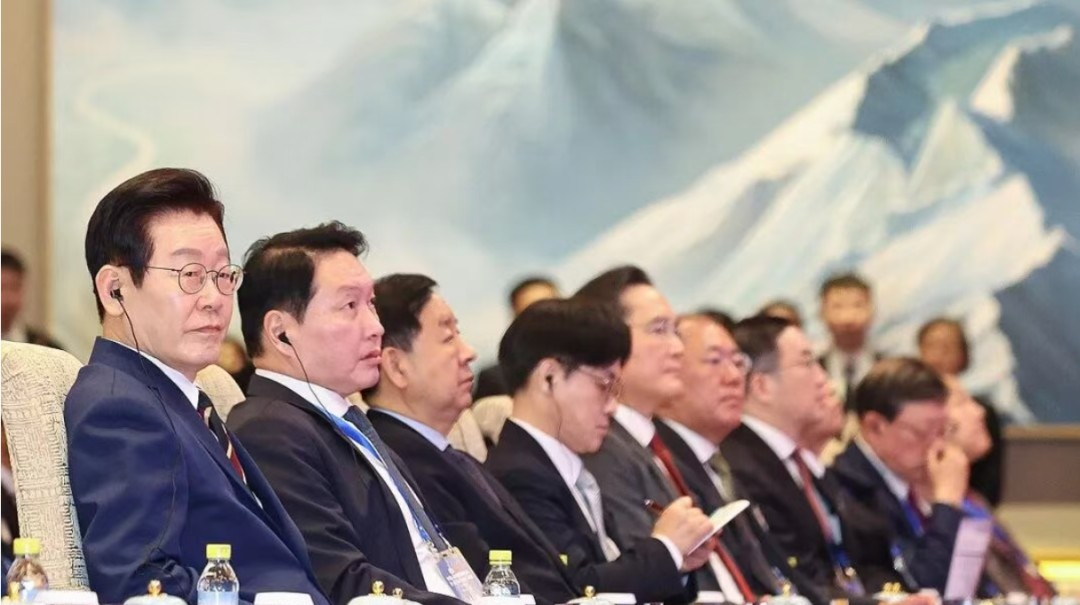
Core Insights - The article highlights the significant collaboration between South Korea and China in the autonomous driving sector, marked by the signing of 32 cooperation agreements during a business forum in Beijing [1][13]. - South Korea aims to achieve Level 4 (L4) autonomous driving commercialization by 2027, positioning itself among the top three global players in the industry [4][16]. Group 1: South Korea's Strategic Framework - South Korea has developed a comprehensive strategy for autonomous driving that includes top-level design, roadmaps, and pilot implementations since 2013 [4]. - Recent policies include the "Plan to Enhance the Competitiveness of the Autonomous Vehicle Industry," which aims for L4 commercialization by 2027, and the designation of Gwangju as the first "city-wide" autonomous driving test city [4][5]. - The government has introduced a regulatory framework that allows for relaxed regulations for Level 3 (L3) and L4 vehicles, empowering local governments to designate pilot areas [5]. Group 2: Commercialization and Application Scenarios - South Korea has seen rapid advancements in autonomous driving applications across various sectors, including public transport and logistics [6][10]. - Seoul is set to launch a daytime autonomous bus route by September 2025, featuring fully automated vehicles without drivers [6]. - The logistics sector has expanded significantly, with autonomous freight trucks now covering 5,224 kilometers of highways, and plans for robot and drone deliveries by 2026 and 2027, respectively [10]. Group 3: Technological Advancements and Infrastructure - South Korea's strength in autonomous driving is supported by its robust capabilities in semiconductors, communications, and automotive manufacturing [9]. - The country is embracing "Physical AI," integrating sensors, vehicle control, and road infrastructure with AI to minimize discrepancies between simulation and real-world conditions [11]. - The establishment of cooperative intelligent transport systems (C-ITS) has been a key focus, with extensive infrastructure already in place to enhance safety and efficiency [12]. Group 4: Sino-Korean Collaboration - The collaboration between Chinese and South Korean companies marks a shift from isolated technical exchanges to a more integrated ecosystem [13]. - Notable partnerships include Lenovo's collaboration with SWM for L4 Robotaxi development and the strategic alliance between Mushroom Carlink and LG Electronics for autonomous vehicle deployment [13]. - This partnership leverages China's data accumulation and cost control expertise alongside South Korea's regulatory framework and supply chain advantages [14]. Group 5: Challenges and Strategic Responses - Despite rapid progress, South Korea faces challenges in transitioning from experimental technologies to large-scale industrial applications [15]. - Issues such as accident liability, data privacy, and public acceptance of autonomous vehicles remain critical hurdles [15]. - South Korea's dual strategy of "open cooperation and technological breakthroughs" aims to address these challenges while enhancing its competitive position in the global market [16]. Group 6: Future Outlook - The collaboration between South Korea and China is seen as a pivotal moment in the global autonomous driving landscape, potentially reshaping industry dynamics [17]. - The next two years are expected to be a "harvest period" for Sino-Korean cooperation in autonomous driving, with the potential emergence of a new global leader in the sector [17].

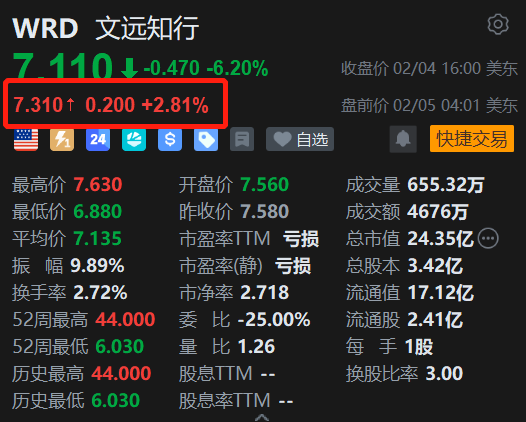
美股异动丨文远知行盘前涨约3% 加码自动驾驶与AI技术布局
Ge Long Hui· 2026-02-05 09:13
Core Viewpoint - Global leading autonomous driving company, WeRide (WRD.US), saw a pre-market increase of 2.8%, reaching $7.31 per share, following the announcement of a capital increase from 3.5 billion RMB to 4 billion RMB, a growth of approximately 14% [1] Company Summary - WeRide has established a diverse product matrix covering five major areas: autonomous taxis, minibuses, freight vehicles, sanitation vehicles, and driver assistance solutions [1] - The company operates in over 40 cities across 11 countries and is the only enterprise with products that hold autonomous driving licenses in eight countries [1] - As of now, WeRide's Robotaxi fleet exceeds 1,600 vehicles, with nearly six years of public operation and over 55 million kilometers of autonomous driving mileage [1]