
制药业

Search documents
千金药业:2026年1月12日召开2026年第一次临时股东会
Zheng Quan Ri Bao Wang· 2025-12-19 15:14
Group 1 - The company, Qianjin Pharmaceutical (stock code: 600479), announced that it will hold its first extraordinary general meeting of shareholders for 2026 on January 12, 2026 [1]

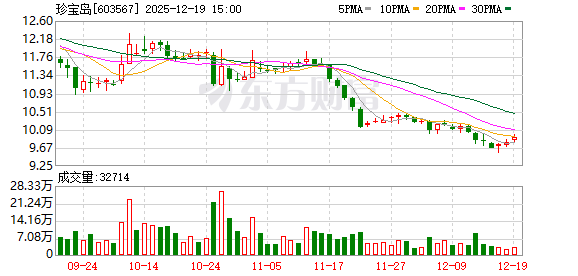
珍宝岛:关于控股股东部分股份质押及解质押的公告
Zheng Quan Ri Bao· 2025-12-19 12:19
Group 1 - The controlling shareholder, Heilongjiang Chuangda Group Co., Ltd., pledged 48.6 million shares of the company to Longjiang Bank for a one-year term [2] - Recently, Chuangda Group released 45.6 million shares from the pledge and completed the share release registration procedures [2]


日本股市没想到过去10年回报还行
集思录· 2025-12-14 14:17
Core Viewpoint - The article discusses the performance of the Japanese stock market and its relationship with the country's economic growth, highlighting the disparity between stock market returns and GDP growth rates [2][3]. Group 1: Japanese Stock Market Performance - The annualized return of the Japanese stock market over the past 10 years is approximately 7.8% [2]. - Major companies mentioned include Toyota with a market cap of over 2 trillion RMB and a PE ratio of 8.67, Fast Retailing with a market cap of 800 billion RMB and a PE of 39, and others like SoftBank, Mitsubishi, Sony, Hitachi, and Nintendo [2]. - The article notes that the performance of the stock market may not directly correlate with domestic economic growth, as many large companies operate internationally [6][11]. Group 2: Economic Growth Data - Japan's GDP growth rates from 2020 to 2023 show fluctuations: -4.3% in 2020, +2.1% in 2021, +1.0% in 2022, and +1.9% in 2023 [2]. - IMF forecasts for 2024 and 2025 predict GDP growth rates of 0.7% and 0.5%, respectively, citing factors like insufficient domestic demand and an aging population [2][4]. Group 3: Global Economic Context - Japan's share of the global GDP has significantly decreased from 17.7% in 1995 to an estimated 3.6% in 2024, indicating a substantial decline in its economic influence [3][4]. - The article suggests that the stock market's performance may not be a reliable indicator of the overall economy, as evidenced by the contrasting trends in GDP and stock market returns [3][10]. Group 4: Investment Strategies - The article mentions that the Bank of Japan has been actively buying Japanese stocks for over 15 years, contributing to market liquidity [12]. - Notable investors like Warren Buffett have shown interest in Japanese companies, focusing on valuation, fundamentals, and shareholder return mechanisms [7].



多措并举激活县域金融“一池春水” 中国人民银行兴安盟分行着力推动金融资源流向实体经济
Jin Rong Shi Bao· 2025-12-11 03:42
Core Viewpoint - The People's Bank of China (PBOC) in the Xingan League is actively enhancing financial services in rural areas by implementing innovative policies and practical measures to better align financial resources with local development needs [1][2][3]. Group 1: Policy Implementation - The PBOC Xingan League branch emphasizes the importance of policy transmission as a means to improve financial services, holding meetings to promote stable and symmetrical reductions in interest rates [2]. - A comprehensive work list was established, detailing 27 core responsibilities and 51 specific measures to optimize county-level financial management and services [2][3]. - The branch has engaged directly with enterprises, addressing financing needs for 18 key companies, totaling 27.8 million yuan, and facilitating cooperation between financial institutions and local businesses [3]. Group 2: Service Innovation - The PBOC Xingan League branch has allocated 159 million yuan in re-loans to support 1,621 agricultural households, ensuring effective funding for agricultural production [4]. - A "financial + industry chain" service model has been implemented, covering 182 agricultural entities with a total financing demand of 235 million yuan [4]. - Innovative financial products such as "Entrepreneur Loans" and "Technology Loans" have been introduced to support key demographics and technology-driven enterprises, enhancing service efficiency through digitalization [5]. Group 3: Future Directions - The PBOC Xingan League branch aims to continue optimizing the financial ecosystem, improving the quality of financial supply, and enhancing policy coordination mechanisms as part of its ongoing efforts [6].
ATFX:港股缩量震荡寻方向,美联储决议成反弹契机?
Sou Hu Cai Jing· 2025-12-10 08:31
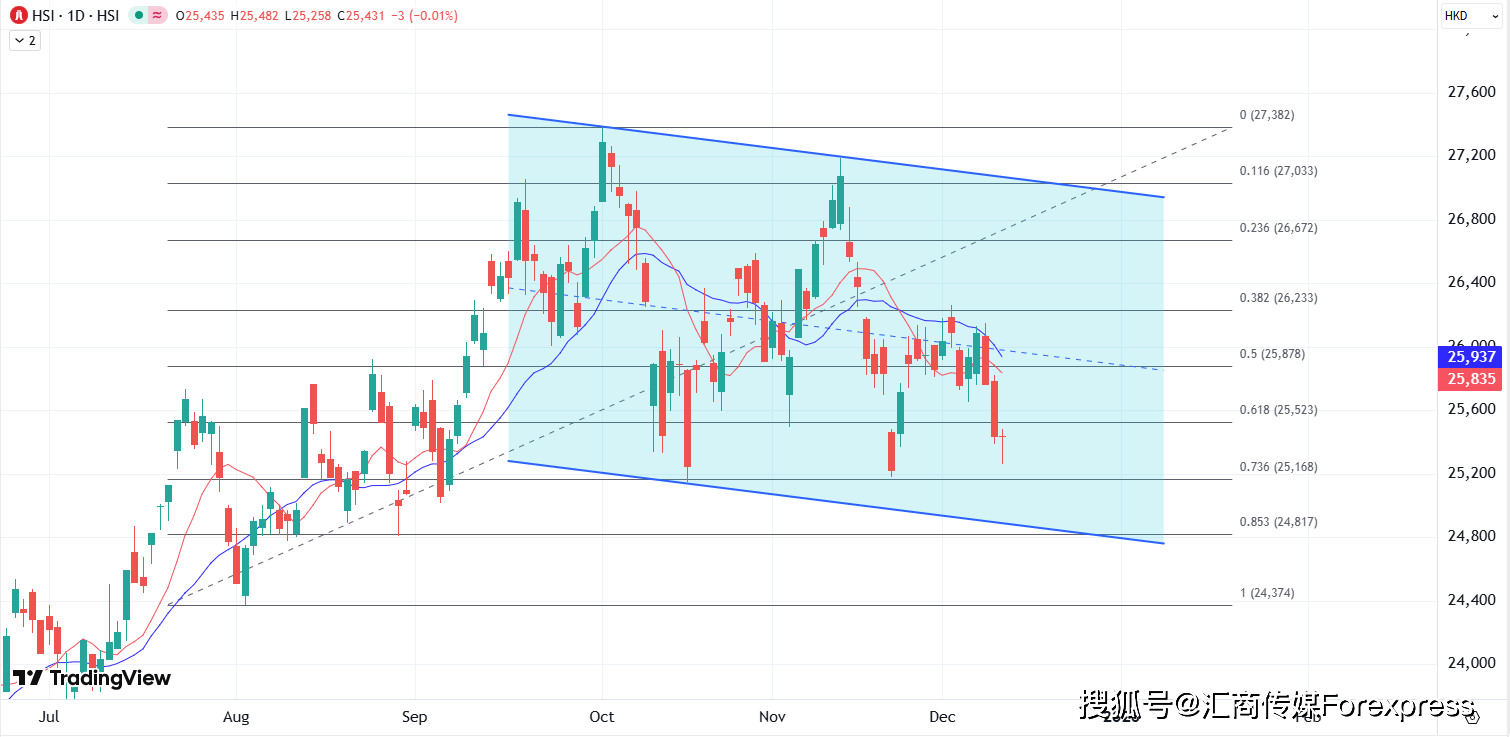
Group 1 - Hong Kong stocks experienced a decline, with the Hang Seng Index dropping 109 points or 0.43% to 25,325 points amid mixed performances from major tech stocks [1] - Alibaba (09988) aims to develop a super app through its newly established C-end business group, resulting in a 0.6% increase in its stock price [1] - Semiconductor stocks faced downward pressure, with SMIC (00981) down 1.7% and ASMPT (00522) down 3.2%, while the U.S. government allows NVIDIA to export H200 AI chips to China, but the Chinese government reportedly plans to restrict access to these chips [1] Group 2 - Automotive stocks showed weakness, with BYD (01211) down 1.1% and NIO (09866) down 2.8%, while Geely (00175) plans to secure a $420 million syndicated loan for the privatization of Zeekr, leading to a 0.9% increase in its stock price [2] - Shipping stocks saw significant declines, with the Baltic Dry Index (BDI) hitting a near two-week low, causing Orient Overseas International (00316) to drop 5.6% [2] - Pharmaceutical stocks were mixed, with China National Pharmaceutical Group (01177) and others declining by 2.5% to 3.3%, while Fosun Pharma (02196) rose by 3.8% [2] Group 3 - The Hong Kong market sentiment has turned cautious as southbound trading has been shrinking, with the upcoming Central Economic Work Conference expected to provide further guidance [3] - The Federal Reserve's interest rate decision is anticipated to impact Hong Kong stocks, with potential support for the market if a hawkish stance is not adopted [3]
今年来,7家上市湘企完成回购超8亿元
Chang Sha Wan Bao· 2025-12-04 08:24
Group 1 - The total amount of share buybacks by A-share listed companies has exceeded 130 billion yuan this year, marking the second highest level in history [1][2] - In December, several companies from Hunan Province, including Hualing Steel and Blue思科技, have announced their share buyback progress, with a total buyback amount exceeding 800 million yuan [1] - Century Huatong completed its share buyback with a total amount of approximately 999.9 million yuan, repurchasing 56,120,796 shares at prices ranging from 17.06 yuan to 18.38 yuan per share [1] Group 2 - Over 1,400 companies in the A-share market have implemented buybacks since 2025, with the total buyback amount exceeding 130 billion yuan [2] - Midea Group leads the buyback amounts this year with over 9.6 billion yuan, having announced two buyback plans [2] - The stock buyback index has increased by over 27% this year, reaching a historical high, with more than 100 companies doubling their stock prices [2] Group 3 - As of December 2, Blue思科技 has repurchased 7.31 million shares for a total amount of 212 million yuan [3] - Flag Group has repurchased 27.96 million shares, exceeding its planned buyback amount, with a total buyback amount of 196 million yuan [3] - Hunan Silver has repurchased 19.76 million shares, with a total buyback amount of 106 million yuan [3] Group 4 - As of November 30, Hualing Steel has repurchased 4.35 million shares for a total amount of 210 million yuan [4]





专访斯洛文尼亚前副总理布尔克:希望欧中尽快签署一项全面协议
Di Yi Cai Jing· 2025-12-03 06:17
Core Viewpoint - The essence of future EU-China cooperation lies in maintaining dialogue and interaction to create new markets and opportunities, especially in sectors like energy, automotive, and pharmaceuticals [1][2][7]. Group 1: Economic Cooperation - Slovenia's economy heavily relies on the automotive and pharmaceutical industries, which together account for 16% of its GDP [1]. - Slovenia welcomes Chinese investment, particularly in energy, automotive, and pharmaceutical sectors, indicating a strong foundation for bilateral cooperation [1]. - The EU is undergoing a transformation and is open to leading global trends, emphasizing the importance of EU-China dialogue [2]. Group 2: Technological Advancements - Emerging technologies such as artificial intelligence, quantum mechanics, and new materials present excellent opportunities for EU-China collaboration [7]. - The electric vehicle sector is a key strategic direction for both regions, with a focus on sustainable energy sources and technological development [5][7]. - The low-altitude economy is reshaping industry dynamics, providing new development spaces for logistics and urban air traffic, which can alleviate ground traffic pressure [6]. Group 3: Future Outlook - A comprehensive agreement between the EU and China is desired to define trade cooperation and address mutual understandings of differences [7][8]. - The need for a unified global regulatory framework is emphasized to foster business predictability and growth amid political polarization [7][8]. - The collaboration in addressing climate change, green technology, and high-tech solutions is seen as a long-term opportunity for both regions [7].

突然暴涨!关税,降至15%!
Zhong Guo Ji Jin Bao· 2025-12-02 06:20
Group 1 - The U.S. will reduce tariffs on South Korean automobiles to 15%, effective retroactively from November 1 [2][7] - Following the announcement, shares of Hyundai and Kia rose nearly 5% and 4% respectively, contributing to a nearly 2% increase in the South Korean Composite Stock Price Index [3][6] - The U.S. Department of Commerce stated that South Korea's commitment to invest in the U.S. strengthens the economic partnership between the two countries and supports domestic employment and industry development [8] Group 2 - The reduction in tariffs is part of a bilateral trade agreement that sets a 15% cap on potential future tariffs on semiconductors and pharmaceuticals, aligning South Korea with Japan in this regard [7] - Prior to this change, the U.S. imposed a 25% tariff on imported goods from South Korea, including automobiles, citing national security concerns [7] - The South Korean government is pushing legislation to fulfill a previous agreement to invest $350 billion in strategic industries in the U.S., including shipbuilding [7]
美国将把韩国汽车关税降至15% 韩国股市大涨
Zhong Guo Ji Jin Bao· 2025-12-02 06:19
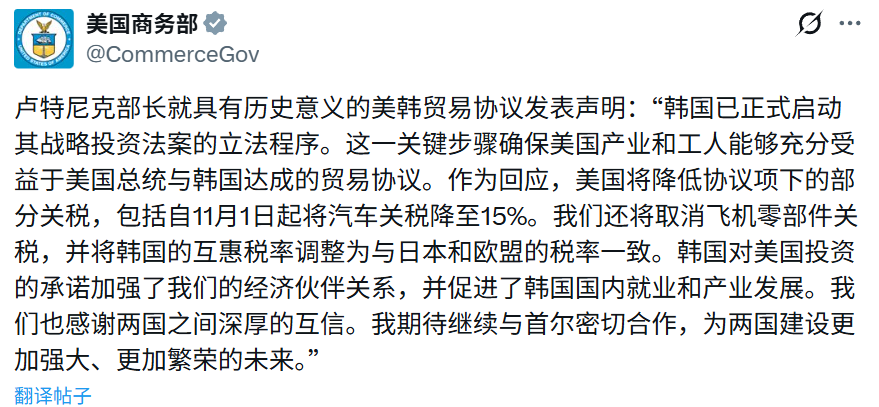
Group 1: US-Korea Trade Agreement - The US has confirmed a reduction of tariffs on South Korean automobiles to 15%, effective retroactively from November 1 [3] - This decision is linked to South Korea's legislative commitment to invest $350 billion in strategic industries in the US, including shipbuilding [7] - The US will also eliminate tariffs on aircraft parts and remove the "reciprocal tariff" on South Korea, aligning it with Japan and the EU [3][7] Group 2: Market Reactions - Shares of Hyundai Motor and Kia Motors rose nearly 5% and 4% respectively following the tariff announcement [4] - The South Korean Composite Stock Price Index increased by nearly 2% in response to the news [6] Group 3: US-UK Pharmaceutical Agreement - The US and UK have reached a zero-tariff agreement on pharmaceutical products and medical technologies [10] - Under this agreement, the UK will increase the net price it pays for new drugs by 25%, while US-made drugs will be exempt from certain tariffs [12] - This move is part of a broader strategy to align US drug prices with those of other wealthy nations, as advocated by former President Trump [12]

突然暴涨!关税,降至15%!
中国基金报· 2025-12-02 06:10
Group 1 - The U.S. will reduce tariffs on South Korean automobiles to 15%, effective retroactively from November 1 [3][8] - Following the announcement, shares of Hyundai and Kia rose nearly 5% and 4% respectively, contributing to a nearly 2% increase in the South Korean Composite Stock Price Index [4][6] - The tariff reduction is part of a bilateral trade agreement that sets a 15% cap on potential future tariffs on semiconductors and pharmaceuticals, aligning South Korea with Japan in this regard [8] Group 2 - The U.S. also announced a zero-tariff agreement with the UK on pharmaceutical products, which includes a 25% increase in the net price paid by the UK for new drugs [9][10] - This agreement aims to enhance investment and innovation between the U.S. and the UK, addressing concerns from the pharmaceutical industry regarding the UK's business environment [10]
