建筑设备

Search documents
香港中小上市公司协会:香港中小上市企业喜迎“十五五”新机遇
Zhi Tong Cai Jing· 2025-11-03 13:05
Core Viewpoint - The "14th Five-Year Plan" emphasizes accelerating high-level technological self-reliance and leading the development of new productive forces, indicating a strategic shift for Hong Kong's small and medium-sized listed companies towards a dual core function of "technology + capital" [1][2] Group 1: Market Context - There are approximately 2,600 listed companies in Hong Kong, with nearly 80% having a market capitalization below 5 billion HKD, highlighting long-standing issues of low valuation, weak liquidity, and financing difficulties [2][3] - The current environment presents significant structural rebound potential, as small and medium-sized companies are at a critical point of transitioning from passive survival to proactive transformation [2][3] Group 2: Transformation Directions - The "14th Five-Year Plan" outlines six definitive mainlines, providing seven transformation directions for Hong Kong's small and medium-sized listed companies [3][4] 1. **AI-Driven Industrial Upgrade**: Companies should leverage AI to achieve asset-light transformation across various sectors [3] 2. **Integration into National Unified Market**: Companies are encouraged to align with mainland standards and supply chain certifications to access broader growth opportunities [3][4] 3. **Promotion of Consumer Technology and Innovation**: There is a push for technological upgrades in sectors like elderly care, education, and culture, creating new consumption technology markets [3][4] 4. **Innovation in Mergers and Acquisitions**: Companies should utilize the flexible advantages of the Hong Kong market to engage in cross-border industrial integration [3][4] 5. **Deepening High-Level Openness and International Connectivity**: Hong Kong can leverage its position to facilitate cross-border data flow and green finance innovations [4] 6. **Participation in New Urbanization Construction**: Companies can engage in urban renewal projects in mainland China, tapping into significant investment opportunities [4] 7. **Embracing Green Finance and Zero-Carbon Economy**: Companies should promote green certification and utilize financial instruments like green bonds to broaden financing channels [5] Group 3: Steps for Transformation - The transformation process is outlined in three steps: 1. **Industrial AI Transformation**: Companies must view AI as a strategic asset and integrate it into all operational aspects [5][6] 2. **Mergers and Acquisitions**: This is seen as an effective path for scaling and enhancing innovation capabilities through horizontal and vertical integration [6] 3. **Green Transformation**: Companies should adopt green manufacturing standards and establish systems for monitoring carbon emissions to attract ESG investments [6][7] Group 4: Policy Recommendations - Seven policy recommendations are proposed to invigorate small and medium-sized listed companies: 1. **Improve M&A Regulations**: Relax restrictions on mergers and acquisitions to facilitate corporate transformation [7] 2. **Establish a Multi-Tiered Capital Market System**: Create a more inclusive capital market structure to support companies at various development stages [8] 3. **Promote Re-Industrialization and Research Commercialization**: Align capital market reforms with re-industrialization strategies to enhance industry upgrades [8] 4. **Relax Intellectual Property Financing**: Encourage financial institutions to recognize intangible assets for financing [8] 5. **Establish Development Funds and Credit Guarantee Mechanisms**: Create funds to support AI transformation and green upgrades [9] 6. **Advance Green Finance and Carbon Asset Marketization**: Develop a carbon asset trading system to incentivize green development [9] 7. **Promote Policy Coordination and Performance Assessment**: Ensure effective implementation of supportive policies for small and medium enterprises [9] Conclusion - The "14th Five-Year Plan" marks a pivotal transition for Hong Kong's economy, urging small and medium-sized listed companies to embrace transformation and innovation to thrive in the new economic landscape [10]
沃尔沃集团预计2026年中国建筑设备市场增速在-5%至+5%之间。
Xin Lang Cai Jing· 2025-10-17 05:33
Core Viewpoint - Volvo Group anticipates that the growth rate of the construction equipment market in China will range between -5% and +5% by 2026 [1] Summary by Category - **Market Growth Forecast** - The expected growth rate for the Chinese construction equipment market is projected to be between -5% and +5% for the year 2026 [1]

大行评级丨美银:上调卡特彼勒目标价至594美元 维持“买入”评级
Ge Long Hui· 2025-10-16 02:08
Core Viewpoint - Bank of America has raised Caterpillar's target price from $517 to $594 while maintaining a "Buy" rating, indicating a positive outlook despite weak demand and improving inventory levels [1] Group 1: Company Analysis - Caterpillar's target price adjustment reflects confidence in the company's future performance, with expectations of easing pressure in the construction sector by the end of 2025 [1] - The current demand for Caterpillar's products remains weak, but there are signs of improvement in inventory levels, which could positively impact future sales [1] Group 2: Industry Outlook - The construction industry is anticipated to experience a reduction in pressure by the end of 2025, suggesting a potential recovery that could benefit companies like Caterpillar [1]

WTO:AI商品提振全球贸易,今年北美进口将萎缩
Di Yi Cai Jing Zi Xun· 2025-10-07 13:40
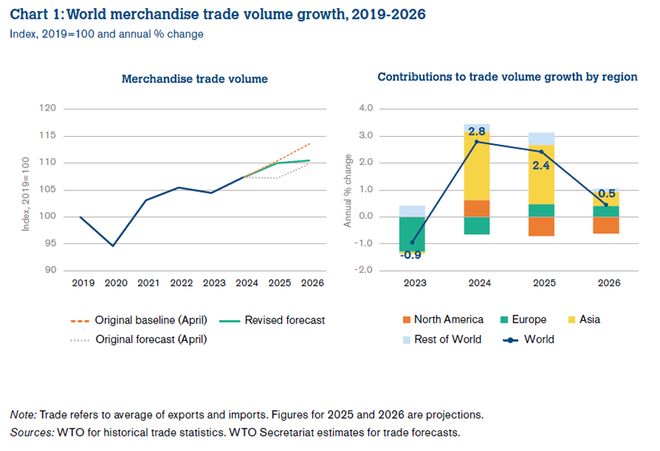
Core Insights - The WTO has revised its global trade growth forecast for 2025 upwards to 2.4%, driven by increased spending on AI-related products, a surge in North American imports before tariff hikes, and strong trade growth in other regions [1][5] - However, the forecast for 2026 has been significantly downgraded to 0.5%, indicating potential challenges ahead [1][5] Group 1: Trade Growth Drivers - In the first half of 2025, global merchandise trade volume is expected to grow by 4.9% year-on-year, with a 6% increase in current dollar terms following a 2% growth in 2024 [4] - Key drivers of this growth include early North American imports, favorable macroeconomic conditions such as deflation and supportive fiscal policies, and robust growth in emerging markets [4] - AI-related products, including semiconductors, servers, and telecommunications equipment, contributed nearly half of the overall trade growth, with a year-on-year value increase of 20% [4] Group 2: Trade Forecast Adjustments - The WTO anticipates that global merchandise trade growth will slow from 2.8% in 2024 to 2.4% in 2025 and further to 0.5% in 2026, reflecting the impact of higher tariffs and trade policy uncertainties [5] - The GDP growth forecast for 2025 is set at 2.7%, with a slight decrease to 2.6% in 2026 [5] - The WTO emphasizes that the main downside risks to this forecast include the spread of trade restrictions and policy uncertainties across more economies and sectors [5] Group 3: Regional Trade Performance - Asia and Africa are expected to achieve the fastest export growth in 2025, while North America is projected to experience a decline [6] - By 2026, export performance in North America and Europe is expected to improve, although all regions are anticipated to see a decline in import performance [6] Group 4: Impact on Services Trade - The WTO has downgraded its forecast for global commercial services trade due to indirect impacts from tariffs, with transportation and tourism sectors expected to see reduced growth rates [7] - The expected growth rate for transportation services in 2025 is 2.5%, down from 4.5% in 2024, while tourism is projected to grow by 3.1%, a decrease from 11% the previous year [7] - Digital services are expected to show slightly stronger growth, with a forecast of 6.1% compared to 5.7% in 2024 [7]

涉及至少720种产品,日企叫苦:“关税比想象中高”
Huan Qiu Shi Bao· 2025-09-28 22:45
Group 1 - Japanese companies are facing significant impacts from the U.S. government's steel and aluminum tariffs, which now include at least 720 products categorized as "derivative goods" [1] - The complex tariff structure imposes a 50% steel and aluminum tariff on the portion of products that use these materials, while a "countervailing duty" of 15% applies to Japan [1] - The expansion of the tariff list to include "derivative goods" has raised concerns among foreign companies and industry organizations, as it appears to be aimed at protecting U.S. domestic manufacturing [1] Group 2 - The Japan Construction Equipment Manufacturers Association has requested the Japanese government to negotiate with Washington to exclude construction machinery from the steel and aluminum tariffs [2] - Exports of construction and mining equipment from Japan to the U.S. were valued at over 800 billion yen in FY2024, but saw a 26% year-on-year decline in August [2] - The inclusion of cutlery products in the "derivative goods" category has negatively impacted manufacturers in Niigata Prefecture, with one company expressing concerns about potential price increases leading to reduced consumer demand [2] Group 3 - A recent agreement between Japan and the U.S. established a 15% tariff rate on Japanese exports, making it easier for companies to strategize around additional costs, but the steel and aluminum tariffs have complicated this [2] - The Japanese Minister of Economy, Trade and Industry has stated efforts will be made to assess the impact of the expanded tariffs and coordinate with relevant industries [2] - The U.S. Department of Commerce has initiated an investigation to determine if specific tariffs or import restrictions should be applied to machine tools, industrial robots, and medical devices, causing the Japanese machine tool industry to remain cautious [2]
Inside information, profit warning: KH Group Plc lowers its profit guidance for 2025
Globenewswire· 2025-09-19 09:45
Core Viewpoint - KH Group Plc has lowered its profit guidance for 2025, indicating a challenging operating environment, particularly in its largest business area, KH-Koneet [1][2]. Financial Performance - The company previously estimated net sales for 2025 to be approximately EUR 194.0 million and comparable operating profit of EUR 7.2 million [1]. - The updated guidance now projects net sales to be between EUR 190 million and EUR 200 million, with comparable operating profit expected to be between EUR 5 million and EUR 6 million [2]. Business Structure - KH Group Plc operates as a Nordic conglomerate with business areas including KH-Koneet, Nordic Rescue Group, and Indoor Group, focusing on construction and earth-moving equipment, rescue vehicles, and furniture retail [2].

益美国际控股(01870)发盈警,预期中期综合亏损不多于约2600万港元 同比盈转亏
智通财经网· 2025-08-11 10:51
Group 1 - The company expects a consolidated loss of no more than approximately 26 million HKD for the six months ending June 30, 2025, compared to a consolidated profit of approximately 4.5 million HKD for the same period in 2024 [1] - The decline in the permanent lifting boat business is attributed to a continued downturn in the Hong Kong construction industry, with multiple projects delayed until the second half of 2025, leading to reduced sales volume and profitability [1] - The company reported a loss in its electricity trading business in Shandong, China, due to abnormal fluctuations in wholesale electricity prices and increased purchasing costs, although improvements are expected in the second half of the year following regulatory changes [2] Group 2 - Administrative expenses have increased primarily due to the development of the green power energy business segment during the interim period [3]
Alta Equipment (ALTG) - 2025 Q2 - Earnings Call Transcript
2025-08-07 22:00
Financial Data and Key Metrics Changes - The company recorded revenue of $481.2 million, a slight reduction of 1.4% year-over-year, but an increase of $58.2 million sequentially from Q1 [15] - New and used equipment sales in the Construction and Master Distribution segments increased by $24.7 million year-over-year, a 15.4% increase, while Material Handling segment sales decreased by $8.3 million [15][16] - Adjusted EBITDA for the quarter was $48.5 million, with a free cash flow before rent to sell decisioning of approximately $32 million [21][22] Business Line Data and Key Metrics Changes - The Construction Equipment segment saw new and used equipment sales increase by nearly $22 million, a 15% increase year-over-year, driven by strong demand in northern regions [17][19] - Material Handling segment revenues were modestly up quarter-over-quarter, but down year-over-year due to cautious spending among automotive and general manufacturing customers [7][19] - Master Distribution segment revenues increased by 25% to $20.9 million, driven by stronger dealer engagement and channel activity [9] Market Data and Key Metrics Changes - The Midwest and Canadian operations outperformed last year, particularly in aggregate and mining markets, while Florida's market remains resilient despite temporary pauses in private nonresidential projects [6][19] - The Material Handling customer base has been more affected by trade policy uncertainties, particularly among larger customers with greater import/export exposure [20] Company Strategy and Development Direction - The company is focused on capital allocation strategies, including a $30 million buyback program, and has repurchased nearly 1.2 million shares at an average price of $5.64 [11][25] - The outlook for the remainder of the year remains encouraging, especially with potential benefits from tax incentives in the One Big Beautiful Bill [11][24] Management's Comments on Operating Environment and Future Outlook - Management expressed optimism about the resilience of the business model and the diversity of end markets providing stability through down cycles [11] - There is confidence in the construction segment's backlog and customer sentiment, which is expected to drive equipment purchases despite macroeconomic uncertainties [39] Other Important Information - The company continues to optimize its product support business, specifically in the construction segment, to drive labor gross margins higher and reduce SG&A spend [16] - The adjusted EBITDA guidance for 2025 has been slightly trimmed to a range of $171.5 million to $181.5 million, primarily due to tariff impacts and expected continued drag in product support and rental departments [23] Q&A Session Summary Question: Impact of the Big Beautiful Bill on demand - Management expects the Big Beautiful Bill to impact construction more than other segments, with potential benefits seen primarily in Q4 2025 [30] Question: Material Handling customer hesitancy - Bookings in July were strong, indicating that customer hesitancy may be subsiding, particularly for fleets due for replenishment [32][34] Question: SG&A discipline and expectations for the second half - Management believes they have found a good level for fixed costs and expects to maintain that level, while being open to increasing variable expenses related to sales [36] Question: Construction activity and customer purchasing behavior - Confidence in backlog is the primary driver for customer equipment purchases, with tax benefits being a secondary factor [39][40] Question: Geographic performance in construction - Florida remains strong, while other manufacturing-oriented regions show softer sentiment [46][48] Question: M&A opportunities - The company sees opportunities in M&A, particularly related to succession planning issues rather than solely economic cycles [50][51] Question: Margin profile and competitive environment - Margins are stabilizing, particularly in heavy equipment, while compact equipment faces more challenges [56][58] Question: Rental fleet utilization and rates - Utilization has improved but is still below targets, with rental rates remaining stable across product categories [59][62]

CNH Industrial N.V.(CNH) - 2025 Q2 - Earnings Call Transcript
2025-08-01 14:02
Financial Data and Key Metrics Changes - Consolidated revenues for Q2 were down 14% year over year at $4.7 billion, with adjusted EBIT down 55% to $224 million and EPS at 17% [13][14] - Adjusted net income decreased by about half, with adjusted diluted earnings per share down from $0.35 to $0.17 [18] - Second quarter gross margin was 21.8%, down from 24.4% in Q2 2024, affected by lower production volumes and unfavorable geographic mix [19] Business Line Data and Key Metrics Changes - Agriculture segment sales were down 17% to $3.2 billion, with North America down 36%, representing over 90% of the total decline in ag sales [18][19] - Construction segment net sales were $773 million, down 13% year over year, with gross margin at 15.7%, down from 16.5% in Q2 2024 [22] - Financial Services reported net income of $87 million, with a year-over-year decrease mainly driven by higher risk costs in Brazil [23] Market Data and Key Metrics Changes - Industrial production hours were down 12% year over year, with agriculture down 12% and construction down 15% [8] - North American industry retail demand was down 37% for high horsepower tractors and down 23% for combines [14] - The global industry forecast for agriculture is expected to be down around 10% from 2024, with 2025 representing a trough level of global market demand [32] Company Strategy and Development Direction - The company is focused on reducing channel inventories and aligning production with retail demand, aiming to achieve target levels of newly built machine inventory by year-end [9][32] - Five key strategic pillars were outlined: expanding product leadership, advancing Iron and Tech integration, driving commercial excellence, operational excellence, and quality as a mindset [14] - A new collaboration with Starlink was announced to provide connectivity for farmers, enhancing productivity [11][16] Management's Comments on Operating Environment and Future Outlook - The management noted ongoing complexity and uncertainty in the macroeconomic environment, making forecasting challenging [6][7] - The company expects to produce in line with retail demand in the second half of 2025 and into 2026, while remaining cautious about tariff impacts [10][36] - Management expressed confidence in the long-term strategy and operational improvements, despite current market headwinds [12][13] Other Important Information - The company reaffirmed its capital allocation priorities, focusing on reinvestment while maintaining a healthy balance sheet [24][25] - Free cash flow from industrial activities was $451 million, significantly better compared to 2024 due to improvements in working capital [18] Q&A Session Summary Question: Inventory levels in Agriculture - Management confirmed a reduction of $200 million in excess inventory, with a focus on clearing aged inventories and supporting dealer sales [40][42] Question: 2026 order trends - Management indicated that 2025 is expected to be a trough year, with uncertainty around tariffs impacting 2026 demand forecasts [46][48] Question: Pricing strategies - Management stated that pricing will be positive for the full year, driven by higher value functionality and cost discipline [58][60] Question: North American market challenges - Management acknowledged the pricing differential between new and used equipment and emphasized efforts to align inventory levels [96][100] Question: Timing of tariff impacts - Management expects most tariff impacts to be felt in Q4, with ongoing efforts to mitigate costs through pricing and operational efficiencies [104][106]

Gencor Stock Gains Following Q2 Earnings Amid Revenue Decline
ZACKS· 2025-07-31 18:20
Core Insights - Gencor Industries, Inc. (GENC) shares increased by 4.1% following the earnings report for the quarter ended March 31, 2025, outperforming the S&P 500 Index's 0.1% gain during the same period [1] Financial Performance - For Q2 fiscal 2025, Gencor reported net revenues of $38.2 million, a decrease of 6.1% from $40.7 million in the same quarter last year, primarily due to lower contract equipment sales [2] - Gross profit for the quarter was $11.4 million, down 7.9% from $12.3 million a year ago, with gross margin slightly compressed to 29.7% from 30.3% due to rising material costs [2] - Net income for the quarter was $6.1 million, a 2% decline from $6.2 million in the prior year, with earnings per share remaining stable at $0.42 [2] - For the first six months of fiscal 2025, Gencor posted revenues of $69.6 million, up 4.4% from $66.7 million in the same period of 2024, while net income decreased to $9.9 million from $10.5 million [3] Key Business Metrics - Operating income for Q2 was $6.5 million, down 8.4% from $7.1 million in the same quarter last year, attributed to lower revenues [4] - Operating expenses decreased by 7.2% to $4.9 million, reflecting cost control measures, including a 23.7% reduction in product engineering and development costs due to reduced headcount [4] - Net other income increased by 74.2% to $1.8 million, supported by gains on marketable securities and higher interest and dividend income [5] Balance Sheet and Cash Position - Gencor maintained a strong balance sheet with no short- or long-term debt, holding $52.3 million in cash and $91.4 million in marketable securities as of March 31, 2025 [5] - Inventories decreased to $55.1 million from $63.8 million as of September 30, 2024, primarily due to large contract orders and strong sales [9] Management Commentary - Gencor's president expressed satisfaction with overall performance, noting that despite a slight revenue decline in Q2, six-month revenue and operating income exceeded fiscal 2024 performance [6] - Management emphasized a focus on market growth and operational efficiency for the remainder of 2025 [6] Market Dynamics - Revenue decline was attributed to the timing of equipment shipments, a cyclical aspect of the business influenced by customer seasonality in the highway construction sector [7] - Economic headwinds such as inflation, supply chain disruptions, and geopolitical uncertainties were identified as potential risks impacting material costs and customer spending [10] Guidance and Future Outlook - Gencor did not provide explicit forward guidance for the remainder of fiscal 2025 but expressed a cautious yet constructive outlook, anticipating a "more traditional market" in the latter half of the fiscal year [11] Internal Controls and Developments - No significant acquisitions or restructurings were reported, but Gencor is actively working on improving internal controls following identified material weaknesses in financial reporting [12]