
民营医院

Search documents
港股打新亏钱!4只新股集体破发,明基医院跌近50%创纪录
第一财经· 2025-12-22 13:42
Core Viewpoint - The recent collective decline of four new stocks on their debut in the Hong Kong market is attributed to multiple factors, including tightening liquidity and a mismatch between high valuations and fundamental performance [2][4]. Group 1: New Stock Performance - Four new stocks listed on December 22, 2025, experienced significant declines on their first trading day: Mingji Hospital down 49.46%, Impression Dahongpao down 35.28%, Huazai Bio down 29.32%, and Nanhua Futures down 24.17% [2][6]. - This trend of new stocks underperforming is not isolated; over half of the 17 new stocks listed in December 2025 have also seen their prices drop on the first day [4]. - In contrast, the overall performance of new stocks throughout 2025 was strong, with 76 out of 102 new listings seeing price increases, and 16 stocks achieving over 100% cumulative gains [5]. Group 2: Market Environment - The Hong Kong stock market is facing a weakening liquidity environment, with average daily trading volume dropping below 200 billion HKD and southbound capital inflows significantly decreasing [2][7]. - Southbound capital net inflow for December 2025 was only 21.91 billion RMB, a stark contrast to previous months where inflows often exceeded 100 billion RMB [8]. Group 3: Factors Behind Weakness - Internal factors contributing to the weak liquidity include new regulations for public funds that may lead to net selling of Hong Kong stocks, as many funds are overexposed compared to their benchmarks [9]. - The high demand for funds in the Hong Kong market is also influenced by a backlog of over 300 companies waiting to go public, which adds pressure to the existing liquidity [9]. Group 4: Individual Stock Fundamentals - Mingji Hospital's high valuation is under scrutiny, with a price-to-earnings (PE) ratio of approximately 29.8, compared to the average PE of 17 for private hospitals in Hong Kong. Its revenue and profit have also declined year-on-year [11][12]. - Impression Dahongpao has similarly reported a decrease in profit, with figures of 42.86 million RMB and 10.23 million RMB for 2024 and the first half of 2025, respectively [12]. Group 5: IPO Mechanism Changes - The introduction of "Mechanism B" for IPOs allows issuers to set a lower limit on the public offering portion, which can lead to smaller trading volumes and potentially reduce mispricing risks. However, it may also hinder companies with high valuations from recovering through retail investor participation [13].


港股打新亏钱!4只新股集体破发,明基医院跌近50%创纪录
Di Yi Cai Jing· 2025-12-22 13:01
Core Viewpoint - The recent performance of new stocks in the Hong Kong market has been notably poor, with four new listings experiencing significant declines on their first trading day, marking a rare occurrence of collective price drops among new stocks [1][2]. Group 1: New Stock Performance - Four new stocks listed on December 22, 2025, saw substantial declines: Ming Kee Hospital down 49.46%, Impression Da Hong Pao down 35.28%, Huazai Biotechnology down 29.32%, and Nanhua Futures down 24.17% [1][3]. - This trend of new stocks underperforming is not isolated; over half of the 17 new stocks listed in December 2025 have experienced price drops on their first day [2]. Group 2: Market Conditions - The overall liquidity environment in the Hong Kong market has tightened, with daily trading volumes falling below HKD 2 trillion, and southbound capital inflows significantly reduced [1][4]. - Southbound capital net inflows for December 2025 were only HKD 21.91 billion, a stark contrast to previous months where inflows often exceeded HKD 100 billion [5][6]. Group 3: Factors Influencing Performance - The decline in new stock performance is attributed to multiple factors, including tightening liquidity and high valuations not aligning with fundamental performance [1][7]. - Specific to Ming Kee Hospital, its price-to-earnings (PE) ratio was approximately 29.8 times, significantly higher than the average PE of 17 times for the private hospital sector in Hong Kong [8][10]. - The company's revenue for the first half of 2025 was reported at HKD 1.312 billion, a decline of 1.34% year-on-year, with net profit also decreasing by 23.18% [8]. Group 4: IPO Mechanisms - The introduction of "Mechanism B" for IPOs allows issuers to set a lower limit on the public offering portion, which can lead to smaller trading volumes and potentially lower the risk of price drops [9][10]. - However, this mechanism can also backfire for companies with high valuations and weak demand, as it lacks a mechanism to adjust allocations to retail investors [10].
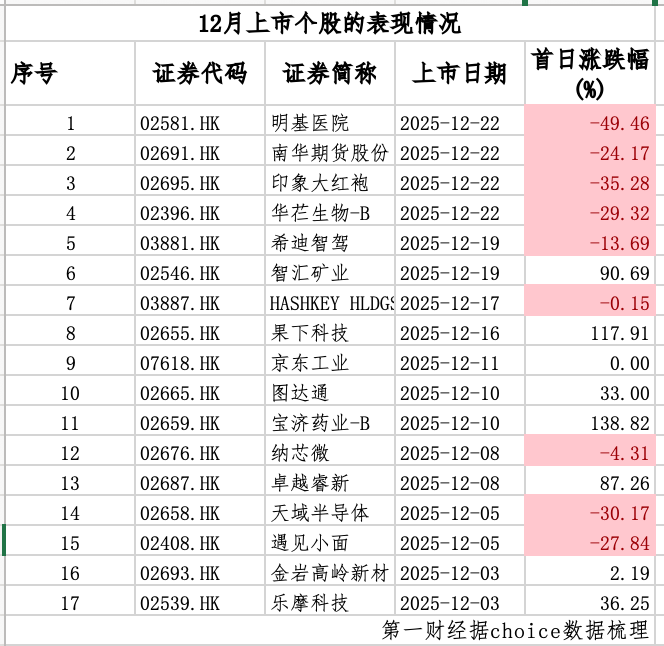
今日港股4新股全部破发!明基医院跌近50%创年内港股新股首日最差表现
Jin Rong Jie· 2025-12-22 11:42
Group 1 - The Hong Kong IPO market experienced a collective downturn on December 22, 2025, with four newly listed stocks, including Impression Da Hong Pao (HK02695), Huaren Biotech-B (HK02396), Ming Kee Hospital (HK02581), and Nanhua Futures (HK02691), all facing significant declines, with Ming Kee Hospital dropping 49.46%, marking the worst debut performance of the year [1] - All four new stocks opened lower and continued to decline throughout the trading day, closing near their lowest prices. Ming Kee Hospital, which had an offering price of 9.34 HKD, closed at 4.73 HKD, resulting in a loss of 1,420 HKD per lot of 500 shares, surpassing the previous record decline of 47.67% set by Conch Cement Technology [1] - Impression Da Hong Pao, despite receiving a 3,400 times oversubscription and a pre-listing increase of 11% on the Futu platform, ultimately closed down 35.28% at 2.33 HKD, leading to a loss of 1,270 HKD per lot of 1,000 shares [1] Group 2 - Following the reform of the Hong Kong IPO pricing mechanism in August 2025, the new stock failure rate was only 7.14% from August to October, but it surged to 42.10% from November onwards, significantly exceeding the 30.23% rate observed in the first half of the year [2] - The core reason for this discrepancy is the misalignment between primary market pricing and secondary market risk appetite, with issuers often referencing A-share valuations while Hong Kong investors prioritize cash flow and dividend returns, compounded by increased pressure from southbound capital and smaller float sizes, leading to concentrated sell-offs post-listing [2] - The Hong Kong IPO market has reached a scale of 267.1 billion HKD this year, with potential to reclaim the top position globally for IPOs. However, ongoing fluctuations in Federal Reserve policy expectations and changes in cross-border capital flows indicate that the valuation restructuring in the Hong Kong new stock market is still ongoing, resulting in a more cautious sentiment among investors regarding new listings [2]
上市首日暴跌近50%!华东最大民营医院港股“首秀”翻车,第三家明基要走出江苏了?
Sou Hu Cai Jing· 2025-12-22 11:05
Core Viewpoint - Ming Kee Hospital Group successfully listed on the Hong Kong Stock Exchange on December 22, raising over HKD 600 million, but experienced a significant drop in stock price on its debut, falling nearly 50%, marking the worst first-day performance for a new stock in Hong Kong this year [1][6]. Group 1: Company Background - Ming Kee Hospital, the largest private hospital in East China, is controlled by Taiwan's global technology company, Qisda, and operates two comprehensive hospitals in Nanjing and Suzhou [3][4]. - The company faced a challenging IPO journey, attempting to go public four times since April 2024 due to incomplete application materials, compliance risks, and business model flaws [3][4]. Group 2: Financial Performance - For the first half of the year, Ming Kee Hospital reported revenues of CNY 1.312 billion, with a net profit of only CNY 49 million, representing a year-on-year decline of over 23% [7]. - The net cash flow from operating activities was CNY 80.129 million, down 52.05% year-on-year, indicating significant financial strain [7]. Group 3: Market Challenges - The company faces intense competition from public hospitals, with 24 hospitals near Nanjing Ming Kee Hospital and 28 near Suzhou Ming Kee Hospital, which may hinder its market position and patient acquisition [7][8]. - Complaints regarding high fees and service quality have been a concern, with 305 patient complaints recorded, primarily related to service efficiency and communication issues [10]. Group 4: Expansion Plans - Ming Kee Hospital has plans for expansion, including the construction of a special needs center in Nanjing and a new maternal and child center in Suzhou, potentially adding around 1,200 beds over the next five years [8]. - The company is also exploring opportunities outside Jiangsu, including a strategic investment in Guangxi's Donghui Hospital, aiming to integrate projects and management models for international market expansion [8][9]. Group 5: Legal and Compliance Issues - The hospital has faced numerous medical disputes, with 297 recorded cases, including 32 with compensation exceeding CNY 300,000 and 61 involving patient fatalities, many of which remain unresolved [10][11]. - These ongoing legal challenges may contribute to uncertainties regarding the company's future performance and market perception [11].
首日暴跌超42%!台资民营医院刚上市就遭“冰封”
Sou Hu Cai Jing· 2025-12-22 08:44
12月22日,明基医院正式登陆港交所,然而其上市之旅却以一场"寒潮"开场。公司发行价为每股9.34港元,但开盘即跌破发行价,随后股价持续下探,截至 午盘跌幅高达42.29%,市值缩水至16.8亿港元。作为基石投资者的禾荣科技,投入的3000万美元短短半日便浮亏超8000万人民币。这一表现不仅让投资者措 手不及,更折射出当下民营医疗行业面临的复杂挑战与市场疑虑。 | [編纂]項下的[編纂]數目 : [繼憲] | | | --- | --- | | . [編纂]數目 | 「編纂](可予重新分配) | | [編纂]數目 . | 「編纂](可予重新分配) | | . . 最高[編纂] | 每股[編纂]港元,另加1% | | | 經紀佣金、0.0027%證監會交易徵費、 | | 0.00015%會財局交易徵費及 | | | | 0.00565%聯交所交易費(須於申請 | | | 時以港元繳足,多繳款項可予退還) | | : 面值 每股股份[1.00]美元 | | | [繼續] : [編纂] | | | 聯席保薦人 ·「編纂] | | | C CICC中等公司 | citi 花旗 | | [繼臺] | | | TBC B ...
视频|港交所四锣齐鸣!4支新股首挂齐潜水
Xin Lang Cai Jing· 2025-12-22 03:47
Group 1: New Stock Listings Performance - Four new stocks, including Impression Da Hong Pao, Huazhang Biotech, Mingji Hospital, and Nanhua Futures, debuted but all experienced a decline on their first trading day [1] Group 2: Huazhang Biotech - Huazhang Biotech opened at HKD 33.8, which is 11.5% lower than the IPO price of HKD 38.2, resulting in a loss of HKD 880 per lot of 200 shares [2] - The company focuses on wound healing therapies and is an unprofitable biotech firm specializing in developing protein drugs, particularly platelet-derived growth factor (PDGF) drugs [2] - The company did not attract cornerstone investors, with Huatai International and CITIC Securities serving as joint sponsors [3] Group 3: Mingji Hospital - Mingji Hospital opened at HKD 6.5, down 30.4% from the IPO price of HKD 9.34, leading to a loss of HKD 1,420 per lot of 500 shares [4] - The company operates as a large private profit-oriented hospital group in East China, primarily managing two tertiary hospitals in Nanjing and Suzhou, with a focus on orthopedics, cardiovascular, oncology, and reproductive medicine [4] - Cornerstone investors include He Rong Technology, He Fu (China), and Suzhou Zhanxing, collectively subscribing to 49.63% of the total offering [5] Group 4: Impression Da Hong Pao - Impression Da Hong Pao opened at HKD 3.26, which is 9.4% lower than the IPO price of HKD 3.6, resulting in a loss of HKD 340 per lot of 1,000 shares [6] - The company operates based on Wuyi Mountain tea culture, providing tourism performances and related services, with its core revenue source being the live performance "Impression Da Hong Pao," accounting for over 85% of its income [6] - The company was oversubscribed by over 3,400 times, with joint sponsors being Xingsheng International and Kaisen [6] Group 5: Nanhua Futures - Nanhua Futures opened at HKD 9.13, down 23.9% from the IPO price of HKD 12, leading to a loss of HKD 1,435 per lot of 500 shares [7] - The company is a futures brokerage listed on the A-share main board, primarily engaged in futures brokerage, investment consulting, asset management, and securities investment fund distribution, focusing on derivative business [7] - CITIC Securities is the sole sponsor for the company [7]
医药行业周报:年末国产创新药出海交易密集落地,2026年向上趋势中价值回归可期-20251218
BOCOM International· 2025-12-18 11:48
Industry Rating - The report rates the pharmaceutical industry as "Leading" [1] Core Insights - The report highlights a concentrated trend of domestic innovative drug collaborations and transactions as the year ends, with expectations for value recovery in 2026 [1][4] - The overall market performance shows a decline, with the Hang Seng Index down 0.8% and the Hang Seng Healthcare Index down 4.3% during the week [4][7] - The report emphasizes the importance of stock selection logic returning to fundamentals and valuations, focusing on stocks that are currently undervalued with expected fundamental improvements [4] Valuation Summary - The report provides a detailed valuation overview of various companies, indicating target prices and earnings per share estimates for FY25E and FY26E, along with their respective price-to-earnings ratios [3] - Notable companies with "Buy" ratings include AstraZeneca, BeiGene, and Hansoh Pharmaceutical, with target prices significantly above current trading prices [3] Market Trends - The report notes a slight decrease in domestic institutional holdings through the Hong Kong Stock Connect, while foreign holdings remain stable [33] - The report identifies a trend of increasing positions in leading innovative pharmaceutical companies by domestic investors, particularly in companies like Heng Rui Medicine and Rongchang Bio [36] Investment Insights - The report mentions several significant business development (BD) transactions exceeding $1 billion, indicating a robust pipeline for innovative drugs [4][5] - It recommends focusing on specific segments such as innovative drugs and CXO companies that are expected to benefit from downstream recovery and high market demand [4]
交银国际_医药行业2026年展望:价值回归,向上趋势延续,分化中择优布局_
2025-12-15 02:13
Summary of the Conference Call on the Pharmaceutical Industry Industry Overview - **Industry**: Pharmaceutical Industry - **Rating**: Leading - **2026 Outlook**: Value recovery, upward trend continues, selective layout amidst differentiation [1] Core Insights and Arguments - **Industry Trends**: - The industry is expected to maintain a relatively fast growth rate despite tightening drug regulations and increasing challenges in new drug development in the U.S. [2] - The integration trend within the industry is just beginning, with leading players in high-growth segments showing strong long-term certainty [2] - **Private Hospitals**: - High-quality private hospital targets are recommended as cost control pressures ease and outdated capacities are eliminated, allowing for a return to faster growth [3] - Recommended stocks include Gushengtang and Haijia Medical, which are expected to rebound in the short term and have clear long-term expansion paths [3] - **Valuation Summary**: - A detailed table of various pharmaceutical companies with their stock codes, ratings, target prices, closing prices, earnings per share (EPS), price-to-earnings ratios (P/E), and other financial metrics is provided [4] Important but Overlooked Content - **Market Performance**: - The MSCI China Pharmaceutical Index increased by 62.0% year-to-date, outperforming the MSCI China Index by 31.8 percentage points [10] - The pharmaceutical sector has officially entered a rebound phase, with significant performance differentiation among sub-sectors [10] - **Policy Environment**: - The policy environment is improving, with the government supporting innovative drug development and introducing commercial insurance funds to supplement the medical insurance directory [11] - The latest round of medical insurance negotiations has successfully included 127 drugs outside the directory, indicating a shift towards a more balanced pricing strategy [11] - **Innovation and R&D**: - The industry is witnessing a positive cycle of R&D breakthroughs and global licensing, with many companies entering a "R&D investment - clinical breakthrough - global licensing" cycle [11] - As of September 2025, Chinese pharmaceutical companies have completed 103 overseas transactions, exceeding 77% of the total transaction amount for 2024 [11] - **Financial Performance**: - The overall revenue of the A-share pharmaceutical sector showed a marginal recovery in Q3 2025, with a 0.7% year-on-year increase, indicating strong operational resilience [17] - The sector's earnings growth expectations are improving, with leading companies showing rapid recovery in performance [11][20] - **Investment Opportunities**: - The report emphasizes two main investment lines: focusing on innovative companies with strong differentiation and product export potential, and capitalizing on the recovery of valuation multiples and earnings growth [32][34] - Specific recommendations include companies like Sanofi Pharmaceutical, Deqi Pharmaceutical, and Baiji Shenzhou, which have rich catalysts and are still undervalued [35] - **AI in Healthcare**: - The application of AI in healthcare is highlighted as a new theme for industry innovation, with significant market expansion potential [33] - **Future Outlook**: - The pharmaceutical industry is expected to maintain a stable upward trend in 2026, with a focus on fundamental performance and valuation [30] - The introduction of the commercial insurance innovative drug directory and ongoing policy reforms are anticipated to further enhance market sentiment and fundamental expectations [37]
港股IPO早播报:华芢生物、南华期货、明基医院和印象大红袍开始招股
Xin Lang Cai Jing· 2025-12-12 03:19
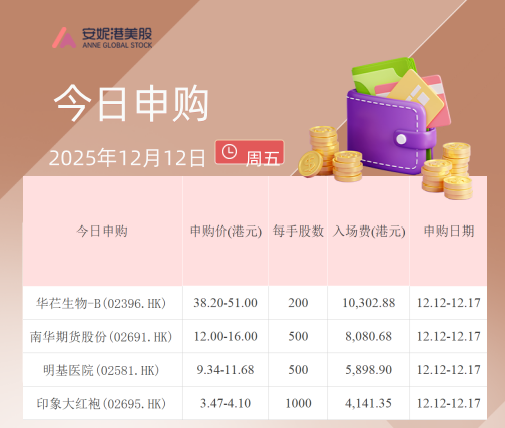
Group 1: Company Overview - Huaman Biotechnology Co., Ltd. - B is a biopharmaceutical company established in 2012, focusing on developing protein drugs for wound healing therapies [4] - Nanhua Futures Co., Ltd. is one of the first companies in China's futures industry, providing global financial services and ranked eighth among all futures companies in China by total revenue in 2024 [9] - Impression Dahongpao Co., Ltd. is a state-owned cultural tourism service enterprise based in Wuyishan, Fujian Province, with operations in performance services, cultural tourism town business, and tea hotel business [21] Group 2: IPO Details - Huaman Biotechnology plans to issue 17.6488 million H-shares with a price range of HKD 38.20-51.00, and the subscription period is from December 12 to December 17, 2025 [2] - Nanhua Futures plans to issue 108 million H-shares with a price range of HKD 12.00-16.00, and the subscription period is also from December 12 to December 17, 2025 [7] - Impression Dahongpao plans to issue 36.1 million H-shares with a price range of HKD 3.47-4.10, with the same subscription period [19] Group 3: Financial Performance - Huaman Biotechnology reported revenues of RMB 471,700 in 2023 and net losses of RMB 1.0519 billion, RMB 2.1225 billion, and RMB 1.6410 billion for the years 2023, 2024, and the nine months ending September 30, 2025, respectively [6] - Nanhua Futures reported revenues of RMB 954.41 million, RMB 1.29287 billion, and RMB 1.35484 billion for the years 2022, 2023, and 2024, with profits increasing from RMB 245.91 million in 2022 to RMB 402.82 million in 2023 [12] - Impression Dahongpao's revenues were approximately RMB 63.04 million, RMB 143.89 million, and RMB 137.20 million for the years 2022, 2023, and 2024, with net profits of RMB 47.50 million in 2023 [23]

聚焦服务实体与保护投资者 推动并购重组市场高质量发展
Zhong Guo Jing Ji Wang· 2025-12-09 08:21
Core Viewpoint - The central financial work meeting in October 2023 emphasizes the political and people-oriented nature of financial work, highlighting the importance of mergers and acquisitions (M&A) in optimizing resource allocation and supporting national strategies [1][2]. Group 1: Importance of Mergers and Acquisitions - M&A is recognized as a key measure to support the development of technology finance, enhance the quality of financial services, and promote high-quality economic development [1][3]. - The integration of resources through M&A is crucial for enhancing the overall strength and competitiveness of the national economy, thereby contributing to the well-being of the people and advancing common prosperity [2][3]. Group 2: Achievements and Benefits - M&A has effectively guided resources towards key areas of new productive forces, such as technology innovation, helping companies acquire critical technologies and improve production capabilities [3][4]. - The health of the M&A market has provided quality wealth management options for investors, with companies enhancing their profitability and dividend mechanisms through strategic acquisitions [4]. Group 3: Challenges in the M&A Market - The M&A market faces challenges such as market failures, where asset pricing may not adequately reflect market dynamics, leading to significant deviations from reasonable valuation ranges [5][6]. - Issues like insider trading, financial fraud, and conflicts of interest are prevalent, undermining market fairness and investor rights [7]. Group 4: Future Development and Recommendations - To promote healthy development in the M&A market, it is recommended to strengthen regulatory effectiveness, enhance policy support, and improve the protection of investor rights [8][9]. - Suggestions include optimizing approval processes, establishing a more diverse valuation method system, and enhancing financial support for key sectors [9][10].