
电动自行车

Search documents
多款新国标电动自行车集中亮相
Jing Ji Ri Bao· 2026-02-02 22:07
电动自行车新标准已全面实施,当前电动自行车市场情况如何?日前,中国自行车协会在北京举 行"2026新国标电动自行车宣传推广活动",17家行业领军企业携33款已获得CCC认证的新国标电动自行 车集中亮相。 记者在活动现场看到,颜色多样、款式新颖、功能各异的新国标电动自行车整齐排列,吸引了许多参观 者。工作人员表示,此次展出的新车型,覆盖雅迪、爱玛、小牛、台铃、九号等17家主流品牌,涵盖南 北主要产业集群,满足消费者多样化的市场需求。 小牛电动车相关负责人告诉记者,此次活动展出U1 One、K Citi两款车型。其中,U1 One已经上市两个 月,取得很好的市场反响;而K系列新国标车型采用长续航科技加持,并通过智能算法实时优化能耗, 让动态续航更精准。 安全是电动自行车行业不可逾越的底线,合规是电动自行车企业生存发展的根本前提。电动自行车新国 标在车辆防火阻燃、塑料占比、防篡改、制动性能等关键领域提出更严格的技术要求,在全面提升电动 自行车安全门槛的同时,充分满足人民群众日常生活需求,推动我国电动自行车产业正式迈入"全面合 规、安全为本、高质量发展"的新阶段。 "合规只是起点,赢得用户才是关键。行业必须从'有没有 ...
17家电动自行车品牌携33款新国标车型集中亮相
Zhong Guo Jing Ji Wang· 2026-02-01 05:42
多家企业表示,已全面完成产线升级,正加速扩大合规产品产能,主动引导消费者从追求极致性能转向 重视"安全与体验",切实履行企业主体责任。 中国自行车协会指出,协会正全力推动行业从"产能切换"迈向"品质跃升"。截至目前,协会31家重点会 员企业已获得748张电动自行车新国标CCC证书,新车型投放超165万辆,行业供给能力持续增强。 1月29日,由中国自行车协会主办的"2026新国标电动自行车宣传推广活动"在北京举行,活动以"新国标 新车型新消费"为主题,通过政策宣贯、产品展示、行业倡议与深度研讨,系统推动新版《电动自行车 安全技术规范》(GB17761—2024)落地见效。 活动现场,雅迪、爱玛、台铃、九号、小牛等17家行业领军企业携33款已获CCC认证的新国标电动自行 车集中亮相。据了解,这些车型严格遵循新国标限速、限重、防火阻燃等安全要求,同时在智能化、轻 量化、长续航、时尚设计、舒适性等方面实现突破,精准满足城市通勤、家庭接送、休闲骑行等多元场 景需求。 为强化行业自我约束,20家电动自行车骨干企业发布《抵制行业不合规行为的公约》,郑重承诺:坚持 诚信经营、严格遵守标准、拒绝非法改装、主动接受社会监督。 工 ...
青海省2025年消费品以旧换新被作为全国典型经验交流
Xin Lang Cai Jing· 2026-01-31 18:30
Core Insights - Qinghai Province is implementing a "trade-in" policy for consumer goods as a key measure to boost consumption, stabilize growth, and improve livelihoods, with significant support from the provincial government and the Ministry of Commerce [1] Group 1: Policy Implementation and Impact - The province has invested a total of 1.69 billion yuan in central and provincial funds, benefiting over 1.52 million people and stimulating consumption worth 19.7 billion yuan [1] - The policy has led to the purchase of 92,000 new vehicles, 496,000 home appliances, 615,000 digital products, 319,000 home and decoration items, and 4,000 electric bicycles [1] Group 2: Operational Framework - A comprehensive policy implementation system has been established, with a single department overseeing the entire process and a unified platform for managing subsidy applications and data [2] - A mechanism for regular reporting and analysis has been put in place to ensure effective policy execution and resource allocation [2] Group 3: Strategic Adjustments - The policy includes measures to stabilize expectations by temporarily pausing certain subsidies and adjusting the pace of fund consumption [2] - Efforts are being made to enhance market participation by encouraging retail companies and financial institutions to collaborate [2] - The frequency of subsidy distribution has been increased from weekly to daily to better support consumer demand [2]
李迅雷:如何提高“以旧换新”受益人口覆盖率 | 立方大家谈
Sou Hu Cai Jing· 2026-01-29 03:49
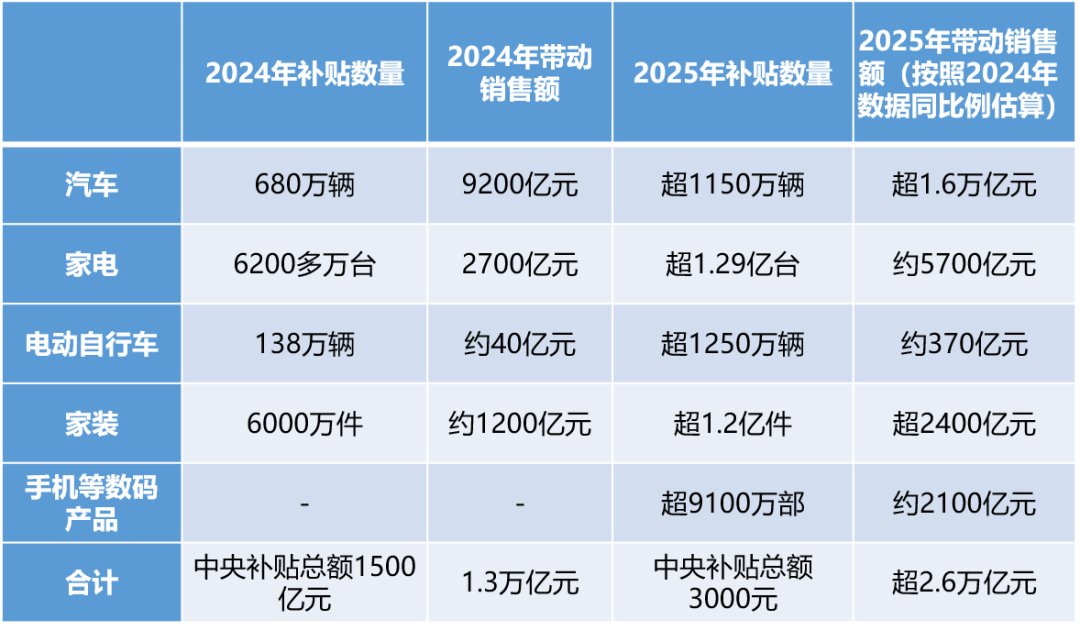
Core Viewpoint - The "old-for-new" policy for consumer goods, implemented from 2024 to 2025, is supported by a total of 450 billion yuan in long-term special government bond funding, aiming to stimulate consumer spending and boost retail sales, although its multiplier effect appears to be less than expected [1][2]. Group 1: Policy Implementation and Financial Support - The State Council issued measures in July 2024, allocating approximately 150 billion yuan in long-term special government bonds for the "old-for-new" policy, with an additional 300 billion yuan planned for 2025, expanding the range of eligible products from 8 to 12 categories [2]. - The estimated sales driven by the subsidies in 2024 and 2025 are projected to exceed 2.6 trillion yuan, with significant contributions from various sectors including automobiles and home appliances [3]. Group 2: Impact on Retail Sales - Retail sales growth for "old-for-new" related products showed an initial acceleration followed by a decline, with significant growth in categories like communication equipment and cultural office supplies, while automotive consumption lagged behind overall consumer spending [4][10]. - The first year after the policy implementation saw a 10% increase in sales for related categories, but the second year showed only a 2% increase, indicating a diminishing effect of the policy [7][10]. Group 3: Consumer Demographics and Coverage - The total number of beneficiaries from the "old-for-new" policy was only 480 million, with a notable drop to 80 million in the second half of 2025, suggesting limited reach among the broader population [25]. - The primary beneficiaries are higher-income groups, as the average price of eligible products, particularly automobiles, is high, limiting participation from lower-income consumers [25]. Group 4: Future Policy Adjustments - The 2026 policy adjustments include expanding the subsidy range to include smart glasses, standardizing subsidy amounts, and shifting from fixed to proportional subsidies for vehicle replacements, aiming to enhance fairness and effectiveness [24]. - To increase the coverage of the "old-for-new" policy, considerations include increasing funding, lowering average product prices, and focusing on job creation and income stability rather than solely on sales volume [26].

贵州:78亿元补贴撬动738亿元消费
Sou Hu Cai Jing· 2026-01-21 01:18
Core Insights - The Guizhou government plans to implement a "trade-in" program in 2025, utilizing a subsidy of 7.828 billion yuan to stimulate consumer spending of 73.82 billion yuan [1] Group 1: Automotive Sector - The program aims to scrap and update 66,300 vehicles, with a fiscal subsidy of 1.224 billion yuan, generating 9.284 billion yuan in new automotive consumption [1] - A total of 313,900 vehicles will be replaced, using 4.223 billion yuan in subsidies, leading to 50.41 billion yuan in new automotive consumption [1] Group 2: Home Appliances - The initiative includes the replacement of 2.2423 million home appliances, supported by 1.568 billion yuan in subsidies, resulting in 8.287 billion yuan in new home appliance consumption [1] Group 3: Home Goods - The program will facilitate the replacement of 133,700 home goods, with 182 million yuan in subsidies, generating 1.25 billion yuan in new home goods consumption [1] Group 4: Digital Products - The trade-in program will also cover 1.5334 million digital products, utilizing 557 million yuan in subsidies, leading to 4.382 billion yuan in new digital product consumption [1] Group 5: Electric Bicycles - The initiative includes the replacement of 81,100 electric bicycles, with a subsidy of 73.8636 million yuan, resulting in 207 million yuan in new electric bicycle consumption [1]
2026电动自行车首张“红牌”:严禁使用新能源汽车废旧电池
高工锂电· 2026-01-19 11:00
Core Viewpoint - The article highlights the increasing penetration of new energy vehicles and the impending large-scale retirement of power batteries, which poses significant safety risks due to the influx of retired batteries into the two-wheeler market [4]. Group 1: Regulatory Changes - The "Interim Measures for the Recycling and Comprehensive Utilization of Waste Power Batteries from New Energy Vehicles" will be implemented starting April 1, 2026, to regulate the use of retired power batteries [4]. - The new regulations prohibit any organization or individual from using retired power batteries directly or after processing in electric bicycles, moving away from the concept of "cascade utilization" [5]. Group 2: Industry Challenges - Retired power batteries have been flowing into illegal enterprises or "small workshops" for disassembly and reinstallation in electric bicycles, creating a gray area in the industry [6]. - Small workshops often acquire retired batteries from leading battery manufacturers, including B-grade products, to enhance product credibility and perform secondary modifications [7]. - In the two-wheeler market, while lithium batteries account for only 20% of the market, the proportion of cascade-utilized lithium batteries is as high as 40% [8]. Group 3: Market Dynamics - The lithium battery market in the price-sensitive two-wheeler sector is challenging to promote, as lithium batteries are typically 1.5 to 3 times more expensive than lead-acid batteries, leading some consumers to bypass legitimate channels for illegal modifications [9]. - The new national standard for electric bicycles requires "one vehicle, one battery, one charge, one code" to trace battery sources and clarify responsibility within the industry [9]. Group 4: Safety Concerns - The lack of standards for the quality, performance, and safety of retired power batteries re-entering the two-wheeler market poses significant safety risks [10]. - The ambiguity surrounding safety responsibility is heightened by the different usage scenarios of electric bicycles compared to new energy vehicles, with retired batteries often being used in unmonitored conditions [10]. - The new national standard strengthens anti-tampering designs, requiring users to replace batteries with those that match original factory parameters, such as voltage and battery type [10]. Group 5: Enforcement Actions - Several provinces have initiated comprehensive inspections of electric bicycles, batteries, and chargers, focusing on company qualifications, product quality certifications, illegal modifications, and the replacement of original components [11]. - The combination of industry self-regulation and strong national oversight is expected to effectively prevent the flow of retired batteries from new energy vehicles into the two-wheeler market [12].
立马车业加强自主研发提升智能化水平——用户体验没有上限
Xin Lang Cai Jing· 2026-01-16 23:10
Core Viewpoint - The company, Hebei Limama Vehicle Technology Co., Ltd., is experiencing growth in electric bicycle production and sales, driven by technological advancements and automation in manufacturing processes [1][2]. Group 1: Company Overview - Hebei Limama is located in Langfang City, Hebei Province, and integrates research, manufacturing, and sales of electric bicycles [1]. - From January to November 2025, the company sold over 660,000 units, generating more than 600 million yuan in revenue, reflecting a year-on-year increase of 6.7% [1]. Group 2: Technological Advancements - The company invests over 10 million yuan annually in R&D for new product development and iterations of existing products, holding more than 60 national patents [1]. - The production process is fully automated, with an automation rate exceeding 92%, and includes 17 production lines such as assembly, welding, and storage [1][2]. Group 3: Product Safety and Compliance - Following the introduction of the new national standard for electric bicycles, the company has upgraded its testing capabilities with six new devices to enhance product safety and stability [2]. - The company has addressed safety concerns by upgrading materials, such as converting magnesium and aluminum components to sheet metal, which reduces costs and improves yield rates [2]. Group 4: Product Development and Market Strategy - The company focuses on stylish and youthful product designs, with smart upgrades that include features like traction control and intelligent positioning [3]. - In 2026, the company plans to invest 12 million yuan in developing 16 new models of electric bicycles, 7 electric lightweight motorcycles, and 14 electric leisure tricycles, with the first products expected to launch in March [3].
昨夜,苹果官宣 iPhone 将搭载最强 AI!马斯克第一个跳出来骂;章泽天开通个人播客,一小时收听量破万;曝强脑科技秘密提交香港IPO申请
雷峰网· 2026-01-13 00:24
Group 1 - Apple announced that the next iPhone will feature advanced AI capabilities, developed in collaboration with Google, utilizing the Gemini model, which has 1.2 trillion parameters compared to Apple's current 150 billion parameters [4][5] - Following the announcement, both Apple and Google's stock prices rose, with Alphabet's market capitalization surpassing $4 trillion, indicating positive market sentiment towards the partnership [4] - Elon Musk criticized the collaboration, suggesting it represents an unreasonable concentration of power, especially given Google's existing dominance in the mobile and web sectors [5] Group 2 - Ctrip mistakenly sent out mass layoff notifications to employees, which was later clarified as a system error related to the shutdown of an internal communication tool [7][8] - The incident sparked significant online discussion, with employees expressing confusion and concern over the implications of the erroneous message [7][8] Group 3 - Zhang Zetian launched a personal podcast that quickly gained over 10,000 listens in its first hour, indicating strong initial interest [10][11] - The podcast aims to provide a more authentic connection with listeners, featuring notable guests like Liu Jialing [10][11] Group 4 - Strong Brain Technology has reportedly submitted a confidential IPO application in Hong Kong, potentially becoming the first of the "Hangzhou Six" tech companies to go public [13][14] - The company specializes in brain-computer interface technology and aims to raise several hundred million dollars to accelerate its research and product development [13][14] Group 5 - ByteDance, Meituan, and Alibaba have collectively invested in a robotics company, which recently completed a 1 billion yuan A++ funding round, highlighting the competitive landscape in the AI and robotics sectors [20] - The investment reflects a growing interest in embodied intelligence and the importance of data and model evolution in this field [20] Group 6 - Aima Electric reportedly laid off over 50% of its staff in certain departments, with affected employees receiving only one month of severance pay, leading to legal disputes [21][22] - The company denied the extent of the layoffs, claiming that annual personnel adjustments are a normal part of their operations [21][22] Group 7 - Xpeng Aeroht, a subsidiary of Xpeng Motors focused on flying cars, has secretly submitted an IPO application in Hong Kong, with plans to launch as early as this year [23][24] - The company aims to capitalize on the emerging low-altitude economy and has made significant progress in its production capabilities [23][24] Group 8 - The semiconductor company OmniVision has successfully listed on the Hong Kong Stock Exchange, achieving a market capitalization exceeding 137 billion HKD, marking a significant milestone for the company [35] - OmniVision's revenue for the first three quarters of 2025 reached 21.783 billion yuan, with a net profit of 3.210 billion yuan, reflecting strong growth in the semiconductor market [35]




新国标落地 中国自行车协会呼吁企业加快转型抢占先机
Zhong Guo Chan Ye Jing Ji Xin Xi Wang· 2026-01-12 01:10
Core Viewpoint - The electric bicycle industry is facing challenges due to the implementation of the new national standard (GB 17761-2024) and seasonal market fluctuations, but there are opportunities for growth through innovation and market expansion [1][2][3] Group 1: Market Demand and Consumer Behavior - Winter is traditionally a slow season for electric bicycle sales, leading to a decrease in market demand [1] - Consumer interest in new standard models is increasing, with new products being stocked in major sales outlets and attracting consumer inquiries [1] Group 2: Industry Challenges - The industry faces four main challenges: 1. Long and costly mold development cycles for magnesium-aluminum alloy die-casting parts, affecting production efficiency and cost control [2] 2. Rising material costs due to the new standard requiring some plastic parts to be replaced with metal, along with the addition of new components like BeiDou positioning systems [2] 3. Challenges in applying new composite materials, such as carbon fiber, which require careful balancing of plastic components for safety and practicality [2] 4. Seasonal market fluctuations, particularly during winter, which impact sales growth of new standard products [2] Group 3: Recommendations for Industry Improvement - Companies are encouraged to recognize the importance of stable production and supply under the new standards, increase the launch of new products, and ensure market supply [3] - To address mold development issues, companies should optimize design plans and improve the use ratio of magnesium-aluminum parts, sheet metal, and plastics [3] - There is a need for increased research and testing in new technologies and materials to overcome production difficulties related to the new standard [3] - The industry should seek policy support and enhance collaboration between upstream and downstream sectors to resolve supply chain bottlenecks [3] - The promotion of eco-friendly transportation and urbanization presents broader market opportunities for the electric bicycle industry [3]
沈阳打响食品药品等民生领域打假治劣攻坚战
Xin Lang Cai Jing· 2026-01-11 21:22
Core Viewpoint - The city of Shenyang has launched a special rectification action titled "Clearing Sources, Cracking Down on Counterfeits, and Safeguarding Consumer Confidence" to combat counterfeit and substandard products in key livelihood sectors, particularly during peak consumption periods like the Spring Festival and Lantern Festival [1][2] Group 1: Special Action Overview - The special action focuses on addressing public concerns and social issues related to counterfeit and substandard food, pharmaceuticals, and other essential products such as gas appliances, children's toys, electric bicycles, and fireworks [1] - The initiative aims to ensure consumer safety and promote fair market competition, allowing citizens to consume with confidence [1] Group 2: Collaborative Approach - The action will break down departmental barriers and enhance collaboration among various agencies, including market regulation, public security, judicial, and prosecutorial departments, to ensure a seamless connection between administrative enforcement and criminal justice [2] - A comprehensive governance system will be established, focusing on source governance, process control, and post-event handling to leave no room for lawbreakers [2] Group 3: Regulatory Principles - The initiative emphasizes a balance between strict enforcement and protective measures for the public, adhering to the principle of "people first" [2] - It promotes a tolerant and prudent regulatory approach for minor violations while ensuring severe penalties for malicious illegal activities that harm public welfare [2] - The action also aims to standardize law enforcement practices to avoid interference with legitimate business operations, ensuring a conducive environment for lawful enterprises [2]