虚拟货币

Search documents
研究 | 破与立:中国虚拟货币监管的制度重构与法律前瞻
Sou Hu Cai Jing· 2026-02-10 02:22
Core Viewpoint - The issuance of Document No. 42 marks a significant shift in China's regulatory approach to virtual currencies, transitioning from fragmented responses to a systematic reconstruction of regulations, including the inclusion of stablecoins and RWA (Real World Asset tokenization) under regulatory oversight [2][3]. Regulatory Policy Evolution - The evolution of China's virtual currency regulation can be categorized into four distinct phases: 1. **2013**: Initial classification of Bitcoin as a "specific virtual commodity" with a cautious observation approach [4]. 2. **2017**: Introduction of the ICO ban and the requirement for existing ICO projects to arrange for refunds, marking a shift to strict limitations [5]. 3. **2021**: Comprehensive crackdown on all virtual currency-related activities, defining them as "illegal financial activities" [6]. 4. **2026**: Systematic reconstruction with Document No. 42, expanding regulatory scope to include stablecoins and RWA, and enhancing legal frameworks [7]. Innovations in Document No. 42 - Document No. 42 introduces three major innovations: 1. **Stablecoins**: Clearly defined and regulated, with restrictions on issuing stablecoins linked to the Renminbi without approval, emphasizing currency sovereignty [8][9]. 2. **RWA**: Introduced under a "principle of prohibition, with exceptions upon approval" framework, allowing for regulated activities under specific conditions [10]. 3. **Overseas Operations Control**: Extends regulatory oversight to the global activities of domestic entities, marking a shift from domestic to global regulatory logic [11]. Legal Responsibilities - The addition of a dedicated chapter on legal responsibilities in Document No. 42 establishes clear administrative and criminal liabilities for violations, addressing previous gaps in enforcement [12]. Legal Classification Dimensions - The legal classification of virtual currencies in China is complex, involving civil, administrative, criminal, and foreign exchange control dimensions: 1. **Civil Aspect**: The recognition of virtual currencies as property has evolved, but contract validity remains contentious [14][15]. 2. **Administrative Aspect**: Strengthened regulatory defenses against financial institutions and enhanced information control measures [16]. 3. **Criminal Aspect**: Expansion of criminal charges related to virtual currencies, including fraud and money laundering [17][18]. 4. **Foreign Exchange Control**: Concerns over the use of virtual currencies like USDT for circumventing foreign exchange regulations [19]. Judicial Practice Developments - Recent trends in judicial practice indicate a move towards nuanced rulings in virtual currency disputes, reflecting a shift from blanket prohibitions to more refined adjudications [20][21]. - The judicial system is exploring practical solutions for the disposal of seized virtual currencies, indicating a willingness to adapt within the regulatory framework [22]. International Comparison - China's regulatory approach contrasts with global paradigms, highlighting a unique stance characterized by comprehensive prohibitions while observing developments in regions like Hong Kong and Singapore [24][25]. - The regulatory landscape in Hong Kong, with its dual-track system, provides a potential model for balancing innovation and regulation in mainland China [26]. Future Trends - The implementation of supporting regulations for Document No. 42, the specific pathways for RWA registration, and the progression of dedicated virtual currency legislation are anticipated areas of focus [27].

果然财经|疯狂虚拟币:有人投入36万元,亏到只剩360元
Sou Hu Cai Jing· 2026-02-09 10:47
Core Insights - The virtual currency market is experiencing a significant value collapse, with Bitcoin dropping below $70,000 for the first time since November 2024, leading to a total market capitalization decline from $4.19 trillion in October 2025 to $2.39 trillion, a nearly 43% decrease [1][3] Regulatory Actions - On February 6, 2026, eight Chinese regulatory bodies, including the People's Bank of China, issued a notice to further prevent and address risks associated with virtual currencies, declaring that related business activities within the country are illegal and emphasizing the ongoing crackdown on mining and trading activities [3][10] Investor Experiences - Investor experiences highlight the risks of the virtual currency market. One investor, Mr. Li, initially invested 360,000 yuan but saw his assets shrink to just 360 yuan, losing 99% of his investment due to a lack of understanding of market dynamics and trading rules [4][6] - Another investor, Mr. Yue, entered the market during a speculative frenzy, initially making small profits but ultimately lost money on new coin investments and decided to exit the market entirely [7][10] - Mr. Du, who engaged in mining rather than trading, invested over 30,000 yuan in mining equipment but ended up with losses close to 20,000 yuan, as the costs of electricity and equipment depreciation outweighed his earnings from mined coins [9][10] Market Characteristics - The virtual currency market is characterized by high volatility and a lack of regulatory oversight, with many coins lacking intrinsic value. Most cryptocurrencies are seen as tools for capital manipulation, where price movements can be easily influenced by market sentiment [9][10]
境内严禁,境外严管,设备数据可能正在"踩线"?42号文给AIoT企业3个合规警示
3 6 Ke· 2026-02-09 10:42
Core Viewpoint - The recent regulatory documents from Chinese authorities signify a shift in the approach to digital asset regulation, moving from strict prohibition to a framework that allows for compliance and controlled utilization of tokenization of real-world assets (RWA) [1][15]. Regulatory Framework - The primary focus of the regulatory documents is on virtual currencies and RWA activities, explicitly prohibiting the tokenization of real-world assets within China and related services, which are deemed illegal financial activities [2][7]. - The documents establish a differentiated regulatory approach, allowing RWA activities under specific conditions while maintaining strict prohibitions on virtual currency operations [3][10]. Definition and Scope - RWA tokenization is defined as the use of cryptographic technology and distributed ledger to convert ownership and rights into tokens for issuance and trading [5]. - The distinction between asset digitization and tokenization is crucial, as the former does not fall under the regulatory scope, while the latter does [4][5]. Compliance Obligations - The regulations impose specific compliance obligations on various market participants, including financial institutions and technology service providers, to ensure that they do not engage in unauthorized RWA activities [9][11]. - For compliant cross-border RWA activities, technology service providers must adhere to legal frameworks, enhance risk management, and report their activities to relevant authorities [11]. Data Security and Cross-Border Concerns - The documents emphasize the importance of data security and the risks associated with cross-border data flows, particularly when domestic asset data is used in foreign financial contexts [12][13]. - Companies must ensure the legality of data transfers and classify data appropriately, especially when it pertains to sensitive information related to asset tokenization [13][14]. Implications for AIoT Companies - AIoT companies must recognize the potential implications of their data usage, especially if their outputs are utilized in RWA activities, as this could subject them to regulatory scrutiny [6][14]. - The regulatory framework necessitates that AIoT firms proactively clarify their data usage and ensure compliance with the new obligations set forth in the regulatory documents [15].
虚拟货币再迎监管新规 从严监管态度明确
Jin Rong Shi Bao· 2026-02-09 02:00
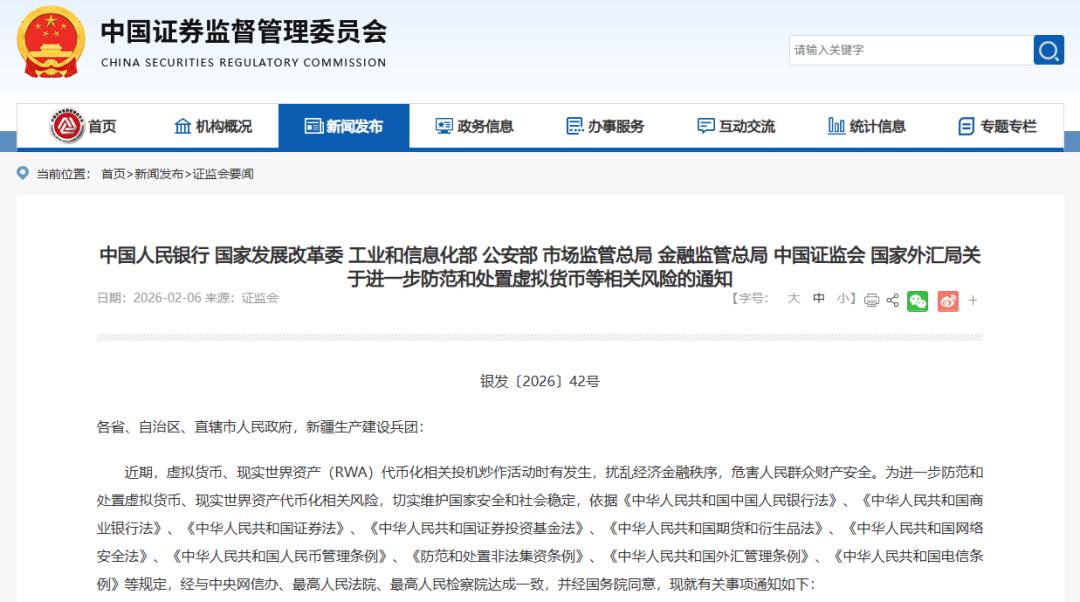
围绕虚拟货币,监管再出新规。 2月6日,中国人民银行、国家发展改革委、工业和信息化部、公安部、市场监管总局、金融监管总局、 中国证监会、国家外汇局联合印发《关于进一步防范和处置虚拟货币等相关风险的通知》(以下简称 《通知》)。 《通知》共分为六部分19条。一是明确虚拟货币、现实世界资产(RWA)和相关业务活动的本质属性;二 是健全工作机制,形成央地协同、条块结合的工作格局;三是明确强化风险监测、防范与处置相关要 求,包括风险监测、中介机构监管、互联网信息内容管理、经营主体登记和广告管理、整治虚拟货 币"挖矿"、打击相关违法犯罪活动、行业自律管理等;四是从严监管境内主体及其控制的境外主体在境 外开展虚拟货币、RWA业务;五是强化组织实施,主要包括组织领导、宣传教育等;六是法律责任。 2025年12月,中国互联网金融协会等7个协会联合发布《关于防范涉虚拟货币等非法活动的风险提 示》,进一步明确虚拟货币、RWA相关业务活动属于非法金融活动,向社会公众提示风险。 业内人士分析认为,虚拟货币依托区块链技术,支持点对点交易,突破物理上的国境概念,相关风险极 易跨境传导。为切实防范风险,《通知》明确提出,未经相关部门依法依 ...
八部门进一步防范和处置风险 重申境内对虚拟货币禁止性政策
Chang Jiang Shang Bao· 2026-02-09 01:55
长江商报消息 ●长江商报记者 徐靓丽 近日,中国人民银行、国家发展改革委、工业和信息化部、公安部、市场监管总局、金融监管总局、中 国证监会、国家外汇局等八部门联合发布《关于进一步防范和处置虚拟货币等相关风险的通知》(下称 《通知》),进一步完善对虚拟货币相关监管要求,重申境内对虚拟货币坚持禁止性政策,再度明确虚 拟货币相关业务活动属于非法金融活动,并强调在境内开展现实世界资产(RWA)代币化活动以及提 供有关中介、信息技术服务等,涉嫌非法发售代币票券、擅自公开发行证券、非法经营证券期货业务、 非法集资等非法金融活动,应予以禁止。 完善对虚拟货币相关监管要求 刷短视频弹出"投资稳定币保本保息"的诱人广告,亲友群里转发"海外理财捷径"……近年来虚拟货币等 炒作交易活动不断更新套路。 《通知》首次对RWA代币化给出明确定义:使用加密技术及分布式账本或类似技术,将资产的所有 权、收益权等转化为代币(通证)或者具有代币(通证)特性的其他权益、债券凭证,并进行发行和交 易的活动。而实际上,境内没有能对RWA进行资产合法合规登记确权的机构,也没有可供资产"上 链"交易的金融基础设施,交易的安全性和可靠性无从保障。 《通知》 ...
虚拟货币相关业务,境内一律禁止
Ren Min Ri Bao· 2026-02-08 19:17
据介绍,虚拟货币现阶段无法有效满足客户身份识别、反洗钱等方面的要求,存在被用于洗钱、集资诈 骗、违规跨境转移资金等非法活动的风险。《通知》明确,境内对虚拟货币坚持禁止性政策,相关业务 活动属于非法金融活动,一律严格禁止,坚决依法取缔。 虚拟货币依托区块链技术,支持点对点交易,突破了物理上的"国境"概念,相关风险极易跨境传导,国 际金融组织和中央银行等金融管理部门对此普遍持审慎态度。为切实防范风险,《通知》明确提出,未 经相关部门依法依规同意,境内主体及其控制的境外主体不得在境外发行虚拟货币。 本报北京2月8日电(记者徐佩玉)近日,中国人民银行、国家发展改革委、工业和信息化部、公安部、市 场监管总局、金融监管总局、中国证监会、国家外汇局等八部门联合发布《关于进一步防范和处置虚拟 货币等相关风险的通知》(以下简称《通知》),明确虚拟货币相关业务活动属于非法金融活动,境内一 律严格禁止。 中国人民银行、中国证监会有关负责人表示,长期以来,中国境内始终对虚拟货币相关业务活动保持禁 止性的政策立场。2013年,中国人民银行等五部门联合印发《关于防范比特币风险的通知》,明确比特 币是一种特定的虚拟商品,不能且不应作为货币 ...
严格禁止境内虚拟货币兑换交易等业务
Xin Lang Cai Jing· 2026-02-08 18:30
中国人民银行、国家发展改革委、工业和信息化部、公安部、市场监管总局、金融监管总局、中国证监 会、国家外汇局等八部门近日联合发布《关于进一步防范和处置虚拟货币等相关风险的通知》(以下简 称《通知》)。日前,中国人民银行、中国证监会有关负责人就《通知》相关问题回答了记者提问。 结合新的风险特征发布此《通知》 当有记者问《通知》的出台背景时,两部门相关负责人回答说,2021年,虚拟货币交易炒作活动盛行, 严重扰乱经济金融秩序,危害人民群众财产安全。按照党中央、国务院决策部署,中国人民银行联合有 关部门发布《关于进一步防范和处置虚拟货币交易炒作风险的通知》,坚决打击相关炒作行为,整顿行 业乱象,取得明显成效。 近期,受多种因素影响,虚拟货币交易炒作死灰复燃,现实世界资产代币化相关投机活动也时有发生, 风险防控面临新形势、新挑战。为进一步完善监管政策体系,防范化解相关风险,切实维护国家安全和 社会稳定,八部门会同中央网信办、最高人民法院、最高人民检察院,在总结前期工作经验的基础上, 结合新的风险特征,对原文件进行修订完善,形成了本次发布的《通知》。 首次明确"现实世界资产代币化"定义 记者问《通知》对虚拟货币、现实世界 ...
史上最严虚拟货币禁令
Bei Jing Shang Bao· 2026-02-08 15:57
Core Viewpoint - The recent regulatory upgrade in China regarding virtual currencies is described as the most stringent ever, aiming to completely block domestic virtual currency activities and extend control to overseas issuance, particularly concerning stablecoins linked to the Renminbi [1][3][4]. Regulatory Overview - The joint notice issued by eight departments, including the People's Bank of China and the China Securities Regulatory Commission, reiterates that virtual currency-related activities are illegal financial activities and strictly prohibited [3][4]. - The notice emphasizes that no domestic entity or individual is allowed to issue Renminbi-linked stablecoins abroad without proper authorization [4][5]. Impact on the Industry - The new regulations are expected to have a comprehensive impact on the virtual currency industry chain, particularly affecting the issuance and circulation of stablecoins [5][6]. - The notice aims to cut off the overseas issuance channels for domestic entities, thereby preventing the illegal issuance and circulation of tokens [5][6]. Mining Regulations - The notice also targets virtual currency mining, mandating strict control and prohibition of new mining projects, while requiring local governments to shut down existing operations [7][9]. - Mining activities are criticized for their high energy consumption and potential to facilitate illegal activities, including money laundering [9]. RWA Tokenization - The notice introduces clear boundaries for the tokenization of Real World Assets (RWA), prohibiting illegal issuance and trading while allowing for compliance under specific conditions [10][11]. - The China Securities Regulatory Commission has issued guidelines requiring domestic entities to file for approval before issuing asset-backed securities tokens abroad, thus creating a pathway for compliant operations [11][12]. Market Reactions - Following the announcement, the cryptocurrency market experienced volatility, with Bitcoin prices fluctuating and significant liquidation events occurring [4][12]. - Analysts predict a deep freeze in the domestic virtual currency market, with a clear shift towards compliance and a reduction in decentralized financial activities [16].
中央一号文件出台——政策周观察第67期
一瑜中的· 2026-02-08 15:02
Core Viewpoint - The article emphasizes the Chinese government's focus on effective investment and economic stability as it enters the "14th Five-Year Plan" period, highlighting the importance of practical planning and execution in various sectors [2][9]. Group 1: Government Initiatives - On February 2, the Premier emphasized the need for local governments to create the "14th Five-Year Plan" with a focus on practicality and system integration, advocating for concise and effective planning at the grassroots level [2]. - On February 6, the State Council held a meeting to discuss policies for promoting effective investment, stressing the importance of planning in infrastructure, urban renewal, and emerging industries [9]. - The Premier highlighted the need for macroeconomic policies to be proactive, ensuring timely allocation of fiscal funds and coordination in project construction to achieve annual targets [10]. Group 2: Agricultural Policies - On February 3, the Central Committee issued a document focusing on agricultural modernization and rural revitalization, including a new round of grain production enhancement actions and the integration of AI in agriculture [3][12]. - The implementation opinions from the Ministry of Agriculture emphasized the need for comprehensive management of pig production and the promotion of high-standard farmland construction [14]. Group 3: Financial Regulations - On February 6, the central bank and eight departments issued a notice to further prevent and manage risks related to virtual currencies, reinforcing a strict prohibition on domestic virtual currency activities [4][13]. - The notice also outlined regulations for domestic entities engaging in overseas virtual currency activities, emphasizing the need for strict compliance with regulatory requirements [13].

人民币稳定币境外发行被禁
第一财经· 2026-02-08 12:45
2026.02. 08 本文字数:2970,阅读时长大约5分钟 作者 | 第一财经 杜川 与此同时,证监会同步发布具有实操意义的附件《关于境内资产境外发行资产支持证券代币的监管指 引》(下称《指引》),首次正面定义现实世界资产(RWA)代币化,并确立"境内严禁、境外严 管"的监管原则。 八部门协同发力联合绞杀非法金融活动,由此形成了对虚拟货币全链条的严格管控。 人民币稳定币境外发行被禁 2025年以来,稳定币市场热度持续攀升的同时,风险防控与合规边界也为各方所关注。伴随《稳定 币条例》在香港落地生效,香港稳定币发行人牌照发放进程备受市场瞩目。在牌照申请热潮中,部分 内地科技巨头的布局与走向成为焦点。此前,相关机构曾参与香港稳定币测试与筹备,一度被视为首 批牌照的热门候选。 此次《通知》在重申虚拟货币相关活动属于非法金融活动的基础上,首次以规范性文件形式明确核心 监管要求:挂钩法定货币的稳定币在流通中变相履行法定货币部分功能,未经相关部门依法同意,境 内外任何单位和个人不得在境外发行挂钩人民币的稳定币;同时严格规范境内主体境外展业行为,境 内主体及其控制的境外主体未经批准不得在境外发行虚拟货币。 "这会直接掐断 ...