
财政税收

Search documents
云南推新一轮财税改革:构建大财政体系,强化债务管控
Di Yi Cai Jing· 2025-08-22 06:15
Core Viewpoint - Yunnan Province aims to address fiscal imbalances, debt issues, and risks related to basic livelihood guarantees through comprehensive fiscal and tax reforms by 2028, focusing on stabilizing local finances and optimizing revenue and expenditure structures [1][6]. Fiscal Health - The government plans to enhance revenue by improving income collection, tapping into state-owned resources, and increasing contributions from state-owned enterprises [1][2]. - A comprehensive inventory of state-owned resources will be conducted to manage assets effectively and mobilize financial resources [2][4]. Debt Management - The province faces significant debt repayment pressures, with a focus on preventing new hidden debts and managing existing liabilities through dual control mechanisms for state-owned enterprise debt [5][6]. - As of the end of 2024, the local government debt is projected to be 16,319.2 billion, well within the limit of 18,552.4 billion [6]. Development Finance - The reforms emphasize promoting economic development as a solution to fiscal challenges, with incentives for local governments based on their contributions to fiscal revenue and high-quality development [7][10]. - A structured approach to industry funding will be established, including a three-tiered fund system to support industrial growth [7]. Social Welfare Finance - The government aims to enhance basic livelihood funding while ensuring fiscal sustainability by avoiding excessive commitments and over-coverage [9][10]. - A differentiated support system will be implemented for border and ethnic regions to address regional disparities [9]. Efficiency and Governance - The reforms will include zero-based budgeting and improved performance management to enhance fiscal governance and efficiency [9][10]. - The overall strategy aims for a coordinated approach to fiscal health, risk management, social welfare, and governance effectiveness [10].

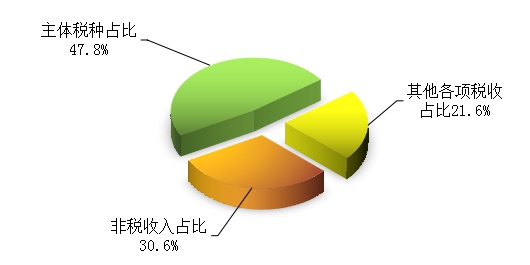
7月财政数据的四大特征
Sou Hu Cai Jing· 2025-08-22 03:28
Core Insights - The general public budget revenue has shown significant recovery, with a year-on-year growth of 0.1% from January to July, marking the first positive growth this year, indicating economic resilience [2][4][14] - The land market remains sluggish, with government fund budget revenue growth weak, reflecting ongoing challenges in the real estate sector [2][8] - Fiscal expenditure has ramped up, with a broad fiscal expenditure growth rate of 9.3%, the highest level in recent years, driven primarily by central government spending [3][10][14] - The structure of fiscal expenditure is optimizing, with a focus on social welfare and education, alongside new policies aimed at supporting families and boosting consumption [3][12] Revenue Analysis - From January to July, the general public budget revenue growth rate turned positive for the first time this year, with July showing a 2.6% increase, the highest monthly growth rate [2][4] - Tax revenue recovery is a key driver, with personal income tax, domestic VAT, and domestic consumption tax showing year-on-year growth rates of 8.8%, 3.0%, and 2.1% respectively [6][8] Land Market Insights - The government fund budget revenue saw a year-on-year decline of 0.7% from January to July, with July's growth rate slowing significantly to 8.9% [2][8] - Real estate investment continues to decline, with a 12% year-on-year drop in property development investment from January to July [8][10] Expenditure Insights - Broad fiscal expenditure growth reached 9.3%, significantly higher than the previous year's decline of 2.0%, with central government expenditure growing by 33.9% [3][10] - The issuance of government bonds is at a rapid pace, with a total of 9.11 trillion yuan issued from January to July, a 33.8% increase year-on-year [10][12] Policy and Structural Changes - Recent fiscal policies have focused on social welfare, with expenditures in social security, education, and health exceeding 6 trillion yuan, reflecting a commitment to improving living standards [12][14] - New initiatives such as childcare subsidies and free preschool education have been introduced to stimulate consumption and support families [12][14]
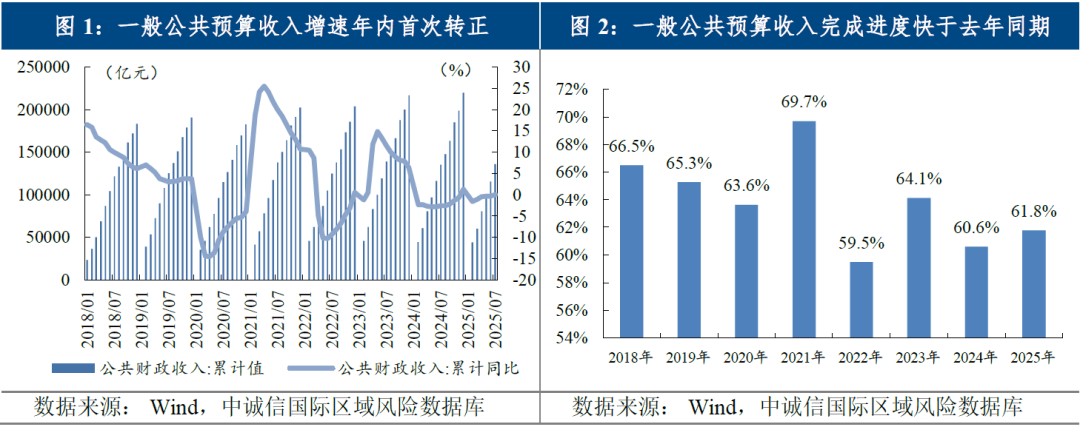
财政部:前7月全国一般公共预算收入年内首次转正
Huan Qiu Wang· 2025-08-20 01:17
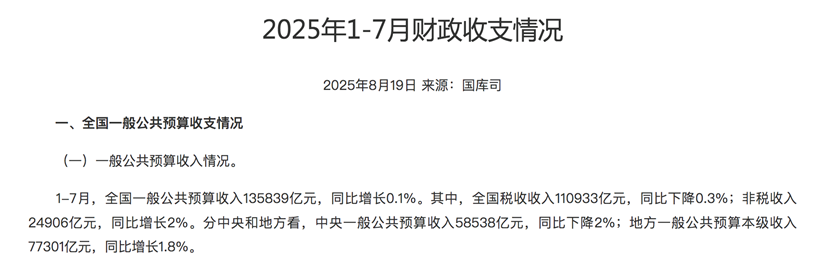
Group 1 - The core viewpoint of the articles indicates that China's general public budget revenue has achieved positive growth for the first time this year, with a total revenue of 135839 billion yuan in the first seven months, reflecting a year-on-year increase of 0.1% [1] - In July, the national general public budget revenue reached 20273 billion yuan, marking a year-on-year growth of 2.6%, with the highest monthly growth rates recorded for both central and local revenues at 2.2% and 3.1% respectively [4] - Tax revenue growth accelerated in July, with a 5% increase, driven by factors such as price improvements, enhanced personal income tax management, and a rising stock market [4] Group 2 - Total public budget expenditure for the first seven months was 160737 billion yuan, showing a year-on-year increase of 3.4%, with significant growth in social security and employment expenditures at 9.8% [5] - Government fund budget revenue for the first seven months was 23124 billion yuan, a decrease of 0.7%, with land use rights transfer income declining by 4.6% [5] - Despite a cooling land market, major cities like first-tier and core second-tier cities showed high activity levels, supporting land transfer income growth [5]
中央财政首发养老消费补贴,价格法时隔27年重修丨一周热点回顾
Di Yi Cai Jing· 2025-07-26 02:37
Group 1: Hainan Free Trade Port - Hainan Free Trade Port is set to officially start operations on December 18, 2025, establishing a customs supervision area with a policy of "one line open, one line controlled, and free flow within the island" [2][3] - The "zero tariff" system for imported goods has been established, allowing eligible enterprises registered in Hainan to import goods without tax under certain conditions [3] - The implementation of the zero tariff policy is expected to lower production costs for market entities and enhance the level of trade liberalization and facilitation in Hainan [3] Group 2: Pension Service Subsidies - The central government has initiated a nationwide pension service consumption subsidy for elderly individuals with moderate to severe disabilities, covering various types of care services [4][5] - Eligible elderly individuals can receive monthly subsidies of 800 yuan for institutional care and 500 yuan for home care services, with a discount of 30% to 60% on service costs [4][5] Group 3: Fiscal Revenue and Expenditure - In the first half of the year, national public budget revenue decreased by 0.3%, while public budget expenditure increased by 3.4%, indicating a more proactive fiscal policy [6][7] - Tax revenue fell by 1.2%, but the decline is narrowing, reflecting a stabilizing economy, with 27 provinces reporting revenue growth [7] Group 4: Price Law Revision - The first revision of the Price Law in 27 years aims to enhance government pricing regulations and address unfair pricing behaviors, including low-price dumping and price collusion [8][9] - The revised law will strengthen market regulation and support fair competition, particularly in the context of new economic models and the current international environment [9] Group 5: Commodity Market Trends - Recent trends in the commodity futures market show significant price increases, with major contracts for glass, soda ash, coking coal, and silicon reaching their daily price limits [10][11] - The price surge is driven by supply-side factors and expectations of increased demand due to fiscal policy initiatives and infrastructure projects [11] Group 6: US Trade Agreements - The US has reached trade agreements with Japan, the Philippines, and Indonesia, with Japan committing to invest $550 billion and open its markets to US goods [12] - The agreements may set a precedent for future trade negotiations, particularly with the EU, which is also in discussions with the US regarding tariff frameworks [12] Group 7: Federal Reserve and Monetary Policy - Tensions between President Trump and Federal Reserve Chairman Powell have escalated, with Trump criticizing Powell's monetary policy decisions [13] - The ongoing conflict raises concerns about the independence of the Federal Reserve and potential implications for inflation and long-term interest rates [13]
★前5个月财政支出超11万亿元 重点领域得到较好保障
Shang Hai Zheng Quan Bao· 2025-07-03 01:55
Group 1: Public Budget Revenue and Expenditure - In the first five months of the year, the national general public budget revenue reached 96,623 billion yuan, a year-on-year decrease of 0.3%, with the decline narrowing by 0.1 percentage points compared to the first four months [1] - National general public budget expenditure increased to 112,953 billion yuan, showing a year-on-year growth of 4.2% [1] - Tax revenue, which is a key component of public budget revenue, totaled 79,156 billion yuan, reflecting a year-on-year decline of 1.6%, with the decline narrowing by 0.5 percentage points compared to the previous four months [1] Group 2: Tax Revenue Performance - Domestic value-added tax, domestic consumption tax, and individual income tax all experienced year-on-year growth in the first five months [1] - The equipment manufacturing sector showed strong tax revenue growth, with railway, shipbuilding, and aerospace equipment manufacturing tax revenue increasing by 28.8%, and computer and communication equipment manufacturing tax revenue rising by 11.9% [1] - The cultural, sports, and entertainment industry saw a tax revenue increase of 7.8%, driven by the expansion of the old-for-new consumption policy and the release of cultural tourism demand [1] Group 3: Non-Tax Revenue and Expenditure Structure - Non-tax revenue for the first five months was 17,467 billion yuan, marking a year-on-year increase of 6.2%, primarily driven by asset revitalization [2] - Social security and employment expenditure reached 20,054 billion yuan, growing by 9.2% year-on-year, while education expenditure was 17,455 billion yuan, up by 6.7% [2] - Government fund budget expenditure totaled 32,125 billion yuan, reflecting a significant year-on-year growth of 16% [2]
日本:考虑取消外国游客购物免税制 提高游客税
财联社· 2025-06-10 09:26
Core Viewpoint - The Japanese government is considering the cancellation of the tax exemption for foreign tourists and the introduction of a "departure tax" for them, in response to rising domestic prices and the abuse of the tax exemption system by tourists [1] Group 1: Government Strategy - The Japanese government is promoting a tourism strategy aimed at increasing foreign tourist numbers to 60 million by 2030 [1] - The backdrop of the yen's depreciation has led to a sustained increase in foreign tourist visits to Japan [1] Group 2: Economic Context - Domestic prices in Japan are continuously rising, prompting the government to explore tax reforms targeting foreign tourists [1] - The government aims to enhance national revenue without increasing the tax burden on Japanese citizens [1]

中央收入、税收收入4月实现正增长
Ren Min Ri Bao· 2025-05-20 22:02
Group 1 - The national fiscal revenue for January to April reached 80,616 billion yuan, a year-on-year decrease of 0.4%, with the decline narrowing by 0.7 percentage points compared to the first quarter [1] - National fiscal expenditure for the same period was 93,581 billion yuan, an increase of 4.6% year-on-year, achieving the fastest expenditure progress for the same period since 2020, completing 31.5% of the budget [1] - Central fiscal revenue decreased by 3.8% year-on-year, but April saw a growth of 1.6%, marking the first positive growth this year [1] Group 2 - Tax revenue for January to April was 65,556 billion yuan, down 2.1% year-on-year, with the decline narrowing by 1.4 percentage points compared to the first quarter; April saw a year-on-year growth of 1.9% [1] - Key sectors such as railway, shipping, and aerospace manufacturing saw tax revenue growth of 33.2%, while computer and communication equipment manufacturing grew by 6.8% [1] - Social security and employment expenditure, education expenditure, and health expenditure grew by 8.5%, 7.4%, and 3.9% respectively [2]

3月财政数据点评:收入降幅收窄,支出持续提高
LIANCHU SECURITIES· 2025-04-22 08:44
Revenue Insights - The fiscal revenue growth rate for the first quarter of 2025 is -1.1%, showing an improvement from the previous decline, primarily due to the accelerated recovery of the economic fundamentals[3] - Total public budget revenue reached 6.02 trillion yuan, with a completion rate of 27.4%, indicating a neutral to fast performance over five years[11] - Tax revenue growth rate is -3.5%, but the decline has narrowed, while non-tax revenue growth is 8.8%, showing a decrease from previous values[15] Expenditure Insights - Public budget expenditure growth rate for the first quarter is 4.2%, an increase of 0.8 percentage points from the previous value, with a completion rate of 24.52%[4] - Central government expenditure growth is at 8.9%, while local government expenditure growth is 3.6%, indicating a significant focus on central spending[4] - Social security and employment expenditure growth reached 7.9%, while infrastructure spending remains low, indicating a need for increased investment in this area[48] Fund Revenue and Debt Insights - Land transfer revenue growth is -15.9%, reflecting a continued downturn in the real estate market, which negatively impacts government fund revenue, recorded at -11%[73] - The issuance progress of new special bonds by local governments is slow, with a completion rate of 21.8%[73] - The government plans to increase the total new debt scale by 2.9 trillion yuan in 2025, with measures including raising the deficit scale and issuing special bonds[5] Policy Outlook - The fiscal policy is expected to remain proactive in response to external shocks, particularly due to tariffs imposed by the Trump administration[5] - Continued fiscal spending is anticipated to support macroeconomic recovery as the government aims to accelerate expenditure and expand special bonds[81]
中银国际-1~2月财政数据点评:广义财政支出靠前发力
Bank of China Securities· 2025-03-25 08:24
Revenue Insights - In January-February, the national general public budget revenue was CNY 43,856.0 billion, a year-on-year decrease of 1.6%, with the decline expanding by 2.9 percentage points compared to the previous year[1] - Central government budget revenue fell to CNY 19,499.0 billion, down 5.8% year-on-year, with the decline expanding by 6.7 percentage points[1] - Local government budget revenue increased by 2.0% year-on-year, reaching CNY 24,357.0 billion, with the growth rate expanding by 0.3 percentage points[1] Tax Contributions - Personal income tax contributed positively to the tax revenue growth, achieving a contribution of 2.3 percentage points, with a month-on-month improvement of 2.4 percentage points[7] - Domestic value-added tax turned from negative to positive, contributing 0.4 percentage points to tax revenue growth, with a month-on-month improvement of 1.9 percentage points[2] - Corporate income tax showed a negative contribution of -2.8 percentage points due to the impact of the Spring Festival, with a month-on-month decline of 2.7 percentage points[2] Expenditure Trends - General public budget expenditure reached CNY 45,096.0 billion, a year-on-year increase of 3.4%, with the growth rate narrowing by 0.2 percentage points[9] - Central government budget expenditure grew by 8.6% year-on-year to CNY 5,242.0 billion, with the growth rate expanding by 2.1 percentage points[9] - Local government budget expenditure increased by 2.7% year-on-year, totaling CNY 39,854.0 billion, with the growth rate narrowing by 0.5 percentage points[9] Focus on Social Welfare - Social security and employment expenditures contributed 1.2 percentage points to the growth of general public budget expenditure, with a month-on-month improvement of 0.4 percentage points[10] - The shift in fiscal expenditure towards "benefiting people's livelihoods" indicates a strategic focus on social welfare[10] Overall Fiscal Performance - General fiscal revenue and expenditure for January-February were CNY 50,237.0 billion and CNY 56,454.0 billion, respectively, with year-on-year growth rates of -2.9% and 2.9%[15] - The expenditure growth rate outpaced revenue growth, indicating a proactive fiscal policy approach[15] - The government plans to implement a more active fiscal policy with a target deficit rate of around 4% for the year, suggesting an increase in fiscal spending[15]