金属交易

Search documents
全球金属狂热停不下来!“神铜”疯完轮到“狂锡” LME锡价突破5.1万美元创历史新高
智通财经网· 2026-01-14 03:35
Group 1 - LME tin prices have surpassed $51,000 per ton, continuing a three-year bull market driven by strong demand from the global electronics industry and significant investments in AI infrastructure and data centers [1][3] - The price of tin on the LME reached $51,675 per ton, marking a 4.3% increase, surpassing the previous record set in 2022 during a period of heightened demand due to supply chain disruptions caused by the COVID-19 pandemic [1][2] - Chinese investors are heavily buying into the global metal market, contributing to a nearly 40% increase in tin prices last year and over a 25% rise since the beginning of 2026 [1][2] Group 2 - The Shanghai tin price has also reached a new historical high of 413,170 yuan per ton (approximately $59,212), reflecting a nearly 9% increase, driven by significant capital inflows into the Chinese stock market [2] - Indonesia's tin supply is under scrutiny due to military crackdowns on illegal mining, which have impacted major production areas, although exports have recently surged [2] - LME tin inventories have risen to their highest level in 11 months, indicating that the market does not currently exhibit signs of extreme supply tightness [2][6] Group 3 - The recent surge in industrial metal prices, including copper and tin, is attributed to a combination of factors such as the recovery in global demand, the transition to electrification and renewable energy, and unprecedented demand for AI computing infrastructure [3][4] - The demand for copper, which has seen significant price increases, is closely linked to large-scale infrastructure projects, including AI data centers, which also drives the demand for tin due to its use in soldering [5][6] - Tin's price increase is influenced by its lower liquidity compared to other major metals, making it more susceptible to speculative buying and market sentiment [6]
供应恐慌与美元走软共推 基本金属全线走强,伦铜逼近历史新高!
智通财经网· 2026-01-12 07:03
Group 1 - The core viewpoint of the articles highlights a strong performance in base metals, particularly copper, driven by supply concerns and a weakening dollar, pushing copper prices close to historical highs [1][2] - Copper prices have increased over 20% since mid-November, with expectations of significant metal inflows into the U.S. before decisions on import tariffs by the Trump administration, potentially leading to supply shortages in other regions [1] - The LMEX Index has seen a strong rebound, rising for four consecutive weeks, marking its best performance since August of the previous year, as investors flock to physical assets amid U.S. monetary easing and supply chain disruptions [1] Group 2 - As of the latest update, LME copper has risen by 0.9% to $13,116.50 per ton, while aluminum is poised for its highest closing price since April 2022, and tin has increased over 3%, resulting in a 16% gain since the beginning of the year [2] - The copper inventory at the Comex has increased for 42 consecutive weeks, reaching record levels, indicating a significant shift in global inventory dynamics [1]
可行性研究完成,沙特金属交易所迈入落地倒计时!
Jin Shi Shu Ju· 2026-01-07 04:06
Core Insights - The establishment of the Saudi Metal Exchange marks a significant step in developing the country's metal and mineral market infrastructure, with the feasibility study completed and implementation in the final stages [1] - The exchange aims to support the mining industry by providing diverse financing tools, enhancing price stability, and creating an integrated system for trading, valuation, and talent attraction [1][2] - This initiative aligns with Saudi Arabia's Vision 2030, focusing on economic diversification and reducing dependence on oil exports, with substantial investments in mining projects expected by 2025 [1] Industry Developments - The Saudi mining sector has seen increased policy activity, including expanded exploration licenses and efforts to attract foreign investment, which complement the establishment of the metal exchange [2] - The exchange is expected to enhance Saudi Arabia's position in the global mineral market and provide local mining companies with a more efficient and transparent trading and financing platform [2] - The launch of the exchange will help create a domestic price discovery mechanism, reducing reliance on external price references and providing more stability to the local industry [2] Challenges and Considerations - The successful launch of the exchange will depend on addressing several challenges, including the development of trading rules that align with international standards, ensuring market liquidity, and establishing risk control and regulatory frameworks [2] - Key variables to monitor include the official launch date of the exchange, the selection of initial trading commodities, and the progress of regulatory details, which will directly impact market participants' expectations [3]
史诗级暴跌!今年“最赚钱的交易之一”,一夜之间大反转
Zhong Guo Ji Jin Bao· 2025-12-29 22:52
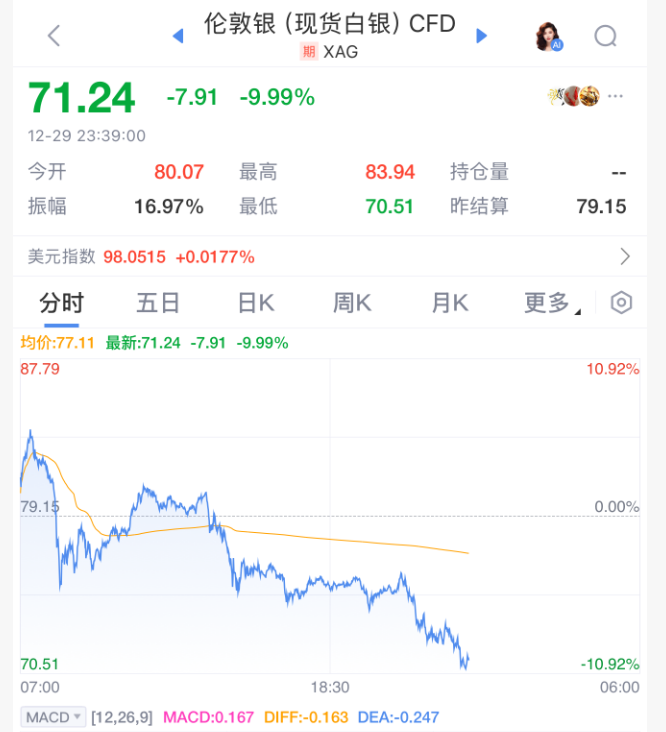
Core Viewpoint - Silver prices experienced extreme volatility, with a historic surge of 10% followed by a rapid decline of 10% shortly after, indicating a highly speculative market environment [1][2]. Group 1: Silver Market Dynamics - On December 29, silver prices initially surpassed $80 per ounce for the first time in history but then fell sharply, marking a drop of over 10%, the largest single-day decline since 2021 [2]. - The decline in silver prices occurred just hours after reaching above $84 per ounce, coinciding with the CME Group's announcement to raise margin requirements for various metal contracts, aimed at reducing speculative trading [6][10]. - The silver market has seen a significant increase of approximately 150% year-to-date, driven by its status as a "critical mineral," supply shortages, and rising industrial and investment demand [10]. Group 2: Broader Market Impact - The decline in silver was mirrored by a notable drop in gold prices, which fell by $200, or 4.5%, to below $4,329 per ounce, reflecting a similar "overbought" condition in the gold market [2][10]. - Other precious metals, such as platinum and palladium, also faced declines, with platinum futures dropping by 14% and palladium by 16% in early trading [6][10]. - The U.S. stock market also reacted negatively, with major indices like the Dow Jones falling over 200 points, indicating a broader market sentiment shift [10].

伦敦金属交易所(LME)三个月期锡跌5.00%,报40674.0美元/吨
Mei Ri Jing Ji Xin Wen· 2025-12-29 15:44
Group 1 - The core point of the article is that the three-month tin futures on the London Metal Exchange (LME) have decreased by 5.00%, reaching a price of $40,674.0 per ton [1]
伦敦证券交易所、伦敦金属交易所12月25日休市
Mei Ri Jing Ji Xin Wen· 2025-12-24 23:49
Group 1 - The London Stock Exchange and the London Metal Exchange will be closed on December 25 due to the Christmas holiday [1]
伦敦金属交易所(LME)三个月期镍涨3.02%,报15250美元/吨
Xin Lang Cai Jing· 2025-12-22 14:58
Core Viewpoint - The London Metal Exchange (LME) reported a 3.02% increase in three-month nickel prices, reaching $15,250 per ton on December 22 [1]. Group 1 - The three-month nickel price on the LME rose to $15,250 per ton [1]. - The percentage increase of 3.02% indicates a significant upward movement in nickel prices [1].
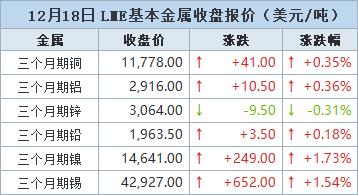
金属涨跌互现 期铜收升,受美国通胀数据提振【12月18日LME收盘】
Wen Hua Cai Jing· 2025-12-19 00:57
Core Viewpoint - The London Metal Exchange (LME) copper prices rose on December 18, but market direction remained unclear due to a stronger dollar offsetting the positive impact of lower-than-expected U.S. inflation data, leading traders to reduce their positions ahead of the Christmas holiday [1]. Group 1: Market Performance - LME three-month copper increased by $41, or 0.35%, closing at $11,778 per ton [2]. - Other base metals also saw price increases, with three-month aluminum up by $10.5 (0.36%) to $2,916 per ton, and three-month tin rising by $652 (1.54%) to $42,927 per ton [2][4]. - Trading volume was low, with approximately 14,300 contracts exchanged, below the 30-day average of nearly 22,000 contracts [3]. Group 2: Economic Indicators - The U.S. Consumer Price Index (CPI) for November rose by 2.7% year-on-year, lower than the 3% increase in September, which positively influenced market sentiment [3]. - Copper is viewed as a barometer for global economic health, having increased by 34% year-to-date and reaching a record high of $11,952 per ton last week [3]. Group 3: Future Outlook - Analysts from Saxo Bank noted a lack of interest in new positions, with a potential for increased volatility as the year ends [3]. - Goldman Sachs projected that copper prices will outperform aluminum in 2026, with an average price forecast of $11,400 per ton [3].
【环球财经】伦敦金属交易所基本金属12日全线下跌
Xin Hua Cai Jing· 2025-12-13 01:41
Core Viewpoint - The London Metal Exchange reported a comprehensive decline in base metal prices on December 12, driven by policy uncertainty from the Federal Reserve and weak industrial demand expectations [1] Price Summary - Three-month copper closed at $11,552.50 per ton, down $319.50, a decrease of 2.69% from the previous trading day [1] - Three-month aluminum closed at $2,875.00 per ton, down $25.00, a decrease of 0.86% [1] - Three-month nickel closed at $14,620.00 per ton, down $6.00, a decrease of 0.04% [1] - Three-month lead closed at $1,966.00 per ton, down $22.50, a decrease of 1.13% [1] - Three-month tin closed at $41,125.00 per ton, down $626.00, a decrease of 1.50% [1] - Three-month zinc closed at $3,139.00 per ton, down $64.50, a decrease of 2.01% [1] Market Dynamics - The decline in metal prices is attributed to reduced risk appetite and decreased capital allocation to commodities, influenced by the Federal Reserve's forward guidance and profit-taking after recent strong price increases [1]
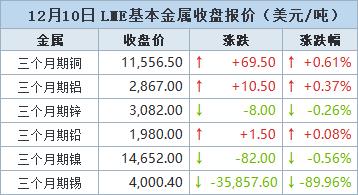
金属普涨 期铜反弹,受需求前景提振【12月10日LME收盘】
Wen Hua Cai Jing· 2025-12-11 00:41
Group 1 - LME copper prices rebounded on December 10, supported by hopes of increased demand, closing at $11,556.5 per ton, up $69.5 or 0.61% [1] - On December 10, the LME reported various base metal closing prices, with three-month copper at $11,556.50, three-month aluminum at $2,867.00, and three-month zinc at $3,082.00 [2] - China's real estate stocks surged on December 10, as the real estate sector is a major consumer of copper and other industrial metals [3] Group 2 - In November, China's consumer price index (CPI) showed a slight month-on-month decrease of 0.1% but a year-on-year increase of 0.7%, indicating a recovery in consumer spending [3] - The producer price index (PPI) rose by 0.1% month-on-month but fell by 2.2% year-on-year, influenced by supply-demand dynamics and international commodity price transmission [3] - LME copper prices have increased by 32% this year due to concerns over mining disruptions and tightening supply in regions outside the U.S. [3]