
IoT

Search documents
【小米集团(1810.HK)】汽车业务首次单季盈利转正,但手机&汽车毛利率或将面临压力——2025三季度业绩点评(付天姿/黄铮)
光大证券研究· 2025-11-20 23:03
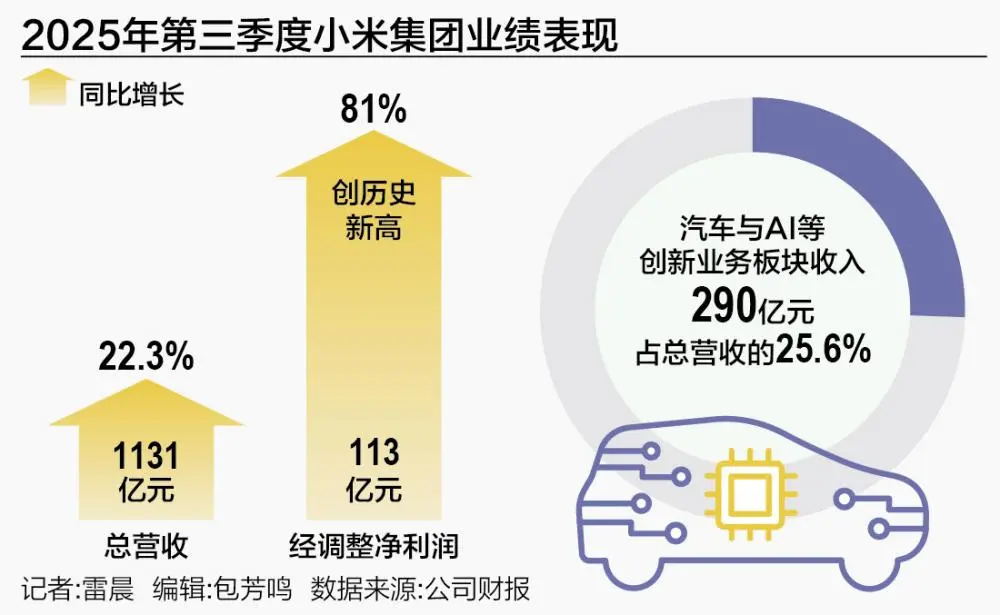
Core Viewpoint - The company reported strong financial performance in Q3 2025, with significant growth in revenue and net profit, driven by innovative business segments like smart cars and AI [4]. Group 1: Financial Performance - Q3 2025 revenue reached 113.1 billion yuan, representing a year-over-year increase of 22.3% but a quarter-over-quarter decrease of 2.4% [4]. - Non-IFRS net profit for Q3 2025 was 11.3 billion yuan, up 80.9% year-over-year and 4.4% quarter-over-quarter, with a corresponding net profit margin of 10% [4]. Group 2: Smartphone Business - Revenue from smartphone sales in Q3 2025 was 46 billion yuan, down 3.1% year-over-year but up 1% quarter-over-quarter [5]. - The company shipped 43.3 million smartphones, achieving a slight year-over-year increase of 0.5%, maintaining a top-three global market share for 21 consecutive quarters [5]. - The average selling price (ASP) of smartphones decreased to 1,062.8 yuan, down 3.6% year-over-year and 1% quarter-over-quarter, primarily due to declining ASP in overseas markets [5]. - Smartphone gross margin was 11.1%, a decrease of 0.6 percentage points year-over-year and 0.4 percentage points quarter-over-quarter, impacted by rising core component prices and intensified competition in mainland China [5]. Group 3: IoT Business - IoT revenue for Q3 2025 was 27.6 billion yuan, reflecting a year-over-year increase of 5.6% but a significant quarter-over-quarter decline of 28.8% [6]. - The gross margin for IoT improved to 23.9%, up 3.1 percentage points year-over-year and 1.4 percentage points quarter-over-quarter, driven by higher sales of high-margin products [6]. - The company faces challenges in the IoT segment due to seasonal fluctuations and increased competition, with future strategies focusing on international expansion and product positioning [6]. Group 4: Internet Advertising - Internet revenue reached 9.4 billion yuan in Q3 2025, a year-over-year increase of 10.8% and a quarter-over-quarter increase of 3.1%, marking a historical high [7]. - The number of global monthly active users reached 742 million, up 8.2% year-over-year [7]. - Advertising revenue grew by 17.4% year-over-year to 7.2 billion yuan, with overseas internet revenue also increasing by 19.1% to 3.3 billion yuan, both achieving historical highs [8]. Group 5: Automotive Business - Revenue from automotive and innovative businesses was 29 billion yuan in Q3 2025, a year-over-year increase of 199.2% and a quarter-over-quarter increase of 36.4% [9]. - The company delivered 109,000 vehicles, with an ASP of 260,000 yuan, benefiting from high ASP models like Xiaomi YU7 and SU7 Ultra [9]. - The automotive segment achieved a gross margin of 25.5% and recorded a positive operating profit of 700 million yuan for the first time in a single quarter [9].


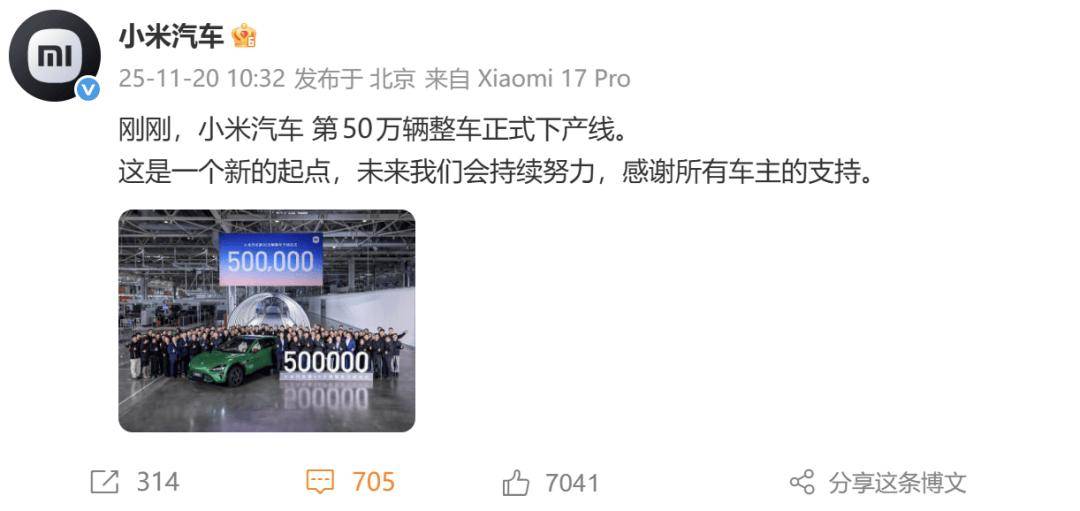
雷军官宣!小米汽车第50万辆车下线
Sou Hu Cai Jing· 2025-11-20 14:02
Core Insights - Xiaomi Auto has officially produced its 500,000th vehicle, marking a significant milestone in the company's automotive journey, achieved in just over 1 year and 7 months since the first vehicle was produced [1][4] - The achievement signifies the validation of Xiaomi Auto's capabilities across research, manufacturing, sales, delivery, and service, indicating a new phase of scalability for the company [4] Company Development - Xiaomi announced its entry into the automotive industry in March 2021, with CEO Lei Jun committing his reputation to the project, describing it as his last major entrepreneurial venture [4] - The company has launched two models: the Xiaomi SU7, set to debut on March 28, 2024, priced between 215,900 to 299,900 RMB, and the Xiaomi YU7, which was launched on June 26, 2023, priced between 253,500 to 329,900 RMB [6] Sales Performance - As of October 2023, Xiaomi Auto has sold a total of 315,400 vehicles, with the SU7 being the best-selling large vehicle of the year at 234,500 units, and the YU7 at 80,900 units [11] - The company aims to deliver 350,000 new vehicles by the end of 2023, a target that is expected to be met ahead of schedule [11] Future Strategy - Lei Jun emphasized that the production of the 500,000th vehicle is just a new starting point for Xiaomi Auto, with a focus on safety, delivery, technological innovation, and the integration of AI and smart manufacturing [12]

小米汽车开始挣钱 卖一台车净赚6434元 雷军最新发声
2 1 Shi Ji Jing Ji Bao Dao· 2025-11-20 04:53
Core Insights - Xiaomi Group reported a total revenue of 113.1 billion yuan for Q3 2025, representing a year-on-year growth of 22.3%, with adjusted net profit reaching 11.3 billion yuan, up 81%, marking a historical high [1][4] - The company successfully transitioned between old and new growth engines, with innovative businesses like smart electric vehicles and AI achieving profitability for the first time in a single quarter, while the traditional smartphone business faced pressure due to rising memory costs [1][4] Financial Performance - The automotive business delivered 108,796 vehicles in Q3, with a total of 265,967 vehicles delivered in the first three quarters, and a monthly delivery of over 40,000 units in October, achieving profitability with a net profit of 6,434 yuan per vehicle sold [4][6] - The smartphone business faced challenges, with global shipments of 43.3 million units and revenue of 45.969 billion yuan, leading to a decline in gross margin to 11.1% due to rising costs of core components [6][5] Business Segmentation - Internet services generated revenue of 9.4 billion yuan in Q3, a 10.8% increase, primarily driven by strong advertising performance [7] - IoT business revenue reached 27.6 billion yuan, maintaining year-on-year growth for seven consecutive quarters, with a gross margin of 23.9% [9][8] R&D and Long-term Strategy - R&D expenditure in Q3 amounted to 9.1 billion yuan, a 52.1% increase, with total R&D investment for the first three quarters nearing last year's total, expected to exceed 30 billion yuan for the year [11][12] - The company is focusing on core technologies and frontier fields, with capital expenditure for the first three quarters at 13 billion yuan, reflecting long-term strategic investments [12][10] Market Outlook and Challenges - Despite achieving profitability in the automotive sector, the company anticipates challenges in 2026 due to reduced purchase tax subsidies and intensified competition [12] - The smartphone business continues to face long-term pressure from rising memory costs, while the IoT sector is experiencing a transitional phase in the domestic appliance market [12][6]
小米汽车开始挣钱,卖一台车净赚6434元,雷军最新发声
2 1 Shi Ji Jing Ji Bao Dao· 2025-11-20 04:53
Core Insights - Xiaomi Group reported a total revenue of 113.1 billion yuan for Q3 2025, representing a year-on-year growth of 22.3%, with adjusted net profit reaching 11.3 billion yuan, a significant increase of 81%, marking a historical high [1] - The financial report indicates a successful transition between old and new growth engines, with innovative businesses like smart electric vehicles and AI achieving profitability for the first time in a single quarter, while the traditional smartphone business faces pressure due to rising memory costs [1][3] - Xiaomi's partner and president, Lu Weibing, emphasized the importance of continuous capability building to enhance resilience against uncontrollable environmental factors [1] Innovative Business Performance - The smart electric vehicle and AI sectors became the core growth drivers, with Xiaomi delivering 108,796 vehicles in Q3 and a total of 265,967 vehicles in the first three quarters, achieving profitability for the first time with an operating profit of 700 million yuan [3] - The average profit per vehicle sold was 6,434 yuan, exceeding expectations and validating the product strength and business model of Xiaomi's automotive division [3] Smartphone Business Challenges - Xiaomi's global smartphone shipments reached 43.3 million units in Q3, generating revenue of 45.969 billion yuan, but the smartphone business faced a decline in gross margin to 11.1% due to rising costs of core components [5] - Lu Weibing noted that the current memory price increase is driven by strong demand for HBM (High Bandwidth Memory) from AI, leading to a long-term cost pressure on the smartphone segment [5] Internet Services Contribution - The internet services segment generated revenue of 9.4 billion yuan in Q3, reflecting a year-on-year growth of 10.8%, primarily driven by strong performance in advertising [6] IoT Business Growth - Xiaomi's IoT and lifestyle product revenue reached 27.6 billion yuan in Q3, maintaining year-on-year growth for seven consecutive quarters, with a gross margin of 23.9% [8] - The overseas market has become a significant growth driver for IoT, with record revenue achieved in Q3, and plans for further expansion in Southeast Asia and Europe [8] R&D Investment and Long-term Strategy - Xiaomi's R&D expenditure in Q3 amounted to 9.1 billion yuan, a 52.1% increase year-on-year, with total R&D investment for the first three quarters nearing last year's total [10] - The company aims to become a global leader in core technology through substantial investments in foundational technologies, particularly in AI [10] Future Challenges and Strategic Focus - Despite achieving profitability in the automotive sector, challenges are anticipated in 2026 due to reduced purchase tax subsidies and intensified competition [11] - The smartphone business continues to face long-term cost pressures, while the IoT sector is navigating a transitional phase in the domestic appliance market [11] - Xiaomi plans to focus on consolidating automotive profitability, advancing smartphone premiumization, and leveraging opportunities in AI to achieve high-quality growth [11]

小米汽车开始挣钱,卖一台车净赚6434元,雷军最新发声
21世纪经济报道· 2025-11-20 04:49
Core Insights - Xiaomi Group reported a total revenue of 113.1 billion yuan for Q3 2025, a year-on-year increase of 22.3%, with adjusted net profit reaching 11.3 billion yuan, up 81%, marking a historical high [1] - The company successfully transitioned between old and new growth engines, with innovative businesses like smart electric vehicles and AI achieving profitability for the first time in a single quarter, while the traditional smartphone business faced pressure due to rising memory costs [1][4] - Xiaomi's President Lu Weibing emphasized the importance of resilience through continuous capability building in response to uncontrollable environmental factors [1] Revenue and Profitability - The innovative business segment, including smart electric vehicles, delivered a significant turnaround, achieving a profit of 700 million yuan in Q3 after a loss of 300 million yuan in Q2, with an average profit of 6,434 yuan per vehicle sold [4] - The smartphone business faced challenges, with global shipments of 43.3 million units and revenue of 45.969 billion yuan, leading to a decline in gross margin to 11.1% due to prolonged cost pressures from core components [6] Business Segmentation - Internet services generated revenue of 9.4 billion yuan in Q3, reflecting a 10.8% year-on-year growth, primarily driven by strong performance in advertising [7] - The IoT business reported revenue of 27.6 billion yuan, maintaining a growth streak for seven consecutive quarters, with a gross margin of 23.9% [9] Strategic Initiatives - Xiaomi is increasing its R&D investment, with Q3 spending reaching 9.1 billion yuan, a 52.1% increase year-on-year, and total R&D expenditure expected to exceed 30 billion yuan for the year [11] - The company is focusing on high-end product strategies to counteract cost pressures, achieving a market share increase in the 4,000-6,000 yuan price segment by 5.6 percentage points to 18.9% [6] Future Outlook - Despite achieving profitability in the automotive sector, challenges remain, including reduced purchase tax subsidies and intensified competition expected in 2026 [12] - Xiaomi aims to solidify its automotive profitability, further penetrate the high-end smartphone market, and leverage opportunities in AI and physical world integration for long-term strategic goals [12]

小米的周期对冲法:新引擎盈利,旧引擎转型
2 1 Shi Ji Jing Ji Bao Dao· 2025-11-19 07:33
Core Insights - Xiaomi Group's Q3 2025 financial results show a total revenue of 113.1 billion yuan, a year-on-year increase of 22.3%, and an adjusted net profit of 11.3 billion yuan, up 81%, marking a historical high [2][3] - The company successfully transitioned from traditional smartphone business to new growth engines, particularly in smart electric vehicles and AI, which achieved quarterly profitability for the first time [2][3] - The smartphone segment is under pressure due to rising memory costs, impacting gross margins, while the company is focusing on high-end strategies to enhance product structure and resilience [2][4] Financial Performance - Xiaomi's revenue from innovative businesses, including smart electric vehicles and AI, reached 29 billion yuan, accounting for 25.6% of total revenue, with a gross margin of 25.5% and a profit of 700 million yuan in the quarter [3][4] - The smartphone business saw a shipment of 43.3 million units, generating revenue of 45.969 billion yuan, with a gross margin dropping to 11.1% due to supply chain cost pressures [3][4] Strategic Initiatives - Xiaomi is implementing three core strategies to build long-term competitiveness: increasing R&D investment, advancing high-end strategies, and exploring new growth opportunities in global markets [2][3] - The company plans to enhance its R&D capabilities, with Q3 spending reaching 9.1 billion yuan, a 52.1% increase year-on-year, and total R&D investment expected to exceed 30 billion yuan for the year [8][9] Market Trends - The current memory price increase is driven by strong demand for HBM (High Bandwidth Memory) from AI applications, differing from previous cycles driven by mobile and laptop demand [4] - Xiaomi's IoT business generated 27.6 billion yuan in revenue, maintaining growth for seven consecutive quarters, with a gross margin of 23.9% [5][6] Operational Developments - Xiaomi has expanded its automotive sales network, with 402 stores in 119 cities in mainland China, and aims to deliver 350,000 vehicles by the end of the year [3][6] - The company has launched a new smart appliance factory in Wuhan, enhancing its production capabilities and supporting its high-end strategy [6][9] Challenges and Outlook - Despite achieving profitability in the automotive sector, challenges remain, including reduced purchase tax subsidies and increased competition expected in 2026 [9] - The smartphone segment faces ongoing pressure from rising memory costs, while the IoT business must navigate a competitive landscape and potential price wars [9]
WISeKey International Holding Ltd Announces Plans to Redomicile to the British Virgin Islands
Globenewswire· 2025-11-18 21:05
Core Viewpoint - WISeKey International Holding Ltd plans to redomicile from Switzerland to the British Virgin Islands (BVI) to enhance strategic growth and attract greater investment from global institutional investors [2][7] Group 1: Redomiciliation Details - The redomiciliation will occur through a cross-border merger with a wholly owned BVI subsidiary, WISeKey Corp, and is subject to regulatory and shareholder approvals expected to be sought in Q1 2026 [2][4] - After the redomiciliation, WISeKey BVI's ordinary shares are expected to be listed on Nasdaq and have a secondary listing on the SIX Swiss Exchange [4][5] Group 2: Strategic Rationale - The BVI is chosen for its modern and flexible corporate legal framework, which is anticipated to provide greater operational flexibility and facilitate access to equity capital markets in both the U.S. and Switzerland [3][7] - The transition aims to streamline the company's structure, enhance comparability with global peers, and improve access to international capital markets, positioning WISeKey for new opportunities, including partnerships and acquisitions [7] Group 3: Shareholder Impact - Each outstanding class of WISeKey International Holding Ltd shares will be exchanged for the corresponding class of shares of WISeKey BVI according to the merger agreement [5][6] - The current American Depositary Share (ADS) program will be terminated, with ADS holders receiving WISeKey BVI ordinary shares in exchange [5]


小米第三季营收1131亿:汽车收入290亿,实现季度盈利,将提前完成全年交付目标
3 6 Ke· 2025-11-18 12:25
Core Viewpoint - Xiaomi Group reported significant growth in revenue and profit for the first nine months of 2025, indicating strong operational performance and strategic investments in AI and IoT sectors [2][19]. Financial Performance - For the first nine months of 2025, Xiaomi's revenue reached 340.37 billion RMB, a 32.5% increase from 256.9 billion RMB in the same period last year [2]. - Operating profit for the same period was 41.672 billion RMB, up 166.9% from 15.613 billion RMB year-on-year [2]. - Adjusted net profit was 32.817 billion RMB, reflecting a 73.5% increase compared to 18.918 billion RMB in the previous year [2]. Quarterly Performance - In Q3 2025, Xiaomi's revenue was 1131.21 billion RMB, a 22.3% increase from 925 billion RMB year-on-year, but a slight decline of 2.4% from the previous quarter [4]. - Gross profit for Q3 2025 was 25.936 billion RMB, up 37.4% from 18.881 billion RMB year-on-year [4]. - The operating profit for Q3 2025 was 15.110 billion RMB, a 150.1% increase from 6.041 billion RMB year-on-year [6]. R&D and Innovation - Xiaomi's R&D expenditure reached 91 billion RMB in Q3 2025, a 52.1% increase year-on-year, with total R&D spending for the first nine months at 235 billion RMB [7][11]. - The number of R&D personnel reached a record high of 24,871 [7]. Business Segments - The smartphone and AIoT segment generated 841 billion RMB in Q3 2025, with smartphone revenue at 460 billion RMB and global smartphone shipments of 43.3 million units, a 0.5% increase year-on-year [12]. - IoT and lifestyle products revenue was 276 billion RMB in Q3 2025, a 5.6% increase year-on-year, with a gross margin of 23.9% [13]. - Internet services revenue for Q3 2025 was 94 billion RMB, up 10.8% year-on-year, with advertising revenue at 72 billion RMB, a 17.4% increase [16]. Automotive and AI Innovations - The smart electric vehicle and AI segment reported revenue of 290 billion RMB in Q3 2025, with a significant year-on-year growth of over 199% [19]. - Xiaomi's automotive division delivered over 100,000 vehicles in Q3 2025, with total deliveries exceeding 260,000 units for the year [19].

小米汽车业务首次单季盈利 预计本周可完成全年交付目标
Zheng Quan Shi Bao Wang· 2025-11-18 12:05
Core Insights - Xiaomi's automotive division achieved its first quarterly profit of approximately 700 million yuan, marking a significant milestone for the company [1] - The company reported a third-quarter revenue of 113.1 billion yuan, a year-on-year increase of 22.3%, and a record net profit of 11.3 billion yuan, up 80.9% year-on-year [1] - Xiaomi's total revenue for the first three quarters reached 340.4 billion yuan, nearing last year's total, with adjusted net profit exceeding last year's total at 32.8 billion yuan [1] Automotive Business - The automotive and AI innovation segment generated revenue of 29 billion yuan, a year-on-year increase of over 199%, with smart electric vehicle revenue accounting for 28.3 billion yuan [1] - In the third quarter, Xiaomi delivered over 100,000 new vehicles, bringing total deliveries for the first three quarters to over 260,000 units [2] - Xiaomi's automotive division is on track to meet its annual delivery target of 350,000 units [1] Smartphone and IoT Business - The smartphone and AIoT segment generated revenue of 84.1 billion yuan, with smartphone revenue at 46 billion yuan, showing growth for nine consecutive quarters [2] - Xiaomi's global smartphone shipments reached 43.3 million units in the third quarter, maintaining a strong position in both domestic and international markets [2] - The IoT and lifestyle products segment reported revenue of 27.6 billion yuan, a year-on-year increase of 5.6%, with over 1 billion connected IoT devices [3] High-End Market Strategy - Xiaomi is accelerating its high-end strategy across various product categories, achieving a significant increase in market share in the high-price segment of smartphones [3] - In the high-end smartphone segment (priced between 4,000 and 6,000 yuan), Xiaomi's market share reached 18.9%, an increase of 5.6 percentage points year-on-year [3] - The company is also establishing a high-end product matrix in the electric vehicle sector, with its models SU7 and YU7 leading sales in their respective categories [3] Research and Development - Xiaomi's R&D investment for the first three quarters reached 23.5 billion yuan, nearing the total planned investment for 2024, with expectations to exceed 30 billion yuan for the year [3] - The third quarter saw a record R&D expenditure of 9.1 billion yuan, a year-on-year increase of 52.1%, reflecting the company's commitment to transitioning from an "internet company" to a "hardcore technology company" [3]
全品类高端化战略加速兑现,小米汽车首次实现单季盈利
2 1 Shi Ji Jing Ji Bao Dao· 2025-11-18 11:13
Core Viewpoint - Xiaomi Group has successfully implemented its high-end strategy across various product categories, achieving significant revenue growth and profitability in its automotive segment for the first time in a single quarter [1][3]. Financial Performance - In Q3 2025, Xiaomi reported total revenue of 113.1 billion yuan, a year-on-year increase of 22.3%, and an adjusted net profit of 11.3 billion yuan, up 80.9% [1]. - The company's R&D investment reached 23.5 billion yuan in the first three quarters of the year, nearing the total for the entire year of 2024 [1]. Business Segments - The smartphone segment saw a slight revenue decline from 47.5 billion yuan to 46 billion yuan, a decrease of 3.1%, primarily due to a drop in average selling price (ASP) [2]. - The IoT and lifestyle products segment grew from 26.1 billion yuan to 27.6 billion yuan, a 5.6% increase, driven by global sales of wearable devices [2]. - Internet services revenue increased from 8.5 billion yuan to 9.4 billion yuan, a growth of 10.8%, largely due to strong performance in advertising [3]. - The smart electric vehicle segment experienced a remarkable revenue increase of 197.9%, rising from 9.5 billion yuan to 28.3 billion yuan, with vehicle deliveries increasing by 173.4% [3]. Cost and Investment - Sales and marketing expenses rose to 8.3 billion yuan, a 32.3% increase, reflecting expansion efforts in retail and advertising [3]. - R&D spending in Q3 reached 9.1 billion yuan, a 52.1% increase, with total R&D investment expected to exceed 30 billion yuan for the year [3]. Workforce and Market Position - As of September 30, 2025, Xiaomi's R&D personnel count reached a record high of 24,871 [4]. - Xiaomi's stock price closed at 40.78 HKD per share on November 18, 2025, with a total market capitalization of 1.06 trillion HKD [4].