
交通运输

Search documents
出口延续高增长,结构性降息政策出台
Hua Lian Qi Huo· 2026-01-18 13:32
1. Report's Investment Rating for the Industry - No investment rating for the industry is provided in the report. 2. Core Viewpoints of the Report - In December 2025, China's exports continued high - growth, imports rebounded significantly, and the trade surplus expanded. The Fed's January rate - cut probability decreased, and the RMB showed an appreciation trend. The central bank adjusted the structural monetary policy tool rate and commercial real - estate credit policies, aiming to improve capital activation and support the real economy [8][10]. 3. Summary According to Relevant Catalogs 3.1 National Economic Accounting - GDP quarterly data from 2023 to 2025 are presented, showing the performance of different industries, including agriculture, forestry, animal husbandry, fishery, industry, and services. The contribution rates and pulling effects of the three industries on GDP are also provided [13][18]. 3.2 Industry Analysis - **Industrial Sector**: The growth rate, added - value of major industries, and production of key products are analyzed. The profit situation of industrial enterprises shows mixed results, with some industries growing and some declining. The inventory of industrial enterprises is at a relatively high level, and enterprises still have the intention to reduce inventory [28][43][53]. - **Price Index**: In December 2025, the national consumer price index (CPI) increased year - on - year, and the industrial producer price index (PPI) decreased year - on - year but the decline narrowed. The prices of different categories in CPI and PPI showed different trends [60][68]. 3.3 Real Estate Market - In January - November 2025, real estate development investment, construction area, new - start area, completion area, sales area, and sales volume all declined year - on - year. The prices of new and second - hand residential properties in major cities also showed different degrees of decline [122][126][130]. 3.4 Foreign Trade and Investment - In December 2025, China's total import and export volume reached a record high. Exports to ASEAN and the EU increased, while exports to the US decreased. The export of key products and the import of key commodities are presented in detailed tables [93][100][101]. 3.5 Fixed - Asset Investment - From January - November 2025, national fixed - asset investment (excluding rural households) decreased year - on - year. Private fixed - asset investment also declined. Investment in different industries showed different trends, with the second - industry investment growing and the third - industry investment declining [114]. 3.6 Domestic Trade - The growth of service retail sales and social consumer goods retail sales is analyzed, and the year - on - year changes in retail sales of different industries above the quota are presented [158][165]. 3.7 Transportation - The transportation volume of goods and passengers by different means, the subway passenger flow in major cities, and the freight rates of shipping routes are analyzed [168][173][179]. 3.8 Banking and Currency - The new social financing scale, social financing scale stock, new RMB loans, and money liquidity are analyzed. The central bank emphasizes reasonable interest - rate control to promote the decline of the real - economy financing cost [183][194][200]. 3.9 Bond Market - The issuance of interest - bearing bonds and the yields of long - and short - term treasury bonds are analyzed [213][216]. 3.10 Foreign Exchange and Gold - The RMB exchange rate against the US dollar and the US dollar index are presented. China's gold reserves increased, and the foreign exchange reserves reached a new high [220][223]. 3.11 Fiscal and Employment - The central and local general public budget revenues and expenditures are analyzed, and the urban surveyed unemployment rate and new urban employment are presented [232][236][242]. 3.12 Business Climate Survey - The global and Chinese manufacturing and non - manufacturing PMI are analyzed. In December 2025, China's manufacturing PMI returned to the expansion range, and the non - manufacturing business activity index also rebounded [245][248][256]. 3.13 US Macroeconomy - The US real GDP growth rate, employment situation, treasury bond yields, retail sales, and the Fed's asset structure and federal funds rate are analyzed [263][266][274].
养殖场防对手投毒 私装信号干扰器 威胁飞机安全被通报
Yang Shi Xin Wen· 2026-01-17 17:02
Group 1 - The article highlights the illegal installation of signal jammers by individuals and organizations near airports, high-speed rail, and subways, which disrupts wireless communication and poses a threat to public safety [1][4] - A specific case is mentioned where a breeding farm near an airport installed a signal jammer to prevent competitors from using drones, inadvertently affecting aviation safety by disrupting critical flight signals [1] - Another case involves a car pawn shop that installed jammers to block GPS signals of mortgaged vehicles, which also interfered with high-speed rail and subway communications [4] Group 2 - National security authorities have conducted investigations and confirmed that these jammers can significantly impact the transmission of communication signals for rail transport and mobile networks [4] - The authorities have taken action by confiscating the illegal devices and educating the responsible parties about the dangers of their actions [1][4] - A warning is issued that signal jammers are illegal and should not be purchased or installed without proper authorization, with a hotline provided for reporting suspicious activities [6]

新一轮寒潮暴雪将至 交通运输部部署低温雨雪冰冻天气防范应对工作
Xin Lang Cai Jing· 2026-01-17 05:22
Core Viewpoint - The Ministry of Transport emphasizes the importance of proactive measures to address the severe cold wave and snowstorm expected from January 17 to 21, which will impact central and eastern China, leading to the strongest winter weather conditions so far this season [1][2] Group 1: Weather Impact and Response - The cold wave is expected to bring heavy snow to regions including Shaanxi, Shanxi, Shandong, Henan, Hubei, Hunan, and Anhui, with freezing rain forecasted in parts of western Henan, western Hubei, Hunan, Guizhou, and eastern Chongqing from January 19 to 21 [1] - The Ministry of Transport is coordinating with meteorological departments to monitor road network operations and ensure safety during this weather event, deploying resources and personnel to manage the situation effectively [1][2] Group 2: Regional Preparedness - The Henan Provincial Department of Transportation has established 407 snow removal material storage points and mobilized 506 emergency teams, with a total of 13,400 personnel ready to respond [1] - The Hubei Provincial Department of Transportation has set up 545 emergency material storage points, stocked 46,900 tons of snow melting agents, and prepared 1,967 snow removal and ice clearing devices [2] - The Shaanxi Provincial Department of Transportation has increased patrols on critical road sections and assembled emergency teams of over 7,000 personnel for snow removal, with significant reserves of snow melting agents and equipment [2] Group 3: Overall Transportation Status - Currently, the national transportation system is operating smoothly without significant delays or congestion due to the cold wave and snowfall, indicating effective management and preparedness by the transportation authorities [2]
新一轮寒潮暴雪将至,交通运输部持续调度做好防范应对工作
Xin Lang Cai Jing· 2026-01-17 04:21
Core Viewpoint - The first cold wave of the year is expected to impact China from January 17 to 21, bringing the strongest rain, snow, and freezing weather since the start of winter, particularly affecting central and eastern regions [1] Group 1: Weather Impact and Response - The cold wave will result in heavy snowfall in parts of Shaanxi, Shanxi, Shandong, Henan, Hubei, Hunan, and Anhui, with freezing rain expected in western Henan, western Hubei, Hunan, Guizhou, and eastern Chongqing from January 19 to 21 [1] - The Ministry of Transport is prioritizing the response to this low-temperature weather, coordinating with meteorological departments to monitor road network operations and ensure safety [1][2] Group 2: Preparedness Measures - The Henan Provincial Department of Transportation is conducting road network inspections every two hours, maintaining a list of icy road sections and emergency resources, with 407 snow removal material storage points and 506 emergency teams ready [1] - Hubei's Department of Transportation has set up 545 emergency material points, stocked 46,900 tons of snow-melting agents, and prepared 5,510 tons of anti-skid materials [2] - Shaanxi's Department of Transportation is increasing patrols on critical road sections and has established emergency teams with over 3,400 personnel for national and provincial roads, along with 7,000 personnel for highways [2] Group 3: Overall Transportation Status - Currently, the national transportation system is operating smoothly without significant congestion or delays due to the cold wave and snowfall [2] - The Ministry of Transport will continue to monitor the weather conditions closely and guide the transportation industry in implementing preventive measures to ensure safe and orderly operations [2]
亿级流量!粤港澳“三联通”跑出新速度
2 1 Shi Ji Jing Ji Bao Dao· 2026-01-17 03:20
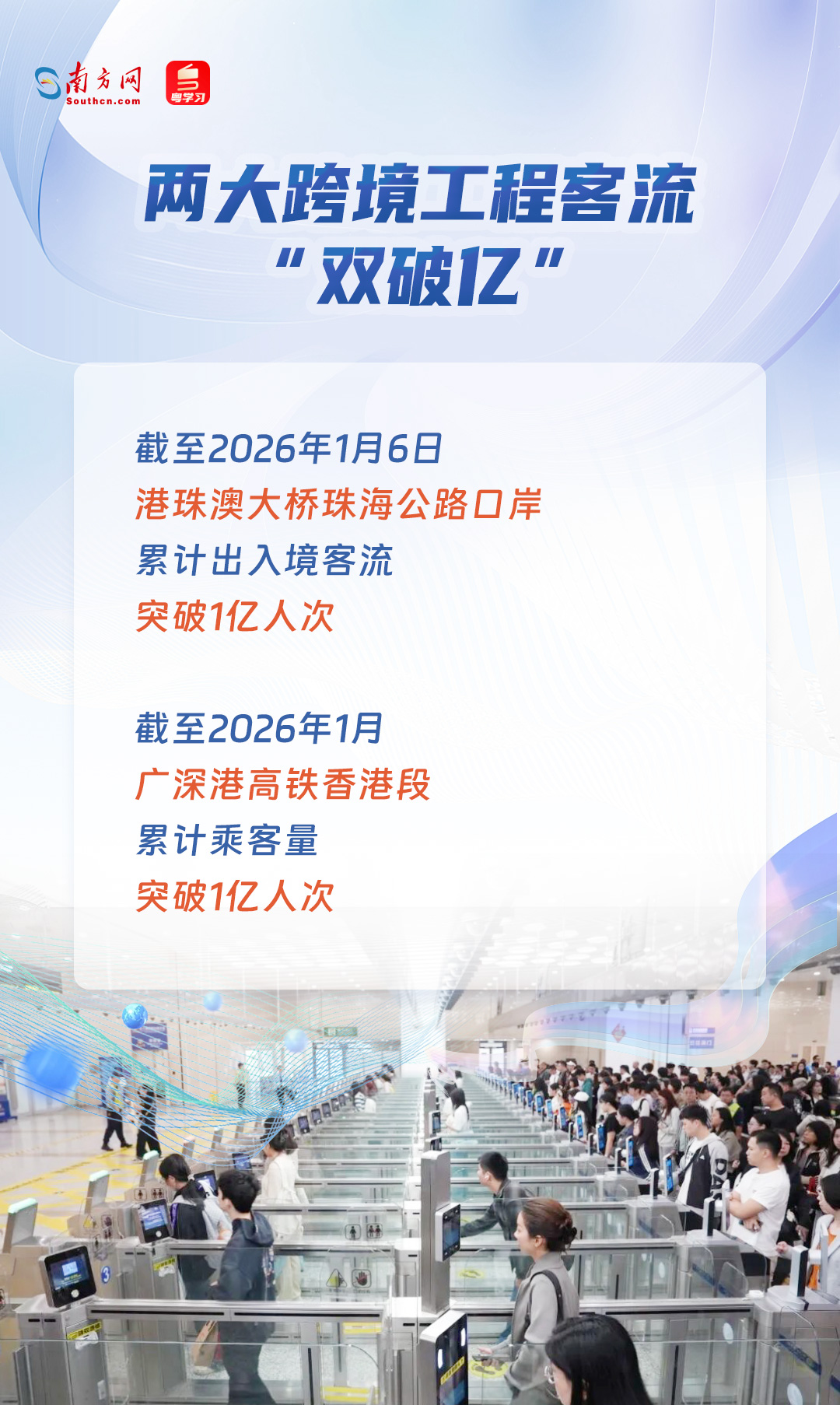
Core Insights - The Hong Kong-Zhuhai-Macao Bridge (HZMB) Zhuhai Port is expected to set new historical records in 2025 for passenger flow, vehicle flow, and cargo value since its opening [1] Group 1: Passenger and Vehicle Flow - In 2025, the passenger flow through the HZMB Zhuhai Port is projected to reach 31.34 million, surpassing the 30 million mark for the first time in a single year, representing an increase of over 140% compared to 2019 [3] - The vehicle flow is expected to exceed 6.8 million trips in 2025 [3] - The number of Hong Kong and Macao registered vehicles crossing the bridge is anticipated to exceed 3.86 million, reflecting a year-on-year growth of 25% [5] Group 2: Cargo Value - The import and export cargo value at the HZMB Zhuhai Port is expected to exceed 300 billion in 2025, marking the first time this threshold has been crossed [4] Group 3: Cross-Border Traffic and Records - The total number of Hong Kong and Macao residents crossing the border is projected to reach nearly 18 million in 2025, which is an increase of nearly 300% compared to 2019 [5] - The total number of inbound and outbound Hong Kong and Macao residents has surpassed 58.7% of the total passenger flow at the port, with over 58.73 million crossings recorded [5] - The bridge has set new records for passenger and vehicle flow multiple times in 2025, with a single-day peak of 170,000 passengers and 28,000 vehicles [6]
梳理2025年中国出口结构:20+图看2025年出口结构-20260116
Huachuang Securities· 2026-01-16 12:41
Export Structure Overview - In 2025, China's export structure shows a significant contribution from emerging markets, with a 49.1% share, up 2.5 percentage points from 2024[21] - Exports to the US decreased to 11.1%, down 3.5 percentage points from 2024, while non-US developed markets increased to 39.8%, up 1 percentage point[21] Commodity Contribution - Intermediate goods' export share rose from 41.9% in 2017 to 47.4% in 2025, with an annual increase of 0.7 percentage points[28] - Consumer goods' share fell from 36.6% to 28.7%, with an average annual decline of about 1 percentage point[28] - Capital goods' share slightly decreased from 21.5% to 20.1%, maintaining relative stability[28] Growth Contribution - From 2018 to 2025, the contribution of intermediate goods to export growth increased from 55.8% to 85%, while consumer goods' contribution dropped from 24.7% to -34%[28] - Capital goods' contribution rose from 19.4% to 22.4% during the same period[28] Regional Analysis - In the US, intermediate goods' share increased by 2.7 percentage points to 33.2%, while consumer goods decreased by 1 percentage point to 43.3%[41] - In the EU, intermediate goods remained stable at 39.3%, with consumer goods dropping by 3.1 percentage points to 31.7%[46] - In ASEAN, intermediate goods rose by 3.1 percentage points to 61.6%, while consumer goods fell by 5 percentage points to 19.1%[52] Market Dynamics - Emerging markets are driving growth, with significant contributions from regions like Africa, ASEAN, and Latin America, which collectively boosted exports by 5.6%[22] - The overall export growth for China in 2025 is projected at 5.5%, a slight decline of 0.3 percentage points from the previous year[21]
聚焦 | 从教育、科技、人才三维视角看国企重组整合
Sou Hu Cai Jing· 2026-01-16 09:06
Core Viewpoint - The article emphasizes that strategic restructuring and professional integration are two core paths in the current state-owned enterprise (SOE) reform, which complement each other to optimize state capital layout and enhance core functions [1] Group 1: Strategic Restructuring and Professional Integration - Strategic restructuring focuses on core responsibilities, reducing redundant investments and homogeneous competition, and emphasizes structural optimization through cross-industry and cross-enterprise resource integration [1] - Professional integration targets niche areas, enhancing technological breakthroughs and innovation collaboration, focusing on functional reinforcement [1] Group 2: Educational Perspective - Restructuring promotes the construction of platforms for industry-education integration and innovative customized talent training, as seen in Hunan's construction company, which restructured its talent development system through property rights reform [1] - The integration of education, talent, and industry chains is facilitated, creating a comprehensive mechanism from basic research to industrialization [4] Group 3: Technological Perspective - Strategic restructuring breaks innovation barriers and promotes interdisciplinary technology integration, as demonstrated by the merger of Baosteel and Wuhan Steel, which enhanced R&D investment intensity and achieved breakthroughs in high-end steel and smart manufacturing [3] - Professional integration is crucial for overcoming "bottleneck" technologies, as exemplified by China Railway's consolidation of R&D resources, leading to advancements in high-speed rail technology [3] Group 4: Innovation Ecosystem Construction - Restructuring fosters collaborative innovation mechanisms by breaking down departmental barriers, ensuring effective alignment between research and industrial needs [4] - The integration of resources across the entire industry chain, as seen in China Shipbuilding Group, has led to significant technological advancements in LNG transport and large cruise ships [4] Group 5: Digital Transformation Empowerment - Restructuring supports the intelligent transformation of traditional industries by optimizing production processes and resource allocation, significantly enhancing production efficiency [5] - The integration of digital technologies in high-end equipment manufacturing is exemplified by China Shipbuilding Group's application of digital twins and virtual reality in ship design and operation [6] Group 6: Talent Perspective - Restructuring enhances talent structure through the aggregation of high-end talent and precise allocation of key positions, as demonstrated by China National Chemical Corporation's establishment of a talent ladder system [10] - Innovative talent incentive mechanisms are introduced, transitioning from a position-oriented to a value-creation-oriented compensation system, enhancing employee retention and growth [11] Group 7: Future Outlook - The article suggests that SOEs should further develop an open talent system, break down institutional barriers, and promote cross-enterprise talent mobility while strengthening innovation ecosystem construction [13]





红利国企ETF(510720)盘中回调,近5日资金净流入超1亿元,市场关注红利策略延续性
Sou Hu Cai Jing· 2026-01-16 06:33
Core Viewpoint - The performance of dividend strategies is expected to improve in 2026 compared to 2025, driven by three main factors: valuation attractiveness, anticipated earnings recovery, and increased allocation of incremental funds towards high-dividend assets [1]. Group 1: Market Performance - On January 16, the Dividend State-Owned Enterprise ETF (510720) fell over 1%, but saw a net inflow of over 100 million yuan in the past five days, indicating market interest in dividend strategies [1]. Group 2: Valuation and Earnings - The relative valuation of dividends compared to growth stocks is at a low level, specifically at the 28.2 percentile since 2016, making it an attractive investment option [1]. - A recovery in A-share earnings is expected to reach its bottom by the end of 2025 or early 2026, with easing pressure on the profitability of cyclical stocks [1]. Group 3: Fund Allocation - Incremental funds from insurance, fixed income, and bank wealth management are expected to increase their allocation to equities, particularly favoring high-dividend assets with strong absolute return characteristics [1]. Group 4: ETF Overview - The Dividend State-Owned Enterprise ETF (510720) tracks the State-Owned Enterprise Dividend Index (000151), which selects high-dividend capable companies with stable dividend records across sectors like banking, coal, and transportation [1]. - The index employs a rigorous assessment of constituent stocks' dividend yields and sustainability, utilizing a cross-industry diversification strategy to effectively manage investment risks [1]. - The ETF has consistently distributed dividends monthly since its listing, achieving 21 consecutive months of dividends [1].
打出经济“开年组合拳”
Xin Lang Cai Jing· 2026-01-15 20:25
Group 1 - The article emphasizes the need to accurately unleash consumer potential through various initiatives [1] - It outlines plans to implement detailed guidelines for a consumption upgrade program in Hunan Province by 2026, alongside increasing the distribution of consumption vouchers [2] - The goal is to conduct over 500 promotional events in the first quarter and distribute nearly one million yuan in hot spring consumption vouchers to national tourists [2] - A systematic approach to spring cultural and tourism consumption is highlighted, including the implementation of a special action plan to boost cultural tourism consumption and the "Bring Customers to Hunan" plan [2] Group 2 - The article discusses the identification and preparation of 4,345 major projects in Hunan, with plans to advance them in the first quarter [3] - Key infrastructure projects include the Shaoyong, Tongji, Changgan, and Yichang railways, as well as the expansion of the G4 Beijing-Hong Kong-Macau Expressway and the renovation of Changsha Airport [3] Group 3 - The article mentions initiatives to support industrial enterprises in increasing production efficiency, including post-holiday resumption assistance and guidance for equipment upgrades [4] - It emphasizes the need for enhanced coordination and support for industries such as new-generation information technology, new energy, low-altitude economy, and electrical equipment [4] Group 4 - The article highlights efforts to promote high-quality development in the service sector, including stabilizing the real estate market and increasing financial support for the real economy [5] - It also mentions the steady development of the transportation industry and support for cultivating large-scale service enterprises [5] Group 5 - The article outlines strategies to stabilize and improve foreign trade and investment, including guiding production-oriented enterprises suitable for export to engage in foreign trade [6] - It emphasizes targeted investment attraction efforts and the implementation of the "Attracting Large, Strong, and Leading Enterprises" initiative [6] Group 6 - The article discusses the orderly advancement of winter and spring agricultural production, focusing on stabilizing grain and oil production and promoting livestock development [7] - It also mentions efforts to expand vegetable production and actively promote fishery development [7] Group 7 - The article stresses the importance of ensuring the safety of people's livelihoods, with a focus on stabilizing employment through over 2,000 online and offline recruitment events [8] - It highlights the need to ensure energy supply and safety during peak winter demand [8]
应急管理部:推动传统高危行业、产业向智能化转型,形成新质生产力
Zhong Guo Jing Ying Bao· 2026-01-15 15:59
Core Viewpoint - The Ministry of Emergency Management aims to enhance guidance and services for emerging industries and new business formats, focusing on safety and consumer stimulation in sectors like leisure fishing and marine sports while addressing competition issues in the new energy sector [1][3]. Group 1: Safety Management Initiatives - The Ministry will establish a long-term mechanism for identifying and addressing major accident hazards, creating a complete logical chain for standards, inspections, and accountability [2]. - There will be a focus on enhancing safety training for key industries such as construction, transportation, and fishing vessels, along with specialized inspections and expert guidance [2]. Group 2: Special Rectification Efforts - The Ministry will continue comprehensive rectification efforts across various sectors, including electric bicycles, urban gas, construction insulation materials, and hazardous chemicals, to prevent major fire accidents and improve safety in critical infrastructure [2]. - There will be a strong push for safety measures in mining and maritime operations, with a focus on identifying and addressing safety hazards in construction, railway maintenance, and other key areas [2]. Group 3: Development and Safety Integration - The Ministry emphasizes the integration of development and safety, advocating for the upgrade of safety risk monitoring systems and the transition of traditional high-risk industries towards intelligent production methods [3]. - There is a commitment to improving safety standards in emerging industries and addressing market chaos in the new energy sector to ensure high-quality development through robust safety guarantees [3].