种植业

Search documents
苏垦农发:2026年公司将继续聚焦主责主业
Zheng Quan Ri Bao Zhi Sheng· 2026-01-21 11:36
Core Viewpoint - The company is focused on agricultural modernization and aims to enhance grain production capacity through strategic initiatives and advanced farming techniques [1] Group 1: Strategic Initiatives - The company implements the strategy of "storing grain in the land and technology" to improve agricultural production conditions and ecological environment [1] - By summer 2025, the company plans to cultivate approximately 1.36 million acres of high-quality arable land, targeting a total summer grain production of 1.351 billion pounds [1] Group 2: Research and Development - The company's subsidiary, Dahua Seed Industry, is dedicated to breeding technology, with new wheat varieties such as "Huamai 29," "Huamai 30," and "Huamai 32" expected to be approved by the National Crop Variety Approval Committee by 2025 [1] - Existing wheat varieties "Huamai 21," "Huamai 22," and "Huamai 1177" have been granted plant variety rights [1] Group 3: Future Plans - In 2026, the company will continue to focus on its core business, striving for increased grain production and income [1] - The company will comply with legal and regulatory requirements for decision-making and disclosure if there are significant project advancements [1]

聚焦粮油稳产与智慧农业,湛江421名基层农技人员“充电”赋能乡村振兴
Nan Fang Nong Cun Bao· 2026-01-21 11:08
Core Viewpoint - The training program for grassroots agricultural technicians in Zhanjiang focuses on stabilizing grain and oil production and promoting smart agriculture, aiming to enhance technical capabilities for rural revitalization [1][3][4]. Group 1: Training Program Details - Zhanjiang's Agricultural and Rural Bureau organized a training program in two phases for 421 grassroots agricultural technicians from various counties [2][3]. - The training combines theoretical and practical teaching methods to update professional knowledge and improve practical skills [4][18]. - Experts from renowned agricultural research institutions were invited to deliver lectures on key topics such as green ecological planting techniques and digital agriculture applications [15][16]. Group 2: Agricultural Production Statistics - In 2024, Zhanjiang's grain sowing area is projected to reach 4.2644 million acres, with a total production of 1.5958 million tons, accounting for 12.15% of the province's total output [9][10]. - The city has achieved growth in area, total production, and yield, with the yield reaching a historical high [10]. - Zhanjiang leads the province in the competitiveness of its tropical crop industry, with significant production in fruits and vegetables [11][12][13]. Group 3: Practical Learning Experience - The training included field visits to advanced agricultural enterprises and e-commerce bases in cities like Guangzhou and Foshan for hands-on learning [19][20]. - Participants expressed that the practical experience broadened their perspectives and enhanced their confidence in agricultural practices [21][22].



四川盐亭:川农大研究生团队开展县域农业高质量发展主题调研
Xin Lang Cai Jing· 2026-01-21 09:16
Core Insights - The research team from Sichuan Agricultural University conducted a field study in Yanting County to explore the internal logic and practical experiences of high-quality agricultural development [1][3] - The study aimed to clarify development fundamentals, explore innovative growth, and empower industrial upgrades through various methods such as site visits and discussions [1][3] Group 1: Agricultural Development Practices - Yanting County has developed a complete industrial chain for egg production, becoming the "number one county in the country for the egg chicken industry" by collaborating with Fengji Food Group [1][3] - The research team focused on issues such as standardized large-scale breeding, production operations, market expansion, deep processing technology of agricultural products, and models for extending the industrial chain [1][3] Group 2: Collaboration and Knowledge Sharing - The collaboration between Sichuan Agricultural University and Yanting County Agricultural and Rural Bureau aims to leverage academic expertise to systematically outline the development paths of order agriculture and the regional public brand "Lezhiwei" [3] - This partnership also serves to fulfill social responsibilities by providing a practical platform for talent cultivation and integrating theoretical research with local agricultural practices [3] Group 3: Modern Agricultural Goals - The "14th Five-Year Plan" emphasizes the modernization of agriculture and rural areas as crucial to China's overall modernization, advocating for the development of technological, green, quality, and brand agriculture [4] - The practices observed in Yanting County exemplify high-standard paradigms for modern agricultural development, enhancing the understanding of how theoretical knowledge can support local agricultural economic growth [4]

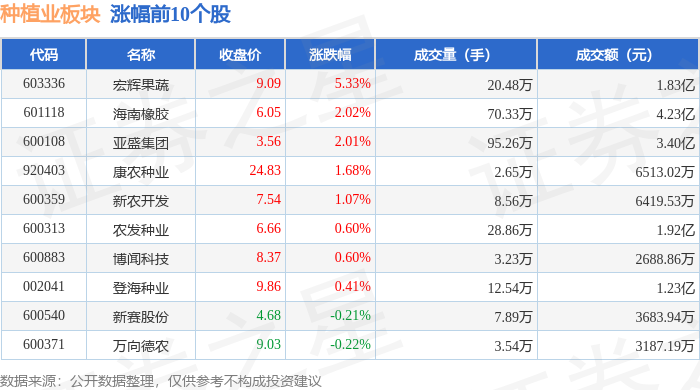
种植业板块1月21日涨0.05%,宏辉果蔬领涨,主力资金净流出7959.94万元
Zheng Xing Xing Ye Ri Bao· 2026-01-21 08:48
Group 1 - The planting industry sector increased by 0.05% on January 21, with Honghui Fruits and Vegetables leading the gains [1] - The Shanghai Composite Index closed at 4116.94, up 0.08%, while the Shenzhen Component Index closed at 14255.12, up 0.7% [1] - Key stocks in the planting industry and their performance included Honghui Fruits and Vegetables (up 5.33%), Hainan Rubber (up 2.02%), and Yasheng Group (up 2.01%) [1] Group 2 - The planting industry sector experienced a net outflow of 79.6 million yuan from main funds, while retail funds saw a net inflow of 2.24 million yuan [2] - Major stocks with significant fund flows included Yasheng Group with a net outflow of 54.55 million yuan from main funds and Honghui Fruits and Vegetables with a net inflow of 27.76 million yuan [3] - The overall trading volume and turnover for the planting industry stocks indicated active market participation, with notable transactions in Hainan Rubber and Yasheng Group [2][3]


福建三明:科技联农,绘就山区农业现代化新图景
Zhong Guo Xin Wen Wang· 2026-01-21 08:15
Core Viewpoint - The agricultural sector in Sanming City is experiencing significant growth through innovative practices and collaborations, particularly in the cultivation of snow lotus mushrooms, which are expected to yield substantial market potential and improve soil quality [1][2]. Group 1: Agricultural Innovations - The snow lotus mushroom cultivation utilizes waste from winter pear tree pruning, with 20 acres successfully planted and the first harvest already completed [1]. - Sanming City has established a modern seed industry expert team, including 13 academicians, to ensure alignment between research and production needs [2]. - The city promotes over 30 modern agricultural technology demonstration bases annually, covering various sectors such as hybrid rice seed production and edible mushroom cultivation [2]. Group 2: Economic Growth Projections - The total output value of agriculture, forestry, animal husbandry, and fishery in Sanming City is projected to reach 64.65 billion yuan by 2025, with an average annual growth rate of over 4.5% during the 14th Five-Year Plan period [1]. - The city has established partnerships with institutions like Fujian Agriculture and Forestry University and Nanjing Agricultural University to focus on efficient planting and deep processing of agricultural products [1]. Group 3: Technical Support and Training - Sanming City has promoted 201 "Five New" technologies and provided agricultural production technical guidance to 7,000 individuals [3]. - Local agricultural technicians are specialized in various sectors, with over 120 focusing on hybrid rice seed production and more than 80 on tea and edible mushroom industries [3].
科技礼包送田间,春播干劲节节高!梅州市农林科学院粮油所特派员团队助农暖人心
Nan Fang Nong Cun Bao· 2026-01-21 06:47
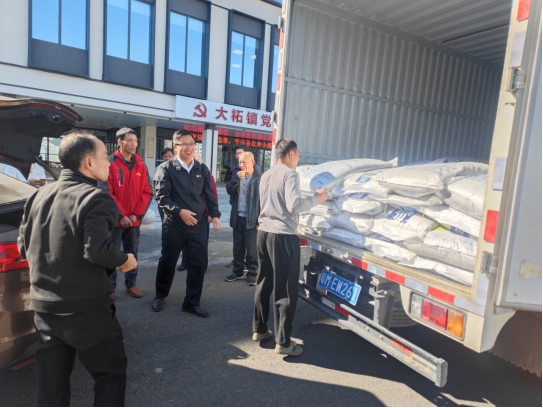
Core Viewpoint - The "Technology Assistance for Farmers" initiative in Dazhi Town aims to enhance agricultural productivity by providing quality agricultural materials and technical guidance to local farmers, thereby supporting food security and rural revitalization efforts [3][5]. Group 1: Initiative Overview - The initiative involves the distribution of 3.5 tons of high-quality compound fertilizer and a batch of quality rice seeds to farmers, along with comprehensive technical support [3]. - The program addresses the challenges faced by local farmers in selecting production materials, ensuring a stable supply of resources for spring farming [3][5]. Group 2: Technical Support and Training - Technical personnel provide on-site guidance on agricultural production techniques, including scientific fertilization, pest control, and water management, helping farmers optimize their practices [3][5]. - Farmers express appreciation for the hands-on training, which allows them to apply scientific methods rather than relying solely on experience [3]. Group 3: Collaboration and Future Plans - The initiative reflects a strong collaboration between the technology assistance team and local support teams, focusing on understanding farmers' needs and tailoring assistance accordingly [5]. - Future plans include ongoing technical guidance and material support, targeting key local crops such as rice, navel oranges, and crispy honey tangerines, to further enhance agricultural productivity [5].
泉城沃野绘新卷:多维赋能让乡村产业旺起来
Feng Huang Wang Cai Jing· 2026-01-21 06:28
Core Viewpoint - The integration of technology in agriculture is driving rural revitalization in Jinan, with a focus on modernizing farming practices and enhancing productivity through smart agricultural techniques [1]. Group 1: Technological Advancements in Agriculture - The use of smart greenhouses in Zhangqiu District has transformed traditional watermelon farming into a modern, efficient industry, allowing for year-round production and improved quality [2][3]. - Innovations such as "hanging vine cultivation" and collaboration with agricultural research institutions have led to the introduction of high-quality watermelon varieties, enhancing market competitiveness [3]. - The establishment of a comprehensive agricultural supply chain, including processing and e-commerce, has increased the value of watermelon production and expanded market reach [4]. Group 2: Hydroponic and Smart Farming Techniques - In Laiwu District, the implementation of hydroponic systems has enabled year-round vegetable production, significantly increasing yield and reducing water usage [6][7]. - The integration of IoT technology in agricultural practices allows for real-time monitoring and management of environmental conditions, leading to improved crop quality and efficiency [7]. Group 3: Youth Engagement and Innovative Marketing - Young entrepreneurs like Yang Jie are leveraging social media and innovative marketing strategies to promote local agricultural products, such as strawberries, enhancing sales and community engagement [9][10]. - The shift from traditional farming to modern, brand-oriented approaches is attracting younger generations to agriculture, fostering new business models and community support [9][15]. Group 4: Role of Party Leadership in Agricultural Development - In Jiyang District, the integration of party leadership in agricultural initiatives has facilitated the development of facility agriculture, enhancing productivity and profitability for local farmers [16][19]. - The establishment of cooperative models led by party organizations has empowered farmers, providing them with resources and technical support to transition to modern agricultural practices [18][19].
2026年02月A股策略:2月热点或将延续1月的科技、有色等方向
Xiangcai Securities· 2026-01-21 02:57
证券研究报告 2026 年 01 月 21 日 湘财证券研究所 策略研究 策略月报 2 月热点或将延续 1 月的科技、有色等方向 ——2026 年 02 月 A 股策略 率窄幅震荡》 2025.11.25 证书编号:S0500519120001 Tel:(8621) 50295323 Email:qh3062@xcsc.com 地址:上海市浦东新区银城路88号 中国人寿金融中心10楼 核心要点: 相关研究: 2026 年宏观短周期和中周期有望形成向上共振格局 1. 《20251125湘财证券-策略研 究-12月等待政策定调,市场大概 2. 《20251222湘财证券-策略研 究-1月市场大概率继续窄幅震荡》 2025.12.22 我们预判 2026 年宏观中周期和宏观短周期均处于底部反弹的阶段,有望形 成向上共振格局。具体原因有:一是海外方面,中美贸易冲突缓和,有助于 减轻经济下行压力。二是"十五五"规划即将落地,新质生产力依然是重要 发展方向,随着人工智能等科技领域的快速发展,将有效推动我国产业升级。 三是 2025 年 12 月中央经济工作会议定调 2026 年宏观政策为继续实施更加 积极的财政政策、适度 ...
【省农业农村厅】陕西加强设施农业防寒工作
Shan Xi Ri Bao· 2026-01-21 00:34
Core Viewpoint - The Shaanxi Provincial Horticultural Technology Station has issued a notice to implement disaster prevention and mitigation measures for vegetable production in response to recent severe cold and snow weather conditions [1][2] Group 1: Disaster Prevention Measures - The notice emphasizes the need to inspect production facilities and drainage systems to ensure proper coverage and prevent damage from snow accumulation [1] - It advises on temperature control measures, including the use of emergency heating equipment and covering outdoor vegetables with floating covers or small arch sheds [1] - Specific agricultural operations are to be adjusted, such as timely snow removal from covers and minimizing nutrient consumption by harvesting mature crops [1] Group 2: Crop Protection and Safety - Recommendations include applying foliar fertilizers to enhance cold resistance and adjusting watering practices for facility vegetables [1] - The notice stresses the importance of pest and disease prevention, advocating for the use of efficient, low-toxicity pesticides while adhering to safety intervals [1] - Safety protocols are highlighted for using heating equipment to prevent fire hazards and carbon monoxide poisoning during adverse weather conditions [1]
农业周报:猪价旺季反弹,产能持续去化
Tai Ping Yang Zheng Quan· 2026-01-21 00:25
Investment Rating - The overall industry investment rating is "Positive" for the planting and livestock sectors, "Neutral" for forestry and aquaculture, and "II" for agricultural product processing [7][8]. Core Insights - The pig price is experiencing a seasonal rebound, with the average price at 12.78 CNY/kg, a slight increase of 0.15 CNY from the previous week. However, the mid-term outlook remains pessimistic due to ongoing market pressures [6][23]. - The livestock industry is undergoing a capacity reduction, with the number of breeding sows decreasing to 39.90 million heads, down 1.1% month-on-month. This trend is expected to continue due to low market prices, rising epidemic risks, and policy pressures [7][24]. - The chicken industry is facing high capacity levels, with prices expected to fluctuate in the mid-term. The average price for broiler chickens is currently at 3.77 CNY/kg, reflecting a slight decrease [8][25]. - The yellow chicken market is anticipated to see price increases due to low production levels, with the average price at 12.95 CNY/kg [10][27]. - The veterinary medicine sector is experiencing a price rebound for key antibiotics, with a year-on-year increase of over 20% expected [11][27]. - The seed industry is benefiting from favorable policies and the advancement of genetically modified crops, which is expected to enhance sales and pricing for quality seed companies [13][28]. - Grain prices are projected to rise in the mid-term due to reduced imports and supportive domestic policies, with corn prices currently at 2369 CNY/ton [14][29]. Summary by Sections Livestock Industry - The average price for live pigs is 12.78 CNY/kg, with a slight increase of 0.15 CNY from last week. The average price for piglets is 25.14 CNY/kg, up 0.66 CNY [6][23]. - The operating rate of large-scale slaughterhouses is 38.58%, down 1.19 percentage points from last week [6][23]. - The number of breeding sows has decreased to 39.90 million heads, down 1.1% month-on-month, indicating a trend of capacity reduction [7][24]. Chicken Industry - The average price for broiler chickens is 3.77 CNY/kg, with a slight decrease of 0.03 CNY from last week [8][25]. - The industry is at a historically high capacity level, with prices expected to remain volatile in the mid-term [9][26]. - The yellow chicken market is expected to tighten supply, with prices likely to rise due to low production levels [10][27]. Veterinary Medicine - Key antibiotic prices are rebounding, with a year-on-year increase of over 20% expected [11][27]. - The market for veterinary vaccines is also growing, with increased sales anticipated for domestically produced vaccines [12][27]. Seed and Grain Industry - The seed industry is benefiting from favorable policies and advancements in genetically modified crops, which are expected to drive sales and pricing [13][28]. - Grain prices are projected to rise due to reduced imports and supportive domestic policies, with corn prices currently at 2369 CNY/ton [14][29].