
贸易

Search documents
苏豪汇鸿拟与控股股东进行资产置换 置入紫金财险2.33%股权
Zheng Quan Shi Bao Wang· 2025-12-04 13:26
Core Viewpoint - Suhao Huihong (600981) plans to conduct an asset swap with its controlling shareholder, Suhao Holding Group, involving the transfer of a total of 2.33% equity (140 million shares) in Zijin Property Insurance Co., Ltd. into the company [1][2]. Group 1: Company Overview - Suhao Holding is a large state-owned enterprise group in Jiangsu Province, with over 380 subsidiaries and 25,000 employees, ranking first in revenue among state-owned enterprises under the Jiangsu Provincial State-owned Assets Supervision and Administration Commission [1]. - In 2024, Suhao Holding's audited revenue is projected to be 130.118 billion yuan, with a net profit of 1.191 billion yuan. For the first nine months of 2025, the unaudited revenue is 98.715 billion yuan, with a net profit of 999.4 million yuan [1]. Group 2: Asset Swap Details - The asset swap will involve Suhao Holding directly holding 100% of Jiangsu Youse and 85.88% of Jiangsu Foreign Trade Co., along with the 2.33% equity in Zijin Property Insurance [2]. - The assets to be divested by Suhao Huihong include 54% of Suhao Zhongjia Fashion Co., 91.35% of Suhao Huisheng Private Fund Management Co., 55% of Jiangsu Suhao Ruiying Fashion Supply Chain Operation Co., and 4.41% of Lianan Life Insurance Co. [3]. - The 2.33% equity in Zijin Property Insurance is valued at 262 million yuan as of the assessment base date of December 31, 2024, and the payment for the equity transfer will be recorded as other payables to Suhao Holding [3]. Group 3: Strategic Implications - The equity asset swap is expected to create synergies with the company's bulk commodity business, optimize the asset structure, enhance risk management capabilities, and improve the company's sustainable operational capacity and competitive advantage [3].

东方创业:近几年公司对美业务规模呈下降趋势
Zheng Quan Ri Bao Zhi Sheng· 2025-12-04 11:18
证券日报网讯 12月4日,东方创业在互动平台回答投资者提问时表示,公司进出口贸易的具体情况详见 公司已披露的2024年年度报告。近几年公司对美业务规模呈下降趋势,目前仍是最大的单一出口国。 (编辑 楚丽君) ...

(乡村行·看振兴)晋南黄河边小村庄“鱼跃龙门”:产业兴 生态美 百姓富
Zhong Guo Xin Wen Wang· 2025-12-04 10:45
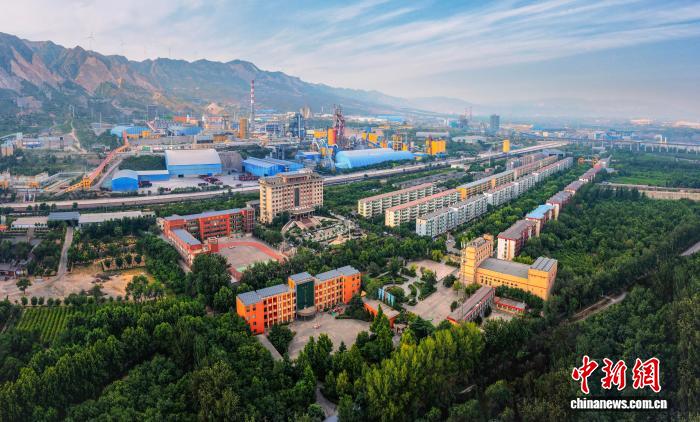
吕梁山下,黄河之滨,昔日"禹凿龙门""鱼跃龙门"神话的诞生地山西省河津市清涧街道龙门村,探索出 一条集体经济壮大与村民共富互促共赢的道路,今日正以产业之兴、生态之美、百姓之富,谱写着新时 代乡村振兴。 "鱼跃龙门"神话的诞生地山西省河津市清涧街道龙门村。 原建发摄 产业跃升:从资源困局到多元共荣 面对"3800人只有1179亩耕地,山荒沟秃无特产"的困境,龙门村以党组织为核心,在稳定农业基础上, 探索出"集体、联户、股份、混合所有制"多轮驱动模式。 从一座年产2.5万吨的小焦炉起步,当地在党员干部带头攻坚的实干中,逐步构建起焦化、新能源、建 材、发电、贸易、房地产、旅游七大产业体系。2024年,全村所属企业实现销售收入达80亿元,居山西 省百强企业行列。 中新网运城12月4日电 题:晋南黄河边小村庄"鱼跃龙门":产业兴 生态美 百姓富 产业发展不仅壮大了集体经济,更拓宽了村民就业渠道。51岁的原玉生在龙门集团水厂工作已30余年, 如今儿子大学毕业后也选择回村进入焦化公司,"在家门口上班,收入不低,心里更踏实"。 作者 张立程 曹文娟 教育方面,该村投资3700余万元建成高标准教育中心,村民子女从幼儿园到初中免 ...

由被动转向主动!欧盟经济安全战略大转变,还有哪些挑战?
Di Yi Cai Jing Zi Xun· 2025-12-04 10:10
Core Viewpoint - The European Commission has announced a new policy framework aimed at enhancing the EU's economic security and resilience in response to increasing external economic threats, marking a shift from a passive to a more proactive approach in economic policy [1][4]. Group 1: Key Initiatives - The flagship proposal under this new framework is the "RESourceEU" plan, which aims to reduce Europe's dependence on external sources for critical raw materials and semiconductors [1][5]. - The EU will focus on six priority areas, including reducing strategic dependence on key goods and services, attracting safer investments, supporting critical industrial sectors, ensuring leadership in key technologies, protecting sensitive information, and maintaining the stability of critical infrastructure [4][6]. - The EU plans to utilize existing policy tools more strategically and may introduce new policies, including the "Security Bill," "Industrial Acceleration Bill," and "Chip 2.0 Bill," among others [4][5]. Group 2: Economic Projections and Challenges - The EU's economic growth is projected to be 1.4% in 2025, an improvement from earlier estimates, but major economies like Germany, France, and Italy are expected to experience sluggish growth [6]. - The European Commission acknowledges the need for decisive action to stimulate internal growth, such as simplifying regulations and promoting innovation [6]. - There are internal challenges to the EU's policy shift, including complex coordination mechanisms and difficulties in fostering a mature venture capital environment [2][6].

四川金沙铜晟科技有限公司成立 注册资本100万人民币
Sou Hu Cai Jing· 2025-12-04 08:25
天眼查App显示,近日,四川金沙铜晟科技有限公司成立,法定代表人为舒勇霖,注册资本100万人民 币,经营范围为一般项目:软件开发;技术服务、技术开发、技术咨询、技术交流、技术转让、技术推 广;货物进出口;五金产品零售;建筑材料销售;轻质建筑材料销售;电力电子元器件销售;半导体分 立器件销售;高速精密重载轴承销售;半导体照明器件销售;半导体器件专用设备销售;智能仪器仪表 销售;橡胶制品销售;包装材料及制品销售;模具销售;有色金属铸造【分支机构经营】。(除依法须 经批准的项目外,凭营业执照依法自主开展经营活动)。 ...
阳江市古伦贸易有限公司成立 注册资本10万人民币
Sou Hu Cai Jing· 2025-12-04 05:48
Core Viewpoint - Yangjiang Gulen Trading Co., Ltd. has been established with a registered capital of 100,000 RMB, focusing on various manufacturing and trading activities in hardware and daily necessities [1] Group 1: Company Overview - Yangjiang Gulen Trading Co., Ltd. was recently founded with a registered capital of 100,000 RMB [1] - The company operates in multiple sectors including wholesale and manufacturing of hardware products, metal tools, and daily necessities [1] Group 2: Business Scope - The business scope includes wholesale and manufacturing of hardware products, metal tools, and plastic products [1] - The company is also involved in the manufacturing and sales of bamboo products and wooden daily necessities [1] - Additionally, it engages in domestic trade agency, import and export of goods, and technology import and export [1]
中美新老经济分化格局下,债券利率下行更为确定
2025-12-04 02:21
Summary of Conference Call Records Industry and Company Overview - The records discuss the economic landscape in the United States and China, focusing on the differentiation between new and old economies, particularly in the context of rising bond rates and economic pressures [1][2][5]. Core Insights and Arguments - **Economic Challenges in the U.S.**: The U.S. economy is facing "three highs" challenges: high inflation, high interest rates, and high wages, leading to increased operational costs for traditional businesses and significant economic downward pressure [1][4]. - **Differentiation in Economic Sectors**: There is a clear divide between new and old economies in both the U.S. and China. In the U.S., sectors related to AI and technology are experiencing rapid investment growth, while traditional industries like automotive manufacturing are under pressure from tariffs and rising costs [5]. In China, although emerging industries are growing quickly, they still represent a small portion of the economy, with traditional sectors like real estate facing significant downward pressure [5]. - **Market Trends**: Funds are increasingly flowing into emerging industries in the stock market, while the bond market is attracting capital due to the financing needs of traditional industries and favorable monetary policies [6]. The U.S. stock market is considered overvalued, but not to an extreme level compared to historical bubbles [6]. - **Electricity Consumption and Metal Usage**: The records highlight that electricity consumption in emerging sectors like AI and chips is increasing, while traditional sectors like real estate show lower consumption. Additionally, demand for copper is strong, while demand for rebar is weak, indicating a disparity in resource utilization between new and old industries [7]. - **Gold Price Dynamics**: Gold prices are performing strongly despite the overall economic conditions. This is attributed to a divergence in the relationship between gold prices and bond yields, as well as the copper-gold ratio, which has been declining while bond yields remain high [8]. This suggests a market contradiction where new economic sectors are thriving while old sectors face challenges, leading investors to seek safety in gold and bonds [8]. Other Important Insights - **Employment and Consumer Confidence**: The U.S. is experiencing deteriorating non-farm employment data, with rising layoffs and consumer confidence hitting historical lows, indicating significant issues within the traditional economy [4]. - **China's Market Performance**: In 2025, China's stock market is performing well, with the bond market outperforming stocks. This performance is closely linked to capital returns, which are influenced by trade surpluses and fiscal deficits [9]. The strong capital returns are driving the stock market's performance, highlighting the impact of new and old economic differentiation [9].
苏州云涟隽贸易有限公司成立 注册资本1万人民币
Sou Hu Cai Jing· 2025-12-04 01:08
Group 1 - Suzhou Yunlianjun Trading Co., Ltd. has been established with a registered capital of 10,000 RMB [1] - The legal representative of the company is Li Yuting [1] - The business scope includes internet sales, watch sales, jewelry retail and wholesale, electronic product sales, and various technical services [1] Group 2 - The company is involved in the sale of gold and silver products, as well as jewelry recovery and repair services [1] - It also offers advertising design and publishing services, along with business agency and consulting services [1] - The company is permitted to operate independently within the scope of its business license, excluding projects that require legal approval [1]
第十届杭州全球企业家大会暨首届企业法治工作大会第三届长三角企业法治工作大会在杭成功举办
Jin Tou Wang· 2025-12-04 00:23
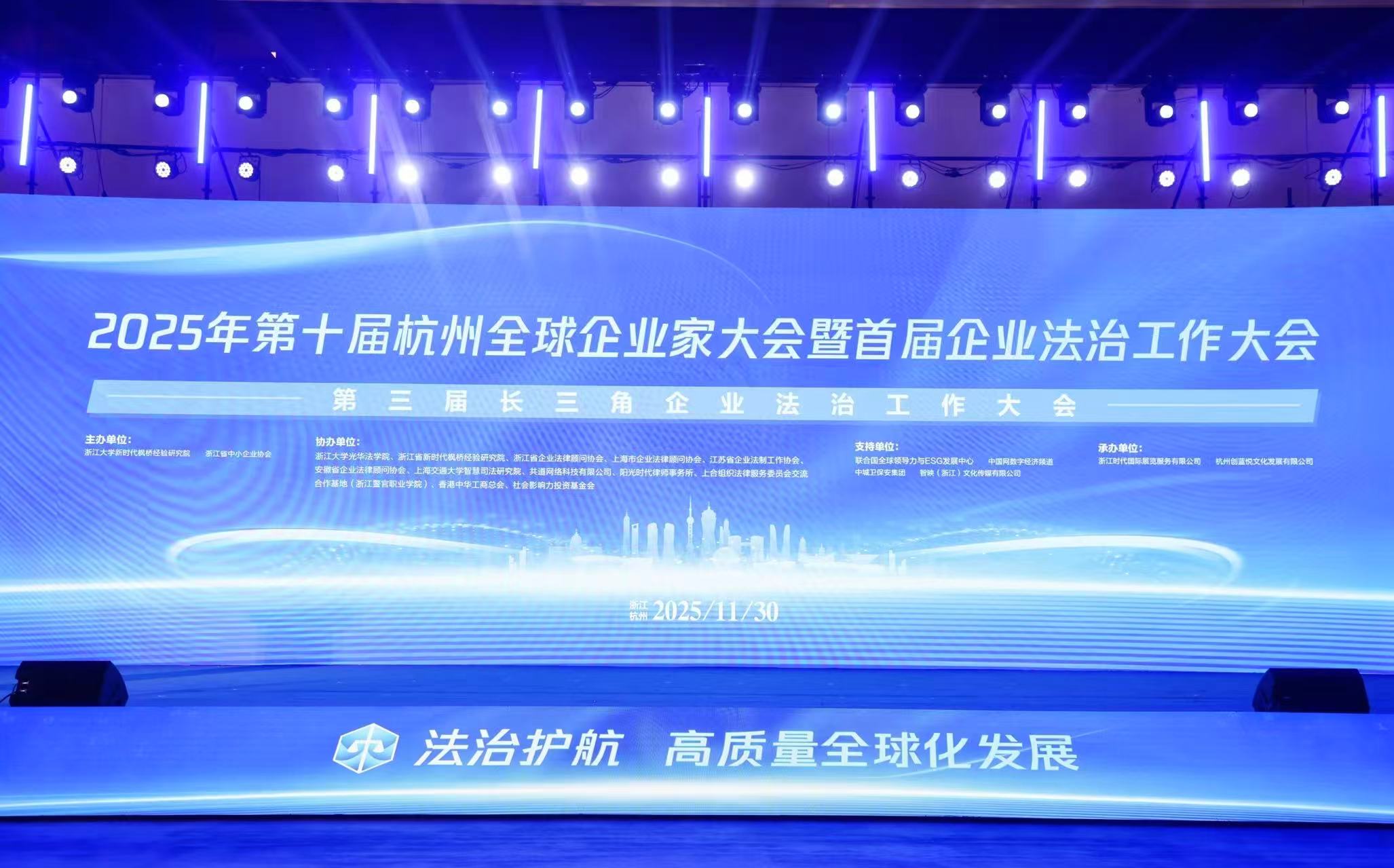
数智赋能生态治理,发布重磅成果 为助力治理体系与治理能力现代化,大会进行了浙江大学钭晓东教授主持、团队完成的国家社会科学基金重大项目《加快推进生态治理体系与治理能力现代 化研究》(编号20&ZD091)的阶段性成果发布仪式,成果一《绿盾执法智擎系统》正式亮相,标志我国数智化提升治理效能获实质性突破;成果二纪录片《绿 色之道》同步首发,以生动镜头呈现生态治理中国路径,为全球提供实践范本。 11月30日,第十届杭州全球企业家大会暨首届企业法治工作大会第三届长三角企业法治工作大会在杭州国际博览中心成功举办并落幕。大会由浙江大学新时 代枫桥经验研究院、浙江省中小企业协会联合主办,浙江时代国际展览服务有限公司、杭州创蓝悦文化发展有限公司承办,获浙江省新时代枫桥经验研究 院、浙江大学光华法学院、长三角企业法律顾问协会联盟、上海交通大学智慧司法研究院、共道网络科技有限公司、阳光时代律师事务所、蓝旗(上海)法律 咨询有限公司、上合组织法律服务委员会交流合作基地(浙江警官职业学院)、香港中华工商总会等众多单位协办。 新时 0 :: ii 本次大会以"法治护航 高质量全球化发展"为核心宗旨,汇聚政府部门、知名企业、法律界、学术界 ...
广州昊景工贸有限公司成立 注册资本100万人民币
Sou Hu Cai Jing· 2025-12-03 23:44
Core Viewpoint - Guangzhou Haojing Industrial and Trade Co., Ltd. has been established with a registered capital of 1 million RMB, focusing on various manufacturing and sales activities in non-metallic minerals, synthetic materials, high-performance fibers, and composite materials [1] Company Overview - The company is legally represented by Huang Zhiyong [1] - The registered capital is 1 million RMB [1] Business Scope - The business activities include sales of non-metallic minerals and products, manufacturing of synthetic materials (excluding hazardous chemicals), and production of high-performance fibers and composite materials [1] - Additional activities encompass the sales of rubber products, paper and cardboard containers, plastic products, and chemical products (excluding licensed chemicals) [1] - The company also engages in the manufacturing of basic chemical raw materials (excluding hazardous chemicals), textile products, construction materials, lubricants, and new material technology promotion services [1] Technical and Consulting Services - The company offers a range of technical services including research and development, consulting, and technology transfer related to new materials [1] - Marketing planning, enterprise management, and brand management are also part of the service offerings [1] Trade and Import/Export Activities - The company is involved in the wholesale of jewelry, professional design services, cultural and artistic exchange activities, and the sale of electronic products [1] - It also engages in import and export activities [1]