
装备制造

Search documents
21社论丨5%增速凸显中国经济向新向优
21世纪经济报道· 2026-01-20 00:24
Economic Growth - In 2025, China's GDP surpassed 140 trillion yuan, growing by 5% compared to the previous year, maintaining a leading growth rate among major global economies [1] - The contribution of final consumption expenditure to economic growth reached 52%, with retail sales of consumer goods exceeding 50 trillion yuan [1] Demand Side - Domestic demand is increasingly being released, with significant contributions from consumption driven by targeted policies [1] - The "trade-in" policy has effectively boosted retail sales of communication equipment and home appliances, achieving double-digit growth [1] - New consumption models catering to quality and personalized needs are gaining momentum, with rapid growth in sales from emerging formats like warehouse membership stores and collective stores [1] Investment Trends - Although overall investment has slowed, the structure of investment is optimizing, focusing on key areas such as infrastructure and modern industrial systems [2] - Investment in key infrastructure sectors like pipeline transportation, power generation, and water conservancy has seen double-digit growth [2] - The proportion of equipment and tool purchases in total investment has risen to 18%, enhancing supply structure and investment efficiency [2] Supply Side - The service sector has become a crucial pillar for economic growth, contributing 61.4% to economic growth and accounting for 57.7% of GDP [2] - Modern service industries, including information technology and finance, are thriving, while emerging service formats like live e-commerce are rapidly developing [2] Industrial Development - The construction of a modern industrial system is progressing, with high-tech manufacturing showing strong growth and leading industrial quality development [3] - The share of equipment manufacturing is increasing, with rapid growth in high-value industries such as aerospace and medical devices [3] - Traditional industries are also upgrading, with a steady increase in the supply of green low-carbon products [3] Challenges and Future Outlook - Despite existing challenges such as external environmental changes and structural issues, the long-term positive trend of the economy remains unchanged [4] - The government plans to implement proactive macro policies to expand domestic demand and optimize supply structure [4] - By 2026, a steady economic growth is expected, with moderate price level recovery and improved economic sentiment among businesses and residents [5]


21社论丨5%增速凸显中国经济向新向优
2 1 Shi Ji Jing Ji Bao Dao· 2026-01-19 23:06
Economic Growth - In 2025, China's GDP surpassed 140 trillion yuan, marking a 5% increase from the previous year, maintaining a leading growth rate among major global economies [1] - Domestic consumption significantly contributed to economic growth, with total retail sales of consumer goods reaching 50 trillion yuan, and final consumption expenditure accounting for 52% of economic growth [1] Investment Trends - Although overall investment has slowed, the investment structure is optimizing, with a focus on key areas such as infrastructure and modern industrial systems [2] - Key infrastructure investments in pipeline transportation, electricity, and water projects achieved double-digit growth, while equipment purchasing investment rose to 18% of total investment [2] Service Sector Contribution - The service sector contributed 61.4% to economic growth in 2025, with its share of GDP increasing to 57.7% [2] - Modern service industries, including information technology and finance, are thriving, alongside emerging service formats like live e-commerce and instant retail [2] Industrial Development - The construction of a modern industrial system is progressing, with high-tech manufacturing showing strong growth and leading industrial quality development [3] - Traditional industries are also upgrading, with an increase in green low-carbon products and a steady advancement in green transformation [3] Policy Measures - China plans to implement proactive macroeconomic policies to expand domestic demand and optimize supply structure [4] - A series of systematic measures are expected to enhance the quality and reasonable growth of the economy, ensuring a strong start for the 14th Five-Year Plan [4]
紧抓“四区联动” 打造开放前沿
Xin Lang Cai Jing· 2026-01-19 22:17
Core Insights - The Kunming Municipal Committee's 12th Plenary Session has outlined a grand blueprint for the city's development over the next five years, emphasizing the need for unified action to implement the decisions made during the session [1] Group 1: Economic Development - During the 14th Five-Year Plan, the Kunming Economic Development Zone (Kunming Free Trade Zone) achieved a regional GDP exceeding 60 billion yuan, with the number of operating entities surpassing 108,000, a growth of over three times compared to the end of the 13th Five-Year Plan [1] - The zone has cultivated 12 national-level specialized and innovative "little giant" enterprises, 180 provincial-level specialized and innovative small and medium-sized enterprises, and 376 high-tech enterprises, ranking first among provincial development zones [1] Group 2: Infrastructure and Connectivity - The completion of the China-Laos Railway and the operation of six freight train routes have facilitated the transportation of over 73 million tons of goods and 63 million passengers [2] - The Kunming International Port is accelerating its construction, with the first phase of the customs supervision facility for international railway freight trains successfully completed [2] Group 3: Industrial Transformation - The municipal committee has called for accelerating industrial transformation and upgrading, focusing on major industries such as equipment manufacturing, biomedicine, and modern logistics [3] - The Kunming Economic Development Zone aims to enhance the quality and efficiency of industrial development, integrating innovation and industrial chains [3] Group 4: Open Economy - The Kunming Economic Development Zone plans to implement a free trade zone enhancement strategy, aiming for breakthroughs in institutional openness and the establishment of high-level open platforms [4] - The focus will be on creating a new development pattern for the Mohan-Moten cooperation zone, leveraging its advantages in ports, channels, and policies [5] Group 5: Future Goals - The Mohan-Moten cooperation zone aims to enhance customs clearance efficiency, with plans to increase the number of freight channels and improve customs capacity by 2 to 3 times [6] - The zone is set to construct new standardized factories and initiate 49 new projects by 2026, aiming for a significant transformation in both efficiency and infrastructure [6]
在复杂变局中书写高质量发展新篇章
Jing Ji Ri Bao· 2026-01-19 22:15
Economic Growth and Stability - In 2025, China achieved a 5% growth rate, surpassing the 140 trillion yuan mark, showcasing its strong resilience and internal driving force amid complex global challenges [1] - China has consistently contributed around 30% to global economic growth over the years, positioning itself as a stabilizing force in the world economy [1] Innovation and Industry Development - China became the first country to possess over 5 million effective domestic invention patents, indicating significant advancements in technological and industrial innovation [2] - The manufacturing sector, particularly in high-tech and equipment manufacturing, has seen rapid growth, with artificial intelligence becoming increasingly integrated into daily life [2] - The country has maintained its position as the world's largest producer and seller of new energy vehicles for 11 consecutive years, highlighting the success of "Chinese manufacturing" in the global market [2] Policy Support and Economic Management - The Chinese government has implemented proactive macroeconomic policies to stabilize employment, businesses, and market expectations, effectively supporting economic stability [3] - Key policies include substantial financial support for families with children under three years old and free preschool education for over 12 million children, ensuring that income growth aligns with economic growth [3] Long-term Economic Resilience - Over the past five years, China's economy has demonstrated significant growth, crossing multiple milestones in total economic output, reflecting the government's adeptness in navigating complex situations [4] - The achievements underscore the unique advantages of the socialist system in China, which allows for concentrated efforts on major challenges and long-term projects [4] - The foundation for sustained economic growth remains strong, with solid development fundamentals and a commitment to high-quality growth [4]
“十四五”圆满收官 中国经济向新向优
Ren Min Ri Bao· 2026-01-19 22:09
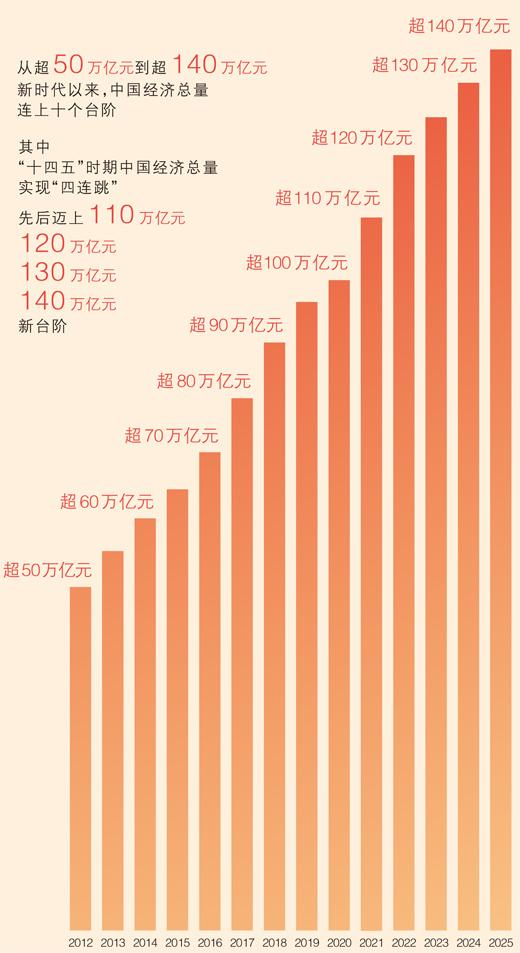
"稳"的格局得到巩固 五年经济增量超过 36 万亿元 2025年 粮食增产丰收 粮食总产量增长 1.2% 连续两年站稳在 1.4 万亿斤 猪牛羊禽肉产量首次超过 | 亿吨 ■ 业 较快增长 装备制造业增加值增长9.2% 高技术制造业增加值增长9.4% 服务业平稳增长 服务业增加值增长5.4% 占 GDP 比重提高到 57.7% "进"的步伐更加有力 "十四五"时期,制造业增加值年均增长5.5% 2025年 经济结构调整优化 规模以上高技术制造业增加值占 最终消费支出对经济增长 规模以上工业增加值比重 贡献奉达52% 升到 17.1% 改革开放持续深化 货物进口规模达到 货物进出口总额增长 3.8% 18.5万亿元 民生保障有力有效 城镇居民人均可支配收入 实际增长 56502元 4.2% 农村居民人均可支配收入 6.0% 24456元 超140万亿元 从超 50 万亿元到超 140 万亿元 2000000 超130万亿元 新时代以来,中国经济总量 连上十个台阶 超120万亿元 其中 "十四五"时期中国经济总量 实现"四连跳" 超110万亿元 先后迈上 1 1 0 万亿元 120万亿元 超100万亿元 130 ...
“稳、进、新、韧” ——四个关键字透视2025年中国经济
Zhong Guo Zheng Quan Bao· 2026-01-19 21:53
Core Viewpoint - In 2025, China's GDP reached 140.19 trillion yuan, marking a 5.0% increase from the previous year, reflecting a stable and progressive economic environment despite various challenges [1][2]. Economic Stability - The GDP growth of 5.0% in 2025 is significant for a large economy like China, which also maintained an average urban unemployment rate of 5.2% and achieved record high trade volumes with foreign exchange reserves exceeding 3.3 trillion USD [2]. - The total retail sales of consumer goods surpassed 50 trillion yuan, growing by 3.7%, indicating a strong consumer market supported by various policy measures [2]. - Industrial production contributed significantly to economic stability, with the industrial added value reaching 41.7 trillion yuan, a 5.8% increase, contributing 35% to economic growth [2]. Economic Progress - Despite complex internal and external environments, China accelerated the transformation of old and new growth drivers, with high-tech manufacturing's added value rising to 17.1% of total industrial output [4]. - The contribution of final consumption expenditure to economic growth exceeded 50%, showcasing a shift towards a consumption-driven economy [4]. - The total import and export volume grew by 3.8%, reflecting a robust trade environment [4]. Innovation and New Growth Drivers - In 2025, R&D expenditure intensity reached 2.8%, surpassing the OECD average for the first time, with total R&D spending at 39.26 billion yuan [6]. - China became the first country with over 5 million valid invention patents, and its PCT international patent applications ranked first globally for six consecutive years [6]. - The manufacturing sector saw significant growth in digital products, with a 9.3% increase in output, and the information technology services sector grew by 11.1% [7]. Resilience - Despite global economic challenges, China's economy demonstrated resilience, achieving a growth rate of 5.0% and contributing approximately 30% to global economic growth [8]. - The diversification of foreign trade has accelerated, with China becoming a major trading partner for over 150 countries, focusing on high-tech and high-value-added exports [8]. - The foundation laid during the 14th Five-Year Plan is expected to support continued high-quality development into the 15th Five-Year Plan [9].
“稳、进、新、韧”——四个关键字透视2025年中国经济
Zhong Guo Zheng Quan Bao· 2026-01-19 21:11
Economic Overview - In 2025, China's GDP reached 140,187.9 billion yuan, growing by 5.0% year-on-year, marking a significant milestone for the economy [1] - The urban unemployment rate averaged 5.2%, indicating overall employment stability [1] - China's foreign exchange reserves exceeded 3.3 trillion USD, reflecting strong trade performance [1] Consumer Market - The total retail sales of consumer goods surpassed 50 trillion yuan, with a growth of 3.7% compared to the previous year, positioning China among the top global retail markets [2] - Consumer market stability was supported by various policies aimed at boosting consumption, leading to an enhanced supply system and optimized consumption structure [2] Industrial Production - The industrial added value reached 41.7 trillion yuan, growing by 5.8%, contributing 35% to economic growth, an increase of 1.8 percentage points from the previous year [2] - The industrial sector is undergoing structural adjustments amid complex external environments, necessitating a focus on new development paradigms [2] Economic Structure and Innovation - The proportion of high-tech manufacturing value added reached 17.1% of total industrial value added, with final consumption contributing over 50% to economic growth [3] - R&D expenditure intensity reached 2.8%, surpassing the OECD average for the first time, indicating a strong focus on innovation [3][4] Technological Advancements - Total R&D expenditure reached 39,262 billion yuan, maintaining China's position as the second-largest globally [4] - China became the first country with over 5 million valid domestic invention patents, and it led the world in PCT international patent applications for six consecutive years [4] Digital Economy - The added value of the digital product manufacturing industry grew by 9.3%, while the information transmission, software, and IT services sector increased by 11.1% [5] - Online retail sales rose by 8.6%, driven by the expansion of new consumption models and scenarios [5] Green Energy - Clean energy generation from hydropower, nuclear power, wind, and solar sources increased by 8.8% [5] - The production and sales of new energy vehicles exceeded 16 million units, showcasing the growing competitiveness of the new energy sector [5] Economic Resilience - Despite global economic challenges, China's economy demonstrated resilience, achieving significant growth and stability [6] - China's contribution to global economic growth is projected to be around 30%, with a diversified foreign trade structure emerging [6]
2025年中国经济的含金量,不止140万亿元
经济观察报· 2026-01-19 15:09
Core Viewpoint - The article emphasizes the importance of China's economic growth trajectory in 2026 as it aims to achieve a per capita GDP of $20,000 by 2035, which is considered the level of a moderately developed country [2][14]. Economic Growth Performance - In 2025, China's GDP grew by 5% year-on-year, surpassing 140 trillion yuan for the first time, with per capita GDP rising from $10,632 in 2020 to $13,953 in 2025 [2][5]. - The average annual GDP growth during the "14th Five-Year Plan" period was 5.4%, significantly higher than the global average, positioning China as a leader among major economies [5]. K-shaped Growth - The Chinese economy is exhibiting a "K" shaped growth pattern, where sectors like equipment manufacturing and high-tech industries are thriving, while other areas show signs of stagnation or decline [2][9]. - Despite achieving the GDP growth target, there is a noticeable decline in quarterly GDP growth rates, indicating potential underlying issues in demand and economic momentum [9][10]. Consumer Market Dynamics - In 2025, retail sales of consumer goods exceeded 50 trillion yuan, with a year-on-year growth of 3.7%, reflecting a shift towards higher quality and diversified consumption preferences [6][7]. - The per capita disposable income for residents reached 43,377 yuan, marking a nominal increase of 5.0%, which supports the potential for continued consumer spending growth [7]. Policy Recommendations - Experts suggest that to counteract the economic downturn, the government should enhance macroeconomic regulation and increase public investment in infrastructure and services [11][12]. - There is a call for policies that better distribute income to lower-income groups to stimulate consumption, alongside fiscal and monetary measures to support economic stability [12][15]. Future Economic Outlook - Projections for 2026 indicate that GDP growth could remain around 5%, with external demand playing a crucial role in sustaining this growth amid rising uncertainties [16]. - Analysts highlight the need for a balanced approach to economic growth, focusing on both short-term stabilization and long-term structural reforms to ensure sustainable development [15][16].
世界见证中国经济“顶压前行”的韧性
Xin Lang Cai Jing· 2026-01-19 15:07
Core Insights - China's GDP exceeded 140 trillion yuan in 2025, achieving a year-on-year growth of 5.0%, demonstrating the resilience of the Chinese economy amid complex global conditions [1][2] - The successful attainment of China's economic growth target reflects high-level policy formulation and strong execution capabilities [1] - The "14th Five-Year Plan" has seen a remarkable achievement with GDP reaching new milestones of 110 trillion, 120 trillion, 130 trillion, and 140 trillion yuan [1] Economic Performance - The past year was marked by significant challenges, including intensified global trade frictions and geopolitical conflicts, yet China managed to achieve both "quantitative leaps" and "qualitative improvements" in its economy [1][3] - The resilience of the Chinese economy is rooted in a solid industrial system and scientific macroeconomic policies [3] - The primary industry grew by 3.9%, the secondary industry by 4.5%, and the tertiary industry led with a growth rate of 5.4%, contributing significantly to GDP [3] Innovation and Global Contribution - China's economic innovation and practical efforts are becoming a rare certainty in the uncertain global economic landscape [4] - Major innovations, such as the Tianwen-1 probe and advancements in high-speed trains and aircraft, highlight China's commitment to technological self-reliance [4] - The data indicates that by the end of 2025, the number of cars per hundred households in China reached 52.9, reflecting a growing consumer market [4] Future Outlook - As China enters the "15th Five-Year Plan," the economy is expected to continue demonstrating resilience and vitality, providing a stable direction for the global economy [5] - The unique resilience and vitality of the Chinese economy send a clear signal of "using its own certainty to counter global uncertainties" [5]
我国GDP首次跃上140万亿元新台阶
Mei Ri Jing Ji Xin Wen· 2026-01-19 13:03
Core Viewpoint - In 2025, China's GDP reached 140,187.9 billion yuan, marking a 5.0% increase from the previous year, driven by proactive macroeconomic policies and consumer initiatives [1] Economic Performance - The implementation of proactive macro policies effectively stabilized the economy, with retail sales of six categories of products under the "old for new" policy increasing by 4.1%, contributing 0.6 percentage points to total retail sales growth [2] - The investment in equipment and tools rose by 11.8%, contributing 1.8 percentage points to overall investment growth [2] Structural Optimization - The focus on high-quality development led to a 5.5% increase in service retail sales, with a continuous recovery observed over four months [3] - The production value of the equipment manufacturing industry grew by 9.2%, with its share rising to 36.8% [3] New Growth Drivers - The integration of technological and industrial innovation, particularly in AI and emerging industries, has significantly contributed to economic stability, with the manufacturing value of smart drones and smart vehicle equipment increasing by 57% and 26.2%, respectively [4] - The growth in integrated circuit manufacturing and optoelectronic device manufacturing was 26.7% and 18.8%, respectively [4] Economic Circulation Improvement - The establishment of a unified national market and improved market competition conditions have positively influenced price recovery and corporate profitability [4] - In December 2025, the core CPI rose by 1.2%, while the manufacturing PMI returned to the expansion zone at 50.1% [4] Achievement of Economic Goals - The economic performance in 2025 laid a solid foundation for continued growth in 2026, with positive changes in production, prices, and expectations [5] - The contribution rates of final consumption expenditure, capital formation, and net exports to economic growth were 52.0%, 15.3%, and 32.7%, respectively [6]