
教育

Search documents
卓越教育集团(03978):受托人依据受限制股份单位计划购买合共4万股
智通财经网· 2026-01-12 09:10
智通财经APP讯,卓越教育集团(03978)发布公告,于2026年1月12日,受限制股份单位计划受托人依据 受限制股份单位计划于公开市场上购买合共4万股股份。 ...
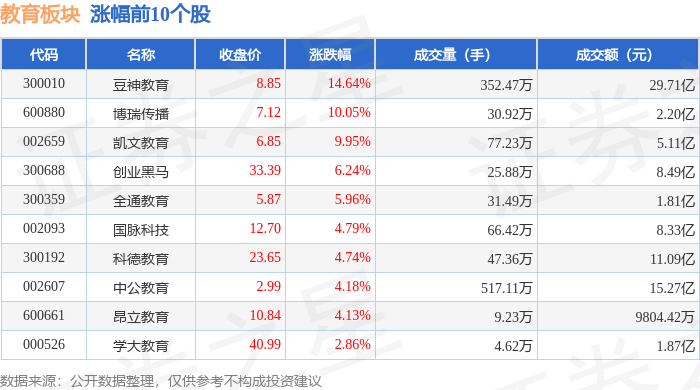
教育板块1月12日涨5.78%,豆神教育领涨,主力资金净流入1.3亿元
Zheng Xing Xing Ye Ri Bao· 2026-01-12 09:04
Market Performance - The education sector rose by 5.78% on January 12, with Dou Shen Education leading the gains [1] - The Shanghai Composite Index closed at 4165.29, up 1.09%, while the Shenzhen Component Index closed at 14366.91, up 1.75% [1] Individual Stock Performance - Dou Shen Education (300010) closed at 8.85, up 14.64%, with a trading volume of 3.5247 million shares and a transaction value of 2.971 billion [1] - Bo Rui Chuan Bo (600880) closed at 7.12, up 10.05%, with a trading volume of 309,200 shares and a transaction value of 220 million [1] - Kaiwen Education (002659) closed at 6.85, up 9.95%, with a trading volume of 772,300 shares and a transaction value of 511 million [1] - Other notable performers include Chuangye Dengdiao (300688) at 33.39 (+6.24%), and Quantu Education (300359) at 5.87 (+5.96%) [1] Capital Flow Analysis - The education sector saw a net inflow of 130 million from institutional investors, while retail investors experienced a net inflow of 96.5441 million [2] - Retail investors had a net outflow of 226 million, indicating a mixed sentiment among different investor types [2] Detailed Capital Flow for Selected Stocks - Dou Shen Education had a net inflow of 131 million from institutional investors, but a net outflow of 139 million from retail investors [3] - Kaiwen Education saw a net inflow of 62.1994 million from retail investors, but a net outflow of 43.7355 million from institutional investors [3] - Zhonggong Education (002607) had a net inflow of 24.5869 million from retail investors, with a net outflow of 25.5291 million from institutional investors [3]





国联民生证券:教育行业有望迎来业绩、估值戴维斯双击 “AI+教育”是板块投资主线
智通财经网· 2026-01-12 08:36
Industry Dynamics - The education industry is experiencing a "three-dimensional resonance" with marginal policy improvements, supply clearing, and demand release, shifting the investment logic from policy-driven to performance-driven, with low relative valuations and potential for a "Davis double play" in performance and valuation under policy support [1] - On January 7, the Minister of Education met with the Singaporean Minister of Education, emphasizing cooperation in foundational and interdisciplinary subjects, encouraging top universities to conduct joint research in life sciences, brain sciences, and artificial intelligence, and promoting international technology transfer and talent cultivation [2] - The National Education Work Conference held on January 8 outlined key tasks for educational reform, focusing on nurturing talent for the party and the country, prioritizing basic education, optimizing higher education structure, enhancing education's support for technology and talent, accelerating vocational education development, and promoting high-level educational openness [2] - On January 9, the Ministry of Education released two industry standards to advance the national education digitalization strategy, improve education data management, and regulate the use of interactive smart teaching terminals [2] Industry Performance - The education sector outperformed the CSI 300 index during the week of January 5 to January 9, with the CITIC Education Index rising by 5.89%, compared to the CSI 300's increase of 2.79% and the Shanghai Composite Index's rise of 3.82%, marking a 3.10 percentage point outperformance [4] Company Performance - The top three performing stocks in the A-share education sector for the week were Borui Communication (+30.97%), Huatu Shanding (+18.67%), and China High-Tech (+14.17%), while the bottom three were *ST Guohua (+0.81%), Qinsun Shares (-0.97%), and ST Kaiyuan (-2.63%) [5] Company Dynamics - Action Education announced a share repurchase plan of no less than 20 million and no more than 25 million yuan, with the first repurchase occurring on January 6, amounting to 4.64123 million yuan for 110,800 shares at an average price of 41.72 yuan [6] - Kede Education's controlling shareholder transferred 77.584267 million shares (23.5716% of total shares) to Huaxin Future and Dongfang International Asset Management, making Huaxin Future the new controlling shareholder and changing the actual controller to Zhou Qichao [6]

锐财经丨服务业扩大开放“路线图”上新
Ren Min Ri Bao Hai Wai Ban· 2026-01-12 03:44
Core Viewpoint - The expansion of China's service industry opening-up pilot program is accelerating, with the recent issuance of a roadmap for nine cities, indicating a significant push towards enhancing service sector openness and reform [1][2]. Group 1: Pilot Program Achievements - The national service industry opening-up pilot program has shown remarkable results since its initiation in 2015, with 412.6 billion USD in foreign investment absorbed by 11 provinces and cities in 2024, accounting for 50.2% of the national total in the service sector [2]. - The new pilot cities are expected to promote service industry openness, with the central economic work conference emphasizing the need for orderly expansion of self-initiated openness in the service sector [2]. Group 2: Differentiated Exploration - The pilot cities are encouraged to develop tailored tasks based on their unique resources and industrial strengths, fostering innovation and complementary achievements [3]. - For instance, Ningbo is focusing on technology services and digital trade, while Dalian aims to leverage its position as an international shipping center to support the revitalization of Northeast China [3][4]. Group 3: Project Implementation for Regional Development - The pilot program aims to facilitate regional development through the implementation of specific projects, with the Ministry of Commerce emphasizing the importance of practical execution and coordination among departments [6][7]. - The Ministry will enhance communication with business entities and conduct evaluations of the pilot program's effectiveness to promote high-quality experiences and innovations [7].
大连等9个城市试点任务明确——服务业扩大开放“路线图”上新
Ren Min Ri Bao· 2026-01-12 03:29
Core Viewpoint - The expansion of China's service industry opening-up pilot program is accelerating, with the recent issuance of a roadmap for nine cities, indicating a significant push towards enhancing service sector openness and reform [1][2]. Group 1: Pilot Program Achievements - The national service industry opening-up pilot program has shown significant results since its initiation in 2015, with 412.6 billion USD in foreign investment absorbed by 11 pilot cities in 2024, accounting for 50.2% of the national total in the service sector [2]. - The new pilot cities, including Dalian, Ningbo, and others, are expected to promote self-directed opening in the service sector, leveraging their unique advantages and focusing on key areas such as telecommunications, healthcare, and finance [2][3]. Group 2: Differentiated Exploration - The pilot cities are encouraged to develop tailored tasks based on their unique resources and industrial foundations, promoting innovation and complementary achievements across regions [3]. - For instance, Ningbo is focusing on technology services and international shipping, while Dalian aims to enhance its role as an international shipping center in Northeast Asia [3][4]. Group 3: Project Implementation for Regional Development - The Ministry of Commerce plans to deepen the service industry opening-up pilot program, coordinating with relevant departments to ensure effective implementation of the pilot tasks and promote project landing to stimulate regional development [6][7]. - The program aims to enhance service consumption, moving from physical goods to services, and to cultivate new development momentum while shaping international competitive advantages [6].
港股开年增持潮,逾30家公司获青睐
Jin Rong Jie· 2026-01-12 01:59
Group 1 - In early January 2026, the Hong Kong stock market experienced a wave of significant share purchases by company executives and investment institutions, with over 30 listed companies receiving increased holdings from January 1 to 8 [1] - The share purchases spanned multiple industries, including consumer goods, industrial manufacturing, and others, with notable increases such as GIC Private Limited acquiring 179,700 shares of Haitian Flavoring and Food [1][2] - A noteworthy trend is the increase in cornerstone investors purchasing shares in the secondary market, exemplified by Horizon Together Holding Ltd. acquiring 688,200 shares of Youjia Innovation, indicating strong confidence in the company's future [1][2] Group 2 - Legal expert Xu Haonan noted that cornerstone investors increasing their holdings in the secondary market is seen as a strong confidence signal, representing strategic endorsement from core industry players [2] - Internal company executives are also actively participating in share purchases, with Youjia Innovation's chairman Liu Guoqing buying 50,000 shares and Tianli International Holdings' chairman Luo Shi acquiring approximately 4.03 million shares over several trading days [2] - The companies that received increased holdings are leaders or significant participants in their respective sectors, including consumer products, gold, building materials, apparel, and education [2]
服务业扩大开放“路线图”上新(锐财经)
Ren Min Ri Bao Hai Wai Ban· 2026-01-11 23:00
Core Insights - The article discusses the acceleration of service industry opening in China, particularly through the implementation of a comprehensive pilot program in nine cities, including Dalian, Ningbo, and Suzhou, aimed at enhancing foreign investment and promoting various service sectors [4][5][9]. Group 1: Pilot Program Overview - The pilot program for expanding service industry openness has been significantly effective since its initiation in 2015, with 412.6 billion USD in foreign investment absorbed by 11 provinces and cities in 2024, accounting for 50.2% of the national total in the service sector [5][9]. - The latest pilot program, outlined by the Ministry of Commerce, aims to further enhance the role of the nine cities by implementing common tasks and encouraging tailored initiatives based on local advantages [5][6]. Group 2: City-Specific Initiatives - Each of the nine pilot cities is encouraged to develop unique tasks that leverage their specific resources and industrial strengths, focusing on key service areas such as telecommunications, healthcare, and finance [6][8]. - For instance, Suzhou will explore the import of biomedical research materials, while Shenzhen will optimize its free trade account functions [8][9]. Group 3: Expected Outcomes and Future Directions - The shift in consumer behavior from goods to services necessitates the expansion of service industry openness to cultivate new growth drivers and enhance international competitiveness [9][10]. - The Ministry of Commerce plans to strengthen communication with businesses, provide targeted policy guidance, and evaluate the effectiveness of the pilot programs to ensure successful implementation and regional development [10].
港股开年增持“忙” 除了股东、高管 基石投资者也加码
Shang Hai Zheng Quan Bao· 2026-01-11 21:55
Core Viewpoint - The Hong Kong stock market is experiencing a surge in share buybacks from company executives, major shareholders, and institutional investors, signaling strong confidence in the market at the beginning of 2026 [1][2]. Group 1: Company Actions - Over 30 Hong Kong-listed companies have seen share buybacks from executives and institutions between January 1 and 8, 2026, indicating a trend of increased confidence among key stakeholders [1]. - Horizon Together Holding Ltd., a cornerstone investor, purchased a total of 688,200 shares of Youjia Innovation in the open market, reflecting a strong belief in the company's future business prospects [1][2]. - Youjia Innovation's executives, including its chairman Liu Guoqing, bought 50,000 shares of the company between January 5 and 7, representing approximately 0.03% of the total issued shares [2]. Group 2: Institutional Investments - Other companies such as Haitian Flavoring and Food Company, Baiyunshan Pharmaceutical, and Naxin Microelectronics have also received significant share buybacks from institutional investors, indicating a broader trend across various sectors [3]. - For instance, Haitian Flavoring received an increase of 179,700 shares from GIC Private Limited, while Baiyunshan saw an increase of 30,000 shares from LSV Asset Management [3]. Group 3: Industry Insights - The companies involved in these buybacks span various industries, including consumer goods, gold, building materials, and education, with many being leaders or significant players in their respective fields [4]. - Analysts suggest that the buybacks from leading companies reflect a stable customer base and clear profit models, indicating a positive outlook for future growth [4].
【我是这样做学问的】研理于经,征事于史,济世于民
Xin Lang Cai Jing· 2026-01-11 20:19
Core Viewpoint - The article reflects on the evolution of economics as a discipline in China, highlighting its transition from obscurity to prominence, particularly after the reform and opening-up period, and emphasizes the importance of developing a unique Chinese economic theory rooted in national practices and challenges [1][6][8]. Group 1: Historical Context - In the late 1970s, economics was not widely recognized or understood in China, with many people unaware of its significance [1][2]. - The restoration of the college entrance examination in China led to a surge of interest in economics, as students began to explore the subject more deeply [3][6]. - The teaching of economics evolved through three stages: unfamiliarity, imitation of foreign models, and the current phase of developing indigenous theories based on China's unique experiences [6][7]. Group 2: Educational Influence - Influential educators played a crucial role in shaping the understanding of economics, emphasizing rigorous scholarship and a commitment to truth [4][5]. - The teaching approach has shifted to focus on engaging students with real-world applications of economic theories, fostering a deeper understanding of the subject [5][6]. Group 3: Theoretical Development - The article discusses the emergence of significant theoretical contributions from Chinese economists that address critical issues such as market mechanisms, government roles, and social governance [7]. - There is a call for a deeper understanding of China's economic development through the lens of Marxist political economy, particularly guided by contemporary Chinese thought [7][8]. Group 4: Future Directions - The construction of a Chinese autonomous knowledge system in economics is essential, requiring a blend of local practices and global insights [8]. - The ongoing challenges faced by China necessitate a robust theoretical framework that can adapt to both domestic and international contexts [8].
港股开年增持“忙” 除了股东、高管,基石投资者也加码
Shang Hai Zheng Quan Bao· 2026-01-11 18:49
Core Insights - The Hong Kong stock market is experiencing a surge in share buybacks from company executives, major shareholders, and institutional investors, signaling strong confidence in the market at the start of 2026 [1][2] - Notably, cornerstone investors are increasingly participating in secondary market purchases, which is viewed as a strong endorsement of the companies' long-term prospects [1][2] Company Actions - Horizon Together Holding Ltd., a cornerstone investor, purchased 688,200 shares of Youjia Innovation, indicating confidence in the company's future and its strategic importance within its parent company's ecosystem [2] - Youjia Innovation's executives, including its chairman Liu Guoqing, also increased their holdings by purchasing 50,000 shares, representing approximately 0.03% of the company's total issued shares [2] - Other executives and shareholders of Youjia Innovation have committed to extending their lock-up periods, reflecting their long-term confidence in the company's core technology and market potential [2] Institutional Investments - Several other Hong Kong-listed companies have also seen institutional buybacks, including Haitan Weiye, which received an increase of 179,700 shares from GIC Private Limited, and Baiyun Mountain, which saw an increase of 30,000 shares from LSV Asset Management [3] - Tianli International Holdings' chairman purchased a total of 1,030,000 shares over four trading days, representing about 0.2% of the company's total issued shares [3] Industry Overview - The companies involved in these buybacks span various sectors, including consumer goods, gold, building materials, apparel, and education, with many being industry leaders or significant players [4] - For instance, Heng'an International is a leading company in the domestic hygiene products sector, while Haitan Weiye is a prominent player in China's condiment industry [4] - Analysts suggest that the buyback activities reflect a positive outlook on the future development prospects of these leading companies, which have established stable customer bases and clear profit models [4]