
智能家居

Search documents
小米推出智能家居未来探索方案 Xiaomi Local Copilot
Bei Jing Shang Bao· 2025-11-14 12:34
Core Insights - Xiaomi has launched a smart home exploration plan called Xiaomi Local Copilot, which integrates visual information from its Mi Home camera and utilizes a self-developed large model to connect various IoT devices in the home [1] Summary by Categories Product Features - The Xiaomi Local Copilot supports four main scenarios: 1. Whole-home visual Q&A (e.g., pet location, object recognition) 2. Rule-based intelligent triggers (e.g., turning on lights when reading, sending reminders when using a phone) 3. Complex linkage control (e.g., playing reminders based on study status, adjusting lighting for mood) 4. Dynamic scene reasoning (e.g., optimizing sleep environment, providing outfit suggestions) [1] Privacy and Security - The visual data processing for the Xiaomi Local Copilot is conducted locally, ensuring privacy through edge deployment [1]

罗福莉官宣后,小米放出首个AI大招,10亿IoT设备一键接入大模型
3 6 Ke· 2025-11-14 11:16
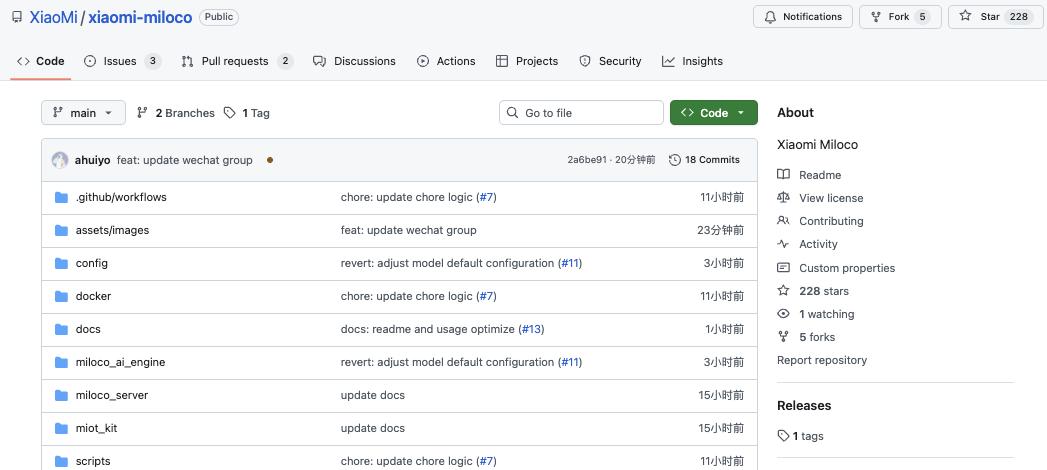
Core Insights - Xiaomi has launched its first "large model + smart home" solution called Xiaomi Miloco, which is a local AI assistant designed to enhance smart home interactions [1][3]. Product Overview - Xiaomi Miloco utilizes the MiMo-VL-Miloco-7B model, which is based on the previously released MiMo model, and connects to various IoT devices in the home [2][11]. - The solution aims to provide a new interaction paradigm through natural language processing, allowing users to communicate with their smart home systems [5][6]. Features and Capabilities - Miloco features a new interaction paradigm that allows users to set rules and control devices using natural language [5]. - It leverages visual data from Xiaomi's cameras to analyze home events and respond to user queries [5]. - The model operates on edge devices, ensuring privacy and security by processing data locally without sending it to external servers [14]. Ecosystem Integration - Miloco connects with the Xiaomi ecosystem and supports integration with third-party IoT platforms, enhancing its functionality [6][9]. - The hardware requirements for deploying Miloco are minimal, needing only x64 architecture and a GPU from NVIDIA's 30 series or higher [6]. Market Context - The launch of Miloco is seen as a significant moment for smart home technology, comparable to the impact of ChatGPT in the AI space [3][14]. - Xiaomi's move follows similar advancements from competitors, indicating a competitive landscape in the smart home sector [14].

广州轻优智能家居有限公司成立 注册资本10万人民币
Sou Hu Cai Jing· 2025-11-14 10:33
天眼查App显示,近日,广州轻优智能家居有限公司成立,注册资本10万人民币,经营范围为金属制日 用品制造;日用陶瓷制品销售;日用陶瓷制品制造;塑料包装箱及容器制造;塑料制品制造;玻璃纤维增强塑 料制品制造;玻璃纤维及制品制造;玻璃保温容器制造;玻璃制造;日用玻璃制品制造;五金产品批发;五金产 品研发;五金产品制造;纸制品销售;办公用品销售;玩具销售;办公设备耗材销售;文具用品零售;日用家电零 售;日用木制品销售;日用玻璃制品销售;日用品销售;日用口罩(非医用)销售;日用杂品销售;针纺织品销 售;金属制品销售;竹制品销售;家用电器销售;厨具卫具及日用杂品零售;家具销售;信息咨询服务(不含许 可类信息咨询服务);市场营销策划;网络技术服务;五金产品零售;玻璃纤维增强塑料制品销售;互联网销 售(除销售需要许可的商品);玻璃纤维及制品销售;塑料制品销售。 ...
小米发布智能家居未来探索方案Xiaomi Miloco
Feng Huang Wang· 2025-11-14 07:17
Core Insights - Xiaomi has launched a smart home exploration plan called Xiaomi Miloco, which is driven by large models to create a fully intelligent living environment [1] - The Miloco plan emphasizes privacy and security by deploying large models on the edge to protect user data [1] - The Xiaomi MiMo-VL-Miloco-7B visual language model serves as the technical core, enabling perception and understanding for smart home interactions [1] Summary by Categories Product Development - Xiaomi Miloco allows users to interact with the smart home system through conversation, utilizing reasoning and computation from large models to fulfill various smart needs [1] - The system is designed to reconstruct the interaction paradigm of home intelligence [1] Privacy and Security - The exploration plan prioritizes user privacy by ensuring that large models are deployed on the edge, preventing data breaches [1] Open Innovation - Miloco has been made available to the public and is hosted on GitHub, allowing developers to modify and expand any layer of the system [1] - The initiative fosters an "open co-creation" environment, encouraging collaboration and innovation within the developer community [1]
新兴产业领跑、传统产业焕新 上市公司结构向好创新向优
Jing Ji Ri Bao· 2025-11-14 00:27
Core Insights - The A-share market is experiencing a dual growth trend with emerging industries and traditional sectors both showing positive performance amid favorable macro policies and challenges such as weak global economic growth and insufficient domestic demand [1][2][5] Emerging Industries - New generation information technology, new energy, and new materials are leading the A-share market, with companies in these sectors showing strong performance [2] - In the first three quarters, 588 companies on the Sci-Tech Innovation Board achieved a total revenue of 1.01 trillion yuan, a year-on-year increase of 6.6% [2] - Key technological breakthroughs are driving the performance of technology companies, with significant advancements in biomedicine, high-end equipment, and communication sectors [2][3] Traditional Industries - Traditional industries are also innovating and improving efficiency, with companies like Midea Group and BYD showing growth in smart home and electric vehicle sales, respectively [5][6] - The steel and cement industries are optimizing supply-demand balances, with companies like Nanjing Steel and Anhui Conch Cement reporting significant profit increases due to improved pricing and cost management [7] R&D Investment - Increased R&D investment is providing strong internal momentum for technology companies, with the R&D intensity for the ChiNext, Sci-Tech Innovation Board, and Beijing Stock Exchange reaching 4.54%, 11.22%, and 4.42% respectively [4] - Companies like Zhongrun Optical are focusing R&D efforts on new product innovation, leading to substantial growth in core technology competitiveness [4] Investor Return Awareness - Companies are enhancing their awareness of investor returns, with an increase in cash dividend announcements and share buybacks, reflecting a commitment to shareholder value [8][9] - As of October 31, 2023, 1,033 companies announced cash dividend plans totaling 734.9 billion yuan, with 89 companies planning dividends exceeding 1 billion yuan [8] Future Outlook - Despite external uncertainties, many companies maintain an optimistic outlook for future growth, supported by proactive strategies and scientific planning [10]
上市公司结构向好创新向优
Jing Ji Ri Bao· 2025-11-13 22:10
Core Viewpoint - The A-share market is experiencing a dual growth trend in both emerging and traditional industries, driven by favorable macro policies and technological innovation, despite facing challenges such as weak global economic growth and insufficient domestic demand [1] Emerging Industries - Emerging industries, particularly in hard technology sectors like new generation information technology, new energy, and new materials, are showing strong performance, with 588 companies on the Sci-Tech Innovation Board achieving a total revenue of 1.01 trillion yuan, a year-on-year increase of 6.6% [2] - Key technological breakthroughs are driving the performance of technology companies, with 26 new Class 1 drugs approved in the biopharmaceutical sector and significant advancements in high-end equipment and communication technologies [2] - Companies like Mingzhi Electric and Obit Zhongguang are capitalizing on opportunities in AI and robotics, with revenue growth of 11.66% and 103.5% respectively in the first three quarters [3] R&D Investment - Increased R&D investment is providing strong internal momentum for technology companies, with R&D intensity reaching 4.54% for the ChiNext, 11.22% for the Sci-Tech Innovation Board, and 4.42% for the Beijing Stock Exchange [4] - Companies are focusing on innovation and technology breakthroughs to enhance their competitive edge, as seen with Zhongrun Optical's 50.47% increase in R&D spending [4] Traditional Industries - Traditional industries are also evolving, with companies like Midea Group and Seres adapting to new technologies and applications, resulting in a 13% increase in smart home revenue and significant sales in the electric vehicle sector [5][6] - The steel and cement industries are optimizing supply-demand balances, with companies like Nanjing Steel and Anhui Conch Cement reporting improved profit margins and net profit growth due to strategic adjustments [7] Investor Return Awareness - There is a growing awareness among companies regarding investor returns, with an increase in cash dividend announcements and share buybacks, totaling 734.9 billion yuan in cash dividends announced by 1,033 companies [8] - Companies like Yili Group are actively engaging in share buybacks and dividend distributions to enhance shareholder value [8][9] Future Outlook - Despite external uncertainties, many companies maintain an optimistic outlook for future growth, supported by proactive strategies in R&D, market expansion, and operational efficiency [10]
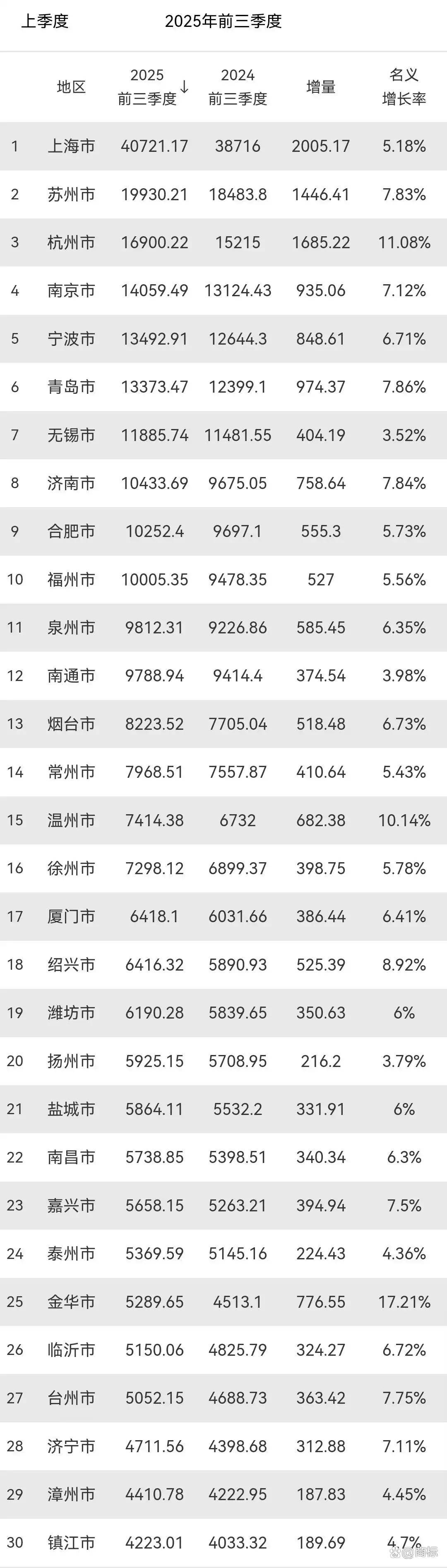
最新GDP!华东地区30强城市洗牌:青岛增速7.86%,温州反超徐州,南昌突破5700亿!
Sou Hu Cai Jing· 2025-11-13 20:50
Core Insights - The Eastern China region has shown remarkable economic growth in the first three quarters of the year, with 30 key cities experiencing steady economic increases, indicating a reshaping of regional competition dynamics [1][2] Group 1: Qingdao's Economic Performance - Qingdao leads with a growth rate of 7.86%, driven by its status as a national marine economy demonstration zone, where marine production value accounts for over 33% of the city's total economy [1][2] - The city has seen a 12% growth in the smart home industry, supported by leading companies like Haier and Hisense, and a 9.5% increase in high-end equipment manufacturing due to over 120 key projects with investments exceeding 100 billion [1][2] Group 2: Wenzhou's Economic Transformation - Wenzhou has surpassed Xuzhou, showcasing the vitality of its private economy, with a 17% increase in the core digital economy sector and a 3.2 percentage point rise in profit margins for traditional industries through digital and intelligent upgrades [4][5] - The city has a 67% share of private investment in total investment, attracting over a thousand technology companies and achieving a 24% increase in patent authorizations [5] Group 3: Nanchang's Economic Growth - Nanchang's economy has crossed the 570 billion mark, with significant contributions from strategic emerging industries, particularly in VR and aerospace equipment, and over 20 billion in new investments from Huawei's local headquarters [6][9] - The city's manufacturing tax contributions grew by 14%, with a notable 32% increase in sales of Jiangling's new energy vehicles, and the integrated circuit industry surpassing 50 billion [9] Group 4: Regional Innovation and Development - Cities like Hangzhou and Jinhua have achieved over 10% economic growth, with innovation as a core driver; Hangzhou's digital economy constitutes 48% of its economic structure, while Jinhua's cross-border e-commerce transactions grew by 35% [9][10] - The average R&D investment intensity among the top 30 cities in Eastern China has risen to 3.2%, surpassing the national average, highlighting the importance of converting technological achievements into productive forces [9][10]
银行卖房背后,一个被多数人忽略的真正信号:一个千亿生意正在上演
Sou Hu Cai Jing· 2025-11-13 08:27
Core Viewpoint - The news about banks selling houses signifies a shift in the real estate market from an "incremental era" to a "stock era," indicating a deeper value reconstruction rather than the end of the industry [1][3]. Group 1: Market Dynamics - Banks disposing of properties is essentially a clearance of the financial attributes of real estate, which activates a larger market for stock housing operations and consumption [3]. - Each successful transaction of bank-owned properties indicates a longer chain of economic activity, supporting a new commercial ecosystem rather than traditional developers [3]. Group 2: Benefiting Industries - The renovation and design industry is positioned as the primary beneficiary, as buyers of foreclosed or second-hand homes typically engage in renovations, providing a steady demand for design firms and contractors [5]. - The smart home industry finds a significant opportunity in upgrading old spaces, with a notable increase in sales for smart hardware solutions in older communities, highlighting a demand for suitable solutions in the stock market [6]. - Property management and community services are evolving from mere gatekeeping to integrated service platforms, focusing on deep community operations as new growth areas [7]. Group 3: Underestimated Industries - The hardware and building materials industry, often overlooked, is crucial in the renovation process, with the upcoming wave of stock renovations pushing this sector into the spotlight [9]. - An example includes the planned renovation of 10,000 old communities in 2024, where hardware components are due for replacement, reflecting a shift in consumer preferences towards quality and aesthetics [9]. Group 4: Innovation and Service Upgrades - Product innovation is essential, with a focus on developing items specifically designed for stock housing, such as ultra-thin smart locks and soundproof sliding doors, to establish a competitive edge [12]. - Service upgrades are transitioning from merely selling products to providing comprehensive solutions, enhancing customer experience and increasing average transaction values [12]. - Brand building is crucial for changing consumer perceptions of the hardware industry, aiming to establish a reputation for professionalism and reliability [13]. Group 5: Future Market Potential - The decline in real estate development presents a significant opportunity for the hardware industry, with over 1.5 billion square meters of residential stock expected to enter the renovation cycle in the next five to ten years, representing a multi-billion market [13][14]. - Industry platforms like "Zongou Direct Train" are becoming increasingly important, enabling local distributors and hardware stores to meet the new demands of the stock market through resource integration [14].

匠心家居11月12日获融资买入335.75万元,融资余额2565.71万元
Xin Lang Cai Jing· 2025-11-13 01:34
Core Insights - The stock of Jiangxin Home fell by 1.07% on November 12, with a trading volume of 82.1851 million yuan [1] - As of September 30, Jiangxin Home reported a revenue of 2.511 billion yuan for the first nine months of 2025, representing a year-on-year growth of 35.80% [2] - The company has distributed a total of 628 million yuan in dividends since its A-share listing, with 468 million yuan distributed in the last three years [3] Financing and Margin Trading - On November 12, Jiangxin Home had a net financing buy of -3.6113 million yuan, with a total financing balance of 26.4923 million yuan [1] - The financing balance of 25.6571 million yuan accounts for 0.13% of the circulating market value, which is below the 50th percentile level over the past year [1] - The company had a high margin trading balance of 835,200 yuan, exceeding the 90th percentile level over the past year [1] Shareholder Structure - As of September 30, the number of shareholders increased by 38.17% to 7,450, while the average circulating shares per person decreased by 27.62% to 19,393 shares [2] - The top ten circulating shareholders include notable funds such as Yongying Ruixin Mixed A and Hong Kong Central Clearing Limited, with significant increases in holdings [3]
进出口银行山东省分行成功投放全行首笔服务消费与养老再贷款
Zhong Guo Jing Ji Wang· 2025-11-12 17:31
Core Viewpoint - The successful loan issuance by the Shandong Branch of the China Export-Import Bank to Zibo Baishi Intelligent Home Co., Ltd. marks a significant breakthrough in the area of service consumption and elderly care financing, providing essential support for local inclusive elderly care development [1] Group 1: Company Overview - Zibo Baishi Intelligent Home Co., Ltd. is a state-owned micro-enterprise located in Huantai County, Zibo City, focusing on the elderly care market with products like electric monitoring smart beds [1] - The company aims to enhance its research and production capabilities for elderly-friendly products, driven by the recent financial support [1] Group 2: Financial Support and Impact - The loan represents the first of its kind in the sector for the bank, injecting "policy financial vitality" into local elderly care initiatives [1] - The financial backing will enable the company to improve the intelligence level of its products and meet the growing market demand, contributing to the high-quality development of the "silver economy" [1] Group 3: Bank's Role and Future Plans - The Shandong Branch of the China Export-Import Bank is committed to aligning with policy directions and addressing enterprise needs by customizing loan solutions [1] - The bank plans to continue increasing financial support for key sectors such as service consumption and elderly care, fulfilling its mission as a policy bank to bolster regional economic and social development [1]