
轻工制造

Search documents
行情切换一触即发 新消费与传统消费开启轮动行情
Mei Ri Jing Ji Xin Wen· 2025-08-26 08:04
Group 1 - The second quarter saw an influx of funds into the new consumption sector, driving an upward trend and raising market expectations for performance in this area [1] - As preliminary reports for the second quarter are released, some high-growth stocks have underperformed relative to previous expectations, leading to a market adjustment that is gradually stabilizing [1] - Despite the adjustments, leading companies continue to maintain stable high growth rates, suggesting that new consumption may experience a new round of market activity as overall consumer sentiment is expected to recover [1] Group 2 - Traditional consumption sectors are showing a high cost-performance ratio, with significant increases in various industries since August, including automotive (12.05%), home appliances (9.37%), and light manufacturing (8.4%) [1] - The valuation levels of these sectors are below their historical averages, with food and beverage, agriculture, home appliances, and social services all positioned below their valuation midpoints [1] - The expected profit growth rates for 2025E in these sectors are 8.64% for food and beverage, 22.26% for agriculture, 13.92% for home appliances, and 45.35% for social services, indicating good investment value in the current industry rotation context [1]
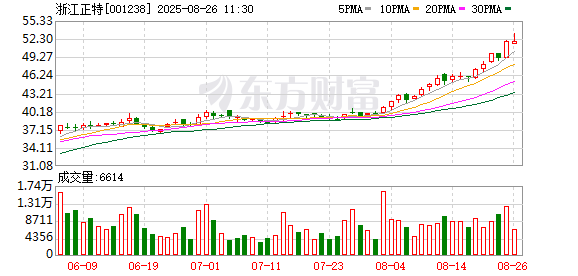
浙江正特持续走强,股价再创新高
Zheng Quan Shi Bao Wang· 2025-08-26 03:54
注:本文系新闻报道,不构成投资建议,股市有风险,投资需谨慎。 (文章来源:证券时报网) 浙江正特股价再创历史新高,该股近期呈不断突破新高之势,近一个月累计有11个交易日股价刷新历史 纪录。截至09:32,该股目前上涨1.89%,股价报52.86元,成交11.92万股,成交金额626.33万元,换手 率0.37%,该股最新A股总市值达58.15亿元,该股A股流通市值16.90亿元。 证券时报·数据宝统计显示,浙江正特所属的轻工制造行业,目前整体跌幅为0.17%,行业内,目前股价 上涨的有43只,涨幅居前的有岳阳林纸、*ST亚振、康欣新材等,涨幅分别为5.85%、5.00%、3.31%。 股价下跌的有116只,跌幅居前的有恒鑫生活、哈尔斯、浙江自然等,跌幅分别为7.75%、3.87%、 3.35%。 公司8月21日在交易所互动平台披露,截至最新(8月20日)股东户数为4164户,较上期(8月10日)减 少163户,环比下降3.77%。 公司发布的一季报数据显示,一季度公司共实现营业收入5.07亿元,同比增长41.69%,实现净利润 4054.79万元,同比增长90.86%,基本每股收益为0.3700元,加权平均净 ...

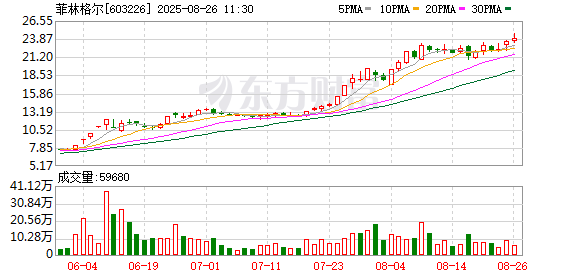
菲林格尔持续走强,股价再创新高
Zheng Quan Shi Bao Wang· 2025-08-26 03:53
菲林格尔股价再创历史新高,该股近期呈不断突破新高之势,近一个月累计有10个交易日股价刷新历史 纪录。截至09:33,该股目前上涨1.61%,股价报23.92元,成交77.21万股,成交金额1841.92万元,换手 率0.22%,该股最新A股总市值达85.03亿元,该股A股流通市值85.03亿元。 证券时报·数据宝统计显示,菲林格尔所属的轻工制造行业,目前整体跌幅为0.17%,行业内,目前股价 上涨的有43只,涨幅居前的有岳阳林纸、*ST亚振、康欣新材等,涨幅分别为5.85%、5.00%、3.31%。 股价下跌的有116只,跌幅居前的有恒鑫生活、哈尔斯、浙江自然等,跌幅分别为7.75%、3.87%、 3.35%。 公司发布的一季报数据显示,一季度公司共实现营业收入3388.62万元,同比下降33.94%,实现净利 润-1367.08万元,同比下降13.96%,基本每股收益为-0.0400元。 7月15日公司发布上半年业绩预告,预计实现净利润-3300.00万元至-2300.00万元,同比变动区间 为-119.30%~-52.85%。(数据宝) 注:本文系新闻报道,不构成投资建议,股市有风险,投资需谨慎。 (文章 ...

14只北交所股票融资余额增加超500万元
Zheng Quan Shi Bao Wang· 2025-08-26 01:42
Summary of Key Points Core Viewpoint - As of August 25, the total margin financing and securities lending balance on the Beijing Stock Exchange reached 7.376 billion yuan, indicating a daily increase of 38.576 million yuan, with the financing balance contributing the majority of this increase [1]. Group 1: Margin Financing and Securities Lending - The financing balance on the Beijing Stock Exchange was 7.376 billion yuan, up by 38.518 million yuan from the previous trading day, while the securities lending balance was 53.35 million yuan, increasing by 57,900 yuan [1]. - The stocks with the highest financing balances included Jinbo Biological, Shuguang Digital Innovation, and Aifeng Software, with financing balances of 335 million yuan, 217 million yuan, and 191 million yuan respectively [1]. - The average ratio of financing balance to circulating market value for these stocks was 1.25%, with the highest ratios seen in Wanyuantong, Minshida, and Juneng Co., at 4.16%, 3.95%, and 3.80% respectively [1]. Group 2: Net Buying and Selling Activity - On August 25, 136 stocks had net financing purchases, with 14 stocks seeing net purchases exceeding 5 million yuan. The top net buyer was Tongli Co., with a net purchase of 33.556 million yuan [2]. - Other notable net purchases included Guangxin Technology and Minshida, with net amounts of 16.039 million yuan and 14.792 million yuan respectively [2]. - The stocks with the highest net selling amounts included Guangmai Technology, Litong Technology, and Kangbiter, with net selling amounts of 14.557 million yuan, 12.496 million yuan, and 9.719 million yuan respectively [2]. Group 3: Industry Performance - The industries with the most stocks seeing net purchases over 5 million yuan were concentrated in computer, electronics, and automotive sectors, with 3, 3, and 2 stocks respectively [2]. - The average increase for stocks with net purchases over 5 million yuan was 1.03%, with notable gainers including Zhonghang Taida, Guangxin Technology, and Zhisheng Information, which rose by 29.99%, 4.35%, and 3.19% respectively [2]. - The average turnover rate for these stocks was 9.85%, with the highest turnover rates recorded for Zhonghang Taida, Guangxin Technology, and Hanxin Technology at 32.01%, 17.31%, and 15.32% respectively [2].

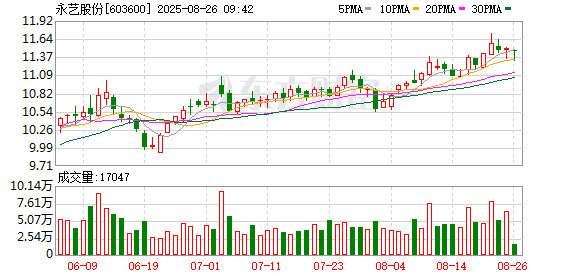
永艺股份2025半年度分配预案:拟10派1.6元
Zheng Quan Shi Bao Wang· 2025-08-26 01:41
证券时报·数据宝统计显示,公司今日公布了半年报,共实现营业收入21.89亿元,同比增长6.66%,实 现净利润1.33亿元,同比增长4.92%,基本每股收益为0.4元。 8月25日永艺股份发布2025半年度分配预案,拟10派1.6元(含税),预计派现金额合计为5286.93万元。 派现额占净利润比例为39.89%,这是公司上市以来,累计第15次派现。 公司上市以来历次分配方案一览 | 日期 | 分配方案 | 派现金额合计(亿元) | 股息率(%) | | --- | --- | --- | --- | | 2025.06.30 | 10派1.6元(含税) | 0.53 | 1.40 | | 2024.12.31 | 10派3元(含税) | 0.99 | 2.66 | | 2024.06.30 | 10派1.6元(含税) | 0.53 | 1.40 | | 2023.12.31 | 10派4元(含税) | 1.32 | 3.91 | | 2022.12.31 | 10派3.5元(含税) | 1.05 | 3.54 | | 2021.12.31 | 10派2.2元(含税) | 0.66 | 1.89 | | 20 ...

【机构策略】当前A股市场情绪处于历史较高水平
Zheng Quan Shi Bao Wang· 2025-08-26 01:01
Group 1 - Current A-share market sentiment is at a historically high level, characterized by liquidity, asset pricing differences, and trading activity [1] - Several industries, including chemicals, building materials, light manufacturing, machinery, defense, automotive, home appliances, textiles, non-bank financials, electronics, communications, computers, and media, are triggering congestion indicators [1] - A high number of industries are in a sustained congestion state, indicating potential for market adjustments [1] Group 2 - A-share market showed strong fluctuations with sectors like liquor, non-ferrous metals, communication equipment, and aerospace performing well, while electronic chemicals, automotive, beauty care, and utilities lagged [2] - There is a notable shift of household savings towards capital markets, providing a continuous source of incremental funds [2] - The overall profit growth expectation for A-share listed companies is projected to turn positive by 2025, ending a four-year decline, with significant elasticity in the technology innovation sector [2] Group 3 - Following stabilization of overseas liquidity disturbances, the A-share market continued its trend of rising volume and price, with the Shanghai Composite Index nearing 3900 points and total market turnover exceeding 30 trillion [3] - There is a focus on the rotation opportunities in recently popular sectors and potential rebounds in relatively low-positioned sectors supported by recent policies [3] - The "anti-involution" policy and demand-side policies are expected to significantly influence the A-share market, with household savings entering the market being a crucial support for index strength [3]
【机构调研记录】银河基金调研伟星新材、兆易创新等6只个股(附名单)
Zheng Quan Zhi Xing· 2025-08-26 00:09
Group 1: Galaxy Fund Research Insights - Galaxy Fund recently conducted research on six listed companies, focusing on their strategies to cope with market challenges and growth opportunities [1][2][3][4][5][6]. Group 2: Company-Specific Highlights - **Weixing New Materials (002372)**: The company is addressing industry demand pressure by enhancing product quality, accelerating business transformation, and implementing cost-saving measures. It has achieved channel penetration in Jiangsu, Zhejiang, and Shanghai, with plans for gradual expansion in other regions. The company anticipates a decline in product prices year-on-year in the first half of 2025, but a recovery in prices quarter-on-quarter is expected. The overall market demand remains weak, and the company aims for steady growth through new product combinations and a water ecosystem strategy [1]. - **Zhaoyi Innovation (603986)**: The company reported strong growth across its business lines in Q2 2024, with NOR Flash experiencing high single-digit growth and niche DRAM growing over 50%. The company expects significant revenue growth in niche DRAM in the second half of the year, driven by tight supply and rising contract prices. Overall gross margins are expected to remain stable, with a focus on customized storage technology and expanding into the automotive MCU market [2]. - **Tebao Bio**: The company is exploring combination therapies for hepatitis B treatment, focusing on optimizing drug strategies. It aims to enhance disease management through a comprehensive treatment network and is collaborating with Ligos for advanced solutions. New technologies like siRNA are entering clinical application stages, with a focus on optimizing combination therapy strategies [3]. - **Baili Tianheng**: The company is advancing its clinical trials for multiple cancer treatments in collaboration with BMS. It has submitted an IND application for its first nuclear medicine candidate and is progressing with several drug candidates in clinical trials. The company aims to become a leading player in oncology treatment within five years [4]. - **Stanley (002588)**: The company achieved steady growth in the first half of the year, with revenue reaching 6.391 billion yuan, a year-on-year increase of 12.66%. The compound fertilizer sales increased by 200,410 tons, up 9.68% year-on-year. Profit growth in Q2 was attributed to improved performance in new materials and better pricing strategies [5]. - **Reliable Co. (301009)**: The company experienced a decline in profits in Q2 due to promotional activities. It plans to expand its institutional and specialty channel business while launching its own brand. The company aims to increase its market share in baby care products despite facing intense competition [6].


北交所日报-20250825
Yin He Zheng Quan· 2025-08-25 13:52
Core Insights - The North Exchange 50 index increased by 0.23% to close at 1604.01 points on August 25, 2025, while the Shanghai Composite Index rose by 1.51% to 3883.56 points [3][4] - The overall trading volume on the North Exchange was 36.555 billion yuan, with a turnover rate of 5.76%, indicating a decrease compared to the previous week's average daily trading volume of 41.701 billion yuan [3][4] - The sectors that saw significant gains included Environmental Protection (+7.5%), Food and Beverage (+3.0%), and Non-ferrous Metals (+2.8%), while the sectors with notable declines were Oil and Petrochemicals (-1.9%) and Electronics (-1.0%) [3][4] Market Performance - Among the 273 listed companies on the North Exchange, 122 companies experienced an increase in stock price, while 141 companies saw a decline [3][4] - The top gainers included Zhonghang Taida (+29.99%), Longzhu Technology (+13.89%), and Kunming Technology (+11.70%), while the largest decliners were Tongli Co. (-9.88%) and Qianjin Technology (-5.85%) [3][8][9] Valuation Metrics - The overall valuation of companies on the North Exchange was reported at a price-to-earnings (P/E) ratio of 55.59 times, which is higher than the P/E ratios of the Sci-Tech Innovation Board (69.10 times) and the Growth Enterprise Market (42.93 times) [3][12] - The highest average P/E ratio among sectors on the North Exchange was in Electronics at 231.3 times, followed by Computers at 162.9 times and Home Appliances at 133.3 times [3][12]
天量大涨,珍惜牛市主升浪!
Sou Hu Cai Jing· 2025-08-25 11:30
Core Viewpoint - The A-share market continues its strong momentum with major indices reaching new highs, driven by favorable policies and industry upgrades, indicating a potential continuation of this strong market trend [1][2]. Major Index Performance - A-share indices collectively surged, with the Shanghai Composite Index rising by 1.51% to 3883.56 points, Shenzhen Component Index and ChiNext Index increasing by 2.26% and 3.00% respectively, and the Sci-Tech 50 Index up by 3.2% [2]. - The total market turnover reached 3.14 trillion yuan, a significant increase of nearly 600 billion yuan compared to the previous trading day, marking a historical high in trading volume [2]. - The Hong Kong market also saw gains, with the Hang Seng Index up by 1.94% to 25829.91 points, the Hang Seng Tech Index rising by 3.14% to 5825.09 points, and the Hang Seng China Enterprises Index increasing by 2.39% [2]. Industry Hotspots and Driving Logic - The A-share market exhibited notable sector rotation, with technology growth and cyclical resource sectors driving the market. The telecommunications sector surged by 4.85%, supported by themes related to computing power and AI hardware [3]. - The non-ferrous metals sector rose by 4.63%, bolstered by demand from the new energy supply chain and high-end manufacturing [3]. - The real estate sector increased by 3.32% due to local policy optimizations, while the comprehensive sector and steel sector also showed positive performance, indicating a strong market response to growth-stabilizing policies [3]. - In the Hong Kong market, the materials sector led with a 4.42% increase, followed by non-essential consumer goods and information technology sectors, which rose by 3.41% and 2.46% respectively [3]. Underperforming Sectors and Driving Logic - All 31 A-share industries recorded gains, but the beauty care and textile sectors lagged, reflecting ongoing market divergence regarding consumer recovery [4]. - In the Hong Kong market, sectors such as online education, fintech, and stablecoins experienced declines, indicating a cautious risk appetite for high-valuation stocks [4]. Investment Strategy Recommendations - With supportive policies and capital inflows creating a positive cycle, the economic recovery expectations and industry upgrade logic are driving the stock market steadily upward [5]. - The market is showing significant sector rotation, suggesting a need to avoid chasing high prices. The alternating performance between cyclical sectors like telecommunications and non-ferrous metals and technology growth sectors will be key to maintaining market momentum [5]. - Low-valuation sectors such as real estate and consumer goods are beginning to show potential for recovery under policy catalysts, necessitating a dynamic balance between valuation safety margins and industry prosperity [5].
菲林格尔股价又创新高,今日涨4.60%
Zheng Quan Shi Bao Wang· 2025-08-25 10:26
公司发布的一季报数据显示,一季度公司共实现营业收入3388.62万元,同比下降33.94%,实现净利 润-1367.08万元,同比下降13.96%,基本每股收益为-0.0400元。 7月15日公司发布上半年业绩预告,预计实现净利润-3300.00万元至-2300.00万元,同比变动区间 为-119.30%~-52.85%。 菲林格尔 股价再创历史新高,该股近期呈不断突破新高之势,近一个月累计有10个交易日股价刷新历 史纪录。截至14:19,该股目前上涨4.60%,股价报23.42元,成交795.96万股,成交金额1.82亿元,换手 率2.24%,该股最新A股总市值达83.26亿元,该股A股流通市值83.26亿元。 证券时报?数据宝统计显示,菲林格尔所属的轻工制造行业,目前整体涨幅为0.15%,行业内,目前股 价上涨的有78只,涨幅居前的有 龙竹科技 、 劲嘉股份 、 蒙娜丽莎 等,涨幅分别为10.81%、10.07%、 10.03%。股价下跌的有80只,跌幅居前的有 匠心家居 、 金陵体育 、 翔港科技 等,跌幅分别为 11.11%、10.86%、7.89%。 ...