公用事业

Search documents
全球资产配置资金流向月报(2026年1月)-20260112
Shenwan Hongyuan Securities· 2026-01-12 14:42
Group 1: Seasonal Capital Inflows - In January, significant seasonal inflows of global capital into Chinese equity markets (including A-shares, H-shares, and Chinese concept stocks) are expected, with a historical probability of 76% for the Hang Seng Index to have a positive annual return if inflows are positive[12] - Since 2000, global capital typically experiences a significant inflow into Hong Kong local stocks in January after marginal outflows in December[10] - In December 2025, the inflow into the Chinese equity market reached $177.6 billion, while the inflow into the emerging market bond market was $177.7 billion[26] Group 2: Global Asset Flow Overview - As of December 31, 2025, the relative inflow ratio for Chinese fixed-income funds reached 11.2%, leading other markets, while equity funds saw a 1.3% inflow, also leading other major markets[23] - In December, the U.S. equity market saw inflows of $778.8 billion, while emerging markets experienced inflows of $339.5 billion[19] - The inflow into the U.S. fixed-income market was substantial, with $391.3 billion in December, indicating a preference for U.S. assets[19] Group 3: Fund Type Analysis - In December, passive equity funds accounted for a significant portion of inflows into emerging markets, with $347 billion, although this was a decrease from $424 billion in November[60] - Active equity funds saw outflows of $7 billion in emerging markets, with China experiencing a $5 billion outflow in December[60] - The inflow into Chinese fixed-income markets was $178 billion in December, representing 68% of the total inflow into emerging market bonds[57]
20股筹码连续3期集中
Zheng Quan Shi Bao Wang· 2026-01-12 09:17
Core Insights - The article highlights a trend of decreasing shareholder accounts among 147 companies, indicating a concentration of shares, with some companies experiencing declines for over three consecutive periods [1][2]. Group 1: Shareholder Account Trends - 20 companies have reported a continuous decrease in shareholder accounts for more than three periods, with the most significant decline being 8 periods for companies like Rainbow Group and Zhongshe Co., Ltd [1]. - Rainbow Group's latest shareholder account number is 14,099, reflecting a cumulative decrease of 37.90%, while Zhongshe Co., Ltd has 17,257 accounts, with a cumulative decline of 19.20% [1]. - Other companies with notable declines include Changyuan Power and Huari Co., Ltd, which also show a trend of decreasing shareholder accounts [1]. Group 2: Market Performance - Among the companies with declining shareholder accounts, 10 have seen their stock prices increase, while another 10 have experienced declines, with Huari Co., Ltd, Hongming Co., Ltd, and Dalian Thermal Power showing significant increases of 34.70%, 14.28%, and 5.39% respectively [2]. - Only 2 companies outperformed the Shanghai Composite Index during this period, with Huari Co., Ltd and Hongming Co., Ltd achieving relative returns of 29.38% and 10.63% respectively [2]. - The sectors with the highest concentration of companies experiencing declining shareholder accounts include public utilities, non-bank financials, and electronics, with 4, 3, and 2 companies respectively [2]. Group 3: Detailed Company Data - The article provides a detailed table of companies with declining shareholder accounts, including their latest account numbers, percentage changes, and stock performance relative to the Shanghai Composite Index [2][3]. - For instance, Fulong Technology reported 51,363 accounts, a decrease of 7.34%, while Huari Co., Ltd had 11,700 accounts, down by 3.18% but with a stock increase of 34.70% [2][3]. - Other companies listed include Changcheng Securities, Dalian Thermal Power, and Hongming Co., Ltd, each with varying degrees of account changes and stock performance [3].





3.6万亿!A股再次见证历史,沪深两市成交额刷新历史新高!杠杆资金密集进场,两融余额也创历史新高,2025年两融账户新开户突破154万
Jin Rong Jie· 2026-01-12 09:01
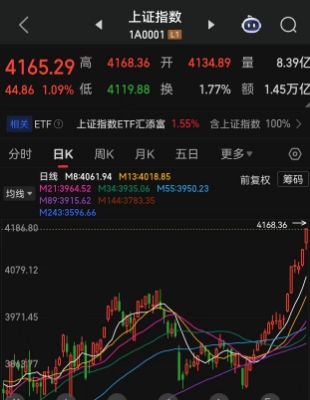
Core Viewpoint - A-shares have witnessed a historic surge, with trading volumes reaching unprecedented levels, indicating strong market momentum and investor confidence in various sectors, particularly in commercial aerospace and AI applications [1][3]. Group 1: Market Performance - On January 12, the Shanghai Composite Index broke through 4150 points, with trading volumes exceeding 3.6 trillion yuan, marking a significant increase of 478.7 billion yuan from the previous trading day [1]. - The trading volume surpassed 2 trillion yuan for the second consecutive day and exceeded 3 trillion yuan for the first time since October 8, 2024 [1]. Group 2: Leverage and Fund Inflows - In the first week of January, net inflows of leveraged funds reached 85.779 billion yuan, ranking fifth in A-share history for weekly inflows [3]. - The margin trading balance hit a record high of 26,276.01 billion yuan, accounting for 2.55% of the A-share market's circulating market value [3][5]. Group 3: Sector Analysis - All sectors except utilities and food and beverage saw significant net inflows of leveraged funds, with the electronics sector leading at 15.812 billion yuan, followed by non-ferrous metals at 9.562 billion yuan, and defense and military at 9.173 billion yuan [5]. - The number of margin trading accounts reached a decade-high, with 1.5421 million new accounts opened in 2025, reflecting a 52% increase from 2024 [5]. Group 4: Future Market Outlook - According to CITIC Securities, the current market excitement is driven by pent-up demand from investors, with expectations of continued momentum in thematic sectors until the National People's Congress [6]. - Huatai Securities suggests that while the spring market may still have room for growth, the concentration of trading structures indicates a potential shift towards rotation among hot sectors [6][7]. - The potential new marginal drivers for A-shares include abnormal inflows into A500 ETF, the appreciation of the yuan reflecting international confidence, and active themes such as AI and commercial aerospace [7].

同样是牛市,为什么2025年赚钱比2020年难?
雪球· 2026-01-12 08:39
Group 1 - The core viewpoint of the article emphasizes that the A-share market is more sensitive to liquidity than to macro fundamentals, indicating a structural bull market driven by capital influx rather than corporate performance [3][4][5] - The overall revenue and net profit growth of non-financial listed companies in the first three quarters was only 0.7% and 1.92% respectively, contrasting with the over 20% growth expected for the entire year, highlighting a disconnect between market performance and corporate earnings [4] - The article identifies two types of capital influencing the market: one based on fundamental performance expectations and the other driven by momentum effects, leading to a "stronger gets stronger" dynamic in stock performance [5][6] Group 2 - True momentum sectors are characterized by sustainable growth logic and broad industry trends, supported by measurable performance variables, while pseudo-momentum sectors rely on speculative assumptions and are often driven by market sentiment [10][11] - The article discusses the distinction between true and pseudo momentum, noting that true momentum sectors have strong institutional participation and consistent earnings growth, while pseudo momentum sectors often lack fundamental backing and are more volatile [12][13] - The performance of momentum strategies in the A-share market has been inconsistent, with cross-sectional momentum strategies underperforming due to rapid sector rotations and frequent policy changes [17][18] Group 3 - The article suggests that the market dynamics in 2025 will be more challenging for investors compared to the 2019-2021 period, where both cross-sectional and time-series momentum strategies were effective due to strong macro fundamentals and diverse sector performance [20][21] - It highlights that the lack of counterbalancing sectors in the A-share market has led to extreme price movements, where strong sectors experience rapid increases followed by sharp declines [24] - The article provides four recommendations for investors to navigate the current momentum-driven market, emphasizing the importance of recognizing sector differentiation, maintaining confidence in fundamentally strong stocks, and being sensitive to trend reversal signals [27][30]

港股开盘 | 恒指高开0.55% 科网股活跃 美团(03690)、百度(09888)涨超2%
智通财经网· 2026-01-12 01:40
Group 1 - The Hang Seng Index opened up by 0.55%, and the Hang Seng Tech Index rose by 0.88%, with notable gains in tech stocks like Meituan and Baidu, both increasing over 2% [1] - Lithium stocks showed strong performance, with Ganfeng Lithium and Tianqi Lithium both rising over 4%, while the precious metals sector also strengthened, with Zijin Mining up nearly 3% and China Aluminum increasing over 2% [1] - Citic Securities anticipates a second round of valuation recovery and performance resurgence in the Hong Kong stock market by 2026, driven by internal "15th Five-Year Plan" catalysts and external economic stimulus [1] Group 2 - Zheshang International views the fundamentals of the Hong Kong stock market as still weak, with a slight decline in the funding environment, but maintains a cautiously optimistic outlook for the mid-term market trends [2] - The firm highlights sectors that are relatively prosperous and benefit from policy support, including new energy, innovative pharmaceuticals, and AI technology, as well as low-valuation state-owned enterprises [2] - The expected performance of the Hong Kong stock market in spring 2026 is projected to be driven by "AI applications, PPI improvement, and expanded domestic demand," with a recommendation to focus on quality stocks in these areas [2]




机构研究周报:中国市场长牛基础日益坚实
Wind万得· 2026-01-11 22:42
Group 1 - The current A-share market ecosystem is undergoing systematic restructuring, with a solid foundation for a "long bull, slow bull" market being established. The strategic position of the capital market has significantly improved, and the institutional framework is becoming more refined, providing a solid guarantee for stable market operations [5][14] - The "New Nine Articles" are promoting a transformation of the market from being financing-led to a balanced focus on both financing and investment, leading to continuous improvements in the quality of listed companies and investor protection [5] - The profitability of core assets is showing signs of a turning point, with both technology and traditional sectors presenting structural opportunities, and the matching of valuation and profitability is improving [5] Group 2 - The spring market is expected to gradually unfold, supported by factors that have driven previous market activity, including liquidity factors such as margin trading and insurance capital, which are anticipated to continue into January [6] - The macroeconomic environment, including the previous appreciation of the RMB, is creating a favorable atmosphere for liquidity and risk appetite, with potential catalysts such as policy adjustments and improvements in fundamental data expected in January [6] - After a two-month earnings window, listed companies will once again face fundamental verification as they enter the earnings forecast disclosure window in January [6] Group 3 - A-share market is expected to maintain an upward trend, with structural inflows of incremental funds anticipated in January, supported by the appreciation of the RMB and foreign capital positioning at the year-end [7] - Market sentiment appears slightly subdued, with industry preferences concentrated in sectors such as non-ferrous metals and defense, suggesting that investors should focus on large-cap styles and policy-related industry opportunities [7] Group 4 - The commercial aerospace industry is expected to enter a period of explosive growth, with the current phase being the initial stage of large-scale infrastructure development, accelerating towards commercial applications [13] - The "Space Power" goal is clearly defined, with national strategic support guiding the industry, and the low-orbit satellite internet constellation is set to begin high-density networking by 2025, marking a critical window for large-scale networking from 2025 to 2027 [13] Group 5 - A weak dollar cycle is expected to boost the performance of A/H shares, as it drives domestic exports and improves corporate profits, with global liquidity easing valuations and funds favoring high-growth emerging markets [14] - Structural improvements in sectors such as technology and domestic demand are anticipated to benefit from corporate profit recovery, leading to a rebound in these areas [14]

公用事业行业周报(2026.01.05-2026.01.09):长协电价风险落地,结算电价有望好于预期-20260111
Orient Securities· 2026-01-11 12:12
Investment Rating - The report maintains a "Positive" outlook for the utility sector, indicating that the expected settlement price for thermal power in 2026 is likely to be better than market expectations [7]. Core Insights - The long-term contract electricity price risk has materialized, and the average reduction in long-term contract electricity prices for 2026 is estimated to be around 3-4 cents per kilowatt-hour. However, the capacity price for coal-fired power is expected to increase by at least 65 yuan per kilowatt per year, which may lead to a lower-than-expected decline in thermal power settlement prices [7]. - The report highlights that the performance expectations for the utility sector have reached a low point, making low-priced utility assets worth considering for investment [7]. - The report suggests that the utility sector remains a quality dividend asset for long-term allocation, especially under the trend of low interest rates and policies encouraging long-term capital market entry [7]. Summary by Sections Electricity Price Dynamics - The average clearing price for the Guangdong electricity market from January 3 to January 9, 2026, was 321 yuan per megawatt-hour, down 51 yuan year-on-year (-13.7%) [10]. - The average price for Shanxi during the same period was 234 yuan per megawatt-hour, down 107 yuan year-on-year (-31.4%) [10]. Coal Price Trends - As of January 9, 2026, the price of Q5500 thermal coal in Qinhuangdao was 699 yuan per ton, reflecting a week-on-week increase of 17 yuan (+2.5%) [15]. - The coal inventory at Qinhuangdao port decreased by 11.6% week-on-week, indicating a tightening supply situation [21]. Performance of Utility Sector - The utility sector index increased by 2.5% during the week of January 5 to January 9, 2026, underperforming compared to the Shanghai Composite Index, which rose by 2.8% [35]. - The report notes that the gas sector within utilities showed the highest weekly increase of 4.8% [37]. Investment Recommendations - The report recommends focusing on quality dividend assets in the utility sector, particularly in thermal power, hydropower, and nuclear power, with specific stocks highlighted for potential investment [7].






每日机构分析:1月9日
Xin Hua Cai Jing· 2026-01-09 12:33
Group 1 - The U.S. labor market may have passed its worst phase, with the upcoming December non-farm payroll report seen as a key indicator to validate this trend [1][2] - The market for short positions on the U.S. dollar is becoming crowded, and a seasonal rebound in the first quarter could lead to a technical recovery for the dollar, particularly against currencies like the euro and Australian dollar that are heavily shorted [1] - Germany is facing a structural economic dilemma, with a report indicating that corporate bankruptcies are expected to reach 17,604 in 2025, the highest level since 2005, impacting approximately 170,000 jobs [2] Group 2 - The volatility of U.S. Treasury bonds has dropped to a four-year low, suggesting that the market may have returned to a more stable state following significant disruptions caused by high inflation and aggressive rate hikes [3] - Geopolitical uncertainties in Greenland are increasing the term premium on Eurozone long-term bonds, as investors anticipate higher defense spending in Europe [3] - Germany's industrial output showed a temporary rebound in November due to a recovery in automobile production, but overall, the economy remains stagnant with a 2.5% decline in exports [3]
2026 年可转债年度策略:穿越“墨西拿海峡”
Huafu Securities· 2026-01-09 11:55
Group 1 - The report highlights that the valuation of convertible bonds does not directly reflect the volatility of the underlying stocks but rather follows the directional changes of the stocks. The market's confidence in the direction of stocks for 2026 remains strong, and the opportunity cost of convertible bonds is expected to be low in the near term [3][4] - The current high valuation of convertible bonds has already factored in significant expected increases in the underlying stocks' prices. The report suggests that the potential for further valuation increases in 2026 may rely more on the recovery of profitability rather than broad-based earnings growth [4][10] - The convertible bond market is expected to exhibit a "dumbbell" structure in 2026, with an increase in the number of new issues and changes in individual bond sizes and industry structures. However, the overall high valuation level may lead to new issues maintaining elevated listing valuations, making secondary market participation less attractive [5][10] Group 2 - The report discusses the construction of a long inflation strategy portfolio, including specific convertible bonds from sectors such as agriculture and electronics, while also preparing a corresponding cash flow strategy portfolio to mitigate potential adverse scenarios [9][10] - The analysis indicates that the high-low price strategy did not yield significant excess returns in 2025, and the report emphasizes the need to maintain a focus on low absolute price screening levels for future selections [6][10] - The report notes that the implied volatility of convertible bonds has recently exceeded the actual volatility of the underlying stocks, indicating a divergence that may reflect market sentiment rather than fundamental value [3][87]
2025年业绩高增长股提前看 18股净利润增幅翻倍
Zheng Quan Shi Bao Wang· 2026-01-09 04:08
Core Insights - A total of 74 companies have released their annual performance forecasts, with 58 companies expecting profit increases, representing 78.38% of the total [1] - The overall proportion of companies reporting positive forecasts is 83.78%, with 4 companies expecting profits and 7 companies expecting losses [1] - Among the companies with positive forecasts, 18 are expected to see net profit growth exceeding 100%, while 13 companies anticipate growth between 50% and 100% [1] Company Performance - The company with the highest expected net profit growth is Zhongtai Co., with a median increase of 677.22% [2] - Other notable companies include Zhongke Lanyun with a 371.51% increase and Chuanhua Zhili with a 308.82% increase [2] - The average increase for companies expecting profit growth has been 10.46% year-to-date, outperforming the Shanghai Composite Index [1] Industry Insights - The sectors with companies expecting profit growth exceeding 100% are primarily concentrated in electronics, biomedicine, and basic chemicals, with 3, 2, and 2 companies respectively [1] - The companies expecting significant profit increases are distributed across different boards, with 11 from the main board, 5 from the ChiNext board, and 2 from the Sci-Tech Innovation board [1]