养殖业

Search documents
天域生物科技股份有限公司 2025年9月养殖业务主要经营数据公告
Zhong Guo Zheng Quan Bao - Zhong Zheng Wang· 2025-10-14 05:29
Core Points - The company reported its main operational data for the pig farming business in September 2025, highlighting sales figures and revenue changes compared to previous periods [1] - The company sold 28,600 pigs in September 2025, generating revenue of 32.76 million yuan, with month-on-month changes of 10.33% and 9.77%, respectively [1] - Year-on-year comparisons show a 38.73% increase in sales volume but a 36.47% decrease in revenue [1] - Cumulatively, from January to September 2025, the company sold 276,000 pigs, a year-on-year increase of 19.64%, while total revenue reached 395.16 million yuan, reflecting a 4.59% year-on-year decline [1] - As of the end of September 2025, the company had a pig inventory of 179,800, which is a 12.69% increase year-on-year but a 0.68% decrease month-on-month [1] Summary of Monthly Operational Data - The monthly operational data is summarized, indicating potential rounding differences in the figures presented [2] Special Notes - The operational data provided is unaudited and may differ from figures disclosed in regular reports, serving only as interim data for investor reference [3] - The company cautions that future sales volumes and revenues may experience monthly fluctuations due to significant market price volatility and changes in the company's breeding schedule [3]

养殖业板块10月13日跌0.35%,圣农发展领跌,主力资金净流入1.82亿元
Zheng Xing Xing Ye Ri Bao· 2025-10-13 12:38
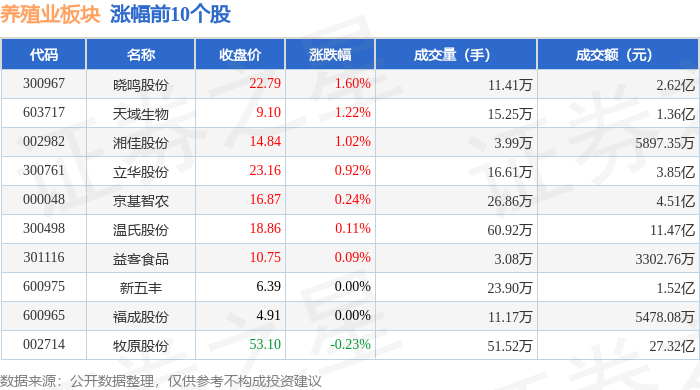
证券之星消息,10月13日养殖业板块较上一交易日下跌0.35%,圣农发展领跌。当日上证指数报收于 3889.5,下跌0.19%。深证成指报收于13231.47,下跌0.93%。养殖业板块个股涨跌见下表: | 代码 | 名称 | 收盘价 | 涨跌幅 | 成交量(手) | 成交额(元) | | --- | --- | --- | --- | --- | --- | | 300967 | 晓鸣股份 | 22.79 | 1.60% | 11.41万 | 2.62亿 | | 603717 | 天域生物 | 9.10 | 1.22% | 15.25万 | 1.36亿 | | 002982 | 湘佳股份 | 14.84 | 1.02% | 3.99万 | 5897.35万 | | 300761 | 立华股份 | 23.16 | 0.92% | - 16.61万 | 3.85亿 | | 000048 | 京基智农 | 16.87 | 0.24% | 26.86万 | 4.51亿 | | 300498 | 温氏股份 | 18.86 | 0.11% | 60.92万 | 11.47亿 | | 301116 | 益客食品 | 10 ...


2025年双粕四季度报告:贸易及南美种植多空交织阶段行情对待
Zhong Hui Qi Huo· 2025-10-13 05:53
1. Report Industry Investment Rating No relevant content provided. 2. Core Viewpoints of the Report - In Q4 2025, the price of soybean meal is expected to stop falling, stabilize, and rebound due to weather speculation in Brazil. However, considering the weak La Nina in winter, the January contract of soybean meal is unlikely to show a bullish trend. There is also a risk of decline if there is a Sino - US trade agreement. Short - term phased trading is recommended, and long - position operations require careful position and risk management [5][7][109]. - Rapeseed meal has been mainly following the trend of soybean meal due to high inventory pressure. There may be opportunities to go long on far - month rapeseed meal contracts considering the low inventory of rapeseed and rapeseed meal in domestic coastal crushing plants and the stagnant China - Canada trade. Attention should be paid to the subsequent development of China - Canada trade, as an improvement in the relationship would be unfavorable for far - month contracts of rapeseed products [9][112]. 3. Summary by Relevant Catalogs 3.1 Chapter 1: Review of the Third - Quarter Market of Soybean Meal and Rapeseed Meal - **Soybean Meal**: In Q3, the price of domestic soybean meal first rose and then fell. It reached a new high for the year in mid - August due to factors such as the Sino - US trade tariff increase, weather premium during the US soybean planting period, the anti - dumping preliminary ruling on Canadian rapeseed by China, and the significant reduction in the US soybean planting area in the USDA report. Subsequently, the price declined due to good weather for US soybean planting, high port inventory of rapeseed meal in China, and other factors [15]. - **Rapeseed Meal**: In Q3, the price of rapeseed meal first increased and then decreased. It reached a new high for the year in mid - August after China announced a deposit system for Canadian rapeseed. Subsequently, high port inventory of imported granular rapeseed meal, concerns about the improvement of China - Canada trade tariffs, and the resumption of China - Australia rapeseed trade suppressed the price [16]. 3.2 Chapter 2: Supply and Demand Situation of the International Soybean Market - **Global Climate**: There is a 71% probability of La Nina occurring from October to December 2025, which may continue until February 2026, with a probability dropping to 54% [21]. - **Global Soybean Inventory - to - Consumption Ratio**: The global soybean inventory - to - consumption ratio is expected to decline. As of the September USDA report, it was 0.29, lower than last year's 0.3 but still above the median of the past decade. There are uncertainties in the future inventory - to - consumption ratio, especially if the Sino - US negotiation remains unresolved, the inventory - to - consumption ratio of Brazilian soybeans may improve significantly [24]. - **US Soybeans**: The planting area of US soybeans decreased, but the yield is expected to be high. The USDA adjusted the planting area and yield estimates, and as of September 28, 2025, the soybean harvest rate was 19%, the excellent - good rate was 62%, and the defoliation rate was 79% [28]. - **US Biodiesel**: In August, the EPA's handling of the backlog of small refinery exemption applications was positive for market confidence. However, in September, differences over the exemption issue led to a delay in the plan, increasing market uncertainty [29][30]. - **Brazilian Soybeans**: The 2025/26 production is expected to increase slightly year - on - year. The planting started in mid - September, but there is a risk of insufficient rainfall in the southern region. As of September 27, the sowing rate was 3.5%. The export volume in September was expected to be 675 tons, and the export volume of soybean meal was expected to be 637 tons [33][34][35]. - **Argentine Soybeans**: The 2025/26 production is expected to decrease slightly. The planting area is expected to decline by 4.3% to 17.6 million hectares, and the production is expected to be 47 million tons. The government temporarily removed export taxes on soybeans and related products from September 22 to October 31 or until the export volume reached $7 billion [40][43]. - **Global Rapeseed**: The global rapeseed production has recovered, with an output of 90.96 million tons in 2025, higher than last year's 85.73 million tons. Canada's rapeseed production is also expected to increase, reaching 20 million tons [47]. - **China's Anti - Dumping Investigation on Canadian Rapeseed**: China's Ministry of Commerce imposed a 75.8% deposit on Canadian rapeseed imports starting from August 14, 2025, and extended the investigation period to March 9, 2026, due to the complexity of the case [49][50]. 3.3 Chapter 3: Supply Situation of the Domestic Oilseed Market - **Soybean Imports**: In August 2025, China imported 12.279 million tons of soybeans, a year - on - year increase of 1.11%. From January to August, the cumulative import volume was 73.312 million tons, a year - on - year increase of 4%. The main sources of imports were Brazil, Argentina, Uruguay, and the US [56]. - **Soybean and Soybean Meal Inventory and Crushing**: As of September 26, 2025, the national port soybean inventory was 9.385 million tons, and the inventory of 125 oil mills was 7.1991 million tons. The soybean meal inventory of 125 oil mills was 1.1892 million tons. In September, the national soybean crushing volume was 9.9354 million tons [58][60][62]. - **Soybean and Soybean Meal Supply from October to December**: From October to December, the soybean import supply is expected to be sufficient, and the supply of soybean meal in Q4 is also expected to be good [64]. - **Soybean Meal Basis and Spread**: In Q3, the soybean meal basis rebounded from a low level but remained in a negative state. As of October 9, the basis for the January and May contracts was - 39 yuan/ton and 145 yuan/ton respectively. The 5 - 1 spread of soybean meal was 184 yuan/ton as of October 9 [68][71]. - **Rapeseed Market Supply**: In August 2025, the rapeseed import volume was 246,600 tons, and the cumulative import volume from January to August was 2.3306 million tons. As of October 3, the coastal oil mill rapeseed inventory was 6,000 tons, and the rapeseed meal inventory was 26,800 tons. The basis of rapeseed meal in East China was 25 yuan/ton as of October 9 [74][78][86]. - **Soybean Meal and Rapeseed Meal Price Difference**: In Q3, the price difference between soybean meal and rapeseed meal futures was relatively stable, while the spot price difference rebounded. As of October 9, the futures price difference was 504 yuan/ton, and the spot price difference was 440 yuan/ton [89]. 3.4 Chapter 4: Domestic Downstream Livestock and Poultry Market - **National Feed Production**: In August 2025, the national industrial feed production was 29.36 million tons, a year - on - year increase of 3.8%. From January to August, the cumulative production was 216.18 million tons, higher than the same period last year [90][92]. - **Pig Market**: As of the end of June 2025, the national pig inventory was 424.47 million heads. In August, the inventory of breeding sows was 40.38 million heads. The piglet sales volume in August was 547,100 heads. The pig farming profit declined in Q3 [95][97][99]. - **Egg and Broiler Chicken Farming**: The egg - laying hen farming profit decreased significantly after the festival, with a profit of - 4.94 yuan/feather as of October 9. The broiler chicken farming profit fluctuated greatly in Q3, with a profit of - 1.55 yuan/feather as of October 10. The inventory of laying hens and broiler chickens was at a relatively high level, indicating optimistic feed demand [102][103][105]. - **Meat Duck Inventory**: As of October 3, the national meat duck parent - stock inventory was 249,000 sets, and the daily average hatching volume of commercial - generation meat ducks was 9.3 million feathers [108]. 3.5 Chapter 5: Price Outlook for the Double - Meal Market - **Soybean Meal Market**: Supply is affected by the harvest of US soybeans, Sino - US trade relations, and weather in Brazil. Domestic supply is sufficient, and the January contract is under pressure. Consumption is expected to be acceptable in Q4 but weaker than in the first half of the year. Overall, the price may stop falling and rebound, but there are risks [5][109]. - **Rapeseed Meal Market**: International supply is affected by the harvest of Canadian rapeseed and the opening of Australian rapeseed imports. Domestic supply is affected by inventory and China - Canada trade. Downstream consumption is in the off - season in Q4. It mainly follows the trend of soybean meal, and attention should be paid to China - Canada trade relations [9][112].
中美博弈加剧,种植产业链会重演4
2025-10-13 01:00
Summary of Conference Call on Sino-U.S. Agricultural Trade Dynamics Industry Overview - The conference call discusses the agricultural trade dynamics between China and the United States, focusing on key products such as soybeans, corn, sorghum, and cotton. The trade volume is projected to be around $40 billion in 2024, with China being a significant buyer of U.S. agricultural products, particularly in soybeans and sorghum [1][2][3]. Key Points and Arguments - **Impact of Tariffs**: The implementation of reciprocal tariffs by the U.S. could lead to retaliatory measures from China, resulting in increased domestic agricultural prices. This scenario would benefit companies in the planting sector, such as Beidahuang and Suqian Agricultural Development [1][3]. - **Import Trends**: From May to August 2025, China's soybean imports increased by 15.7% year-on-year, with Brazilian soybeans accounting for 87% of imports. Conversely, sorghum imports plummeted by 99% due to a significant reduction in U.S. imports [1][5][10]. - **Tariff Effects on Imports**: The imposition of a 10% tariff on soybeans and sorghum has effectively reduced import volumes. For corn and cotton, a 15% tariff led to an 87% and 75.3% decline in imports, respectively [2][12][16]. - **Market Reactions**: The market's concern over food security has led to a notable increase in the stock prices of planting-related companies following the announcement of tariffs. The planting sector has shown more resilience compared to the livestock sector, which has a longer supply chain and less immediate impact from tariff changes [2][4]. - **Long-term Food Security**: China's long-term food security risks are manageable, with proactive international soybean procurement in early 2025. The abundant soybean harvests in Brazil and Argentina have helped stabilize international prices [1][9]. - **Future Trade Challenges**: If the U.S. tariffs are fully implemented, both countries may face significant challenges, particularly in key agricultural products. The lack of new purchasing agreements could lead to supply shortages in China and increased pressure on U.S. agriculture [6][7][9]. Additional Important Insights - **Vegetable Seed Imports**: China imports about 20% of its vegetable seeds from the U.S. The potential for increased costs due to tariffs could benefit domestic companies like Green Hen Technology and COFCO Sugar, which have already seen stock price increases [1][8]. - **U.S. Agricultural Exports**: The U.S. is expected to see a 10% decline in soybean exports in 2025, with a significant increase in carryover stocks if China continues to refrain from purchasing U.S. soybeans [2][16]. - **Global Agricultural Market Impact**: The ongoing trade tensions may lead to fluctuations in global agricultural planting areas, particularly in North America and Brazil. Observations of planting area changes will be crucial in assessing future price movements [17]. - **Regional Weather Effects**: Recent heavy rainfall in Henan has raised concerns about corn quality, potentially impacting prices. However, further information is needed to assess the overall impact on production [18].
2025年第41周周报:养猪进入全面亏损,后市如何解读?-20251012
Tianfeng Securities· 2025-10-12 13:16
Investment Rating - The industry rating is maintained as "Outperform the Market" [11] Core Insights - The pig farming sector is experiencing comprehensive losses, with a focus on the expected differences in the sector [3][15] - The dairy and beef sectors are anticipated to enter a new cycle, with opportunities in the beef industry [4][17] - The pet industry is witnessing a rise of domestic brands and a positive trend in pet food exports [5][19] - The poultry sector is focusing on breeding gaps and improving consumer demand for yellow chickens [6][24] - The seed industry is waiting for a turnaround, emphasizing opportunities in biological breeding [7][27] - The feed sector is recommended for companies with increasing market share and consistent performance [8][28] Summary by Sections Pig Farming Sector - The industry is in comprehensive losses, with a significant drop in pig prices, down 9.37% to 11.41 CNY/kg as of October 11 [15] - The average loss per pig is 77.09 CNY, with a notable increase in the number of sows being culled [15][16] - Key companies to focus on include Muyuan Foods and Wens Foodstuffs, with valuations at historical lows [3][16] Beef Sector - Raw milk prices are stabilizing, and the beef cycle may have started, with a focus on companies with mother cow resources [4][17] - The average price of live cattle is 27.16 CNY/kg, showing a year-on-year increase of 13.6% [17] Pet Industry - Domestic brands are rapidly growing, with significant sales increases in pet food, particularly on platforms like Douyin [5][18] - Pet food exports reached 230,400 tons, a year-on-year increase of 6.23% [19] Poultry Sector - The white chicken sector is focusing on breeding imports, with a 21.78% year-on-year decrease in breeding stock [21][22] - Yellow chicken prices are expected to improve due to supply constraints and increasing consumer demand [24] Seed Industry - The seed industry is expected to see a turnaround, with a focus on high-yield production and the integration of advanced agricultural technologies [27] - Recommended companies include Longping High-Tech and Dabeinong [27] Feed Sector - Hai Da Group is highlighted for its increasing market share and consistent performance in the feed sector [28] - The sector is expected to recover as smaller companies exit the market, leading to improved conditions [28]





益生菌“雪山草鸡”项目成功落地,乳源瑶族自治县一六镇农业动能再添新彩
Nan Fang Nong Cun Bao· 2025-10-11 08:36
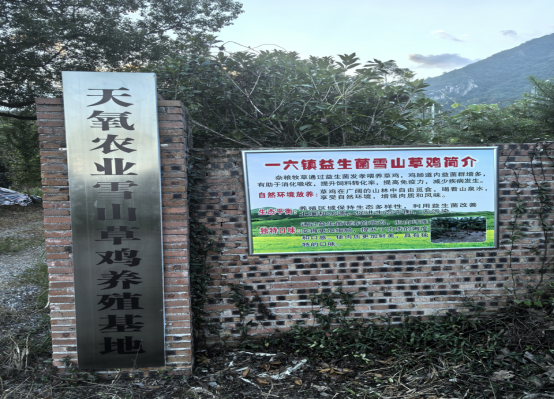
Core Insights - The successful implementation of the probiotic "Snow Mountain Grass Chicken" breeding project in Yili Town is a significant step towards revitalizing local rural industries and providing sustainable income channels for farmers [1][4][6] Group 1: Project Overview - The project is driven by the collaboration between the Guangdong Provincial High Court, the local government, and the investment team, focusing on high-quality specialty breeding [1][3] - It aims to create a comprehensive service system from chick supply to technical guidance and product recovery, adopting an "enterprise + base + farmer" operational model [3][4] Group 2: Economic Impact - The project has already introduced over 3,000 chicks in four batches, with plans to gradually expand the breeding scale and enhance product quality and market competitiveness [4] - The initiative is expected to significantly contribute to the local economy by integrating more farmers into the specialty breeding industry chain, thereby increasing their income [4][6] Group 3: Strategic Goals - The local government plans to continue providing policy support and service guarantees to ensure the project's steady expansion and success [4][6] - The project emphasizes a "not quantity, but quality" approach, aiming to establish a distinctive breeding brand with regional influence [3][4]
人工智能如何重塑农业新局
Huan Qiu Wang Zi Xun· 2025-10-11 07:43
Group 1: AI in Agriculture - Artificial intelligence is transforming agriculture by integrating into breeding, planting, and breeding processes, leading to a significant shift from traditional methods to data-driven decision-making [1][2][3] - The Chinese government has initiated the "AI+" action plan to promote the deep integration of AI with various sectors, including agriculture, aiming for a profound digital transformation [1][2] Group 2: Smart Breeding Techniques - High-throughput molecular breeding technology allows for the simultaneous detection of tens of thousands of samples, significantly speeding up the breeding process compared to traditional methods [2][3] - The breeding accelerator can reduce the growth cycle of crops like soybeans from 120 days to as little as 60 days, enabling multiple generations of breeding within a year [4][6] Group 3: Smart Farming Practices - Digital farm management tools are being utilized to optimize agricultural practices, providing real-time data on weather, soil conditions, and crop management [7][9] - AI-driven smart machinery is enhancing efficiency in farming operations, with automated systems for planting, harvesting, and soil management [10] Group 4: Fruit Harvesting Innovations - The introduction of robotic systems for apple picking is revolutionizing the harvesting process, making it safer and more efficient [11][12] - Advanced sorting technologies using AI are improving the quality control of harvested fruits, ensuring only the best products reach the market [13][15] Group 5: Intelligent Pig Farming - The modern "high-rise pig farming" model incorporates AI and IoT technologies to enhance efficiency and animal welfare, significantly reducing disease rates and improving meat quality [17][18][20] - AI systems are being developed to optimize feeding and health monitoring of pigs, allowing for personalized care and management [20] Group 6: Challenges and Future Directions - The integration of AI in agriculture faces challenges such as data interoperability, talent shortages, and high application costs, which need to be addressed for widespread adoption [21][22][24] - Collaborative efforts among government, research institutions, and industry are essential to create a supportive ecosystem for AI in agriculture, ensuring that innovations are effectively implemented [22][24]

10月10日晚间重要公告一览
Xi Niu Cai Jing· 2025-10-10 10:17
Group 1 - Jieqiang Equipment has completed the acquisition of 51% stake in Shandong Carbon Seeking, which will now be included in the company's consolidated financial statements [1] - Tonghua Dongbao's insulin injection product has received marketing approval in Myanmar for diabetes treatment [1] - New Light Optoelectronics' actual controller plans to increase shareholding by 5 to 10 million yuan within six months [2] Group 2 - Far East Holdings received contracts worth 1.769 billion yuan in September [3] - Poly Developments reported a 1.84% decrease in signed sales amount in September, totaling 20.531 billion yuan [4] - ST Nuotai expects a net profit increase of 5.62% to 13.74% for Q3 2025 [7] Group 3 - Chongqing Port's controlling shareholder plans to merge with another entity, changing the controlling shareholder to Chongqing Logistics Group [9] - New Energy Company reported a 28.21% increase in cumulative power generation from January to September [11] - Dashiang Co. announced the resignation of its chairman due to personal reasons [12] Group 4 - Liao Port Co. announced the resignation of a non-executive director due to work changes [13] - Zhongzai Resources received a government subsidy of 5.33 million yuan, accounting for 23.72% of its audited net profit for 2024 [14] - Xiaoming Co. reported a sales revenue of 66.15 million yuan from chicken products in September [15] Group 5 - Tianyi Co. signed a framework contract worth 23.50 million yuan for e-business network terminal production [16] - Jingu Co. signed a strategic cooperation agreement with Ninebot Technology for lightweight materials [18] - Tianbang Foods reported a sales revenue of 634 million yuan from commodity pigs in September [20] Group 6 - Shaanxi Energy's subsidiary received an administrative penalty for safety violations, resulting in a fine of 940,000 yuan [22] - North Bay Port reported a 9% increase in cargo throughput in September [23] - Tangrenshen reported a sales revenue of 639 million yuan from pig sales in September [24] Group 7 - Dabeinong reported a sales revenue of 541 million yuan from pig sales in September [25] - Jiukang Bio obtained four medical device registration certificates [26] - Canan Co. invested 90 million yuan in structured deposits with a bank [27] Group 8 - Zhuhai Port reported a 5.44% decrease in cargo throughput in Q3 [28] - Jinli Yongmag expects a net profit increase of 157% to 179% for the first three quarters [29] - Huamao Logistics' controlling shareholder plans to increase shareholding by 64.5 to 129 million yuan [30] Group 9 - Dongjie Intelligent signed a 50 million yuan contract for intelligent warehousing in the steel industry [31] - Sais Technology signed a cooperation framework agreement with Volcano Engine for intelligent robotics [32] - Huadong Pharmaceutical's subsidiary received approval for clinical trials of a new drug targeting advanced solid tumors [34] Group 10 - TCL Technology completed the acquisition of 80% and 100% stakes in LG Display's subsidiaries for 11.088 billion yuan [34] - Shuangliang Energy won a 419 million yuan EPC project for cooling systems [36] - Ruina Intelligent announced plans for shareholders to reduce their stakes by up to 1.18% [38] Group 11 - Baodi Mining announced plans for shareholders to reduce their stakes by up to 5.45% [40] - Xinyi Technology's shareholders set the transfer price for shares at 328 yuan each [42] - Sunshine Power submitted an application for H-share listing on the Hong Kong Stock Exchange [44] Group 12 - Qisheng Technology's controlling shareholder plans to reduce their stake by up to 3.09% [46] - Wu Ming Kangde sold 30.3 million shares of Wu Ming He Lian through block trading [48] - Qiaoyin Co. announced plans for shareholders to reduce their stakes by up to 6% [49] Group 13 - Muyuan Foods reported a sales revenue of 9.066 billion yuan from commodity pigs in September [51] - Huawang Technology's shareholders plan to reduce their stakes by up to 1.1% [53] - Huaxin Xinchuang received a project notification from Lantu Automotive for display components [54] Group 14 - China Merchants Shekou reported a signed sales amount of 16.698 billion yuan in September [55] - Shao Neng Co. received approval for an antitrust review regarding a share acquisition [57] - Pengding Holdings reported a 6.21% increase in consolidated revenue in September [58] Group 15 - Ganfeng Lithium is advancing its solid-state battery commercialization and strategic investment in the energy storage sector [59]





养殖业板块10月10日涨0.72%,立华股份领涨,主力资金净流入1.34亿元
Zheng Xing Xing Ye Ri Bao· 2025-10-10 08:39
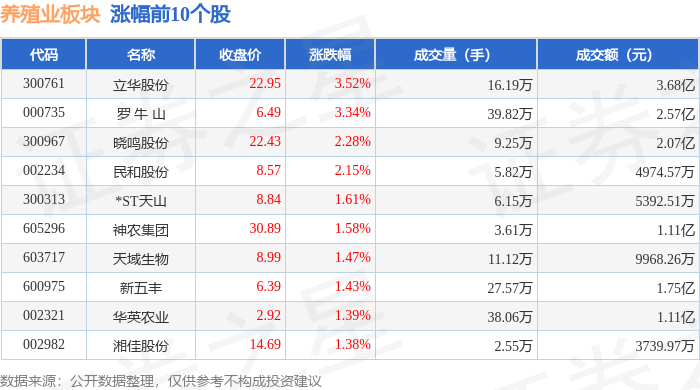
Core Insights - The aquaculture sector experienced a rise of 0.72% on October 10, with Lihua Co. leading the gains [1] - The Shanghai Composite Index closed at 3897.03, down 0.94%, while the Shenzhen Component Index closed at 13355.42, down 2.7% [1] Aquaculture Sector Performance - Lihua Co. (300761) closed at 22.95, up 3.52% with a trading volume of 161,900 shares and a transaction value of 368 million yuan [1] - Other notable performers included: - Luoniushan (000735) at 6.49, up 3.34% [1] - Xiaoming Co. (300967) at 22.43, up 2.28% [1] - Minhe Co. (002234) at 8.57, up 2.15% [1] - The overall trading volume and transaction values for various stocks in the aquaculture sector were significant, indicating active market participation [1] Capital Flow Analysis - The aquaculture sector saw a net inflow of 134 million yuan from institutional investors, while retail investors experienced a net outflow of 1.31 billion yuan [2] - The main stocks with significant capital flow included: - Muyuan Foods (002714) with a net inflow of 199 million yuan from institutional investors [3] - Wens Foodstuff Group (300498) with a net inflow of 15.53 million yuan from institutional investors [3] - Retail investors showed a negative trend in net inflows across several stocks, indicating a cautious sentiment among smaller investors [2][3]



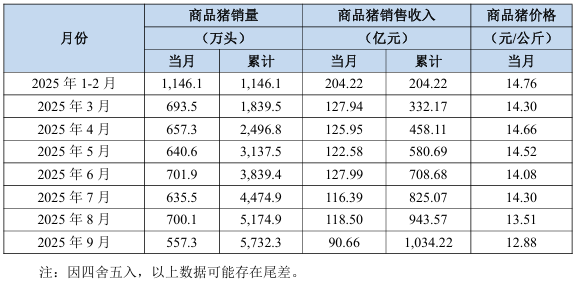
超50亿元分红,002714,下周除权除息
Zheng Quan Shi Bao· 2025-10-09 23:23
Core Viewpoint - Muyuan Foods (牧原股份) announced a cash dividend plan for the first half of 2025, distributing 9.275214 RMB per 10 shares, totaling 5 billion RMB, alongside a sales report indicating a decline in sales revenue and price for September 2025 [1][3]. Financial Performance - In the first half of 2025, the company achieved a revenue of 76.46 billion RMB, a year-on-year increase of 34.46%, and a net profit attributable to shareholders of 10.53 billion RMB, a staggering increase of 1169.77% [3][4]. - The net profit excluding non-recurring gains was 10.68 billion RMB, reflecting an increase of 1115.32% compared to the previous year [4]. Sales and Pricing - In September 2025, the company sold 5.573 million pigs, a year-on-year increase of 11.05%, with a sales revenue of 9.066 billion RMB, down 22.46% year-on-year [1][2]. - The average selling price of pigs in September was 12.88 RMB per kilogram, a decrease of 30.94% compared to the previous year [1][2]. Market Outlook - The company has adjusted its forecast for piglet output in 2025 from a range of 8 million to 12 million to a new range of 12 million to 14.5 million, indicating a strong demand in the market [2]. Stock Information - As of October 9, 2025, Muyuan Foods' stock price was 52.85 RMB, with a total market capitalization of 288.7 billion RMB [4][5].