
国防军工

Search documents
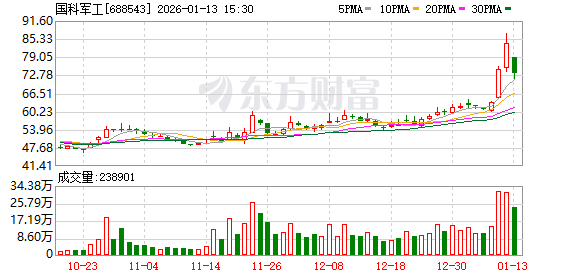
国科军工:截至2025年12月31日股东人数为18652户
Zheng Quan Ri Bao· 2026-01-13 13:42
Group 1 - The company, Guokai Military Industry, stated that as of December 31, 2025, the number of shareholders will be 18,652 [2]


美股盘前要点 | 美国12月CPI数据重磅来袭!“五角大楼披萨指数”再度狂飙
Ge Long Hui· 2026-01-13 12:35
Group 1 - US stock index futures showed slight declines, with Nasdaq futures down 0.17%, S&P 500 futures down 0.09%, and Dow futures down 0.12% [1] - European stock indices had mixed results, with Germany's DAX up 0.01%, UK's FTSE 100 down 0.06%, France's CAC down 0.44%, and the Euro Stoxx 50 up 0.06% [1] - Nvidia clarified tightened payment terms for chips, stating that H200 chips do not require prepayment [1] Group 2 - Nvidia and Eli Lilly announced a $1 billion investment over the next five years to accelerate AI applications in the pharmaceutical industry [2] - Meta plans to lay off at least 10% of its virtual reality R&D department as part of the launch of the Meta Compute top-level strategic plan [2] - Citigroup is reportedly set to lay off about 1,000 employees as part of a broader plan to cut 20,000 jobs [2]
美股异动丨L3Harris盘前大涨13% 获美国防部10亿美元拟议注资
Ge Long Hui A P P· 2026-01-13 12:30
Core Viewpoint - L3Harris Technologies (LHX.US) experienced a pre-market surge of 13% following the announcement of a proposed $1 billion investment from the U.S. Department of Defense to significantly enhance the production capacity of solid rocket engines that power critical missiles for the U.S. and its allies [1]. Group 1 - L3Harris Technologies is a U.S. defense contractor that specializes in advanced technology solutions [1]. - The company has secured a $1 billion investment from the U.S. Department of Defense [1]. - The investment aims to boost the production capacity of solid rocket engines, which are essential for missile systems [1].

获美国防部10亿美元拟议注资+拟分拆导弹业务上市 L3Harris(LHX.US)盘前大涨13%
Zhi Tong Cai Jing· 2026-01-13 12:20
Group 1 - L3Harris Technologies (LHX.US) stock surged 13% after announcing a proposed $1 billion investment from the U.S. Department of Defense to significantly enhance solid rocket engine production capacity for missiles [1] - The investment will be made through convertible preferred securities, which will convert to common stock during a future IPO, and L3Harris plans to spin off its missile solutions business into an independent company by the second half of 2026 [1] - CEO Christopher Kubasik emphasized the need to strengthen the defense industrial base and revitalize competition, positioning the new company as a key partner for the Department of Defense in deterrence efforts [1] Group 2 - Other defense contractors, including General Dynamics (GD.US), RTX (RTX.US), Lockheed Martin (LMT.US), and Northrop Grumman (NOC.US), also saw slight stock increases following the news [2]
1月13日深证国企ESG(970055)指数跌1.7%,成份股中核科技(000777)领跌
Sou Hu Cai Jing· 2026-01-13 10:53
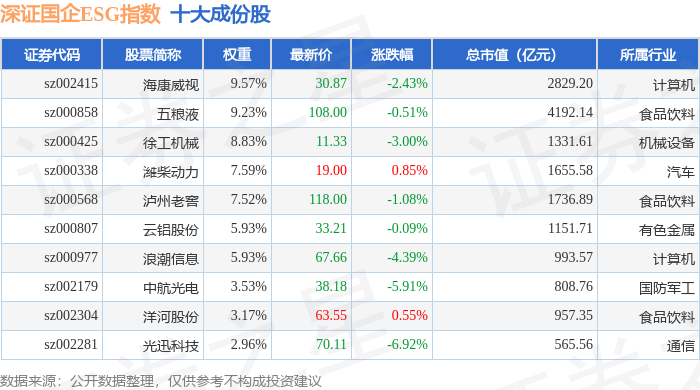
Group 1 - The Shenzhen State-owned Enterprise ESG Index (970055) closed at 1462.82 points, down 1.7%, with a trading volume of 56.526 billion yuan and a turnover rate of 2.08% [1] - Among the index constituents, 9 stocks rose while 40 stocks fell, with Dengkang Dental leading the gainers at a 6.17% increase and China Nuclear Technology leading the decliners at a 9.27% decrease [1] - The top ten constituents of the Shenzhen State-owned Enterprise ESG Index include Hikvision, Wuliangye, and Xugong Machinery, with respective weights of 9.57%, 9.23%, and 8.83% [1] Group 2 - The net outflow of main funds from the index constituents totaled 2.961 billion yuan, while retail investors saw a net inflow of 2.199 billion yuan [1] - Detailed fund flow data indicates that Yunnan Energy Investment and Yanghe Brewery experienced net inflows from retail investors, while major funds showed outflows for several stocks including Yun Aluminum and Wuliangye [2] - The fund flow analysis highlights the varying investor sentiment, with significant retail interest in certain stocks despite overall net outflows from institutional investors [2]





【数据看盘】顶级游资扎堆海格通信 超30亿元资金激烈博弈航天电子
Xin Lang Cai Jing· 2026-01-13 09:53
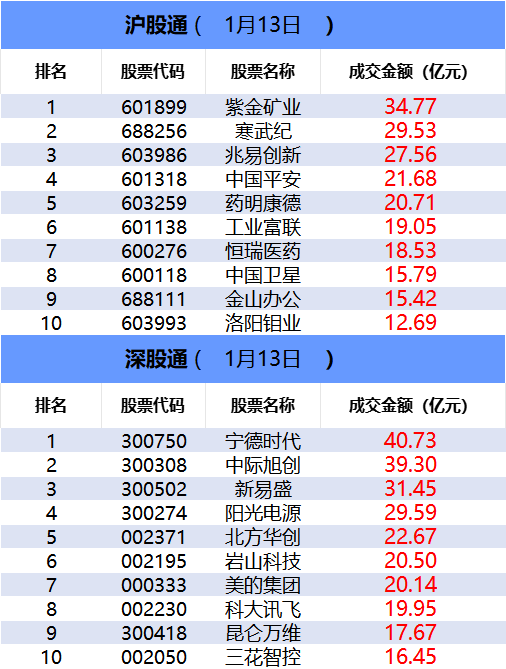
沪深股通今日合计成交4209.36亿,其中紫金矿业和宁德时代分居沪股通和深股通个股成交额首位。板块主力资金方面,医药板块主力资金净流入居首。 ETF成交方面,科创100ETF基金(588220)成交额环比增长211%。 龙虎榜方面,海格通信走出2连板,获两家一线游资(国泰海通证券宜昌沿江大道、国泰海通证券上海江苏路)分别买入3.71亿、2.64亿,同时遭一家一线游 资(华鑫证券上海红宝石路)卖出0.4亿。商业航天概念今日集体退潮,航天电子遭大量资金博弈,一家机构卖出11.1亿,一家量化资金(国泰海通证券总 部)卖出4.29亿,两家一线游资(国泰海通证券宜昌沿江大道、国泰海通证券南京太平南路)合计卖出12.68亿,同时两家机构买入7.59亿,一家量化资金 (国信证券浙江互联网分公司)买入2.73亿。 一、沪深股通前十大成交 今日沪股通总成交金额为1824.91亿,深股通总成交金额为2384.45亿。 | | 沪股道( | 1月13日 | ) | | | --- | --- | --- | --- | --- | | 排名 | 股票代码 | 股票名称 | | 成交金额(亿元) | | 1 | 601899 | 紫 ...


主力动向:1月13日特大单净流出1035.54亿元
Zheng Quan Shi Bao Wang· 2026-01-13 09:48
两市全天特大单净流出1035.54亿元,其中46股特大单净流入超2亿元,海格通信特大单净流入26.56亿 元,特大单净流入资金居首。 特大单净流入资金排名 所属行业来看,上述特大单净流入资金居前个股中,医药生物、传媒、电力设备行业最为集中,上榜个 股分别有8只、8只、6只。(数据宝) | 代码 | 简称 | 收盘价(元) | 涨跌幅(%) | 特大单净流入(亿元) | 行业 | | --- | --- | --- | --- | --- | --- | | 002465 | 海格通信 | 24.20 | 10.00 | 26.56 | 国防军工 | | 600089 | 特变电工 | 27.37 | 10.01 | 26.06 | 电力设备 | | 300315 | 掌趣科技 | 6.86 | 14.91 | 10.53 | 传媒 | | 600588 | 用友网络 | 17.28 | 7.87 | 9.93 | 计算机 | | 603986 | 兆易创新 | 263.50 | 0.64 | 6.16 | 电子 | | 600170 | 上海建工 | 3.04 | 10.14 | 5.88 | 建筑装饰 | ...

粤开市场日报-20260113-20260113
Yuekai Securities· 2026-01-13 09:28
Market Overview - The A-share market saw a majority of indices decline today, with the Shanghai Composite Index down by 0.64% closing at 4138.76 points, the Shenzhen Component down by 1.37% at 14169.40 points, the Sci-Tech 50 down by 2.80% at 1469.57 points, and the ChiNext Index down by 1.96% at 3321.89 points [1] - Overall, there were 1619 stocks that rose and 3726 stocks that fell, with a total market turnover of 36510 billion yuan, an increase of 496 billion yuan compared to the previous trading day [1] Industry Performance - Among the Shenwan first-level industries, the leading sectors included Oil & Petrochemicals, Pharmaceuticals & Biotechnology, Nonferrous Metals, Media, and Banking, with respective gains of 1.62%, 1.21%, 0.91%, 0.67%, and 0.65% [1] - Conversely, sectors such as Defense & Military, Electronics, Telecommunications, Computers, and Building Materials experienced declines, with losses of 5.50%, 3.30%, 2.88%, 1.92%, and 1.87% respectively [1] Sector Highlights - The top-performing concept sectors today included CRO, Selected Medical Services, Weight Loss Drugs, SPD, Lithium Extraction from Salt Lakes, Genetic Testing, Lithium Mining, Pharmaceutical Digitalization, Selected Insurance, Stem Cells, Synthetic Biology, Influenza, Gold & Jewelry, and Biotechnology [2]
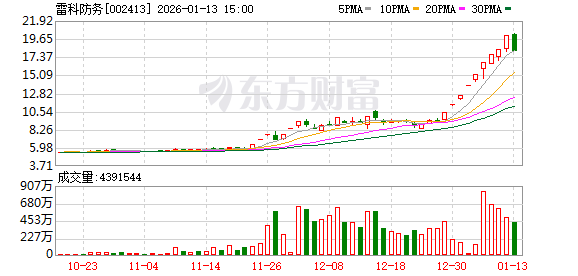
雷科防务1月13日龙虎榜数据
Zheng Quan Shi Bao Wang· 2026-01-13 09:13
Group 1 - The stock of 雷科防务 (Leike Defense) experienced a limit down on the trading day, with a turnover rate of 33.96% and a total transaction amount of 8.096 billion yuan, showing a fluctuation of 11.98% [2] - The stock was listed on the龙虎榜 (Dragon and Tiger List) due to a daily decline deviation of -8.58%, with net selling from the Shenzhen Stock Connect amounting to 183 million yuan [2] - The top five trading departments on the list had a combined transaction amount of 1.397 billion yuan, with buying amounting to 455 million yuan and selling at 939 million yuan, resulting in a net selling of 482 million yuan [2] Group 2 - In the past six months, the stock has appeared on the龙虎榜 20 times, with an average price increase of 2.50% the day after being listed and an average increase of 11.59% over the following five days [3] - The stock saw a net outflow of 1.910 billion yuan in main funds today, with a significant outflow of 1.670 billion yuan from large orders [3] - The latest margin trading data shows a total margin balance of 1.326 billion yuan, with a financing balance of 1.324 billion yuan and a securities lending balance of 2.2666 million yuan, indicating a recent increase in financing balance by 367 million yuan, or 38.31% [3]

主力资金连续6天净流出
Zheng Quan Shi Bao Wang· 2026-01-13 09:04
1月13日,沪指下跌0.64%,深成指下跌1.37%,创业板指下跌1.96%,沪深300指数下跌0.60%。可交易 A股中,上涨的有1622只,占比29.75%,下跌的3729只。 资金面上,今日主力资金全天净流出1627.43亿元,已连续6个交易日资金呈净流出状态。其中,创业板 主力资金净流出510.74亿元;科创板主力资金净流出189.50亿元;沪深300成份股主力资金净流出363.77 亿元。 分行业来看,申万所属的一级行业中,今日上涨的有6个,涨幅居前的行业为石油石化、医药生物,涨 幅为1.62%、1.21%。跌幅居前的行业为国防军工、电子,跌幅为5.50%、3.30%。 行业资金流向方面,今日有4个行业主力资金净流入,医药生物行业主力资金净流入规模居首,该行业 今日上涨1.21%,全天净流入资金43.48亿元,其次是石油石化行业,日涨幅为1.62%,净流入资金为 5.86亿元。 今日各行业资金流向 | 行业 | 日涨跌幅(%) | 资金流向(亿元) | 行业 | 日涨跌幅(%) | 资金流向(亿元) | | --- | --- | --- | --- | --- | --- | | 医药生物 | 1 ...