
石油石化等

Search documents
——2026.03.09-2026.03.13日策略周报:两会顺利结束,A股指数窄幅震荡-20260315
Xiangcai Securities· 2026-03-15 09:53
Core Insights - The A-share index experienced narrow fluctuations during the week of March 9-13, 2026, with the Shanghai Composite Index slightly down by 0.70%, while the ChiNext Index rose by 2.51% [2][3][11] - The fluctuations were attributed to ongoing geopolitical tensions, particularly the conflict between the US and Iran, and the conclusion of China's Two Sessions, which led to stable domestic policy progress [3][14] - February export data showed a significant year-on-year increase of 39.60%, contributing to positive market expectations for the first quarter of 2026 [6][27] Industry Performance - Among the 31 first-level industries, coal and electric equipment saw the highest weekly gains of 5.03% and 4.55%, respectively, while defense and petroleum sectors faced declines of 6.64% and 4.33% [4][19] - In the second-level industries, wind power equipment and batteries led with weekly increases of 11.74% and 9.73%, while oil service engineering and precious metals showed significant year-to-date gains of 49.71% and 37.52% [4][24] - The third-level industries saw coal chemical and wind power components with weekly gains of 14.80% and 13.37%, and year-to-date leaders included oil and gas refining engineering with a 66.88% increase [5][24] Investment Recommendations - Long-term, the year 2026 is viewed as a starting point for the 14th Five-Year Plan, with expectations for continued proactive fiscal and moderately loose monetary policies to support stable economic growth and a "slow bull" market for A-shares [7][28] - Short-term strategies suggest a defensive approach, focusing on dividend-related sectors and industries benefiting from Middle Eastern conflicts, such as oil and gas extraction, coal chemical, and new energy sectors [9][28]
“十五五”定调,A股韧性体现在哪些板块?
Zhong Guo Yin He Zheng Quan· 2026-03-15 07:50
Market Performance - The A-share market experienced a fluctuation with the overall index declining by 0.48% from March 9 to March 13, 2026[2] - The ChiNext Index rose by 2.51%, while the Science and Technology Innovation 50 and North China 50 indices fell over 2%[4] - The daily average trading volume decreased to 24,987 billion yuan, down by 1,459.12 billion yuan from the previous week[11] Fund Flow - The margin trading balance increased to 26,646.47 billion yuan, up by 191.00 billion yuan from the previous week[13] - A total of 21 new equity funds were established this week, with a total issuance of 19.824 billion units, representing a 54.93% share of new fund issuance[19] - Global funds saw a net outflow of 3.615 billion USD from A-shares, reversing from a net inflow of 1.471 billion USD the previous week[27] Valuation Changes - The PE (TTM) ratio for the overall A-share index decreased by 0.44% to 23.33 times, placing it at the 94.22% percentile since 2010[36] - The PB (LF) ratio fell by 0.27% to 1.93 times, situated at the 56.66% percentile since 2010[36] - The bond yield spread for A-shares was 2.4717%, near the 42.78% percentile level since 2010[36] Investment Outlook - The government work report emphasizes domestic demand, fostering new growth drivers, and high-level technological self-reliance as key tasks[47] - The "14th Five-Year Plan" focuses on high-quality development and modern industrial system construction, indicating a long-term investment logic shift towards quality[47] - The market is expected to transition from "emotion-driven" to "fundamentals-driven," with corporate earnings becoming the core anchor for future trends[47]
中银量化多策略行业轮动周报–20260212
Bank of China Securities· 2026-02-13 07:50
Investment Rating - The report does not explicitly state an overall investment rating for the industry but provides insights into sector allocations and performance metrics. Core Insights - The current allocation in the multi-strategy industry configuration system includes: Basic Chemicals (22.4%), Home Appliances (10.1%), Telecommunications (10.0%), Pharmaceuticals (7.7%), and others [1]. - The best-performing sectors this week were Non-ferrous Metals (6.2%), Oil & Petrochemicals (5.1%), and Basic Chemicals (4.7%), while the worst were Food & Beverage (-4.1%), Retail (-3.1%), and Agriculture (-1.9%) [3][10]. - The composite strategy achieved a cumulative return of 2.6% this week, outperforming the benchmark by 1.3% [3]. Summary by Sections Recent Industry Performance Review - The average weekly return for the 30 sectors was 1.3%, with a monthly average return of 1.2% [10]. - The top three sectors for the week were Non-ferrous Metals (6.2%), Oil & Petrochemicals (5.1%), and Basic Chemicals (4.7%) [11]. Industry Valuation Risk Warning - Current valuation alerts indicate that sectors such as Retail, Computers, Non-ferrous Metals, Defense, Oil & Petrochemicals, Electronics, Media, Machinery, Coal, and Textiles have PB ratios above the 95th percentile of their historical range, signaling potential overvaluation [13][14]. Top Performing Strategies and Recent Performance - The S1 strategy focusing on industry profitability tracking has the highest weight at 21.4%, while the S3 macro style rotation strategy has the lowest at 18.0% [3]. - The top three sectors based on the S1 strategy are Telecommunications, Basic Chemicals, and Home Appliances [16]. Composite Strategy and Performance Review - The composite strategy has significantly increased its positions in consumer and mid-cycle sectors while reducing exposure to TMT and upstream cyclical sectors [3]. Macro Style Rotation Strategy - The top six sectors favored by current macro indicators are Banking, Telecommunications, Oil & Petrochemicals, Construction, Home Appliances, and Coal [24]. Long-term Reversal Strategy - The recommended sectors for the long-term reversal strategy include Comprehensive, Pharmaceuticals, Basic Chemicals, Electric Equipment & New Energy, and Consumer Services [28].
【金工】市场小市值风格显著,大宗交易组合再创新高——量化组合跟踪周报20260207(祁嫣然/张威)
光大证券研究· 2026-02-08 23:02
Core Viewpoint - The article provides a comprehensive analysis of market performance, highlighting the varying returns of different factors and strategies within the stock market [4][5][9]. Group 1: Market Factor Performance - The overall market showed a positive return of 0.38% for the leverage factor, while the market capitalization factor, Beta factor, and non-linear market capitalization factor recorded negative returns of -0.83%, -0.45%, and -0.43% respectively [4]. - The momentum factor yielded a negative return of -0.32%, indicating a reversal effect in the market, while other style factors performed generally [4]. Group 2: Single Factor Performance - In the CSI 300 stock pool, the best-performing factors included operating cash flow ratio (2.56%), large net inflow (2.23%), and momentum-adjusted large orders (2.21%) [5]. - Conversely, the worst-performing factors were net profit gap (-2.15%), year-on-year growth rate of quarterly net profit (-2.12%), and year-on-year ROA (-1.81%) [5]. - In the CSI 500 stock pool, the top factors were price-to-book ratio (2.38%), EPTTM quantile (1.96%), and ROA stability (1.95%), while the bottom factors included net profit gap (-0.76%), year-on-year growth rate of quarterly operating revenue (-0.58%), and TTM gross margin (-0.32%) [5]. - For the liquidity 1500 stock pool, the leading factors were logarithmic market capitalization (3.14%), price-to-earnings ratio (2.64%), and 5-day reversal (2.28%), with the lagging factors being year-on-year growth rate of quarterly operating revenue (-1.34%), TTM gross margin (-1.31%), and total asset growth rate (-1.09%) [5]. Group 3: Industry Factor Performance - Fundamental factors showed varied performance across industries, with net asset per share and TTM operating profit factors yielding consistent positive returns in the home appliance and beauty care sectors [6]. - Valuation factors like BP showed significant positive returns in the banking sector, while EP factors performed well in the home appliance and food & beverage industries [6]. - Residual volatility and liquidity factors also demonstrated consistent positive returns in the oil and petrochemical industry, with large-cap styles being prominent in the food & beverage, coal, beauty care, and banking sectors [6]. Group 4: Strategy Performance - The PB-ROE-50 combination in the CSI 500 and CSI 800 stock pools recorded negative excess returns of -0.98% and -1.43% respectively, with an overall market excess return of -2.11% [7]. - Public fund research stock selection strategies and private fund research tracking strategies achieved positive excess returns, with public strategies outperforming the CSI 800 by 0.18% and private strategies outperforming by 4.25% [9]. - The block trading combination achieved a positive excess return of 0.84% relative to the CSI All Index [10]. - The targeted issuance combination also gained a positive excess return of 0.83% compared to the CSI All Index [11].


【盘中播报】78只A股封板 建筑材料行业涨幅最大
Zheng Quan Shi Bao Wang· 2026-01-22 06:28
Market Overview - The Shanghai Composite Index increased by 0.07% with a trading volume of 1,239.75 million shares and a transaction amount of 21,864.55 billion yuan, representing a 5.68% increase compared to the previous trading day [1][2] Industry Performance - The top-performing industries included: - Building Materials: Increased by 3.89% with a transaction amount of 259.81 billion yuan, up 34.26% from the previous day, led by N Guoliang with a rise of 161.99% [1] - National Defense and Military Industry: Increased by 2.97% with a transaction amount of 1,378.68 billion yuan, up 39.12%, led by Triangle Defense with a rise of 19.99% [1] - Oil and Petrochemicals: Increased by 2.51% with a transaction amount of 239.20 billion yuan, up 54.79%, led by Intercontinental Oil and Gas with a rise of 10.10% [1] Underperforming Industries - The industries with the largest declines included: - Beauty and Personal Care: Decreased by 0.74% with a transaction amount of 37.03 billion yuan, down 21.48%, led by Yanjiang Co. with a decline of 5.02% [2] - Banking: Decreased by 0.73% with a transaction amount of 283.95 billion yuan, up 25.57%, led by Agricultural Bank with a decline of 2.01% [2] - Pharmaceutical and Biological: Decreased by 0.50% with a transaction amount of 760.16 billion yuan, down 7.58%, led by Aidi Pharmaceutical with a decline of 13.57% [2]
【早盘三分钟】1月21日ETF早知道
Xin Lang Cai Jing· 2026-01-21 01:53
Market Overview - The market temperature gauge indicates a 75% level, with the Shanghai Composite Index, Shenzhen Component Index, and ChiNext Index showing historical P/E ratios at 99.71%, 93.7%, and 50.02% respectively as of January 20, 2026 [1][13] Sector Performance - The top-performing sectors on January 20, 2026, included Real Estate (+1.74%), Oil & Petrochemicals (+1.71%), and Building Materials (+1.55%), while the worst performers were Computer (-3.23%), Defense & Military Industry (-2.87%), and Communication (-1.94%) [2][13] Capital Flow - The sectors with the highest net inflows were Real Estate (¥471 million), Food & Beverage (¥218 million), and Retail (¥203 million). Conversely, the sectors with the largest outflows included Power Equipment (-¥14.402 billion), Electronics (-¥11.803 billion), and Communication (-¥10.812 billion) [2][13] ETF Performance - The Chemical ETF (516020) rose by 1.27%, reaching a new high since August 2022, reflecting a strong performance in the chemical sector [4][17] - The Bank ETF (512800) increased by 0.77%, with historical data indicating an 80% success rate for absolute and excess returns in the banking sector prior to the Spring Festival [6][17] Fund Performance - The following ETFs showed notable performance: - Real Estate ETF: 3.22% increase, 6-month performance of 4.73% [2][15] - A500 Dividend Low Volatility ETF: 1.32% increase, 6-month performance of 0.50% [2][15] - 800 Dividend Low Volatility ETF: 1.27% increase, 6-month performance of -0.75% [2][15] - Chemical ETF: 1.27% increase, 6-month performance of 52.31% [2][15] - 300 Cash Flow ETF: 1.13% increase, 6-month performance of 15.76% [2][15]

主力资金连续6天净流出
Zheng Quan Shi Bao Wang· 2026-01-13 09:04
Market Overview - The Shanghai Composite Index fell by 0.64%, the Shenzhen Component Index decreased by 1.37%, the ChiNext Index dropped by 1.96%, and the CSI 300 Index declined by 0.60% [1] - Among the tradable A-shares, 1,622 stocks rose, accounting for 29.75%, while 3,729 stocks fell [1] Capital Flow - The main capital experienced a net outflow of 162.74 billion yuan, marking six consecutive trading days of net outflows [1] - The ChiNext saw a net outflow of 51.07 billion yuan, the Sci-Tech Innovation Board had a net outflow of 18.95 billion yuan, and the CSI 300 constituents experienced a net outflow of 36.38 billion yuan [1] Industry Performance - Out of the 28 primary industries, 6 sectors saw gains, with the top performers being Oil & Petrochemicals and Pharmaceutical & Biological sectors, which rose by 1.62% and 1.21%, respectively [1] - The sectors with the largest declines included Defense & Military and Electronics, which fell by 5.50% and 3.30%, respectively [1][2] Industry Capital Inflows - The Pharmaceutical & Biological sector led with a net inflow of 4.35 billion yuan, while the Oil & Petrochemicals sector followed with a net inflow of 0.59 billion yuan [1] - Other sectors with net inflows included Banking and Beauty & Personal Care, while sectors like Electronics and Defense & Military saw significant net outflows [3] Individual Stock Performance - A total of 1,683 stocks experienced net inflows, with 772 stocks having inflows exceeding 10 million yuan, and 116 stocks with inflows over 100 million yuan [3] - The stock with the highest net inflow was TBEA, which rose by 10.01% with a net inflow of 2.18 billion yuan, followed by Haige Communications and Yonyou Network [3] - Conversely, 433 stocks had net outflows exceeding 100 million yuan, with the largest outflows from Goldwind Technology, Aerospace Electronics, and Bluefocus, amounting to 4.72 billion yuan, 4.71 billion yuan, and 3.32 billion yuan, respectively [3]
中国银河证券:料港股交投活跃度有望续升 关注科技及消费板块
智通财经网· 2026-01-05 06:53
Core Viewpoint - The Hong Kong stock market is expected to remain active and experience an upward trend due to multiple positive factors, with a focus on the technology and consumer sectors for medium to long-term investment opportunities [1] Group 1: Market Performance - The Hong Kong stock market rose by 2.01% last week, with the Hang Seng Technology Index increasing by 4.31% [2] - Among the primary sectors, 7 sectors saw gains while 4 sectors declined, with notable increases in Information Technology (4.54%), Energy (3.97%), and Materials (2.98%) [2] - In the secondary sectors, Semiconductor, Defense, Oil & Petrochemicals, Software Services, and Paper & Packaging led the gains, while Household Products, Durable Goods, Consumer Services, Daily Consumer Retail, and Textiles & Apparel faced declines [2] Group 2: Market Liquidity - The average daily trading volume on the Hong Kong Stock Exchange was HKD 171.19 billion, an increase of HKD 31.26 billion from the previous week [3] - The average daily short-selling amount was HKD 19.93 billion, up by HKD 2.96 billion from the previous week, with short-selling accounting for 11.78% of the trading volume, a decrease of 0.22 percentage points [3] - There was a net outflow of HKD 3.81 billion from southbound funds, a decrease of HKD 6.37 billion compared to the previous week [3] Group 3: Valuation and Risk Appetite - As of January 2, 2026, the Hang Seng Index had a price-to-earnings ratio of 12.09 and a price-to-book ratio of 1.23, both up by 2.36% from the previous week, positioned at the 79% and 56% percentiles since 2010 [4] - The Hang Seng Technology Index had a price-to-earnings ratio of 23.8 and a price-to-book ratio of 3.15, at the 36% and 66% percentiles since 2010 [4] - The risk premium for the Hang Seng Index was 4.08%, which is 1.82 standard deviations below the 3-year rolling mean, placing it at the 4% percentile since 2010 [4]

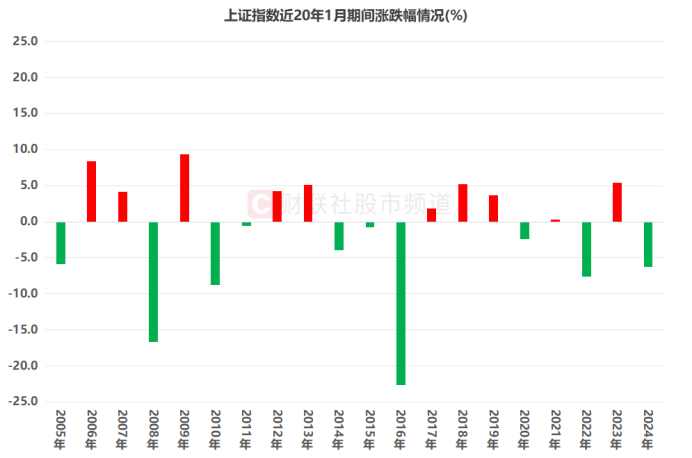
近20年数据复盘:沪指1月上涨概率50%,这些板块历史“战绩”较佳
Xin Lang Cai Jing· 2026-01-01 00:00
Group 1 - The A-share market is expected to enter 2026 with a nearly 50% probability of the Shanghai Composite Index rising in January, based on nearly 20 years of data [1] - In January, the Shanghai Composite Index has shown a monthly increase of over 5% in years such as 2009, 2006, 2023, 2018, and 2013 [1] Group 2 - Among major indices, the Sci-Tech 50, Dividend Index, and Shenzhen Component Index have shown over 50% rising probability in January over the past 20 years, with respective rates of 60%, 58%, and 55% [3] - The average increase for the Dividend Index and the Dividend Index is 0.98% and 0.74% respectively during January [3] Group 3 - In terms of industry sectors, 8 out of 31 Shenwan first-level sector indices have shown a rising probability of over 50% in January over the past 20 years, including Banking and Defense, both exceeding 60% [4] - The average increase for the Home Appliances and Banking sectors is 1.9% each, while the Computer sector averages 1.0% during January [4] Group 4 - Specific sub-sectors such as Air Conditioning, Pig Farming, and Robotics have shown relatively high rising probabilities in January over the past 20 years [6] - The average increase for sectors like Wind Power Components, Air Conditioning, and Organic Silicon is notably high [6]
资金跟踪系列之二十四:两融净买入规模上升,机构ETF被继续净申购
SINOLINK SECURITIES· 2025-12-15 09:29
Macro Liquidity - The US dollar index continued to decline, and the degree of "inversion" in the China-US interest rate spread has deepened. The nominal and real interest rates of 10Y US Treasury bonds have both rebounded, with inflation expectations remaining unchanged [1][14]. - Offshore dollar liquidity has marginally tightened, while the domestic interbank funding environment remains balanced and relatively loose. The yield spread between 10Y and 1Y bonds continues to widen [1][19]. Market Trading Activity - Overall market trading activity has increased, with trading heat in sectors such as light industry, retail, military, textiles, communications, and real estate all above the 80th percentile [2][25]. - The volatility of major indices has generally increased, with the volatility of sectors like communications, electric power, and electronics remaining above the 80th historical percentile [2][31]. Institutional Research - Research activity is concentrated in sectors such as electronics, pharmaceuticals, electric power, machinery, and non-ferrous metals, with an upward trend in research heat for non-ferrous metals, computers, and textiles [3][42]. Analyst Forecasts - Analysts have adjusted the net profit forecasts for the entire A-share market for 2025/2026, with increases in forecasts for sectors including pharmaceuticals, coal, automobiles, food and beverage, and oil and petrochemicals [4][21]. - The proportion of stocks with upward revisions in net profit forecasts for 2025/2026 has increased across the A-share market [4][17]. Northbound Trading Activity - Northbound trading activity has rebounded, continuing to net sell A-shares. The ratio of buy/sell amounts in sectors like communications, electronics, and finance has increased, while it has decreased in electric power, chemicals, and automobiles [5][31]. - Northbound trading primarily net bought sectors such as communications, machinery, and home appliances, while net selling occurred in pharmaceuticals, computers, and electronics [5][33]. Margin Financing Activity - The activity of margin financing has slightly increased but remains at a relatively low level since late July 2025. The main net purchases were in sectors like electronics, communications, and military [6][39]. - The proportion of financing purchases in sectors such as oil and petrochemicals, retail, and electronics has increased [6][38]. Hot Stocks Trading - The trading volume on the "Dragon and Tiger List" has increased, with sectors like retail, light industry, and electric power showing relatively high and rising trading volumes [7][41]. Active Equity Fund Positioning - The positions of actively managed equity funds have continued to decline, with significant increases in positions in sectors like pharmaceuticals, agriculture, and retail [8][45]. - The correlation of actively managed equity funds with mid/small-cap growth and mid-cap value has increased, while the correlation with large-cap growth and large/small-cap value has decreased [8][48]. - The scale of newly established equity funds has continued to decline, with both active and passive fund sizes decreasing [8][50].