
支付行业

Search documents
跨境电商行业周刊:产业链上下游齐发力,跨境电商行业持续繁荣
Chan Ye Xin Xi Wang· 2025-09-24 07:08
Group 1 - The "2025 Qingdao Cross-Border E-Commerce High-Quality Development Exchange Conference" was successfully held, aiming to create an optimal ecosystem for cross-border e-commerce in Qingdao [1] - The conference discussed policies, excellent service providers, successful brand export cases, and talent cultivation to enhance the cross-border e-commerce environment [1][2] - Qingdao's cross-border e-commerce pilot zone has been recognized for its significant achievements and is expected to further support enterprises in exploring international markets and building global logistics systems [3][4] Group 2 - The Guangxi region is promoting AI-enabled cooperation in cross-border e-commerce with ASEAN countries, focusing on new models and practical project signings [5][6] - From January to August this year, Guangxi's cross-border e-commerce import and export value reached 30 billion RMB, showing over 110% year-on-year growth [8] - The region aims to enhance the entry of quality ASEAN products into the Chinese market and strengthen regional cooperation in cross-border e-commerce [9] Group 3 - The China-Vietnam Cross-Border Economic Cooperation Alliance was launched, with projects in various sectors totaling an investment of 7.555 billion RMB [10] - The event focused on deepening regional industrial collaboration among China, Vietnam, Laos, and Cambodia [11] Group 4 - The China-Malaysia Trade and Investment Matching Conference was held, facilitating cooperation in AI, supply chain collaboration, and agriculture [14] - The bilateral trade volume between China and Malaysia is expected to exceed 200 billion USD in 2024 [15] Group 5 - The "Cross-Border E-Commerce and Vocational Education Seminar" in Yunnan discussed the collaboration between border industries and vocational education [17] - The seminar highlighted the need for talent in cross-border e-commerce and logistics optimization [19] Group 6 - Amazon announced its second Prime Day event for 2025, scheduled for October 7-8, featuring discounts on various products [20][21] - The event will also be held for the first time in Colombia, Ireland, and Mexico [22] Group 7 - Amazon Advertising has formed a strategic partnership with Netflix to launch programmatic advertising solutions in 11 countries [23][24] Group 8 - Temu reported a 50% increase in global GMV to 35 billion USD in the first half of the year, adapting to regulatory pressures by shifting to a local fulfillment model [27][28] - The platform is expanding its local seller base in Europe, particularly in Switzerland, to enhance its market presence [29][30] Group 9 - Temu was fined 2 million USD for violating the Consumer Information Act in the U.S., marking the first penalty under the new law [31][32] - The company is facing increased scrutiny in Europe due to regulatory changes affecting low-value imports [33][35] Group 10 - SHEIN launched the "SHEIN Xcelerator" program to support emerging brands and designers in global market expansion [37][39] - The initiative aims to enhance the brand ecosystem and provide growth opportunities for suppliers and partners [38][40] Group 11 - The Douyin E-commerce Author Exchange Conference was held, focusing on new growth trends and platform support for e-commerce authors [42] Group 12 - Ozon announced an increase in logistics fees for large items starting October 1, while optimizing its return process to enhance efficiency [44][45] Group 13 - The U.S. will impose new tariffs on Chinese-built ships starting October 14, raising concerns about the impact on global shipping chains [46][47] Group 14 - Multiple payment institutions have connected to a cross-border unified gateway, expanding the use of foreign wallets in China [48][50] - The unified gateway aims to streamline cross-border payment processes and enhance efficiency [51][52] Group 15 - CoGoLinks has obtained a payment license in the UAE, marking a significant step for Chinese payment institutions in overseas markets [55][56] Group 16 - The Beijing Central Asia Freight Train route has achieved regular operation, enhancing logistics efficiency for international trade [57][58] - Amazon has opened its first smart logistics center in Abu Dhabi, equipped with advanced automation technology to improve delivery services [59][60]


支付宝时隔17年再更名,“支付科技”写入公司名称,“碰一下”用户破2亿
3 6 Ke· 2025-09-19 12:16
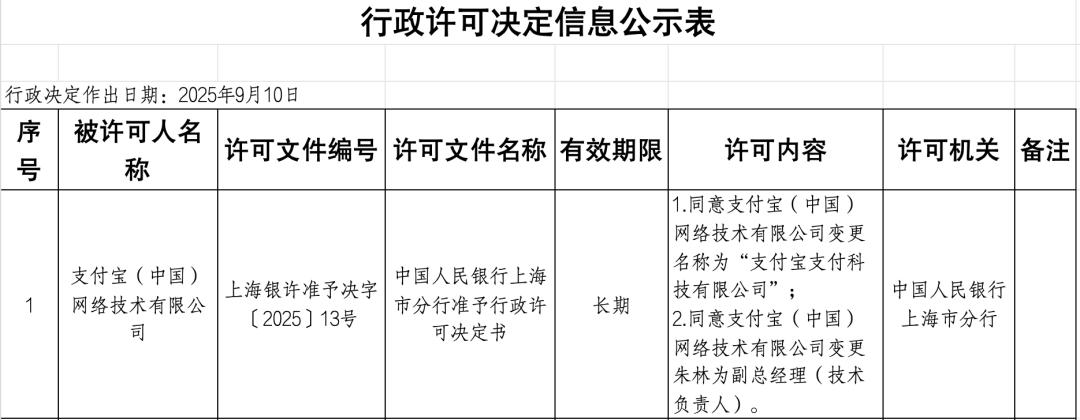
Core Viewpoint - The People's Bank of China approved the name change of Alipay (China) Network Technology Co., Ltd. to Alipay Payment Technology Co., Ltd., reflecting the company's governance upgrade under the "dual flywheel" strategy, while maintaining the Alipay brand and app name [1][2][5]. Group 1: Company Name Changes - Alipay's main operating entity has been renamed from Alipay (China) Network Technology Co., Ltd. to Alipay Payment Technology Co., Ltd. [2] - Alipay (Hangzhou) Information Technology Co., Ltd. will also change its name to Alipay (Hangzhou) Digital Service Technology Co., Ltd. [2][5]. Group 2: Strategic Direction - The name changes align with Ant Group's strategic direction, which includes "AI First," "Alipay Dual Flywheel," and accelerating globalization [5]. - The establishment of two major business groups, Digital Payment and Alipay, aims to enhance product innovation and user growth [5]. Group 3: Leadership Changes - Zhu Lin has been appointed as the Vice General Manager (Technical Head) of Alipay, previously serving as the Chief Technology Officer of Ant Group's Digital Payment business group [5][6]. Group 4: Technological Innovations - Alipay has introduced the "Tap to Pay" feature, allowing users to complete payments by tapping their phones, which has seen user adoption surpassing 200 million [6]. - The company has launched the "AI Pay" service, the first of its kind in China, aimed at providing payment solutions for AI entities [6][7]. Group 5: Market Growth Predictions - Predictions indicate that new interactive payment methods may exceed 50% in the next five years, with a tenfold increase in diverse smart device payments [7]. - The AI payment market is expected to reach a trillion-level scale, driven by the growth of the AI industry and smart terminal proliferation [7]. Group 6: Recent Developments - Alipay has introduced new AI features, including a voice search function and AI assistant tools for various services, enhancing the app's intelligence [7][8]. - The AQ health application, launched by Ant Group, has served over 140 million users, with a significant portion from lower-tier cities [8].
蚂蚁集团首批参与跨境二维码统一网关业务试点
Zheng Quan Shi Bao Wang· 2025-09-17 03:22
Core Viewpoint - Ant Group's Alipay and Ant International have become the first institutions to participate in the cross-border QR code unified gateway pilot program, enhancing payment convenience for international travelers in China [1] Group 1: Cross-Border Payment Initiatives - The initiative is guided by the People's Bank of China and the China Payment and Clearing Association [1] - Alipay now supports international bank cards from 7 major brands and 31 e-wallets from 12 countries and regions [1] - Recent additions to supported e-wallets come from Indonesia, Uzbekistan, and Thailand [1] Group 2: Economic and Cultural Impact - The cross-border QR code unified gateway is expected to facilitate new partnerships that will soon be implemented [1] - This initiative aims to enable overseas travelers to use "one wallet to travel across China," promoting tourism and enhancing economic and cultural exchanges [1]
蚂蚁集团CEO韩歆毅:AI时代中国移动支付正迈入新一轮创新周期
Xin Lang Ke Ji· 2025-09-16 07:29
Core Viewpoint - Ant Group's CEO, Han Xinyi, highlighted that the Chinese mobile payment sector is entering a new innovation cycle driven by technological advancements, regulatory empowerment, and innovative practices, aiming to enhance service for the real economy and achieve high-quality development [1][2] Group 1: Historical Development of Alipay - Alipay has undergone three innovation cycles over its 20-year history, starting in 2004 with the rise of online payments facilitated by the popularity of PCs, which significantly reduced trust and usage barriers in online transactions, thus promoting e-commerce growth [1] - Around 2011, the mainstream adoption of smartphones and 3G networks led to the emergence of mobile payment methods such as barcode and facial recognition payments, which simplified mobile transactions and reduced costs, achieving an 86% coverage rate in China, the highest globally [1] Group 2: Future Innovations in Payment - Starting in 2024, the maturity of NFC-enabled devices, smart cabins, smart glasses, and AI agents will shift service entry points, introducing new payment experiences like "tap," "look," and "AI payment," which align with current demands and will foster the AI industry ecosystem [2] - The "tap" feature allows users to make payments by simply tapping their NFC-enabled phones on payment devices, which is particularly beneficial for elderly individuals, visually impaired users, and foreign tourists, resulting in an increase of 100 million users in the last four months, surpassing a total of 200 million [2] - The "look" feature enables payments through smart glasses, allowing users to verbally confirm payment amounts while interacting with QR codes or payment devices, addressing the needs of users who cannot use their hands [2] - "AI payment" encompasses a range of services designed for the AI era, including "Payment MCP service," "AI tipping service," and "AI pay," catering to new payment scenarios involving AI tools and intelligent agents [2] - The new payment experiences aim to make transactions as natural as human communication, creating a comprehensive ecosystem involving hardware supply chains, smart terminals, service providers, and merchants, fostering continuous innovation among ecosystem partners [2]

微信分付哪些商家可以用?2025年实测这8类场景90%能付款
Sou Hu Cai Jing· 2025-09-15 07:55
Core Insights - WeChat Pay's "Fenfu" installment payment option is not universally accepted across all merchants, with acceptance varying based on merchant type and transaction scenarios [3][4] - The success rate for using Fenfu is highest in specific categories of merchants, including large chain supermarkets, brand restaurants, and major e-commerce platforms [4] - WeChat has strict merchant qualification criteria, which can lead to inconsistent acceptance of Fenfu payments, particularly among smaller vendors [3][4] Merchant Categories - The following merchant categories have the highest success rates for Fenfu payments: 1) Large chain supermarkets (e.g., Yonghui, Walmart) 2) Brand restaurants (e.g., KFC, Starbucks) 3) Chain convenience stores (e.g., 7-Eleven, FamilyMart) 4) Leading e-commerce platforms (e.g., JD.com, Pinduoduo) 5) Utility payment channels (in some regions for water, electricity, and gas) 6) Brand gas stations (e.g., Sinopec, Shell) 7) Chain pharmacies (e.g., Lao Bai Xing Pharmacy) 8) Designated brand online stores [4] Payment Techniques - Merchants may utilize multiple payment accounts, allowing some small vendors to accept Fenfu payments despite not being officially listed as supporting merchants [4] - A recent update to WeChat's payment service agreement stipulates that installment transactions over 1500 yuan must be processed through UnionPay certified merchants, which can lead to payment failures if not adhered to [4] - A common workaround for larger transactions is to split payments into smaller amounts, which many users may not be aware of [4] Merchant Support Dynamics - The list of merchants supporting Fenfu payments is updated weekly, and users can check for supported merchants through the WeChat Pay wallet interface [5] - Merchants incur a service fee of 0.6% to 1.2% for enabling Fenfu, which can lead to some low-margin businesses opting to disable this feature [5]

新国都(300130):海外市场表现持续向好 推进国际化战略
Xin Lang Cai Jing· 2025-09-07 02:42
Group 1 - The company reported a revenue of 1.527 billion yuan for the first half of 2025, a year-on-year decrease of 3.17% [1] - The net profit attributable to shareholders was 275 million yuan, down 38.61% year-on-year, while the net profit after deducting non-recurring items was 242 million yuan, a decrease of 38.90% [1] - The overseas market showed continuous improvement, with a total transaction volume of approximately 721.8 billion yuan, remaining stable compared to the same period last year, and achieving an operating income of 949 million yuan [1] Group 2 - The electronic payment equipment segment generated an operating income of 544 million yuan, with overseas sales reaching 533 million yuan, reflecting a year-on-year growth of 22.02% [1] - Revenue from high-end overseas markets in Europe, America, and Japan approached 200 million yuan, with a year-on-year increase of over 80% [1] - The company has approved plans for an H-share issuance and listing on the Hong Kong Stock Exchange, indicating a commitment to international expansion [1] Group 3 - The company’s subsidiary, Shanghai Shier District Information Technology Co., Ltd., is actively exploring AI applications, enhancing product efficiency, and expanding into various industries [2] - The AI Agent product has been successfully applied in the payment sector, improving merchant review efficiency and user experience [2] - The company maintains stable performance, with projected EPS for 2025-2027 at 1.05, 1.22, and 1.40 yuan respectively, and a "buy" rating is maintained [2]

再聊“磁升芯”背后的多重考量
凤凰网财经· 2025-09-05 12:28
Core Viewpoint - The announcement of the upgrade of UnionPay-Visa dual-branded magnetic stripe cards to chip cards marks a significant step in the internationalization of the Renminbi, providing enhanced security and user experience compared to single-branded chip cards [1][6]. Group 1: Security and Acceptance - The chip card offers a substantial upgrade in security compared to traditional magnetic stripe cards, utilizing dynamic authentication to prevent data copying and fraud [2][3]. - Chip cards have a broader acceptance range, especially in cross-border scenarios, where they have become essential as many markets no longer accept magnetic stripe transactions [4][5]. Group 2: Strategic Considerations - The transition from magnetic stripe to chip cards reflects a strategic shift in the market, driven by the need for enhanced security and the internationalization of the Renminbi [6][7]. - The collaboration between UnionPay and Visa in launching the chip card is seen as a mutually beneficial outcome, aligning their strategic interests in expanding market presence [8]. Group 3: Evolution of Payment Tools - The upgrade to chip cards signifies an evolution in credit card functionality, transforming them from mere payment tools to international bridges for commerce and communication [9]. - Banks are enhancing their product offerings to cater to cross-border needs, providing additional benefits and rewards for overseas transactions [9][10]. Group 4: Market Performance - The performance of credit cards, particularly from China Merchants Bank, indicates a strong market position, with significant overseas transaction volumes and a leading industry presence [10].


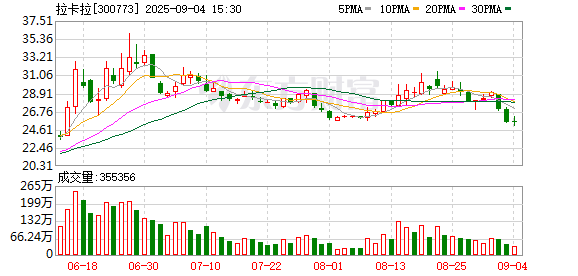
拉卡拉:2025年6月30日的股东为141234户
Zheng Quan Ri Bao· 2025-09-04 09:08
Group 1 - The company, Lakala, reported that as of June 30, 2025, it will have 141,234 shareholders [2]

连连数字(2598.HK):上半年TPV增速好於预期 全球支付稳健前景不变
Ge Long Hui· 2025-09-02 11:36
Core Viewpoint - The company reported a 27% year-on-year increase in revenue for the first half of the year, driven by a 94% increase in global payment TPV and a 28% increase in domestic payment TPV, indicating a strong growth trend in its digital payment business [1][2]. Group 1: Financial Performance - Total revenue for the first half of the year reached 780 million RMB, slightly exceeding expectations by 2% [1]. - Gross profit was 410 million RMB, a 25% increase year-on-year, with a stable gross margin of 52% [1]. - Operating profit was 1.97 billion RMB, including cash and diluted earnings from the sale of part of the shares in a connected company, amounting to 2.05 billion RMB [1]. Group 2: Digital Payment Business - Global payment TPV increased by 94% to 198.5 billion RMB, with significant growth in B2B and service trade TPV, as well as strong performance in B2C cross-border e-commerce [2]. - The payment fee rate for global payments was 23.8 bps, down 12.6 bps year-on-year, reflecting a healthy trend due to the faster growth of lower-fee B2B and service trade segments [2]. - Domestic payment TPV grew by 28% to 1.87 trillion RMB, with a stable fee rate of 1.13 bps and a gross margin of 20% [2]. Group 3: Future Outlook and Valuation - The company adjusted its 2025 global payment TPV forecast upward by 9% to 442 billion RMB, maintaining the domestic payment TPV forecast [3]. - Total TPV was adjusted upward by 1%, with expectations of a 28% year-on-year increase [3]. - The SOTP target price was revised to 17.7 HKD, reflecting a slight increase from the previous value, while maintaining a buy rating [3].
翠微股份上半年实现营业收入11.20亿元 利润总额同比减亏
Zheng Quan Ri Bao Wang· 2025-09-01 03:25
Core Insights - The company reported a revenue of 1.12 billion yuan in the first half of 2025, a year-on-year decrease of 4.12% [1] - The total profit was -199 million yuan, showing a reduction in losses by 38.99 million yuan year-on-year [1] - The net profit attributable to shareholders was -203 million yuan, reflecting a decrease in losses by 35.59 million yuan year-on-year [1] Revenue and Profit Analysis - The decline in retail business revenue was primarily due to market conditions and store adjustments, with retail revenue down 11.34% year-on-year [1] - The overall gross profit decreased by 12.77% year-on-year [1] - The subsidiary Haike Rongtong's transaction volume reached 546.8 billion yuan, a year-on-year increase of 19% [1] Future Strategies - The company plans to actively respond to industry and regional market challenges in the second half of the year [2] - Focus will be on reducing losses and increasing profits, accelerating commercial transformation, and upgrading urban renewal projects [2] - The company aims to enhance internal control effectiveness and promote high-quality development through governance system improvements [2]
