
生态治理

Search documents
蒙草生态创新草种科技助力库布其沙漠治理提质增效
Quan Jing Wang· 2025-12-17 09:06
Core Viewpoint - The company is implementing innovative desertification control strategies in the Kubuqi Desert, focusing on long-term ecological restoration through advanced technology and sustainable practices [1][7]. Group 1: Ecological Restoration Techniques - The Kubuqi Desert features various ecological types, including mobile/fixed sand dunes and desert grasslands, which require precise seed selection and planting for effective long-term management [2]. - The company employs a "tree-shrub-grass combination" planting model, utilizing 111 proprietary seed varieties to create customized ecological seed packages for sand area restoration [3]. - The "Mengnong No. 1" grass is identified as a preferred species for restoring degraded sandy grasslands, with a mixed planting ratio that enhances vegetation coverage by approximately 20% and species richness by over 30% compared to single-species restoration [5]. Group 2: Technological Innovations - The company has established a mechanical service team for desertification control, significantly increasing operational efficiency by 20 to 30 times compared to traditional manual methods [6]. - Smart equipment, such as AI-driven seed-sowing robots, operates continuously, improving seed survival rates by nearly 20%, reducing water usage by 90%, and cutting seed consumption by 60% [6]. Group 3: Integrated Renewable Energy Solutions - The company collaborates with renewable energy firms to develop a multi-functional ecological photovoltaic desertification control model, integrating sustainable practices with energy production [7]. - This model aims to enhance desert greening while promoting economic development through the cultivation of forage and ecological livestock farming [7]. Group 4: Research and Development - The company is conducting research on integrated grass planting techniques under photovoltaic systems in collaboration with the Northwest Institute of Eco-Environment and Resources, focusing on developing new materials and technologies for sustainable desertification control [9]. Group 5: Comprehensive Service Support - A one-stop ecological service center has been established to provide lifecycle support for desertification control projects, ensuring comprehensive ecological management [10]. - The company utilizes a smart command center for real-time monitoring and management of project quality, progress, and safety, employing drones for daily inspections and intelligent monitoring stations for key indicators [11].


乘三峡时光列车,来一趟穿越15年的绿水青山之旅
Nan Fang Nong Cun Bao· 2025-12-16 03:35
Core Viewpoint - The article highlights the transformative journey of the Three Gorges area over the past 15 years, focusing on ecological restoration, community development, and industrial revitalization, showcasing significant improvements in both the environment and local livelihoods [1][6][81]. Group 1: Ecological Restoration - The article emphasizes the successful ecological restoration efforts, such as the transformation of polluted rivers into national-level demonstration rivers, exemplified by the "Dragon River's rebirth" in Fengdu [15][18]. - It details the significant changes in water quality and landscape, including the East Wind Lake's transformation from polluted to clear water, demonstrating effective urban water management practices [64][67]. Group 2: Community Development - The narrative includes the establishment of new towns for relocated residents, highlighting the importance of not just moving people but ensuring they have stable and prosperous lives, as seen in the dual-river street immigrant settlement [36][38]. - The article discusses the rise of local tourism and hospitality, particularly in villages like Green Spring Dam, which have benefited from improved environmental conditions [20][21]. Group 3: Industrial Revitalization - The article outlines the agricultural success in the region, particularly the 400,000 acres of navel oranges in Zigui, which generate an annual output of 1 million tons and a comprehensive value of 25 billion yuan, becoming a crucial economic pillar for local residents [57][58]. - It also mentions the comprehensive river management projects in Jiujiang, which serve as a model for ecological governance and urban river management [75][79].

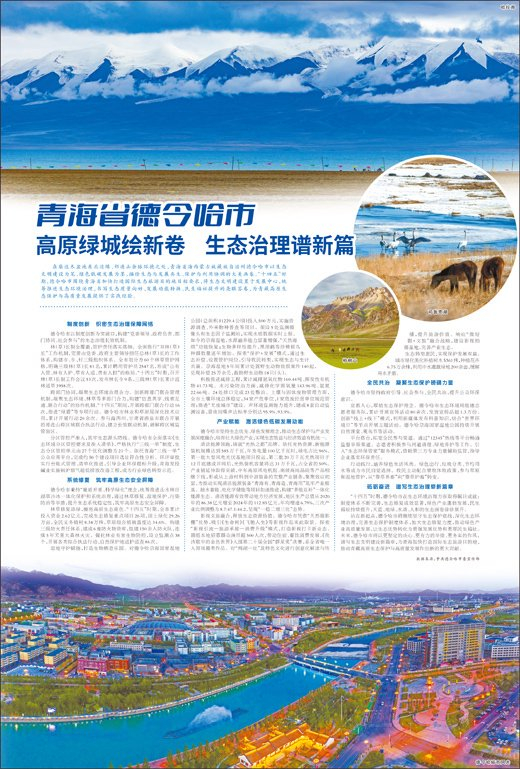
青海省德令哈市 高原绿城绘新卷 生态治理谱新篇
Ren Min Wang· 2025-12-10 01:21
Core Viewpoint - Delingha City in Qinghai Province is focusing on ecological civilization construction and green low-carbon development, aiming to balance ecological protection and economic growth during the 14th Five-Year Plan period [4][13]. Group 1: Institutional Innovation - Delingha City has established a long-term ecological governance mechanism led by the Party, with responsibilities clearly defined across various levels of government and society [5]. - The city has implemented a comprehensive "Double Forest (Grass) Chief" system, with 81 forest (grass) chiefs and 2,547 caretakers, ensuring effective management of forest and grassland resources [6]. - A cross-departmental collaborative management mechanism has been created, conducting 16 joint actions during the 14th Five-Year Plan to enhance ecological governance [6]. Group 2: Systematic Restoration - The city has invested 262 million yuan in ecological restoration projects, achieving significant improvements in ecosystem stability and biodiversity [7]. - Delingha has implemented a fire prevention system and established monitoring points for pest control, resulting in no major forest fires for five consecutive years [7]. - Wetland protection efforts have led to enhanced water conservation capabilities and increased biodiversity in the Gahai National Wetland Park [8]. Group 3: Industrial Empowerment - Delingha is promoting green industries, with a focus on clean energy, achieving a total installed capacity of 5.85 million kilowatts and generating 10 billion kilowatt-hours of electricity annually [9]. - The city has developed a complete industrial chain for clean energy, contributing to a GDP growth from 8.638 billion yuan in 2020 to 11.285 billion yuan in 2024, with an annual growth rate of 6.79% [9]. Group 4: Ecological Transformation - Urban greening efforts have included planting over 5,361 trees and 67,500 flowers, utilizing recycled water for irrigation [11]. - The city has engaged the public in ecological protection through volunteer programs and educational campaigns, enhancing community involvement in environmental governance [12]. Group 5: Future Outlook - Delingha aims to continue improving its ecological governance system, enhance ecological restoration efforts, and promote high-quality development of green industries, contributing to the establishment of an international ecological tourism destination in Qinghai [13].
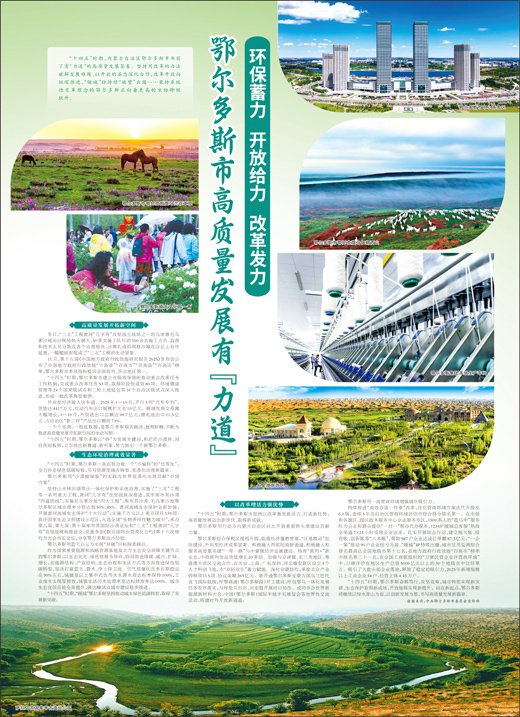
鄂尔多斯市高质量发展有“力道”
Ren Min Wang· 2025-12-09 01:21
Core Viewpoint - During the "14th Five-Year Plan" period, Ordos City in Inner Mongolia has achieved significant high-quality development through reforms, open cooperation, and systematic changes, aiming for a higher developmental trajectory [2][9]. Group 1: High-Quality Development - Ordos has established a mechanism led by city leaders to promote key reform tasks, completing 53 major reform tasks with 80 achieving phased results [3]. - The city ranks first in North China and among the top in the nation for various indicators in the "2025 China Local Government Administrative Efficiency Research Report" [3]. - The external economy is thriving, with foreign trade reaching 9.87 billion yuan and lithium battery exports accounting for 1.15 billion yuan, representing 73% of the region's "new three products" exports [4]. Group 2: Ecological and Environmental Governance - Ordos has made significant progress in ecological governance, implementing integrated protection and systematic management of natural resources, achieving a governance rate of 50% in the Kubuqi Desert and 85% in the Mu Us Sandy Land [6]. - The city has been recognized as a national ecological civilization demonstration zone and has hosted international forums on desertification [6]. Group 3: Urban Development and Business Environment - Ordos has optimized its business environment, achieving the highest score in the autonomous region for five consecutive years, and has established a service team to assist over 987 enterprises, resulting in an order amount of 8.73 billion yuan [11][12]. - The city has attracted 54 new large-scale industrial enterprises and 44,500 business entities during the "14th Five-Year Plan" period, enhancing its urban appeal [12]. Group 4: Infrastructure and Connectivity - The Ordos Comprehensive Bonded Zone has been upgraded, and the city is actively integrating into the Western Land-Sea New Corridor and the Belt and Road Initiative [10]. - New international flight routes and infrastructure projects are being developed to enhance connectivity with neighboring regions and countries [10].

鄂尔多斯市高质量发展有“力道” 环保蓄力 开放给力 改革发力
Ren Min Ri Bao· 2025-12-08 22:22
Group 1: Core Insights - During the "14th Five-Year Plan" period, Ordos City in Inner Mongolia has achieved significant high-quality development through reforms and open cooperation, aiming for a higher developmental trajectory [1][9] - The city has established a mechanism for leading key reform tasks, completing 53 major reform tasks with 80 achieving significant results, and has been recognized for its administrative efficiency [2][9] - Ordos has seen a substantial increase in its foreign trade, with total import and export value reaching 9.87 billion yuan and lithium battery exports accounting for 1.15 billion yuan, representing 73% of the region's "new three samples" product exports [2] Group 2: Environmental and Ecological Initiatives - Ordos has made notable progress in ecological governance, implementing integrated protection and systematic management of natural resources, with desertification control rates reaching 50% in the Kubuqi Desert and 85% in the Mu Us Sandy Land [5] - The city has been recognized as a national ecological civilization demonstration zone and has hosted international forums to share its desertification control experiences [5] - Air quality has remained stable at around 90% for good quality, with 100% compliance in urban drinking water quality and zero industrial wastewater discharge [6] Group 3: Economic Development and Reforms - The city has enhanced its external economic activities, with significant growth in cross-border e-commerce and the establishment of new international trade routes, including direct flights to Ulaanbaatar, Mongolia [9][10] - Ordos has improved its business environment, ranking first in the region for five consecutive years in business environment assessments, and has implemented a "one-stop" service model for enterprises [10] - The city has attracted numerous leading enterprises, with 54 new large-scale industrial enterprises and 44,500 business entities established by 2025 [10]
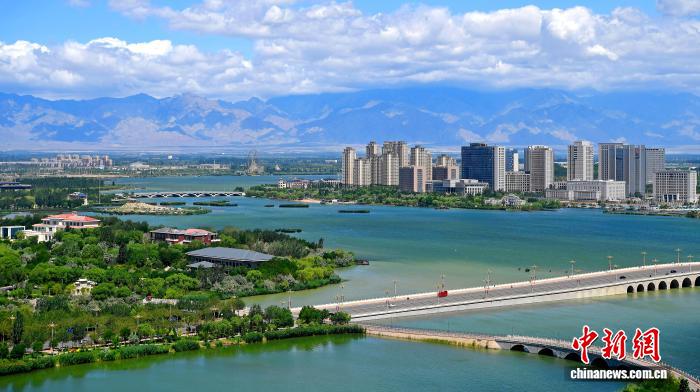
生态打底 让“塞上湖城”既有颜值更有内涵
Zhong Guo Xin Wen Wang· 2025-11-30 02:05
Core Viewpoint - The city of Yinchuan has made significant strides in ecological protection and urban development over the past five years, enhancing both its natural environment and the quality of life for its residents [1][3][5][6]. Group 1: Ecological Initiatives - Yinchuan has implemented a "river chief system" combined with legal and police oversight to ensure effective river and lake management, resulting in improved water quality and ecological restoration projects [3][5]. - The city has achieved a level A or above discharge standard for all 17 sewage treatment plants, and the Yellow River (Yinchuan section) has maintained a Class II water quality for eight consecutive years [3][5]. Group 2: Urban Greenery and Biodiversity - Over the past five years, Yinchuan has added 7,500 acres of green space, with a park service radius coverage of 94%, making urban greenery accessible to residents [5][6]. - The ecological transformation of the Helan Mountains has led to a nearly fourfold increase in the population of wild goats since 2000, with over 40,000 individuals now present [5][6]. Group 3: Economic Development through Ecology - The ecological restoration of 270,000 acres of previously barren land has resulted in the establishment of a wine grape planting base and winery clusters, promoting both ecological improvement and economic benefits for local residents [6]. - The integration of the goji berry industry into various sectors, including health products and cultural creations, has created job opportunities and enhanced the region's unique brand [6].
“十四五”期间陕西建成1426个政府投资重大项目
Shan Xi Ri Bao· 2025-11-27 22:49
Group 1 - The core report highlights that during the "14th Five-Year Plan" period, a total investment of 962.9 billion yuan has been completed, with 1,426 major projects constructed and put into operation, resulting in a significant number of quality assets and effective supply [1] - Since 2021, over 30,000 government investment projects have been implemented in Shaanxi, covering 17 public sectors including transportation and water conservancy [1] - In the comprehensive transportation sector, an investment of 388.8 billion yuan has been completed, with five high-speed rail constructions fully promoted, achieving historic "highway access for every county" [1] Group 2 - In terms of high-level innovation platforms, Shaanxi has completed the reorganization and establishment of 42 national key laboratories, accelerating the potential release of the Qin Chuang Yuan platform, and overcoming over 1,100 key core technologies in critical fields such as high-end equipment and aerospace [2] - To enhance public welfare capabilities, 56 key medical projects, including the provincial public health center (Phase I), have been put into use, along with the construction and expansion of 345 county-level hospitals and health centers [2] - In improving ecological environment quality, the province has completed afforestation of 1.585 million acres and improved the centralized sewage treatment rate in Guanzhong towns to 97% [2]
云南省文山州 创新驱动引领高质量发展
Ren Min Ri Bao· 2025-11-27 22:18
Core Insights - Yunnan Province's Wenshan Zhuang and Miao Autonomous Prefecture is focusing on high-quality development driven by innovation, achieving significant economic growth, ethnic unity, ecological improvement, social stability, and enhanced public happiness [1] Economic Development - Wenshan's GDP is projected to grow at an average rate of 6.3% annually from 2021 to 2024, with industrial output exceeding 130 billion yuan [1] - The region has achieved full coverage of provincial industrial parks across its eight counties, with green aluminum production capacity reaching 3.43 million tons and expected output surpassing 100 billion yuan this year [1] - The tourism sector is also thriving, with 50.045 million visitors expected in 2024, generating tourism revenue of 54.14 billion yuan [1] - The foreign trade sector is seeing growth, with a total import and export value of 2.96 billion yuan in the first three quarters of this year [1] Infrastructure Development - The total length of roads in Wenshan has reached 42,000 kilometers, with significant projects like the Wenshan-Mongolia Railway and Funing Port enhancing transportation [2] - By 2025, Wenshan plans to implement 4,089 projects, with water storage capacity increasing by 220 million cubic meters by 2024 [2] - Energy capacity has improved, with total installed power reaching 6.74 million kilowatts and over 10,000 5G base stations established [2] Social Welfare - Wenshan has implemented initiatives to improve community welfare, including job placement services that have facilitated employment for 470,000 people [3] - The region has achieved a rural sewage treatment rate of 72.82% and a sanitation toilet coverage rate of 78.35% [3] - All eight counties have reached basic educational equity and healthcare standards, contributing to the creation of a national civilized city [3] Ecological Development - Wenshan is committed to ecological preservation, with air quality remaining above 99.2% for three consecutive years and water quality at 100% for two years [4] - The region has undertaken extensive greening efforts, planting 15.06 million square meters of greenery and establishing over 190 kilometers of health greenways [4] - Wenshan's innovative practices in ecological civilization have been recognized nationally, contributing to its high-quality development narrative [4]
“沙海明珠”走上生态振兴路
Ren Min Ri Bao· 2025-11-26 22:51
Core Points - The transformation of Tumushuke City from a desert area to a green oasis is attributed to effective desertification control and water resource management [1][2] - The implementation of ecological restoration practices, such as the cultivation of reed and the use of recycled water, has led to improved agricultural productivity and environmental conditions [1][3] - The city has developed a comprehensive urban greening strategy, resulting in significant increases in green space and park facilities, enhancing the quality of life for residents [3][4] Group 1: Desertification Control and Water Resource Management - Tumushuke City has successfully implemented a "desertification control + water resource recycling" model, utilizing treated wastewater for irrigation [1] - The cultivation of 2,000 acres of reed has been a key initiative in combating desertification and improving local ecology [1] Group 2: Agricultural Improvement - Local farmers have adopted innovative practices, such as planting trees around vineyards and using drip irrigation, which have led to better fruit quality and increased income [2] - The diversification of income sources for farmers, including agrotourism, has been noted as a significant benefit of improved agricultural practices [2] Group 3: Urban Greening and Ecological Protection - The urban area of Tumushuke City has achieved a green space area of 9.0346 million square meters, with a green coverage rate of 43.58% [3] - The city has established 29 parks, enhancing community engagement and recreational opportunities for residents [3] - The protection of natural resources, including the introduction of ecological water replenishment for the Populus euphratica forest, has been prioritized [3][5]
“十四五”时期 内蒙古完成防沙治沙6688万亩
Ren Min Ri Bao· 2025-11-24 23:12
Core Viewpoint - Inner Mongolia has made significant progress in ecological construction during the 14th Five-Year Plan period, completing 1.23 million acres of ecological tasks, which accounts for 43.2% of the total planned tasks [1] Group 1: Ecological Construction Achievements - A total of 66.88 million acres have been completed for desertification control [1] - The total ecological construction task in Inner Mongolia under the "Three North" project is 285 million acres, with 38.61 million acres dedicated to comprehensive management of desertified land [1] - By 2024, the forest coverage rate in Inner Mongolia is expected to reach 21.98%, an increase of 1.19 percentage points compared to 2021 [1] Group 2: Innovative Mechanisms and Strategies - Inner Mongolia has innovated mechanisms in areas such as project integration, funding input, social participation, joint prevention and control, and industry-driven development [1] - The region has adopted a new approach focusing on comprehensive management of key areas, scientific governance based on water resources, efficient governance through innovative models, strengthened protective system governance, and collaborative industry development [1] Group 3: Ecological Stability Indicators - Grassland vegetation coverage remains stable at over 45% [1] - Wetland area is maintained at around 7 million acres, reinforcing ecological security functions [1]