
酒店运营

Search documents
新鸿基地产(00016) - 2025 H2 - 电话会议演示
2025-09-04 10:00
Financial Performance - The underlying profit attributable to the company's shareholders increased by 0.5% to HK$21,855 million in FY2025 [11] - Reported profit attributable to the company's shareholders increased by 1.2% to HK$19,277 million in FY2025 [11] - Property development operating profit in Hong Kong decreased by 50.9% to HK$3,200 million in FY2025 [30] - Property development operating profit in Mainland increased by 281% to HK$5,090 million in FY2025 [72] - Property rental operating profit decreased by 3.2% to HK$18,392 million in FY2025 [12] - Hotel operations operating profit decreased by 5.4% to HK$615 million in FY2025 [12] Financial Position - Net debt decreased to HK$93,298 million as of 30 June 2025 [13] - Gearing ratio decreased to 15.1% as of 30 June 2025 [13] - Fixed-rate or RMB floating debt accounted for 55% of total debt as of 30 June 2025 [19] Land Bank and Property Development - Total land bank in Hong Kong was 57.4 million sq ft as of 30 June 2025 [23] - Total land bank in Mainland was 65.3 million sq ft as of 30 June 2025 [66] - Contracted sales in Hong Kong amounted to approximately HK$42.3 billion in FY2025 [35] - Contracted sales on the Mainland amounted to approximately RMB4.0 billion in FY2025 [78]

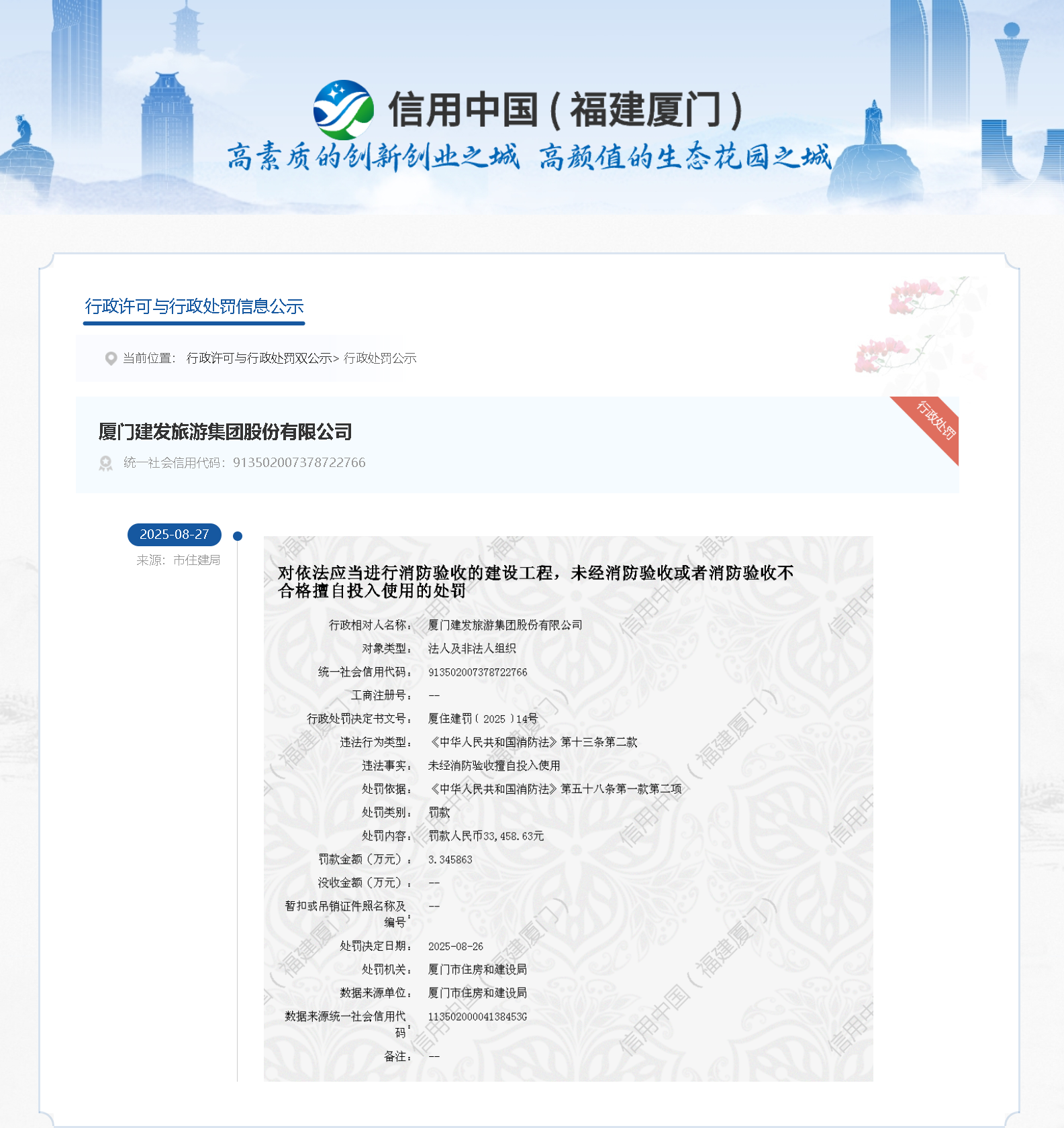
建发旅游集团因未经消防验收擅自投入使用被罚
Qi Lu Wan Bao· 2025-08-31 22:40
Group 1 - The company Xiamen C&D Tourism Group Co., Ltd. was fined 33,458.63 yuan by the Xiamen Municipal Housing and Construction Bureau for using a facility without passing fire safety inspection [1] - Xiamen C&D Tourism Group is a wholly-owned subsidiary of the Fortune Global 500 C&D Group, established in 2003, focusing on hotel operations, travel agencies, and tourism investment management [3] - As of 2024, the group's asset scale exceeds 3.4 billion yuan, operating and managing 30 hotels with a total of over 7,800 rooms/suites, and owns the "Yuehua" and "Yihua" hotel brands [3]

从供应链到消费端构建绿色闭环
2 1 Shi Ji Jing Ji Bao Dao· 2025-08-29 23:13
Core Insights - The forum discussed the exploration and core challenges of leading enterprises in the green transformation of supply chains, industrial chains, and value chains [1] - The emphasis is on how to turn consumers' green choices into sustainable lifestyles and collective practices among enterprises [1] Group 1: Supply Chain and Sustainability - The supply chain is extensive, covering everything from ingredient cultivation to waste management, with upstream agriculture being a significant challenge for carbon reduction [1] - McDonald's is actively exploring the concept of regenerative agriculture to maintain food quality while reducing environmental pollution [1] - Mars Asia Pacific highlighted that only 5% to 10% of food packaging in China is truly recyclable, indicating a bottleneck in the recycling system [1] Group 2: Technological Innovations and Practices - Mars has invested over $100 million in R&D to improve packaging recycling issues, transitioning MM chocolate beans to paper packaging [2] - McDonald's implemented a data collection system to monitor electricity usage, leading to nearly double-digit energy savings and effective emissions reduction [2] - Huazhu Group adopted modular design in its latest hotel version, achieving a 15% cost reduction, 30% shorter construction time, and 40% less construction waste [2] Group 3: Consumer Engagement and ESG Initiatives - Transforming corporate green commitments into consumer understanding and action is crucial for completing the green loop [3] - Huazhu launched a "Green Stay" product on its app, encouraging guests to bring their own toiletries and opt for no cleaning, rewarding them with green points [3] - The initiative has been well-received, particularly among younger guests who actively embrace ESG initiatives [3]
绿地控股2025年上半年营收近945亿元
Zheng Quan Shi Bao Wang· 2025-08-26 15:37
Group 1 - The company reported a revenue of 94.496 billion yuan for the first half of the year, a year-on-year decrease of 18.06%, primarily due to reduced real estate turnover and a slowdown in the infrastructure sector [1] - The net profit for the company was -3.506 billion yuan, reflecting a significant year-on-year decline of 1772.40% [1] - In the real estate sector, the company focused on "high-quality destocking," achieving a contract sales amount of 33.9 billion yuan, which is a 6.6% increase year-on-year, with a contract sales area of 3.73 million square meters, up 25.6% year-on-year [1] Group 2 - The infrastructure segment generated a revenue of 43.322 billion yuan, with a total amount of ongoing projects reaching 628.2 billion yuan [2] - The company signed new contracts worth 78 billion yuan, making breakthroughs in the renewable energy sector with projects like the Xinjiang 5G base station and Ordos photovoltaic projects [2] - The company improved its cash flow situation, with a net cash flow from operating activities of -2.479 billion yuan, showing a year-on-year improvement of 52.48% due to reduced procurement expenses and optimized inventory management [2]

从供应链到消费端,企业如何构建绿色闭环?
2 1 Shi Ji Jing Ji Bao Dao· 2025-08-26 08:41
Core Insights - The shift towards green consumption is accelerating from conceptual advocacy to behavioral transformation, necessitating deep changes in supply chains, industrial chains, and value chains [1] - The third "Vibrant ESG" Innovation Forum highlighted the critical role of enterprises in the green transition, emphasizing the need for tangible actions to eliminate "greenwashing" and enhance consumer awareness of environmental contributions [1] Group 1: Supply Chain Challenges - Companies face significant emission reduction challenges across their supply chains, with industry-specific pain points. For instance, McDonald's identifies upstream agricultural sectors as the most challenging area for carbon reduction [2] - Adidas reports that 80% of its carbon emissions come from suppliers, highlighting the reliance on supplier cooperation for effective carbon reduction [2] Group 2: Recycling and Consumer Responsibility - The rapid growth of the food delivery market in China raises concerns about the effective recycling of packaging waste, with only 5%-10% of food packaging currently recyclable [3] - Sony's diverse business operations complicate ESG management across different sectors, indicating the need for a comprehensive approach to sustainability [3] Group 3: Technological Innovations - Companies are investing in innovative technologies to address green transition challenges. For example, Sony's "So Plus" technology converts waste materials into recyclable products, achieving a 99% rate of renewable plastic [4] - Mars is investing over $100 million in research to improve packaging sustainability, transitioning to paper packaging for its products [4] Group 4: Cost Reduction and Efficiency - Huazhu Group emphasizes cost reduction and efficiency through modular design, achieving a 15% cost reduction and a 30% decrease in construction time [5] - Adidas has implemented a project to recycle returned or substandard clothing into eco-friendly bags, successfully recycling 60,000 tons of waste clothing [5] Group 5: Consumer Engagement - Huazhu's "Green Stay" initiative encourages guests to bring their own toiletries and opt for no cleaning services, rewarding them with green points, which has been well-received by consumers [5] - Adidas aims to make sustainable choices effortless for consumers, integrating sustainability into the core of its product offerings [6] Group 6: Strategic Reassessment - Companies must rethink governance, risk management, and operational management to transform potential cost burdens into efficiency gains and sustainable brand value [7]
2025年第31周:跨境出海周度市场观察
艾瑞咨询· 2025-08-14 00:06
Group 1: Media Industry Analysis - The domestic short drama industry has matured, transitioning from chaotic growth to standardized development, with a shift in profit models from IAP to IAA, and a move from mini-programs to independent apps targeting overseas markets [3] - The market size for short dramas is projected to reach 50.4 billion yuan by 2024, surpassing box office revenues for the first time, with a user base of 666 million and an increasing share of the IAA model [3] - The short drama industry has a short payback period and encompasses content production, distribution, and consumption, with significant growth in anime short dramas primarily targeting Generation Z [3] Group 2: Emerging Markets for Chinese Enterprises - Chinese companies are accelerating their expansion into emerging markets such as Africa, Central Asia, the Middle East, and Latin America amid ongoing US-China tariff disputes [4] - Brand globalization is becoming a core focus, with trends indicating a shift towards younger global markets and a positive image of Chinese technology [4] - The characteristics of five major regional markets vary, with Africa emerging as a new blue ocean requiring localization strategies [4] Group 3: Gaming Industry Insights - The Chinese gaming industry is experiencing accelerated overseas expansion, supported by various local policies, with 25 evergreen games generating approximately 11.6 billion yuan in overseas revenue in the first half of 2025 [5] - Notable games like PUBG MOBILE and Genshin Impact have monthly revenues exceeding 100 million yuan, while potential games like Whiteout Survival are showing strong performance [5] - Future trends in gaming exports may include mixed casual games, female-oriented titles, and the integration of AI technology [5] Group 4: AI Industry and Brazil - The relationship between China and Brazil has deepened since 1974, with China being Brazil's largest trading partner, focusing on agricultural products, minerals, and machinery [6] - Chinese enterprises are actively investing in Brazil's infrastructure, agriculture, and energy sectors, with a report highlighting opportunities and challenges in the Brazilian market [6] - The 2025 BRICS summit will focus on AI governance, with Chinese AI companies like DeepSeek driving global collaboration [6] Group 5: Chinese Milk Tea Brands Going Global - Chinese milk tea brands are making significant inroads into overseas markets, becoming a cross-cultural "social currency" [7][8] - Brands like Tea Yan Yue Se are utilizing e-commerce to enter the North American market, avoiding traditional brick-and-mortar strategies [8] - The global ready-to-drink tea market holds substantial potential, with e-commerce providing a low-cost, rapid feedback mechanism for brands [8] Group 6: Automotive Industry Expansion - In the first half of the year, China exported 3.083 million vehicles, with 1.06 million being new energy vehicles, marking a 75.2% increase [9] - The China Association of Automobile Manufacturers predicts total exports could exceed 7 million vehicles for the year, with a shift towards technology output [9] - The industry is calling for "high-quality exports" to avoid chaotic competition, particularly in the European market [9] Group 7: Brand Expansion Strategies - Wangzai Milk has successfully expanded overseas, with a unique English name "HOT-KID," generating nearly 1.2 billion yuan in overseas revenue in the 2023 fiscal year [16] - The brand's strategy focuses on retaining unique characteristics while adapting to local markets, achieving significant brand recognition [16] - The recent popularity of "HOT-KID" has generated buzz in domestic marketing, showcasing the brand's innovative vitality [16] Group 8: E-commerce and Supply Chain Strategies - Dingdong Maicai is prioritizing overseas expansion, starting with Saudi Arabia and collaborating with local retailers to enhance supply chain capabilities [21] - The company aims to leverage China's rapid development in agriculture and supply chain to address market gaps in overseas regions [21] - Dingdong's approach emphasizes collaboration and technology support rather than direct consumer sales, differentiating its strategy from domestic operations [21]

做好小微企业金融服务需要“去标签化”
Jin Rong Shi Bao· 2025-08-08 07:55
Group 1 - The core viewpoint emphasizes the need for financial institutions to understand the personalized needs of small and micro enterprises, particularly regarding loan terms, amounts, and purposes, to help them become more resilient and transform out of difficulties [1][2] - Small and micro enterprises are facing significant challenges such as longer accounts receivable periods, shrinking profits, and increased competition, which severely impact their liquidity and risk-bearing capacity [1][3] - Financial institutions have traditionally relied on standardized products and customer profiling based on data, but there is a need to move away from labeling these enterprises and instead focus on individualized assessments to better support their unique circumstances [1][2] Group 2 - From the perspective of small and micro enterprises, obtaining appropriate loans is crucial for their development, and the focus should be on the timing and suitability of the loans rather than just the amount or interest rates [2][3] - Banks often face challenges in providing loans due to the high risks associated with small and micro enterprises, leading to a tendency to reduce or withdraw loans, which exacerbates the financial pressure on these businesses [2][3] - A personalized assessment of small and micro enterprises should consider factors such as operational stability, the founder's industry standing, current cash flow, and potential growth opportunities to tailor financial support effectively [3][4] Group 3 - The coffee industry in Yunnan has seen a positive trend due to global supply issues, prompting banks to develop credit products tailored to the entire coffee supply chain, although caution is advised regarding potential market overheating [4][5] - Small and micro enterprises in the construction sector are experiencing increased accounts receivable and project scarcity, leading some to pivot towards property management to maintain cash flow, highlighting the need for timely financial support from banks during their transition [5] - The health of small and micro enterprises is critical for economic development, and financial support must adapt to the evolving characteristics and needs of these businesses to enhance their sustainability and contribute to high-quality economic growth [5]
梦百合、左右家居跨界开酒店,醉翁之意还是“卖货”?
Guan Cha Zhe Wang· 2025-08-01 04:20
Core Viewpoint - Several soft furniture companies are exploring the hotel industry as a means to expand into downstream sectors amid an overall industry downturn [1][4]. Group 1: Company Initiatives - Left Home has opened its first hotel, "Left Home Happiness Hotel," in Shenzhen, featuring 156 rooms priced between 300-500 RMB, positioning itself in the mid-range hotel market [1]. - Dream Lily has launched its first hotel, "Dream Lily Zero Pressure Hotel," in Shanghai, with 119 rooms equipped with its signature zero-pressure smart beds, emphasizing a deep sleep concept [1][3]. - Both companies are transitioning from product manufacturers to lifestyle service providers, marking a significant shift in their business models [1][3]. Group 2: Business Strategy - Dream Lily aims to open 2,000 hotels, integrating hotel functions with product experience and sales, effectively turning each hotel into a showroom for its products [3]. - Left Home's hotel also allows guests to purchase furniture directly from their rooms, utilizing technology to collect user sleep data for product development [3][4]. - The core strategy for both companies remains focused on selling products, despite the hotel industry's emphasis on service operations [4]. Group 3: Industry Context - Historically, soft furniture companies like Dream Lily and Left Home have collaborated with hotel chains, indicating a trend of moving from suppliers to direct competitors in the hotel space [5]. - Dream Lily previously partnered with major hotel groups and has recently taken legal action against them, highlighting the competitive dynamics in the industry [6]. - The hotel business for both companies is still in its early stages, and it remains uncertain whether this will become a significant growth area for them [6][7].


远东发展(00035) - 2025 H2 - 电话会议演示
2025-06-30 09:19
Financial Performance - Adjusted revenue increased by 3.8% to HK$10.6 billion [13] - Adjusted cash profit was HK$266 million [13] - Net loss attributable to shareholders was approximately HK$1,275 million [22] - Total bank loans and notes decreased by approximately HK$2.4 billion, an 8.6% drop compared to March 31, 2024 [22] - Monetized approximately HK$1.2 billion in non-core assets and businesses in FY2025 [22] Operational Highlights - Property development adjusted revenue increased by 5.3% to approximately HK$7.2 billion [14] - Hotel revenue increased by 2.3% to approximately HK$2.077 billion [16] - Car park revenue decreased by 2.6% to approximately HK$713 million [16] - Gaming revenue increased by 1.6% to approximately HK$409 million [16] Balance Sheet Management - Adjusted net gearing ratio decreased to 67.6% as of March 31, 2025 [22] - Net debt reduced by HK$1.3 billion [29] - Total cumulative attributable presales and unbooked contracted sales reached approximately HK$8.9 billion [14]

远东发展(00035) - 2025 Q4 - 业绩电话会
2025-06-26 01:00
Financial Data and Key Metrics Changes - Adjusted revenue increased by 3.8% to HKD 110 billion, with adjusted cash profit at HKD 266 million, primarily driven by property development [4][8] - Adjusted revenue from property development grew by 5.3% to approximately HKD 7.2 billion compared to HKD 6.8 billion last year [4][28] - Total bank loans and notes decreased by HKD 2.2 billion, and the net adjusted gearing ratio dropped by 1.2 points to 67.6% [9][19] Business Line Data and Key Metrics Changes - Hotel revenue was HKD 2 billion, reflecting a growth of 2.3% year-on-year [6][51] - Gaming revenue increased by 1.6% to approximately HKD 400 million, indicating stability in recurring income [8][51] - Revenue from car parks decreased by 2.6%, attributed to the phasing out of underperforming contracts [55][56] Market Data and Key Metrics Changes - The total accumulated attributable pre-sale value and unbooked contracted sales reached approximately HKD 8.9 billion [4][17] - The gross margin improved to 31.8% from 31% last year, particularly in the car park business [18][19] - The average selling price in Manchester increased by 35%, reflecting a strong market demand [40] Company Strategy and Development Direction - The company aims to accelerate project completion to enable early revenue recognition and optimize cash flow [26][47] - A robust development pipeline of around HKD 61 billion is expected to support sustainable growth over the next six to eight years [26][47] - The company is focusing on inventory monetization and asset disposal to reduce debt levels [65][66] Management's Comments on Operating Environment and Future Outlook - Management expressed cautious optimism about the property market, indicating that they believe it has bottomed out [76] - The company plans to maintain a conservative approach to lower the gearing ratio while exploring new project opportunities [71][76] - Future cash flow visibility is supported by both property development projects and recurring income businesses [66] Other Important Information - The company has completed several significant property projects, including Aspen in Canary Wharf and Huon Hole in Singapore, contributing to revenue [4][30] - The company has entered into contracts for the sale of non-core assets, including a car park in Manchester and a hotel asset in North London [14][15] Q&A Session Summary Question: When will the dividend be restored? - Management indicated that due to market uncertainties and impairments, they are being conservative and have not yet decided on dividend payments [75][76] Question: How much of the HKD 8.9 billion pre-sale will be recognized in FY 2026 and FY 2027? - Approximately HKD 11 billion is expected to be recognized in FY 2026, with the remaining to be recognized in FY 2027 [79][80] Question: What is the company's stance on perpetual bonds given recent market events? - Management stated that they have not yet had internal discussions regarding the high coupon of perpetual bonds and will provide updates in due course [82][83] Question: What challenges does the company face in expanding its hotel portfolio? - Management acknowledged competition from global hotel groups and emphasized the importance of consistency in service and brand quality [84][88]