
美妆

Search documents
市值暴增超210亿美元,美妆巨头雅诗兰黛,悄然“翻身”
Xin Lang Cai Jing· 2025-12-20 05:45
Core Insights - The global cosmetics industry has faced significant challenges over the past two years, leading to declines and losses for major players like Estée Lauder, which saw its market value drop by over 85% from the end of 2021 to mid-2025, equating to a loss of more than $110 billion [1] - Estée Lauder has begun to recover, with its stock price increasing by over 120% since mid-April, resulting in a market value growth of over $21 billion [3] - The company's Q1 FY2026 financial results show a net sales increase to $3.481 billion, a 4% year-over-year growth, and a return to profitability with a net income of $47 million [3] Financial Performance - For Q1 FY2026, Estée Lauder reported net sales of $3.481 billion, up from $3.361 billion in the same period last year, marking a 4% increase [3] - The operating profit for the quarter was $169 million, a turnaround from an operating loss of $121 million in the previous year [3] - The gross margin improved from 72.4% to 73.4%, and the operating margin shifted from -3.6% to 4.9% [3] Market Dynamics - The Asia-Pacific region, particularly the Chinese market, contributed significantly to the company's growth, achieving a 9% organic net sales increase, driven by strong perfume sales and inventory optimization [3][6] - Estée Lauder's strategic plan, "Reinventing Beauty," aims to restructure operations, optimize marketing investments, and focus on high-potential brands, with a notable emphasis on the Chinese market [5][6] Strategic Adjustments - The company has restructured its management team and is now reporting the Chinese market's performance independently, reflecting its importance in the overall business strategy [5][6] - Estée Lauder is considering divesting underperforming brands while concentrating resources on those with higher growth potential, although no specific sale plans have been confirmed [6] Analyst Perspectives - Analysts from Goldman Sachs and BofA Securities have upgraded their ratings on Estée Lauder, citing improvements in the company's fundamentals and market conditions, with price targets adjusted upwards [7][8] - Goldman Sachs predicts that Estée Lauder's EBITDA margin could reach double digits by FY2027, indicating a positive outlook for the company's financial recovery [7] Future Outlook - Estée Lauder anticipates organic net sales growth of 0% to 3% for FY2026, with adjusted operating margins expected to be between 9.4% and 9.9% [4] - The company is expected to continue benefiting from the recovery in the Chinese market and the resurgence of travel retail, which could further enhance its performance [9]

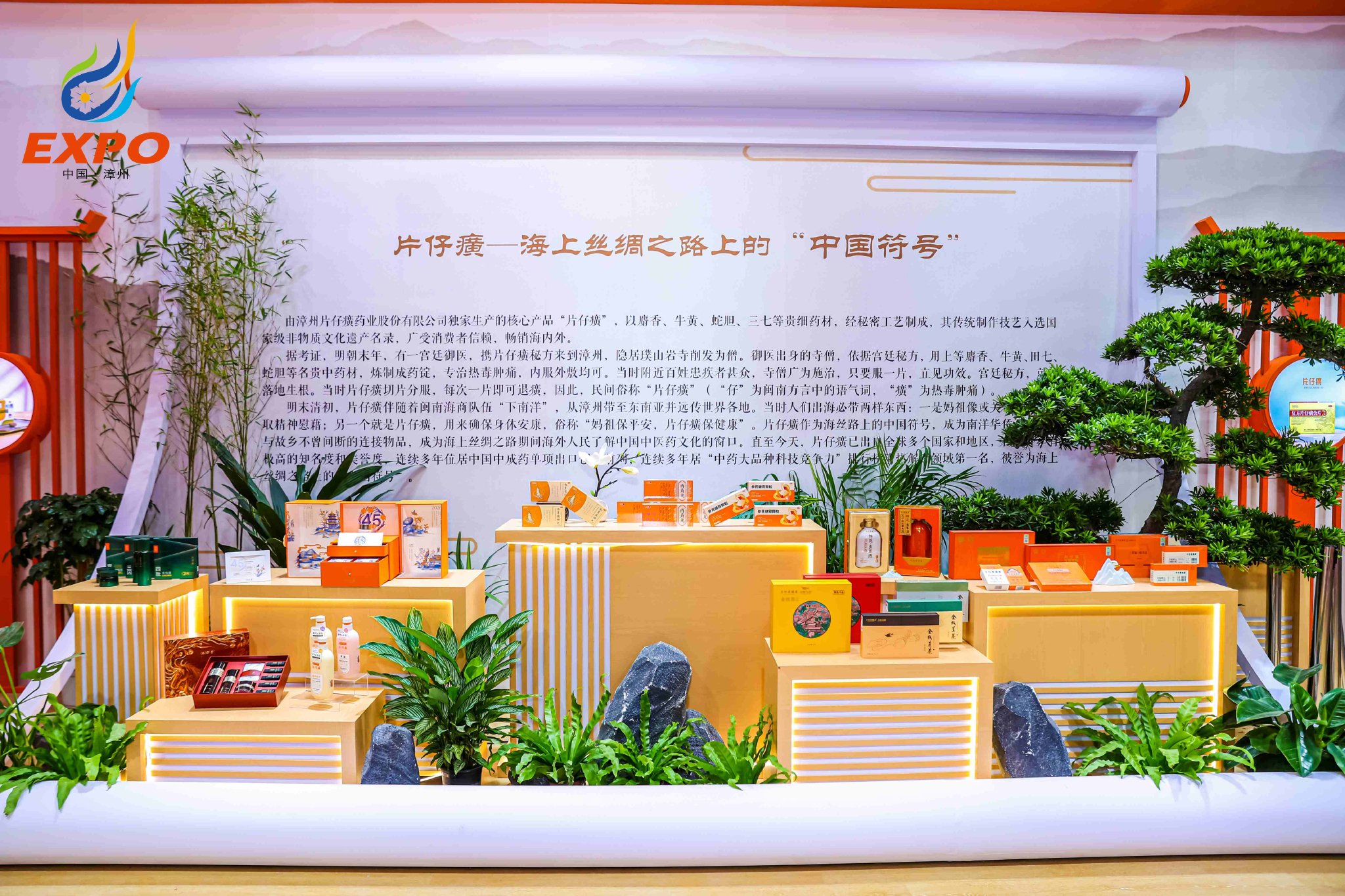
绽放创新活力 片仔癀三大战略板块新品正式发布
Zhong Guo Jin Rong Xin Xi Wang· 2025-12-19 14:29
Core Viewpoint - The 2025 Southeast Modern Agriculture Expo and Flower Expo showcased the innovative products of Zhangzhou Pien Tze Huang Pharmaceutical Co., Ltd, emphasizing its commitment to integrating tradition with innovation in the health industry [1]. Group 1: Product Launches - Pien Tze Huang launched four core product series across its three strategic segments: a classic product series in the pharmaceutical sector, an Eastern skincare series in the beauty segment, and a health food series focused on food-medicine integration [1][3]. - The pharmaceutical segment introduced new products such as Renrong Anshen Pills and Xihuang Pills, targeting specific health needs and enhancing the product matrix [3]. - The beauty segment highlighted new offerings like the Jin Xian Lian series and Ren Shen series, focusing on the efficacy of traditional Chinese ingredients for skincare [3]. - The health food segment presented four new products, including a low-temperature fermented green plum wine and a green plum essence pill, both made from high-quality ingredients sourced from Fujian [4]. Group 2: Innovation and Development Strategy - Innovation is identified as the core driver for revitalizing traditional brands, with the new product launch marking a significant step towards establishing a diversified health service system [4]. - Pien Tze Huang plans to invest 270 million yuan in R&D in 2024, reflecting a 16.38% increase year-on-year, with ongoing clinical research on five traditional Chinese medicine innovations and four chemical drug innovations [4]. - The company aims to strengthen its core business while expanding its product matrix and developing a second growth curve, aligning with the "14th Five-Year Plan" and "Healthy China" strategy [5].


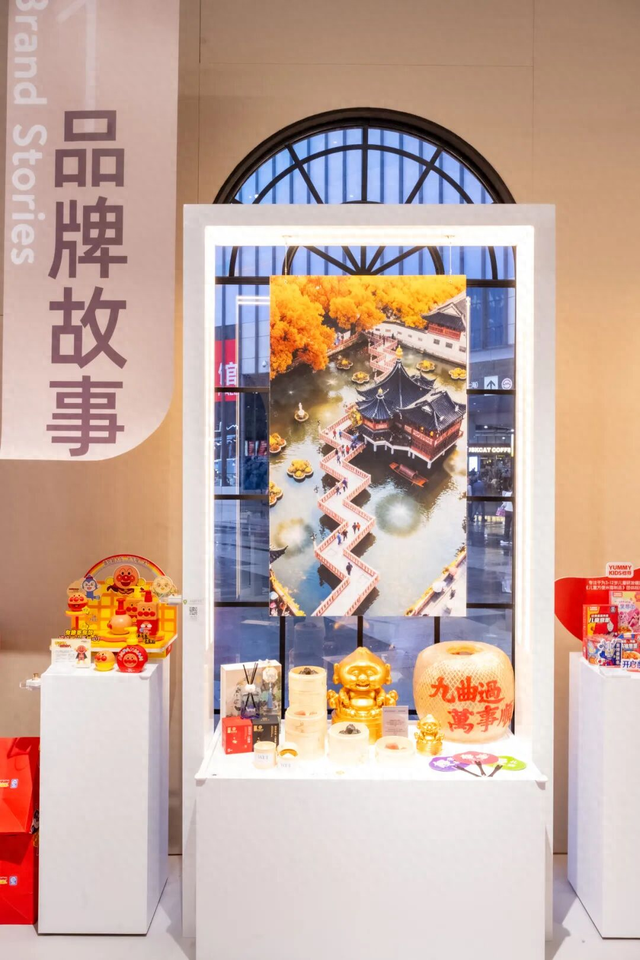
豫园股份加速全球化布局:从进博会到东南亚市场的战略跃进
Guan Cha Zhe Wang· 2025-12-19 13:48
Core Insights - The company is advancing its globalization strategy by forming strategic partnerships and showcasing its cultural heritage through innovative branding initiatives [1][2][10] Group 1: Strategic Partnerships and Market Expansion - The recent collaboration with Thailand's Saha Group marks a significant step in the company's efforts to penetrate the Southeast Asian market, leveraging local expertise and distribution networks [1][13] - The partnership aims to address challenges related to channels, logistics, and localized operations, facilitating a faster market entry for the company's brands [1][13] - The company is also independently expanding its restaurant brands, with locations in London and Bangkok, indicating a dual approach of strategic partnerships and self-driven market entry [1][15] Group 2: Cultural Branding and Market Positioning - The company utilizes a "cultural-led" strategy, exemplified by the successful "Mountain and Sea" themed lantern festival, which has attracted millions and created a strong cultural presence in international markets [11][12] - The participation in the China International Import Expo serves as a platform for showcasing brand innovation and cultural integration, reinforcing the company's commitment to modernizing traditional brands [3][10] - The integration of traditional Chinese elements with contemporary trends, such as collaborations with luxury brands, highlights the company's innovative approach to brand rejuvenation [5][6] Group 3: Performance Metrics and Future Outlook - The company's strategy is expected to create a replicable framework for international expansion, benefiting not only its own growth but also serving as a model for other Chinese brands [2][16] - Key performance indicators, such as sales data from new international locations and the impact of partnerships, will be critical in assessing the success of the globalization strategy [15][16] - The potential for growth in the Southeast Asian market is significant, but the company faces challenges related to cultural differences and competitive pressures [15][16]

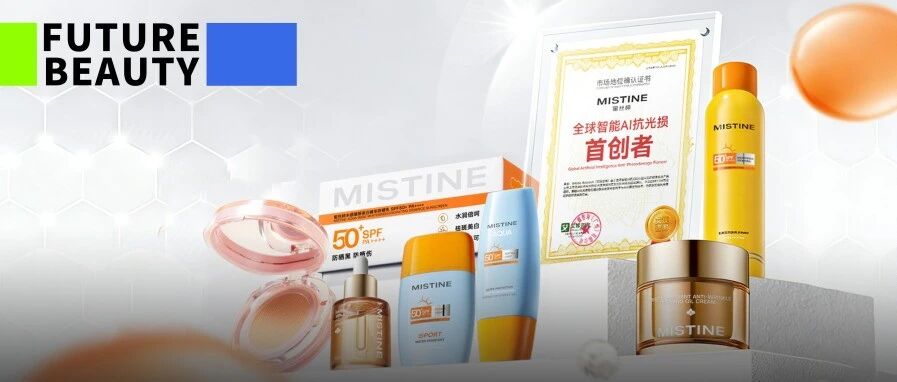
从美妆业首个自研AI大模型,看蜜丝婷的“技术主权”野心
FBeauty未来迹· 2025-12-19 10:14
Core Viewpoint - MISTINE has developed an AI model named SCOPE-DTI, marking a significant advancement in the beauty industry by creating a proprietary AI infrastructure for product innovation, as opposed to merely using AI for market analysis or marketing optimization [3][5][7]. Group 1: AI Model Development - The SCOPE-DTI model, published in the prestigious journal Nature Communications, represents the first self-trained AI model in the beauty industry, indicating a shift towards proprietary technology in product development [4][7]. - This model addresses a critical bottleneck in drug development by efficiently predicting interactions between new compounds and protein targets, thus transforming the traditional beauty ingredient development process from trial-and-error to precision-guided methods [10][11]. Group 2: Technological Paradigm Shift - The introduction of the SCOPE-DTI model signifies a fundamental paradigm shift in cosmetic research, moving from experience-driven methods to data-driven predictions, enhancing the efficiency and accuracy of ingredient selection [11][12]. - The model utilizes advanced algorithms and integrates data from 13 authoritative international databases, achieving over 80% experimental validation success rate, which significantly surpasses the average performance of general AI models [12]. Group 3: Commercial Application and Recognition - MISTINE has been recognized as the first brand to systematically apply this AI model in the specific area of "anti-light damage," achieving full industrialization of its research [14]. - The brand's proactive approach in 2022, participating in the development of guidelines for active ingredient development based on computational biology, laid the groundwork for its subsequent commercial success [15]. Group 4: Product Innovation and Market Position - The evolution of MISTINE's core ingredient "Yuguang Filter" exemplifies the role of AI in accelerating and optimizing product development, expanding the competitive dimension of sunscreen technology [20]. - MISTINE has established a strong market presence in various categories, including sunscreen and makeup, achieving significant sales milestones and leading positions in the Chinese market [22][26]. Group 5: Strategic Expansion and Future Outlook - The brand's strategic focus on skincare, leveraging its existing AI capabilities, indicates a calculated move into high-value segments with less competition, such as anti-aging products [28][29]. - MISTINE's development trajectory illustrates a clear path for the beauty industry, emphasizing the importance of technological originality and foundational research in building long-term competitive advantages [31][32].
“小进博”来了,进博老友携首发和爆款返场
Di Yi Cai Jing· 2025-12-19 09:48
Group 1 - The first "Mini Import Expo" is held in Shanghai from December 19 to 21, showcasing over 700 global companies from more than 60 countries, with an exhibition area of approximately 60,000 square meters [1] - Unlike previous import expos that focused on B2B trade, the "Mini Import Expo" targets the consumer end, expecting to attract around 3,000 buyers and over 80,000 professional visitors and individual consumers [1] - The event aims to expand imports, enhance the spillover effects of the main import expo, and promote consumption upgrades, marking a transition to a comprehensive open platform integrating exhibition, trade, investment, consumption, culture, and finance [1] Group 2 - Established brands like L'Oréal, Amorepacific, and Medtronic return to the expo, showcasing their star products and reinforcing their connection with the import platform [2] - New Zealand's dairy company, New Zealand, sets up a 360-degree live streaming area and successfully sells out 25,000 cans of a popular colostrum milk powder during the event [2] - The "Mini Import Expo" features a dedicated area for new product launches, displaying nearly 180 items from around 100 companies, including Medtronic's first rechargeable closed-loop spinal cord stimulator [3] Group 3 - New Zealand ranks first in communication influence within the agricultural and food products sector, signing 19 cooperation agreements and achieving over 50 million total exposure through live broadcasts [3] - The ongoing "import opportunities" are transforming into strategic choices for companies to integrate into China's development and share growth dividends, with a commitment to increase investment and deepen market engagement [3]

2025进博优品交易会在上海开幕
Sou Hu Cai Jing· 2025-12-19 08:36
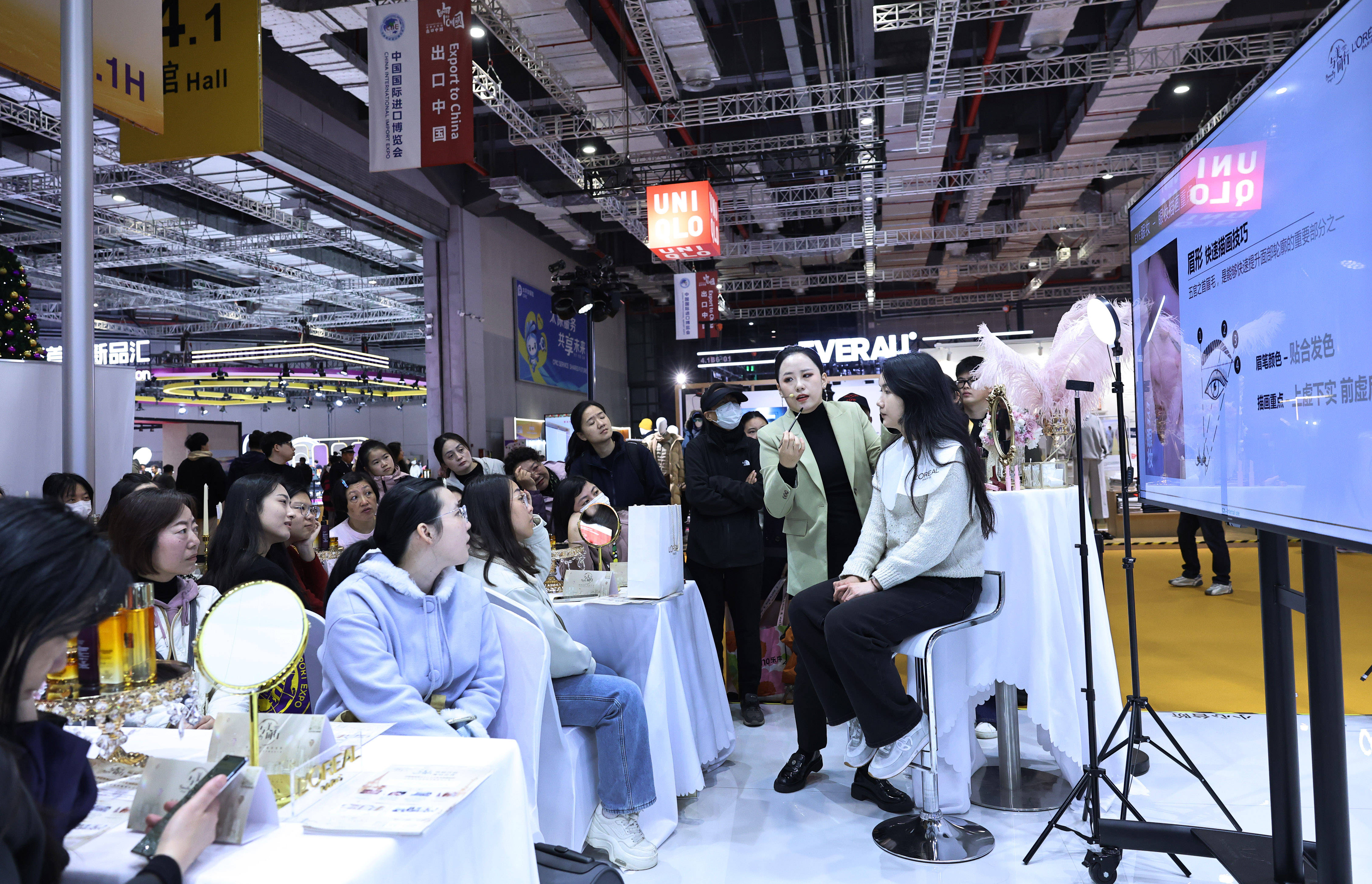
12月19日,参观者在欧莱雅展台上观看现场美妆教学。 新华社记者 方喆 摄 o ma s MODEL 1945 10 30 00 12 0 2006 ASSOCIATION IN 69 17 9-35-1 1: 11:33 e 1X B CHERR 就用在线试号系数据 2011 - 12 - 4497 CICAPIAST LIST EXCITES LESULAR 图片是比分子 | | 如平都点有具 理念 此前 分子 精公 包球 12月19日,2025进博优品交易会在国家会展中心(上海)开幕。进博优品交易会是进博会的延展,被称为"小进博",也是"共享大市场·出口中国"系列活动 的重要一站。从舌尖珍馐到智能家居,从健康科技到炫酷汽车,"小进博"将助力更多"进博好物"展出来、卖出去,加快走进千家万户,更好满足广大消费者 对品质生活的需求。 12月19日,参观者在进博首发新品汇展区内观看展品。 新华社记者 方喆 摄 加拿大野生肖 一佰温冰川深酒 无人纯净目然 造就顶级酒养 - 1017年85 PEWINE D 1 15 享随机立减/随机 最高免单1999元! 12月19日,参观者在加拿大商品展台前与工作人员交流。 新 ...
欧莱雅加仓高德美股权至20%,这场跨界融合玩得多大?
Sou Hu Cai Jing· 2025-12-19 07:42
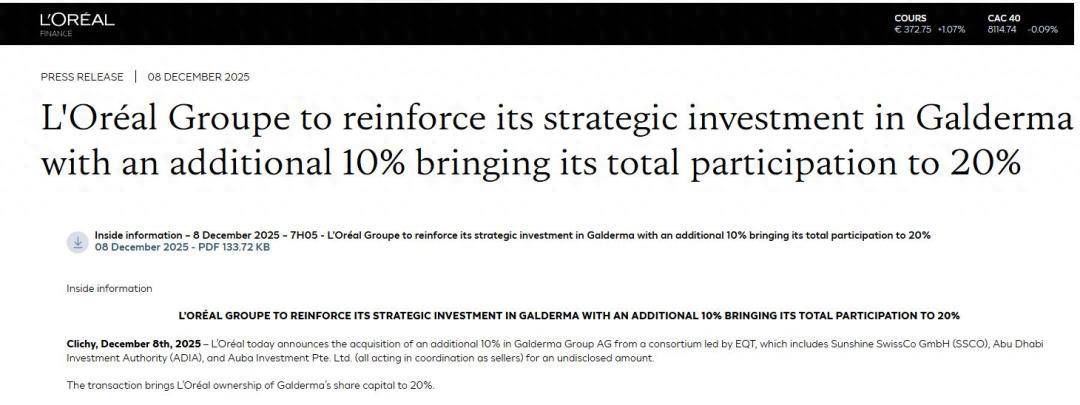
Core Viewpoint - The boundary between beauty and medical aesthetics is increasingly blurred, with major beauty companies like L'Oréal investing in medical aesthetics firms, reflecting a strategic shift in the industry towards a more integrated approach to consumer beauty needs [1][5]. Group 1: Company Actions - L'Oréal announced the acquisition of an additional 10% stake in Galderma, increasing its ownership from 10% to 20%, marking a significant move into the medical aesthetics sector [1][3]. - The transaction involves Sunshine SwissCo GmbH, backed by EQT, Abu Dhabi Investment Authority (ADIA), and Auba Investment Pte. Ltd., and is expected to finalize in Q1 2026 [3]. - L'Oréal plans to nominate two non-independent directors with L'Oréal backgrounds to Galderma's board, enhancing its influence over strategic decisions [4]. Group 2: Industry Trends - The integration of beauty and medical aesthetics is becoming a necessity, with companies like Estée Lauder and Shiseido also making moves into the medical aesthetics space, indicating a broader industry trend [7]. - The driving force behind this trend is the demand for a comprehensive ecosystem that combines daily skincare, medical devices, and professional medical aesthetics [7]. - The Chinese medical aesthetics market is seen as a key growth area for beauty companies, as consumer demand for "scientific beauty" continues to rise [7]. Group 3: Challenges and Opportunities - The fusion of beauty and medical aesthetics presents challenges due to differing business models and channel logic, with beauty companies focusing on mass production and marketing, while medical aesthetics emphasize personalized services and compliance [9]. - The entry of beauty companies into the medical aesthetics field is expected to enhance consumer education and push for safer, more convenient medical technologies [9]. - Successful integration of technology transfer, channel adaptation, and compliance operations will be crucial for capturing opportunities in the rapidly growing medical aesthetics market [10].

科蒂集团将其在威娜品牌的剩余股份作价7.5亿美元售予KKR
Xin Lang Cai Jing· 2025-12-19 07:25
Core Viewpoint - Coty has sold its remaining 25.8% stake in the hair care brand Wella to private equity giant KKR for $750 million, while retaining a 45% share of any future proceeds from further sales or an IPO of the Wella brand [1][2] Group 1 - Coty announced the sale of its remaining stake in Wella to KKR for $750 million [1][2] - The transaction involves Coty retaining a 45% share of any future profits from Wella's further sale or IPO [1][2]


港股异动 毛戈平(01318)涨近4% 政策红利覆盖美妆产业全链条 公司提前落子布局海南自贸
Jin Rong Jie· 2025-12-19 07:02
Core Viewpoint - The stock of Mao Ge Ping (01318) has seen an increase of nearly 4%, currently trading at 87.1 HKD with a transaction volume of 146 million HKD, driven by favorable policies in Hainan Free Trade Port [1] Group 1: Industry Developments - On December 18, Hainan Free Trade Port officially closed its borders, with CITIC Securities believing that policy benefits will make Hainan a hotspot for industrial migration, potentially leading to new economic growth points [1] - The Hainan Provincial Drug Administration has introduced a special support policy for the cosmetics industry, marking the first provincial-level initiative aimed specifically at this sector, creating a comprehensive support system across eight dimensions [1] - In the past six months, Hainan has seen the registration of 41,826 new cosmetics-related enterprises, indicating a strong consensus on the region's prospects within the industry [1] Group 2: Company Developments - In November, Mao Ge Ping established Mao Ge Ping (Hainan) Trading Co., Ltd. in Haikou with a registered capital of 10 million RMB, focusing on wholesale and retail of cosmetics and goods import and export [1]
上美股份涨超6% 韩束稳坐抖音美妆榜首 机构料其多品牌快速增长
Zhi Tong Cai Jing· 2025-12-19 06:51
Group 1 - The core viewpoint of the article highlights that Shangmei Co., Ltd. (02145) has seen a stock price increase of over 6%, currently trading at 87.5 HKD with a transaction volume of 48.11 million HKD [1] - According to data compiled by Qingyan Intelligence, Han Shu has maintained the top position in the Douyin beauty brand rankings for 11 consecutive months [1] - Guojin Securities emphasizes that the company is a leading player in China's beauty and personal care industry, with a multi-brand matrix covering skincare, baby care, and hair care segments [1] Group 2 - The firm is optimistic about the company's ability to leverage a mature brand operation methodology to build a multi-brand group [1] - Guojin Securities estimates that Han Shu is expected to exceed 10 billion RMB in revenue within three years, driven by rapid growth across its multiple brands [1]