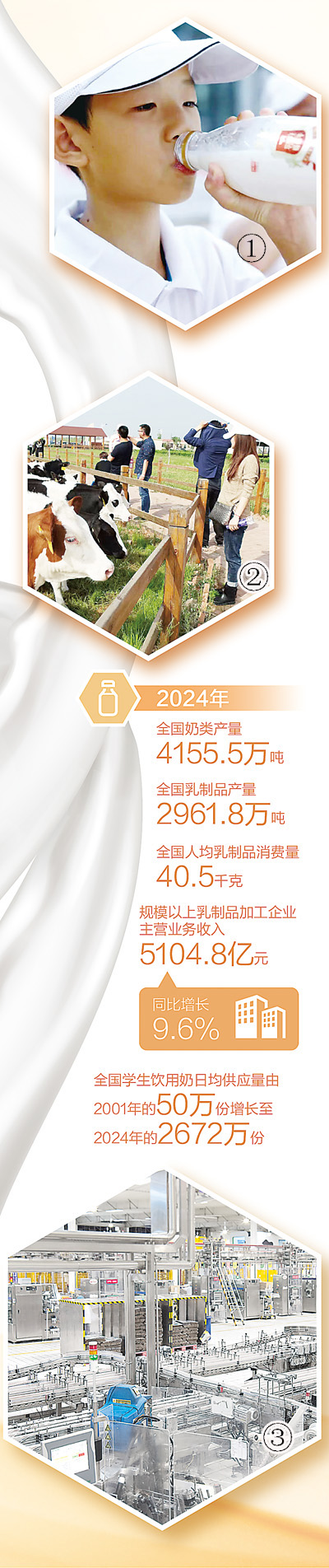
奶业

Search documents
【活力中国调研行】湖北南漳万头奶牛睡“席梦思” 有专属营养师
Zhong Guo Xin Wen Wang· 2025-08-29 03:05
Core Insights - The article highlights the advanced dairy farming practices at Yunshang Muge (Xiangyang) International Agricultural Technology Co., Ltd. in Nanzhang County, Hubei, showcasing the integration of technology in dairy production [1] Company Overview - The company operates a smart dairy industry park with a capacity to produce 130 tons of fresh milk daily, positioning Nanzhang County as the largest and most technologically advanced dairy farming hub in Central China [1] Technological Innovations - Each cow is equipped with an electronic ear tag to monitor identity, health status, and milk production in real-time [1] - The facility utilizes a fully automated rotary milking machine imported from Germany, ensuring high-quality milk production through batch automated milking [1] - A precise feeding system adjusts feed formulations based on the specific needs of different cows, significantly enhancing their nutritional intake and milk quality [1] Environmental Control - The barns are equipped with temperature and humidity sensors along with an automatic control system to maintain optimal living conditions for the cows [1] - An intelligent spraying and ventilation system ensures comfort for the cows, while a biological lighting system simulates natural light to regulate hormone levels and biological rhythms [1] - Cows rest on water beds valued at over 2000 yuan, providing a comfortable environment that is warm in winter and cool in summer [1]
产业转型发展势头正旺
Jing Ji Ri Bao· 2025-08-25 21:44
Group 1: Industry Transformation and Development - Inner Mongolia is accelerating the transformation of traditional industries and nurturing emerging industries, showcasing strong momentum in industrial development [1][4] - The region is focusing on six major industrial clusters, including green agricultural products processing, clean energy, modern chemicals, new materials, modern equipment manufacturing, and biomedicine [2][3] Group 2: Dairy Industry Advancements - Yili Group's modern smart health valley in Hohhot has an impressive production capacity, processing 6,500 tons of fresh milk daily and producing 60,000 tons of milk powder and 200,000 tons of cheese annually [1] - The company aims to launch additional projects this year, including 150,000 tons of raw cheese and 63,000 tons of milk powder, indicating a robust growth trajectory in the dairy sector [1] Group 3: Wind Power Equipment Manufacturing - Baotou City is rapidly developing its wind power equipment manufacturing sector, with 44 wind power equipment enterprises already in operation, aiming for an 85% component matching rate this year [3] - The city is focusing on building a complete industrial chain that includes main engines, generators, gearboxes, blades, and towers [3] Group 4: Renewable Energy Initiatives - Ordos City is promoting energy transition to drive industrial upgrades, creating a comprehensive "wind-solar-hydrogen-storage vehicle" industrial cluster [3][4] - The "Photovoltaic Great Wall" project in the Kubuqi Desert is producing green electricity while preventing desert encroachment, achieving ecological, economic, and social benefits [3] Group 5: Zero-Carbon Industrial Development - The Zero-Carbon Industrial Park in Ordos is a key project focusing on new energy systems and green industrial clusters, aiming for 100% green electricity production [4] - The region's non-coal industries are projected to grow at an average rate of over 8% annually from 2021 to 2024, with high-tech manufacturing and strategic emerging industries also showing significant growth [4]
内蒙古向世界递出多彩“名片”
Zhong Guo Chan Ye Jing Ji Xin Xi Wang· 2025-08-24 23:50
Group 1: Agricultural Development - Inner Mongolia is a significant agricultural production base in China, leading in beef, mutton, and milk production, with grain output exceeding 700 billion jin for five consecutive years [1][2] - In 2024, Tongliao City achieved a grain output of 194.1 billion jin, marking the 21st consecutive year of increased production [2] - The local government is investing 98 million yuan in grain storage and processing improvements from 2023 to 2025, enhancing the entire grain supply chain [3] Group 2: Meat Industry - Inner Mongolia is recognized as a "meat warehouse," with a focus on developing the beef industry, particularly in Tongliao City, which has a cattle population of 3.955 million [4] - The brand value of "Tongliao Beef" is estimated at 27.16 billion yuan, reflecting the region's reputation for high-quality beef [4] - In the previous year, Inner Mongolia produced 3.008 million tons of pork, beef, mutton, and poultry, maintaining its leading position in beef and mutton production [4] Group 3: Dairy Industry - Inner Mongolia is the largest dairy production area in China, with the highest number of dairy cows and milk output, contributing significantly to the national dairy supply [5][6] - The total output value of the dairy industry chain in Inner Mongolia exceeds 200 billion yuan, with milk production reaching 7.767 million tons last year [6] - The region is enhancing its dairy production through modern farming techniques and a complete industry chain from feed cultivation to product sales [6] Group 4: Cashmere Industry - Ordos City in Inner Mongolia is renowned for its high-quality cashmere, being one of the largest cashmere production areas globally [7] - The cashmere industry is evolving towards high-end and branded products, with a focus on quality and design improvements [7] - Sustainable practices are being implemented in cashmere production to balance economic and ecological benefits [7]

金融“活水”润沃土 绘就“三农”新图景 中信银行北京分行为乡村振兴注入强劲动能
和讯· 2025-08-22 10:56
Core Viewpoint - The article emphasizes the role of financial services in promoting rural revitalization, highlighting the collaboration between financial institutions and agricultural enterprises to enhance economic growth and sustainability in rural areas [1][2]. Group 1: Financial Services and Rural Revitalization - Citic Bank Beijing Branch has successfully led the underwriting of 80 billion yuan in bonds for Yili Group and CGN Wind Power, focusing on technology innovation, green finance, and rural revitalization [1]. - The bank has developed an integrated payment and settlement service system to address the challenges faced by tech-driven agricultural enterprises like "Yimudian," facilitating cash flow and comprehensive financial services [2]. Group 2: Strategic Partnerships and Channel Development - The bank is enhancing its customer channels by deepening strategic partnerships with national agricultural industry clusters and private equity firms, aiming to create an efficient model for customer acquisition [3]. - Collaboration with Citic Agriculture and Citic Consulting is being leveraged to provide tailored financial solutions across the entire agricultural value chain, from production to market [3]. Group 3: Professional Training and Capacity Building - The bank is conducting specialized training for its staff to improve their understanding of agricultural policies and enhance their ability to identify opportunities in rural revitalization [3]. - The "Five Integrations" framework (financing, intelligence, commerce, supply chain, and benefits) is central to the bank's comprehensive service system for rural revitalization [3]. Group 4: Risk Management and Resource Allocation - The bank is utilizing advanced management systems to create a project reserve for agricultural initiatives, ensuring efficient resource allocation and meeting diverse financial needs [4]. - The focus is on maintaining a balance between financial support and ecological improvement, contributing to the overall prosperity of rural areas [4].

奶业消费需求不足?农业农村部:鼓励向特定人群发奶类消费券
Nan Fang Du Shi Bao· 2025-08-14 03:01
Core Viewpoint - The Ministry of Agriculture and Rural Affairs has issued a notification aimed at alleviating the difficulties faced by the dairy industry and enhancing the high-quality development of the entire industry chain in response to current challenges such as insufficient consumer demand and rising production costs [1][2]. Group 1: Industry Challenges - The dairy industry is currently experiencing low prices for fresh milk, a slowdown in dairy product consumption growth, and significant losses for farms, leading to a dual pressure of "difficulty in selling milk" and "high costs" [1]. - The notification addresses the need for improved coordination within the industry chain to tackle these challenges effectively [1]. Group 2: Policy Measures - The notification outlines specific measures including the implementation of central financial support policies, increasing the supply of quality feed, and improving farming facilities [1][2]. - Local governments are encouraged to introduce tailored subsidy policies for breeding, spraying, and increased purchasing [1][2]. Group 3: Financial Support and Risk Management - The notification emphasizes the establishment of a whitelist system and encourages financial institutions to innovate products like "silage loans" to meet the funding needs of farming entities [2]. - It also highlights the importance of optimizing herd structure and enhancing the quality safety supervision of fresh milk [2]. Group 4: Consumer Promotion - To boost consumption, the notification calls for increased promotion of dairy products, encouraging the development of affordable and simplified packaging [3]. - It suggests expanding the "student milk program" and promoting dairy products in canteens and welfare institutions, along with the distribution of milk consumption vouchers to specific groups [3]. Group 5: Collaborative Mechanisms - The notification requires the establishment of a collaborative mechanism among various departments to address new challenges in the industry and promote high-quality development [3].
湖北南漳奶产业串起“牛链条”
Jing Ji Ri Bao· 2025-08-13 22:10
Core Viewpoint - The article highlights the successful integration of agricultural waste, specifically wheat straw, into the dairy industry in Nanzhang County, Hubei Province, through the establishment of the Yunshang Mugge smart dairy farm, which has significantly improved local dairy production and farmer incomes [1][2][3]. Group 1: Dairy Industry Development - The Yunshang Mugge smart dairy farm represents a total investment of 1.2 billion yuan and occupies 1,200 acres, addressing the gap in large-scale milk production in southern China [1]. - The farm utilizes high-quality wheat straw as feed, with a purchase agreement for 500 tons at 420 yuan per ton, ensuring strict quality standards for the straw [2]. - The dairy farm has a modern milking facility where over 80 Holstein cows are milked, producing fresh milk with a protein content of 3.6 grams per 100 milliliters [1][2]. Group 2: Economic Impact on Local Farmers - The model implemented by Yunshang Mugge has led to over 3,000 local farmers benefiting from increased income through land leasing and specialized grass planting [2][3]. - Farmers can earn nearly 10,000 yuan annually from land leasing and up to 200,000 yuan from grass planting contracts, which is more profitable than traditional labor [3]. - The local government has supported this initiative with 260 million yuan in loans and 12 million yuan in subsidies for farmers planting silage corn [3]. Group 3: Infrastructure and Logistics - The construction of a new road connecting National Highway 207 to the dairy farm has reduced transportation time for fresh milk by 30 minutes, enhancing logistics efficiency [3]. - The county is actively attracting investments in related agricultural processing projects, including a 350 million yuan dairy product project and a 300 million yuan beef processing facility [4]. Group 4: Sustainable Practices and Circular Economy - The county is developing a circular economy model that integrates livestock waste management with agricultural practices, including the production of organic fertilizers from dairy waste [5]. - A partnership with Shanghai Shunji Environmental Technology Co., Ltd. aims to establish a large-scale biomass utilization demonstration base, converting agricultural waste into high-value products [5]. Group 5: Government Support and Strategic Planning - The Nanzhang County government has formed a task force to streamline project implementation, focusing on land use, infrastructure, and resource management to support the dairy industry [6]. - The county's strategic plan emphasizes the development of a comprehensive dairy industry chain, including feed production, dairy farming, processing, and tourism [4][5].
一张小票据撬动千乡变
Jin Rong Shi Bao· 2025-08-13 01:27
Financial Support for Rural Revitalization - The People's Bank of China and the Ministry of Agriculture and Rural Affairs issued guidelines to enhance financial support for rural revitalization, focusing on food security and financial assistance for rural industries [1][2] - The guidelines encourage eligible enterprises to issue rural revitalization bonds to fund modern rural industries and the integration of rural industries [1] Issuance of Rural Revitalization Bonds - As of July 2025, 196 enterprises have issued a total of 285.25 billion yuan in rural revitalization bonds, with a 37% year-on-year increase in issuance scale in the first seven months of this year [1] - The funds raised through these bonds are directed towards rural industry development, employment increase for farmers, agricultural modernization, and rural construction [2] Case Studies of Bond Utilization - Inner Mongolia Yili Industrial Group issued 4 billion yuan in rural revitalization bonds to stabilize income for pastures and promote modern, standardized dairy farming [3] - New Hope Liuhe successfully issued 500 million yuan in rural revitalization bonds, with 30% of the funds allocated to feed, veterinary medicine, and payments to farmers, enhancing the economic efficiency of farming [4] - Jiangxi Water Group issued 500 million yuan in bonds to support urban-rural integrated water supply projects, ensuring safe drinking water for rural populations [6] Environmental and Economic Projects - The integration of wind and solar energy projects in Inner Mongolia aims to combat desertification while providing economic benefits and job creation, with 4 billion yuan in bonds issued for these initiatives [7] - The projects not only focus on ecological restoration but also contribute to the economic development of local communities, thereby supporting poverty alleviation efforts [7]
农业农村部:奶业发展的积极因素正在积聚
Xin Hua Wang· 2025-08-12 06:37
Core Insights - The current positive factors in the dairy industry are accumulating, indicating a potential recovery in the sector [1] - The extent of losses in livestock farming has decreased, suggesting improved financial conditions for farmers [1] Industry Summary - The Ministry of Agriculture and Rural Affairs highlighted the ongoing improvements in the dairy sector during a press conference [1] - The reduction in farming losses points to a more favorable economic environment for agricultural producers [1]
从“鲜奶+烘焙产品”到“牧场+观光+销售” 乳制品供给侧带动消费新趋势
Ren Min Ri Bao· 2025-07-31 22:55
Core Viewpoint - The Chinese dairy industry is experiencing new consumption trends and opportunities, driven by government initiatives and evolving consumer preferences, particularly in the context of deep processing and diversified product offerings [1][2][3]. Group 1: Industry Trends and Opportunities - The Ministry of Agriculture and Rural Affairs, along with nine other departments, released a plan to promote agricultural product consumption, highlighting the importance of dairy products [1]. - The China Dairy Association's report indicates that the quality and competitiveness of domestic dairy products are improving, with a fresh milk inspection pass rate of 99.96% in 2024 [2]. - The domestic cheese consumption has surged by 120% over the past five years, indicating a shift in consumer preferences towards dairy products that can be integrated into various food items [3]. Group 2: Market Dynamics and Consumer Preferences - The B2B dairy market in China is nearing 100 billion yuan, with 70% to 80% of this market share currently held by imports, suggesting a significant opportunity for domestic producers to replace imports [4]. - The average per capita dairy consumption in China is less than one-third of the global average, with a low penetration rate of cheese and butter products, indicating room for growth [4]. - The government aims to increase per capita dairy consumption to 47 kg by 2030, promoting the development of low-temperature dairy products and cheese [4]. Group 3: Product Innovation and Differentiation - Dairy companies are increasingly focusing on product differentiation to meet diverse consumer needs, including low-sugar yogurt and high-protein dairy products [9]. - The market for functional dairy products is growing rapidly, with an annual growth rate of 8% to 10%, driven by rising health consciousness among consumers [9]. - Specialty dairy products, such as goat and buffalo milk, have seen their market share increase from 5% to 12%, reflecting changing consumer preferences [9]. Group 4: Supply Chain and Production Challenges - The production of cheese requires high-quality raw milk and advanced processing technology, much of which is still imported, posing challenges for domestic producers [5]. - The dairy industry is facing pressure from declining fresh milk prices, necessitating structural adjustments in dairy product offerings and herd management to achieve supply-demand balance [12][14]. - The integration of technology in dairy farming, such as smart management systems, is enhancing milk production efficiency and quality [11][12]. Group 5: Policy and Regulatory Environment - Recent government policies emphasize the importance of quality control and safety in dairy production, aiming to strengthen consumer trust in domestic dairy brands [10][14]. - The central government's support for integrated development of dairy farming and processing is expected to benefit capable farms and ensure farmers' income [14].
乳制品供给侧带动消费新趋势
Ren Min Ri Bao· 2025-07-31 22:22
Core Insights - The Chinese dairy industry is experiencing a transformation driven by new consumption trends and government initiatives aimed at boosting agricultural product consumption [5][6][14] - The quality of domestic dairy products is improving, with a high inspection pass rate of 99.96% for fresh milk in 2024, indicating strong competitiveness against imported products [6] - The dairy sector is focusing on deep processing and innovation to meet diverse consumer demands, particularly in cheese and other dairy products [7][8][11] Group 1: Market Trends and Consumer Behavior - There is a notable shift in dairy consumption from drinking to eating, with cheese products seeing a 120% increase in consumption over the past five years [7] - The demand for dairy products is expanding in conjunction with the growth of the tea, baking, and ice cream industries, leading to increased market needs for cream and butter [7] - The per capita dairy consumption in China is currently less than one-third of the world average, with a significant opportunity for growth in cheese and butter consumption [8] Group 2: Industry Challenges and Opportunities - The dairy industry is facing challenges such as supply-demand imbalances and reliance on imported processing equipment, which presents opportunities for domestic innovation and production [9][10] - The development of cheese production is seen as a key to addressing seasonal and regional supply-demand issues in the dairy sector [8] - The government aims to increase per capita dairy consumption to 47 kg by 2030, promoting the consumption of cheese and other dairy products [8] Group 3: Product Differentiation and Innovation - Companies are increasingly focusing on differentiated products to meet diverse consumer needs, including low-sugar yogurt and high-protein dairy options [13] - The market for functional dairy products is growing rapidly, with an annual growth rate of 8% to 10%, significantly outpacing traditional dairy products [13] - Regional specialty dairy products, such as water buffalo milk, are gaining market share, reflecting changing consumer preferences [13] Group 4: Supply Chain and Production Efficiency - The integration of technology in dairy farming is enhancing production efficiency, with large-scale farms achieving an average milk yield of over 10 tons [16] - Sustainable practices, such as waste recycling and low-carbon transitions, are becoming integral to dairy farming operations [16] - The establishment of cooperative relationships between dairy farmers and processing companies is essential for ensuring fair distribution of profits within the industry [18]