
汽车整车制造

Search documents
青岛云易智能汽车科技有限公司成立,注册资本10000万人民币
Sou Hu Cai Jing· 2025-07-23 04:16
Company Overview - Qingdao Yunyi Intelligent Automotive Technology Co., Ltd. has been established with a registered capital of 100 million RMB [1] - The legal representative of the company is Ma Yuzhong, and it is wholly owned by Xiaolong (Shanxi Province) Group Co., Ltd. [1] Shareholder Information - Xiaolong (Shanxi Province) Group Co., Ltd. holds 100% of the shares in Qingdao Yunyi Intelligent Automotive Technology Co., Ltd. [2] Business Scope - The company's business scope includes various services such as artificial intelligence application system integration, automobile sales, microbus rental services, charging control equipment rental, second-hand car brokerage, and more [2] - Additional services include IoT application services, technology consulting, supply chain management, and investment activities in unlisted companies [2] - The company is classified under the manufacturing industry, specifically in automobile manufacturing and complete vehicle manufacturing [2]
CPI四连降终结 “内卷”行业价格回暖
Huan Qiu Wang· 2025-07-10 02:14
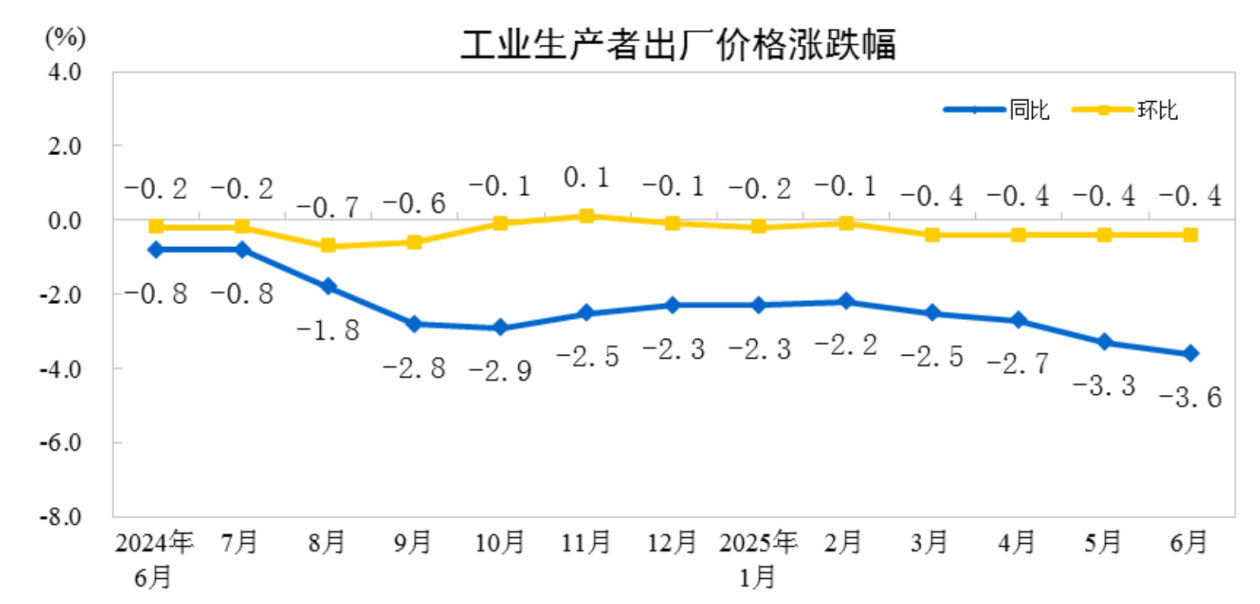
Group 1 - The Consumer Price Index (CPI) in June showed a slight increase of 0.1% year-on-year, ending four consecutive months of negative growth, primarily due to the recovery in industrial product prices and the gradual effects of consumption promotion policies [1][3] - The Producer Price Index (PPI) experienced a year-on-year decline of 3.6%, indicating continued weakness in domestic investment and export demand [1][3] - Positive changes were observed in previously competitive industries such as automotive and photovoltaic sectors, where prices began to stabilize and recover [1][4] Group 2 - The transition of CPI from negative to positive is attributed to reduced international input pressure and the effectiveness of domestic consumption promotion policies, alongside base effect considerations [3] - The core CPI, excluding food and energy, rose by 0.7%, reaching a 14-month high, indicating an increasing domestic demand influence on prices [3] - Despite the positive CPI movement, economists suggest that the core CPI remains in a low inflation environment, and significant changes in this trend are unlikely in the short term [3] Group 3 - The PPI saw a month-on-month decrease of 0.4%, with the year-on-year decline expanding by 0.3 percentage points to 3.6%, driven by seasonal price declines in certain raw material manufacturing sectors and increased green energy supply [3] - The automotive manufacturing sector, including both traditional and new energy vehicles, experienced a month-on-month price increase, with a notable narrowing of year-on-year price declines [4] - The Chinese government has introduced measures to support employment, indicating a focus on job stability alongside price monitoring, which includes increased unemployment insurance and expanded loan support for small and medium enterprises [4]

江淮汽车: 安徽江淮汽车集团股份有限公司2024年度向特定对象发行A股股票募集说明书(修订稿)
Zheng Quan Zhi Xing· 2025-07-09 14:09
Core Viewpoint - Anhui Jianghuai Automobile Group Corp. is facing significant challenges, including market competition, economic fluctuations, and operational risks, while planning to raise funds for high-end intelligent electric platform development. Company Overview - The company is headquartered in Hefei, Anhui Province, with a total share capital of 2,184,009,791 shares and is listed on the Shanghai Stock Exchange under the stock code 600418 [11]. - The controlling shareholder is Anhui Jianghuai Automobile Group Holdings Co., Ltd., holding 28.22% of the shares as of April 2025 [11]. Financial Performance - The company reported a net loss of CNY 223.00 million in Q1 2025 and a net loss of CNY 2,741.45 million for the entire year of 2024, primarily due to declining revenues and losses from joint ventures [8][15]. - The company aims to raise up to CNY 3.5 billion through a targeted stock issuance to fund its projects [5]. Market and Industry Context - The automotive industry in China is experiencing intense competition, particularly in the electric vehicle sector, with traditional automakers and new entrants vying for market share [2][3]. - China's automotive production and sales reached over 31 million units in 2024, maintaining its position as the world's largest automotive market [15]. - The penetration rate of new energy vehicles in China is rapidly increasing, with 40.9% of new car sales in 2024 being electric vehicles, reflecting a 9.3 percentage point increase from 2023 [15]. Fundraising and Investment Plans - The funds raised will be allocated to the development of a high-end intelligent electric platform, with a total investment of CNY 5.87459 billion planned for this project [7]. - The issuance will involve a competitive pricing mechanism, with the final price determined after regulatory approvals [4][6]. Risks and Challenges - The company faces risks related to market competition, macroeconomic fluctuations, and the need for continuous technological innovation to keep pace with industry developments [2][3][4]. - The automotive sector is sensitive to changes in national policies, which could impact the company's operational environment [2][3].

宏观数据|2025年5月我国汽车整车出口情况简析
中汽协会数据· 2025-07-04 06:51
Group 1 - In May 2025, the export of complete vehicles reached 695,000 units, representing a month-on-month increase of 12% and a year-on-year increase of 22.1% [1] - The export value in May 2025 amounted to $11.99 billion, with a month-on-month growth of 7.4% and a year-on-year growth of 13.7% [1] - From January to May 2025, the total export of complete vehicles was 2.853 million units, showing a year-on-year increase of 16.6% [1] - The total export value during the same period reached $48.9 billion, reflecting a year-on-year increase of 5.3% [1]

核心CPI企稳的三个特征?——5月通胀数据点评(25.05)(申万宏观·赵伟团队)
赵伟宏观探索· 2025-06-11 23:28
Core Viewpoints - The improvement in consumer demand stabilizes the core CPI, but supply-side factors significantly suppress inflation readings [3][72] - The core commodity PPI shows a notable rebound primarily due to demand improvement, with tariff impacts on prices not intensifying [3][72] - The overall CPI aligns with market expectations, with food supply showing a mixed performance leading to a slight decline in food CPI [28][74] Group 1: Core CPI Characteristics - Characteristic 1: The core commodity PPI rebounded by 0.3 percentage points to -1.4% YoY, driven by sustained effects of consumption policies and a moderation in tariff impacts [3][72][8] - Characteristic 2: The core commodity CPI increased by 0.1 percentage points to 0.2% YoY, supported by consumption policies and rising gold prices, with gold jewelry prices up 40.1% YoY [19][73] - Characteristic 3: The service CPI rose by 0.2 percentage points to 0.5% YoY, aided by an increase in holiday days, which enhanced service demand [22][61] Group 2: Future Outlook - The combination of policy reinforcement and recovery in domestic demand is expected to alleviate inflationary pressures, although supply-side changes may still impose constraints on price readings [5][74] - Continued emphasis on policies to boost service consumption may further improve core service CPI, while the "old-for-new" policy could support core commodity CPI and PPI [5][74] - Despite these positive factors, low capacity utilization in downstream sectors and uncertainties regarding tariffs may still limit price recovery [5][74] Group 3: Regular Tracking - The CPI remained flat YoY, with improvements in both core commodity and core service CPI [38][74] - The PPI continued to decline, with a YoY drop of 0.6 percentage points to -3.3%, particularly in production materials [38][74] - Food CPI showed a slight decline due to mixed supply conditions, with fresh fruits and fish prices rising while seasonal vegetables saw price drops [28][74]
核心CPI企稳的三个特征?——5月通胀数据点评(25.05)(申万宏观·赵伟团队)
申万宏源宏观· 2025-06-10 03:59
Core Viewpoints - The improvement in consumer demand stabilizes the core CPI, but supply-side factors significantly suppress inflation readings [3][68] Group 1: Key Features of Core CPI Stabilization - Feature 1: The core commodity PPI shows a significant rebound, primarily due to improved demand and a lack of further tariff impacts. In May, the core commodity PPI increased by 0.3 percentage points to -1.4% [3][68] - Feature 2: Consumption promotion policies combined with rising gold prices lead to an increase in core commodity CPI. In May, the core commodity CPI rose by 0.1 percentage points to 0.2% [4][19] - Feature 3: The increase in holiday days in May allows for a more substantial release of service demand, pushing the core service CPI higher. The service CPI rose by 0.2 percentage points to 0.5% in May [4][22] Group 2: Outlook and Regular Tracking - The combination of policy reinforcement and recovery in domestic demand is expected to alleviate inflationary pressures, but supply-side changes must be monitored for their impact on price readings [5][33] - The overall CPI in May was -0.1%, slightly better than market expectations, with food supply showing a mixed performance [5][27] - The non-food CPI saw improvements in transportation and communication, while fuel prices for transportation significantly declined [51][71]
5月核心CPI涨幅扩大 居民消费需求正逐步回暖
Zheng Quan Shi Bao· 2025-06-09 17:53
Group 1 - The Consumer Price Index (CPI) decreased by 0.2% month-on-month and 0.1% year-on-year in May, while the Producer Price Index (PPI) fell by 0.4% month-on-month and 3.3% year-on-year, indicating a continued impact of consumption-boosting policies [1][2] - Energy prices were the main factor dragging down both the CPI and PPI, with energy prices decreasing by 6.1% year-on-year and 1.7% month-on-month, significantly affecting the overall CPI decline [1] - Core CPI, excluding food and energy, increased by 0.6% year-on-year, with hotel accommodation and tourism prices rising by 4.6% and 0.8% respectively, indicating a recovery in certain sectors [1] Group 2 - PPI data showed marginal improvement in terminal consumer demand, with life goods prices stabilizing and some manufacturing prices narrowing their year-on-year decline [2] - High-tech product demand is expanding, with prices in sectors like integrated circuit packaging and testing, aircraft manufacturing, and wearable smart devices increasing by 3.6%, 3.0%, and 2.1% respectively [2] - Economic analysts predict a likely upward trend in the price index, with CPI expected to gradually recover and PPI showing signs of marginal improvement due to previous consumption-boosting policies [2]
核心CPI企稳的三个特征?——通胀数据点评(25.05)
申万宏源宏观· 2025-06-09 15:25
Core Viewpoints - The improvement in consumer demand stabilizes the core CPI, but supply-side factors significantly suppress inflation readings [2][68] Group 1: Characteristics of Core CPI Stabilization - Characteristic 1: Core commodity PPI shows a notable rebound, primarily due to improved demand and a lack of further tariff impacts. In May, the core commodity PPI increased by 0.3 percentage points to -1.4%. This is attributed to the sustained effects of consumption-boosting policies and a moderation in tariff impacts on prices [2][68] - Characteristic 2: Consumption promotion policies combined with rising gold prices lead to an increase in core commodity CPI. In May, the core commodity CPI rose by 0.1 percentage points to 0.2%, supported by increased consumer demand and a 40.1% rise in gold jewelry prices [3][18] - Characteristic 3: The increase in holiday days in May allowed for more substantial service demand release, positively impacting core service CPI, which rose by 0.2 percentage points to 0.5% [3][21] Group 2: Future Outlook - The combination of policy reinforcement and recovery in domestic demand is expected to alleviate inflationary pressures, although supply-side changes may still impose constraints on price readings [4][32] - The focus on boosting service consumption is likely to improve core service CPI further, while the ongoing "old-for-new" policy may provide significant support to core commodity CPI and PPI [4][70] Group 3: Regular Tracking - The overall CPI in May was -0.1%, slightly better than market expectations, with food supply showing a mixed performance. Fresh fruit and fish prices increased due to supply reductions, while seasonal vegetables saw a price drop [5][26] - Non-food CPI showed improvement in transportation and communication, while fuel prices for transportation saw a significant decline [50][71] - Service CPI in May reflected a recovery in demand, with core service CPI performing better than in previous years, indicating a positive trend in the service sector [58][71]
通胀数据点评:核心CPI企稳的三个特征?
Shenwan Hongyuan Securities· 2025-06-09 10:13
Group 1: Inflation Data Overview - In May, the CPI decreased by 0.1% year-on-year, matching the previous value and slightly better than the expected decrease of 0.2%[1] - The PPI fell by 3.3% year-on-year, a decline from the previous value of 2.7% and worse than the expected 3.2%[1] Group 2: Core CPI Stabilization Features - Core commodity PPI rebounded by 0.3 percentage points to -1.4%, driven by improved demand and a moderation in tariff impacts[2] - The core commodity CPI increased by 0.1 percentage points to 0.2%, supported by consumption policies and rising gold prices, which boosted jewelry prices by 40.1%[3] - Service CPI rose by 0.2 percentage points to 0.5%, aided by increased holiday days in May, enhancing service demand[4] Group 3: Future Outlook - Continued policy support and recovery in domestic demand are expected to alleviate inflationary pressures, but supply-side constraints remain a concern[5] - The ongoing "trade-in" policy may provide significant support to core commodity CPI and PPI, while abundant supply of bulk commodities and food could exert downward pressure on prices[5]
国家统计局城市司首席统计师董莉娟解读2025年5月份CPI和PPI数据
Guo Jia Tong Ji Ju· 2025-06-09 01:44
Group 1: CPI Analysis - In May, the Consumer Price Index (CPI) decreased by 0.2% month-on-month and by 0.1% year-on-year, while the core CPI, excluding food and energy, increased by 0.6%, with the growth rate expanding by 0.1 percentage points compared to the previous month [1][2][3] - The month-on-month decline in CPI was primarily driven by a 1.7% decrease in energy prices, which accounted for approximately 70% of the total decline in CPI [2] - Food prices fell by 0.2%, with seasonal vegetables seeing a 5.9% price drop, while prices for eggs, pork, and poultry slightly decreased by 0.3% to 1.0% [2][3] Group 2: PPI Analysis - The Producer Price Index (PPI) decreased by 0.4% month-on-month and by 3.3% year-on-year, with the year-on-year decline expanding by 0.6 percentage points compared to the previous month [1][4][5] - The month-on-month PPI decline was influenced by international factors, including a 5.6% drop in oil and gas extraction prices and a 3.5% decrease in refined oil product manufacturing prices [4] - Some sectors showed marginal price improvements, with consumer demand policies positively impacting prices in certain industries, such as a 12.8% increase in the price of arts and crafts and a 0.8% rise in footwear manufacturing [5]