石油行业

Search documents
刚果(布)2025年第三季度经济发展良好
Shang Wu Bu Wang Zhan· 2025-12-24 16:27
Group 1 - The Congolese economy is expected to show positive growth, with a projected real GDP growth rate of 2.8% in Q3 2025, up from 1.5% in 2024, driven by increased investment in the oil sector and strong performance in non-oil industries [1] - Inflation is anticipated to remain around 3.0%, slightly lower than the 3.1% forecasted for 2024, influenced by rising food prices and power supply disruptions [1] - As of August 2025, the total outstanding loans issued by Congolese banks increased by 27.9% to 1,816.4 billion Central African Francs, while non-performing loans rose by 15.7% to 264.8 billion Central African Francs [1] Group 2 - The economic development composite index for the Central African Economic Community (CEMAC) grew by 6.7% year-on-year, with a quarterly growth of 8.0%, compared to 9.3% in the same period last year [2] - The average annual inflation rate for the region stood at 2.8%, down from 4.3% in the previous year, while the GDP growth rate is projected at 2.6%, slightly lower than the 2.7% expected for 2024 [2] - Despite challenges from U.S. trade protectionism and ongoing geopolitical tensions, the economies of CEMAC member states have demonstrated resilience [2]
特朗普停止CAFE标准,美国能源、环境与产业政策急转弯
Zhong Guo Qi Che Bao Wang· 2025-12-23 06:29
Core Viewpoint - The Trump administration's decision to halt the Corporate Average Fuel Economy (CAFE) standards marks a significant shift in U.S. automotive regulation, impacting energy, environmental, and industrial policies [1]. Group 1: Policy Changes - The new regulations set the fuel efficiency target for 2031 vehicles at 34.5 miles per gallon (mpg), a substantial decrease of 31.5% from the previous target of 50.4 mpg [4]. - The elimination of the CAFE standards means automakers will no longer need to invest heavily in research and development to meet stringent fuel efficiency requirements, allowing them to focus on producing more profitable traditional fuel vehicles and larger models [5]. Group 2: Economic Implications - The policy change is expected to save consumers at least $1,000 when purchasing new vehicles, with potential for even greater savings [3]. - Under the Trump administration, $700 billion has been invested in the U.S. automotive industry, with significant investments announced by major automakers such as Ford and Stellantis [3]. Group 3: Industry Reactions - The automotive industry has largely welcomed the decision, with industry leaders stating that the previous CAFE standards were unrealistic and burdensome [5]. - The oil industry has expressed optimism that higher fuel consumption vehicles will boost gasoline demand and support traditional energy sectors [6]. Group 4: Environmental Concerns - The cessation of CAFE standards is anticipated to lead to stagnation or regression in vehicle fuel efficiency, resulting in increased fuel costs for consumers [6]. - Critics argue that the rollback of these standards could hinder technological advancements in the automotive sector, which have historically been driven by the need to meet fuel efficiency regulations [6].


泰山石油:截至2025年12月19日公司股东户数合计40260户
Zheng Quan Ri Bao Wang· 2025-12-22 11:44
证券日报网讯12月22日,泰山石油(000554)在互动平台回答投资者提问时表示,截至2025年12月19日 登记在册的公司股东户数合计40260户。 ...

国会夺权记!美国贸易政策,如何从总统主导变成行政立法拔河
Sou Hu Cai Jing· 2025-12-19 05:01
Core Viewpoint - The article discusses the subtle shift in U.S. trade policy from promoting free trade to implementing protectionist measures during the 1950s, driven by domestic economic interests and international pressures [1][19]. Group 1: Historical Context - In the 1950s, U.S. trade policy appeared stable, but underlying changes were occurring as the U.S. began to set barriers on domestic industries despite previously advocating for free trade [1]. - The political landscape made it difficult to distinguish between the Democratic and Republican parties regarding trade policy, as both parties shifted their positions on tariffs and trade agreements [3]. Group 2: Regional Economic Shifts - The Southern U.S. economy transitioned from relying on cotton exports to developing labor-intensive industries like textiles, leading to a demand for higher tariffs to protect local production [5][6]. - By 1947, three-quarters of U.S. textiles were produced in the South, prompting Southern Democratic lawmakers to ally with Republican protectionists to support higher tariffs [6]. Group 3: International Trade Dynamics - The U.S. faced challenges in international trade as European nations formed trade alliances that created barriers for American goods, countering the initial intentions of the Marshall Plan [10][11]. - The establishment of the European Economic Community and the European Free Trade Association in the late 1950s complicated U.S. access to European markets, leading to regret over earlier U.S. policies [10][11]. Group 4: Policy Evolution - The 1959 introduction of the Mandatory Oil Import Quota aimed to protect the U.S. oil industry but inadvertently led to higher prices due to OPEC's formation, illustrating the long-term consequences of short-term protectionist measures [13]. - President Kennedy's Trade Expansion Act of 1962 was framed as a response to international competition but included provisions that allowed for protectionist measures under the guise of national security [15][17]. Group 5: Legacy of Trade Policy - The Trade Expansion Act became a foundational element of U.S. trade protectionism, allowing future administrations to impose tariffs under the pretext of national security, a practice that continues today [17][19]. - The article concludes that the trade policies of the 1950s laid the groundwork for current global trade tensions, highlighting the long-lasting impact of historical decisions on present circumstances [21].
资讯早班车-2025-12-12-20251212
Bao Cheng Qi Huo· 2025-12-12 01:55
1. Macroeconomic Data Overview - GDP in Q3 2025 grew by 4.8% year-on-year, down from 5.2% in the previous quarter but up from 4.6% in the same period last year [1] - In November 2025, the Manufacturing PMI was 49.2%, slightly up from 49.0% in the previous month but down from 50.3% in the same period last year; the Non-Manufacturing PMI: Business Activity was 49.5%, down from 50.1% in the previous month and 50.0% in the same period last year [1] - In October 2025, the monthly increase in social financing scale was 816.1 billion yuan, significantly lower than 3529.9 billion yuan in the previous month but higher than 1412.0 billion yuan in the same period last year [1] - In November 2025, CPI increased by 0.7% year-on-year, up from 0.2% in the previous month and the same period last year; PPI decreased by 2.2% year-on-year, down from -2.1% in the previous month but up from -2.5% in the same period last year [1] - In November 2025, exports increased by 5.9% year-on-year, turning positive from -1.1% in the previous month but slightly down from 6.58% in the same period last year; imports increased by 1.9% year-on-year, up from 1.0% in the previous month and turning positive from -4.03% in the same period last year [1] 2. Commodity Investment Reference 2.1 Comprehensive - The Central Economic Work Conference emphasized continuing proactive fiscal and moderately loose monetary policies, with 8 key tasks including promoting investment recovery, developing new energy, and stabilizing the real estate market [2] - High-frequency data in November showed positive trends in consumption, investment, and foreign trade, with offline consumption index up 12.0% year-on-year, infrastructure project中标金额 and construction machinery operating rate increasing, and international freight flights up 6.2 percentage points from October [2] - In the first 11 months, China's total goods import and export value increased by 3.6% year-on-year, with private enterprises' imports and exports reaching 23.52 trillion yuan, up 7.1% year-on-year, and the number of private enterprises with import and export records increasing by 66,000 [3] 2.2 Metals - The aluminum industry chain prices are diverging, with alumina prices halved from a year ago while electrolytic aluminum prices are rising, leading to improved profitability for electrolytic aluminum enterprises and potential losses for some alumina enterprises [4] - As of December 11, 2025, the international silver futures price on the COMEX had increased by 113.3% since the beginning of the year, reaching $62.5 per ounce [4] - Goldman Sachs believes there is room to raise the gold price forecast to $4900 per ounce by the end of 2026 if US private investors increase their investment in gold ETFs [5] 2.3 Energy and Chemicals - Jilin Province plans to develop future industries such as artificial intelligence, hydrogen energy, and new energy storage [8] - Citibank revised its oil price forecast, expecting Brent crude oil prices to remain stable in 2026, with an average price of $62 per barrel in the base scenario and potentially reaching $75 per barrel in an optimistic scenario [8] - OPEC maintained its global oil demand growth forecast at 1.3 million barrels per day in 2025 and 1.38 million barrels per day in 2026 [9] 2.4 Agricultural Products - Malaysia's palm oil inventory is expected to continue rising in December, potentially exceeding 3 million tons if exports remain weak, and its 2025 production is expected to exceed 20 million tons for the first time [11] - Argentina reduced the export tax rate for soybeans from 26% to 24% and for wheat and barley from 9.5% to 7.5% [11] - Brazil has been authorized to export beef and beef products to Guatemala [12] 3. Financial News Compilation 3.1 Open Market - On December 11, the central bank conducted 118.6 billion yuan of 7-day reverse repurchase operations, with a net withdrawal of 62.2 billion yuan as 180.8 billion yuan of reverse repurchases matured [14] 3.2 Key News - The Central Economic Work Conference set the tone for next year's economic work, emphasizing proactive fiscal and moderately loose monetary policies, and outlined 8 key tasks [15] - The Ministry of Commerce will issue opinions to promote the innovation and development of the retail industry [15] - In November, China's automobile production and sales reached 3.532 million and 3.429 million vehicles respectively, with year-on-year growth of 2.8% and 3.4%, and new energy vehicle production and sales reached 1.88 million and 1.823 million vehicles respectively, with year-on-year growth of 20% and 20.6% [16] 3.3 Bond Market Summary - China's bond market continued to perform well, with most interest rate bond yields declining, and treasury bond futures rising [19] - In the exchange bond market, Vanke bonds generally adjusted downward, while some other bonds such as "25 TeGuo 03" rose [20] - Most money market interest rates declined on December 11 [21] 3.4 Foreign Exchange Market - The onshore RMB against the US dollar closed at 7.058 on December 11, up 58 points from the previous trading day, and the central parity rate of the RMB against the US dollar was 7.0686, up 67 points [24] 3.5 Research Report Highlights - CITIC Construction Investment believes that the Central Economic Work Conference provided clear policy directions, including more proactive fiscal and moderately loose monetary policies, and emphasized new industries and anti-competition [25] - CITIC Securities expects the fiscal budget deficit rate to remain at around 4% in 2026, with a slight increase in the scale of special treasury bonds and local special bonds, and there may be a 10bps interest rate cut in the first half of the year [25][26] - Huatai Fixed Income believes that the November inflation data has some impact on the bond market, but the bond market's counterattack logic remains unchanged, and it is recommended to hold short-term credit bonds, certificates of deposit, and interest rate bonds with maturities of 5 - 7 years or less [26] 4. Stock Market News - The A-share market declined, with the Shanghai Composite Index down 0.7%, the Shenzhen Component Index down 1.27%, and the ChiNext Index down 1.41%, while the BeiZheng 50 Index rose 3.84% [29] - The Hong Kong stock market opened higher but closed lower, with the Hang Seng Index down 0.04%, the Hang Seng Tech Index down 0.83%, and the Hang Seng China Enterprises Index down 0.23% [29]
泰山石油:截至2025年12月10日登记在册的公司股东户数合计39888户
Zheng Quan Ri Bao Wang· 2025-12-11 08:42
证券日报网讯12月11日,泰山石油(000554)在互动平台回答投资者提问时表示,截至2025年12月10日 登记在册的公司股东户数合计39888户。 ...
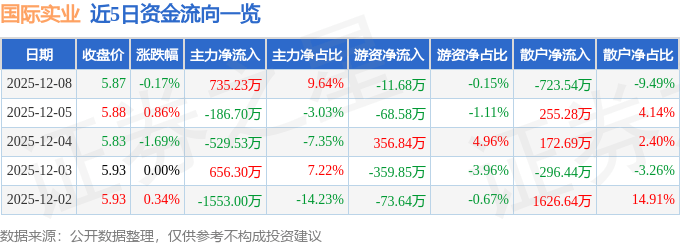
股票行情快报:国际实业(000159)12月8日主力资金净买入735.23万元
Sou Hu Cai Jing· 2025-12-08 13:17
Core Viewpoint - International Industry (000159) has shown a decline in stock price and mixed financial performance, with significant changes in revenue and profit margins, indicating potential challenges in the oil and chemical products sector. Group 1: Stock Performance - As of December 8, 2025, International Industry closed at 5.87 yuan, down 0.17%, with a turnover rate of 2.7% and a trading volume of 129,800 hands, amounting to a transaction value of 76.26 million yuan [1] - On December 8, the net inflow of main funds was 735.23 thousand yuan, accounting for 9.64% of the total transaction value, while retail investors saw a net outflow of 723.54 thousand yuan, representing 9.49% of the total [1] Group 2: Financial Indicators - The total market value of International Industry is 2.822 billion yuan, significantly lower than the industry average of 212.697 billion yuan, ranking 61st in the sector [2] - The net profit for the company was 20.109 million yuan, with a year-on-year increase of 104.45%, despite a 46.47% decline in main operating revenue to 1.302 billion yuan [2] - The company reported a gross margin of 10.82% and a net margin of 1.54%, both below the industry averages of 18.66% and 4.47%, respectively [2] Group 3: Recent Financial Performance - In Q3 2025, the company's main operating revenue was 356 million yuan, down 34.29% year-on-year, while the net profit for the quarter was -4.6608 million yuan, showing a 99.02% increase compared to the previous year [2] - The company has a debt ratio of 43.35% and reported financial expenses of 36.6248 million yuan [2]

股票行情快报:中国石化(600028)12月8日主力资金净买入4362.12万元
Sou Hu Cai Jing· 2025-12-08 11:57
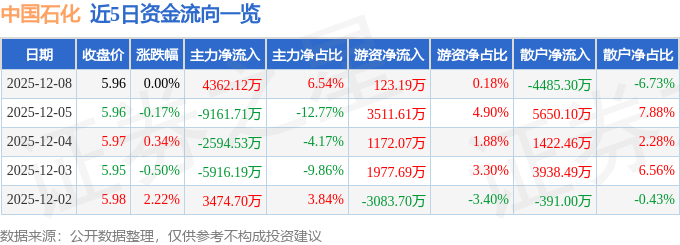
12月8日的资金流向数据方面,主力资金净流入4362.12万元,占总成交额6.54%,游资资金净流入 123.19万元,占总成交额0.18%,散户资金净流出4485.3万元,占总成交额6.73%。 证券之星消息,截至2025年12月8日收盘,中国石化(600028)报收于5.96元,上涨0.0%,换手率0.12%, 成交量111.8万手,成交额6.67亿元。 | 指标 | 中国石化 | 石油行业均值 | 行业排名 | | --- | --- | --- | --- | | 总市值 | 7216.86亿元 | 2126.97亿元 | 61 E | | 净资产 | 9883.61亿元 | 1921.21亿元 | 2 19 | | 净利润 | 299.84亿元 | 136.37亿元 | 61 E | | 市盈率(动) | 18.05 | 34.16 | 4 19 | | 市净率 | 0.87 | 2.51 | 2 19 | | 毛利率 | 15.68% | 18.66% | 61 II | | 净利率 | 1.61% | 4.47% | 61 IT | | ROE | 3.63% | 1.3% | alında v ...

中国石油(601857)12月5日主力资金净卖出1.07亿元
Sou Hu Cai Jing· 2025-12-06 00:35
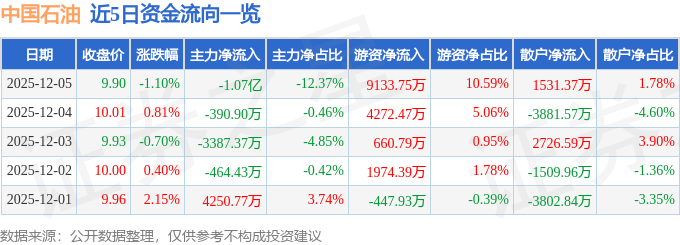
近5日融资融券数据一览见下表: 证券之星消息,截至2025年12月5日收盘,中国石油(601857)报收于9.9元,下跌1.1%,换手率0.05%, 成交量86.82万手,成交额8.62亿元。 12月5日的资金流向数据方面,主力资金净流出1.07亿元,占总成交额12.37%,游资资金净流入9133.75 万元,占总成交额10.59%,散户资金净流入1531.37万元,占总成交额1.78%。 近5日资金流向一览见下表: | | | | 日期 收盘价 涨跌幅 主力净流入 主力净占比 游资净点比 散户净流入 散户净占比 | | | | | | --- | --- | --- | --- | --- | --- | --- | --- | | 2025-12-05 | 9.90 -1.10% | -1.07亿 | -12.37% | 9133.75万 | 10.59% | 1531.37万 | 1.78% lin | | 2025-12-04 | 10.01 0.81% | -390.90万 | -0.46% | 4272.47万 | 5.06% | -3881.57万 | -4.60% | | 2025-12-03 ...

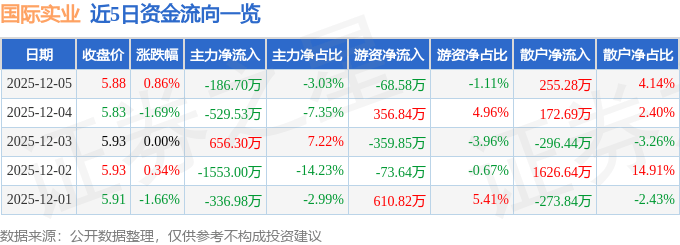
股票行情快报:国际实业(000159)12月5日主力资金净卖出186.70万元
Sou Hu Cai Jing· 2025-12-05 13:43
证券之星消息,截至2025年12月5日收盘,国际实业(000159)报收于5.88元,上涨0.86%,换手率2.2%, 成交量10.55万手,成交额6163.86万元。 12月5日的资金流向数据方面,主力资金净流出186.7万元,占总成交额3.03%,游资资金净流出68.58万 元,占总成交额1.11%,散户资金净流入255.28万元,占总成交额4.14%。 该股主要指标及行业内排名如下: | 指标 | 国际实业 | 石油行业均值 | 行业排名 | | --- | --- | --- | --- | | 总市值 | 28.26亿元 | 2142.13亿元 | 61 81 | | 净资产 | 20.38亿元 | 1921.21亿元 | 12 19 | | 净利润 | 2010.9万元 | 136.37亿元 | 14 19 | | 市盈率(动) | 105.42 | 34.58 | 61 TI | | 市净率 | 1.39 | 2.52 | ə (19 | | 毛利率 | 10.82% | 18.66% | 14 19 | | 净利率 | 1.54% | 4.47% | 12 19 | | ROE | 0.99% ...