酒类

Search documents
A股收评:三大指数齐跌!白酒股重挫,化工股逆市爆发
Ge Long Hui· 2026-02-06 07:30
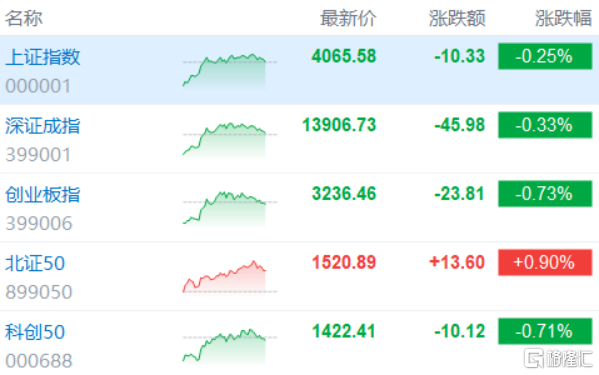
Market Overview - The A-share market experienced slight declines on February 6, with the Shanghai Composite Index down 0.25% to 4065 points, the Shenzhen Component Index down 0.33%, and the ChiNext Index down 0.73% [1][2] - The total market turnover was 2.16 trillion yuan, a decrease of 30.8 billion yuan compared to the previous trading day, with over 2700 stocks rising [1] Sector Performance - The mining and oil sectors saw gains, with stocks like Tongyuan Petroleum and Zhun Oil Co. hitting the daily limit [2] - The fluorine chemical sector was strong, with Tianji Co. also reaching the daily limit [2] - The lithium mining and battery sectors were active, with Enjie Co. hitting the daily limit [2] - Conversely, the liquor sector faced widespread declines, with Huangtai Liquor hitting the daily limit down [2] - The retail sector fell, led by Baida Group, which dropped nearly 10% [11] - The tourism sector weakened, with Dalian Shengya leading the decline, down over 8% [12] Notable Stocks - In the battery sector, stocks such as Zhenyu Technology and Enjie Co. saw significant gains, with Zhenyu Technology rising 13.39% [4][5] - The chemical sector was active, with stocks like Shanshan Co. and Yongtai Technology also hitting the daily limit [7] - The small metals sector rose, with Xianglu Tungsten Industry hitting the daily limit and Zhangyuan Tungsten Industry up over 9% [8] Economic Indicators - The China Bulk Commodity Price Index (CBPI) for January was reported at 125.3 points, a month-on-month increase of 6.3% and a year-on-year increase of 12.7%, marking the highest level since July 2022 [6] - The chemical price index also saw a significant rise, reporting a month-on-month increase of 3.8% [6] Liquor Industry Outlook - Recent forecasts from several liquor companies, including Huangtai Liquor and Jiu Gui Liquor, predict declines in net profits for 2025, with expectations of a bottoming out in the industry by 2026 [9] - The liquor sector is currently at historical low valuations, presenting strong bottom-fishing opportunities [9] Market Sentiment - Analysts from Guosen Securities noted that the market is currently under pressure due to hawkish sentiments, leading to a contraction in liquidity [17] - Despite short-term pressures on indices, the release of liquidity is expected to alleviate the impact on other sectors and reduce long-term bubble risks [17]

争抢“Z世代” “老白酒”杀向低度酒
Shen Zhen Shang Bao· 2026-02-05 17:55
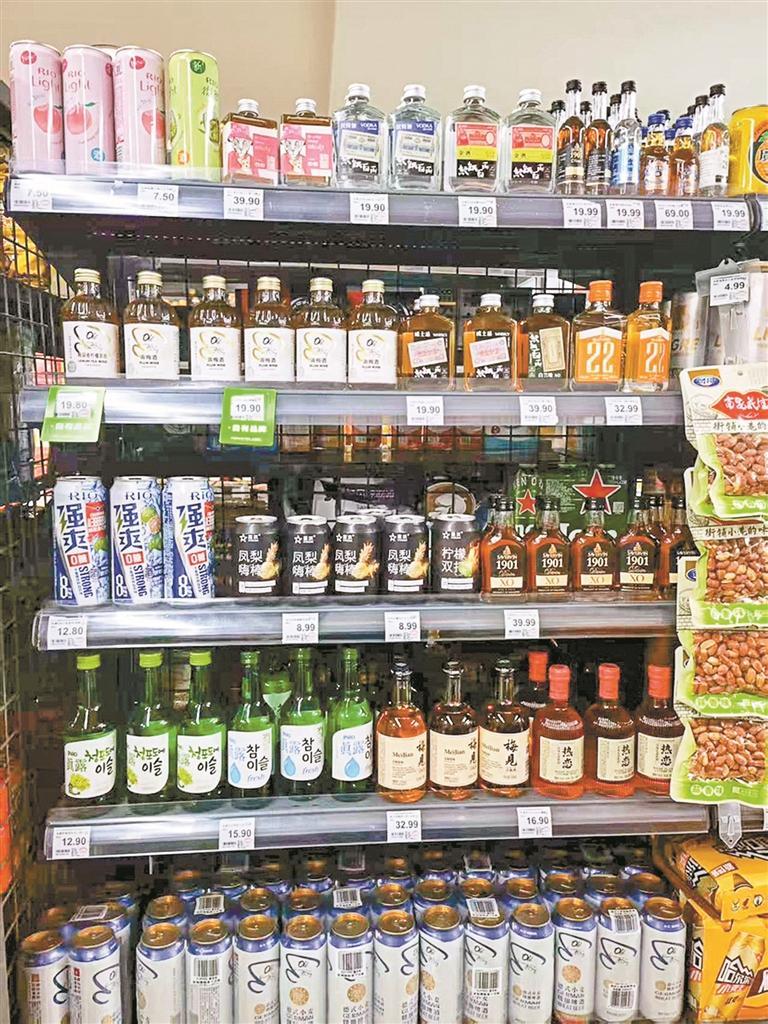
Group 1 - The core viewpoint of the articles highlights the increasing trend of low-alcohol beverages in the Chinese liquor market, particularly driven by the younger generation's consumption preferences as the Spring Festival approaches [1][5] - Traditional liquor companies are launching new low-alcohol products to attract younger consumers, with notable examples including Moutai's 6-degree blueberry sparkling wine and Wuliangye's 29-degree product that achieved over 100 million yuan in sales within 60 days [2][3] - The market for low-alcohol beverages is experiencing growth rates that exceed the industry average, indicating a shift in consumer preferences from high-alcohol content to more moderate options [4][5] Group 2 - The competition between traditional and new liquor brands is intensifying, with established companies adapting their strategies to include younger demographics and low-alcohol products [2][3] - The market is transitioning from "expansion-based growth" to "structural growth," indicating a new phase of competition and differentiation among liquor brands [4] - The Chinese Alcoholic Drinks Association notes that the growth rate of low-alcohol products reflects a change in consumer attitudes, where alcohol is increasingly viewed as an emotional medium rather than just a social tool [5]
争抢“Z世代”,“老白酒”杀向低度酒
Shen Zhen Shang Bao· 2026-02-05 17:53
Core Viewpoint - The low-alcohol beverage market is experiencing significant growth, driven by the younger generation's changing preferences and the strategic shifts of traditional liquor companies towards lower-alcohol products [5][8]. Group 1: Market Trends - The low-alcohol beverage segment is gaining traction, with new brands and products emerging to cater to the preferences of the "Z generation" [5]. - Traditional liquor companies are launching lower-alcohol products to attract younger consumers, with several major brands already introducing new offerings [5][6]. - The growth rate of low-alcohol beverages is surpassing the average growth rate of the industry, indicating a shift in consumer demand [8]. Group 2: Product Launches - Moutai's subsidiary launched a 6-degree blueberry sparkling wine in October 2024, available on multiple online platforms [5]. - Wuliangye introduced a 29-degree product called "Yijianqingxin" in August 2023, which achieved over 100 million yuan in sales within 60 days [5][6]. - Luzhou Laojiao is preparing to launch a 28-degree product, while Yanghe has introduced a 33.8-degree "light white wine" [6]. Group 3: Consumer Preferences - Younger consumers are increasingly drawn to low-alcohol beverages for reasons such as appealing packaging and celebrity endorsements [5]. - Traditional high-alcohol products still dominate the preferences of long-time customers, who may view lower-alcohol options as less desirable [7].
酒企押注春节档,资金却有新看法
Sou Hu Cai Jing· 2026-02-05 15:34
最近有酒企披露调研信息:春节是全年消费核心时段,今年整体动销能达预期但同比会回落;价格带上,百元内和800元以上市场占比微增,主流政商务价 位承压明显;区域布局里,省内大本营份额稳固,苏南高端产品占比超6成,省外部分地区增速亮眼、份额提升。不少人看完纠结,这信号对市场有啥影 响?其实市场波动的核心,从来不是单一消息,而是背后资金的真实动作。尤其是在行情向好阶段,抓准资金行为才是提升参与效率的关键,这时候量化大 数据能帮我们跳过表面消息,直接还原市场本质逻辑。 一、别被震荡耗掉行情效率 很多时候,看似持有能等来回报,但近一个月的等待,在行情向好时远不如一周参与一波行情效率高。多数个股震荡背后,是资金的反复动作,普通投资者 难分辨,但量化数据能直接呈现核心特征。 看图1: 图中橙色柱体是「机构库存」数据,反映机构交易活跃程度;蓝色柱体是「空头回补」数据,反映前期做空资金的补仓行为。两者同时出现,说明机构补仓 动作明确,震荡阶段即将结束。 二、量化数据锁定资金关键动作 行情里,两只个股的行情表现相近,但如果能避开震荡期,资金利用率会大幅提升。量化数据能帮我们跳过无效等待,直接抓准资金转向的核心节点,不用 靠主观猜测 ...

牛栏山、北京二锅头:北京两品牌入选“2025年度中国消费名品”
Sou Hu Cai Jing· 2026-02-05 09:43
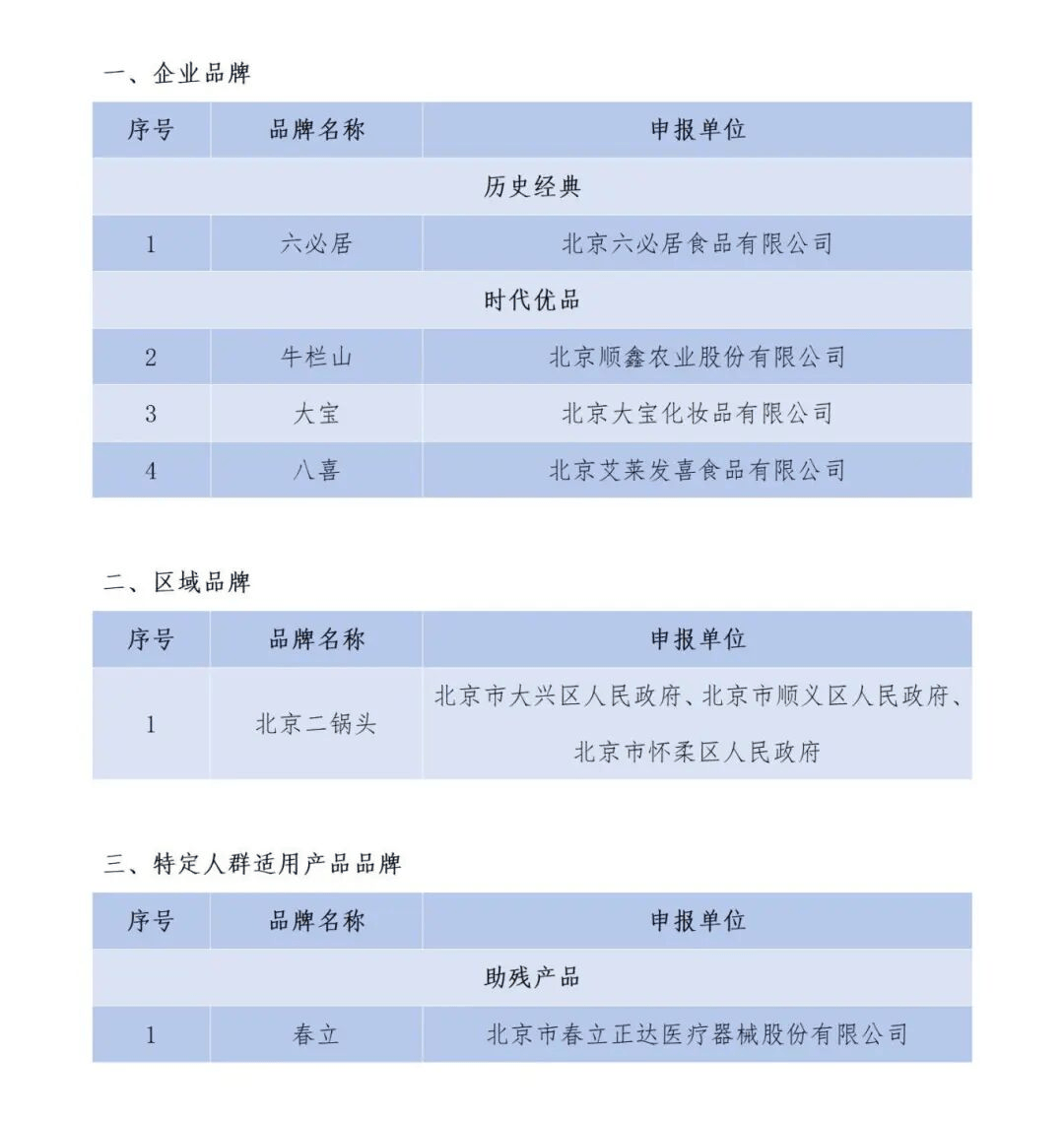
Core Viewpoint - The Ministry of Industry and Information Technology announced the list of China's consumer brands for 2025, highlighting the strong performance of the liquor industry in Beijing, with brands Niulanshan and Beijing Erguotou being recognized for their innovation and cultural heritage [1]. Group 1: Brand Recognition - Six brands from Beijing were selected, with Niulanshan recognized as a "Time Quality Product" and Beijing Erguotou as a "Regional Brand" [1][2]. - Niulanshan, owned by Beijing Shunxin Agricultural Co., has a rich history dating back to 1952 and is recognized as a national intangible cultural heritage protection unit [3][5]. - Beijing Erguotou, a collaborative effort by local governments, showcases a unique model of regional brand development [5][7]. Group 2: Innovation and Cultural Integration - Niulanshan integrates traditional craftsmanship with modern technology, featuring advanced production facilities and research platforms [3][9]. - The establishment of the Beijing Niulanshan Erguotou Cultural Park in 2023 serves as a significant venue for promoting Chinese liquor culture [3][9]. - The brand has adapted to market trends by launching new products, including a low-alcohol variant, which has received positive consumer feedback [3][9]. Group 3: Regional Collaboration - The success of Beijing Erguotou reflects the collaborative efforts of local governments and enterprises in building a regional brand [5][9]. - The company has evolved from its origins in 1949 and has become a beloved brand in the capital, with cultural initiatives like the Beijing Yongfeng Erguotou Wine Museum enhancing its visibility [5][7]. Group 4: Industry Trends and Future Directions - The recognition of these brands indicates a shift in consumer preferences from quantity to quality, emphasizing cultural significance and craftsmanship [9][10]. - The liquor industry in Beijing is encouraged to focus on quality, cultural empowerment, digital transformation, and sustainable development to ensure long-term growth [10]. - Government support is crucial for fostering innovation and collaboration among regional brands, which can drive industry development [10].


30个酒类品牌登上胡润中国品牌榜,贵州茅台、五粮液和国窖1573稳居前三
Xin Lang Cai Jing· 2026-02-05 02:22
Core Insights - The "2025 Hurun China Brand List" has been released, marking the first inclusion of non-Chinese brands and providing comprehensive coverage of the Chinese market [1][5]. Group 1: Brand Rankings - Apple tops the list with a brand value of 1.11 trillion yuan, followed by Kweichow Moutai at 795 billion yuan, and WeChat at 325 billion yuan, which has replaced Douyin as the most valuable private Chinese brand [1][5]. - Douyin's brand value increased by 14% to 280 billion yuan, but it dropped two places to fourth. Tesla made its debut on the list with a brand value of 270 billion yuan, ranking fifth [1][5]. Group 2: Industry Insights - The largest increase in brand value was seen by Pop Mart, which grew by 288% to 48.5 billion yuan, entering the top 50 [2][5]. - The consumer electronics sector, led by Apple, has surpassed the liquor industry to become the highest-valued sector on the list, while liquor remains the highest-valued sector for domestic brands [2][5]. - Among liquor brands, Kweichow Moutai, Wuliangye, and Guojiao 1573 continue to hold the top three positions. A total of 30 liquor brands made the list, with 18 being state-owned, 8 private, and 3 non-Chinese brands, collectively accounting for 14% of the total brand value on the list [2][5]. Group 3: Brand Value Data - The top ten brands and their values are as follows: 1. Apple: 1,110 billion yuan 2. Kweichow Moutai: 795 billion yuan 3. WeChat: 325 billion yuan 4. Douyin: 280 billion yuan 5. Tesla: 270 billion yuan 6. Zhonghua: 195 billion yuan 7. Wuliangye: 170 billion yuan 8. Pinduoduo: 150 billion yuan 9. Ping An: 130 billion yuan 10. BYD: 120 billion yuan [3][6]. Group 4: Non-Chinese Brands - The top non-Chinese brands include: 1. Apple: 1,110 billion yuan 2. Tesla: 270 billion yuan 3. Hermès: 83.5 billion yuan 4. Other notable brands include Coca-Cola and Louis Vuitton, with values of 31 billion yuan and 24.5 billion yuan respectively [4][8].




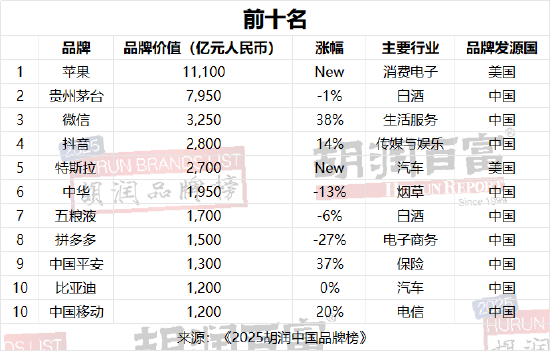
2025胡润中国品牌榜:苹果登顶,贵州茅台第二、微信第三
Xin Lang Cai Jing· 2026-02-05 02:11
Core Insights - The 2025 Hurun China Brand List has been released, for the first time including non-Chinese brands, providing a comprehensive overview of the Chinese market [1][4]. Brand Rankings - Apple tops the list with a brand value of 1.11 trillion yuan, followed by Kweichow Moutai at 795 billion yuan, maintaining its position as the highest-valued Chinese brand [1][4]. - WeChat ranks third with a brand value of 325 billion yuan, overtaking Douyin as the most valuable private Chinese brand [1][4]. - Douyin's brand value increased by 14% to 280 billion yuan, but it dropped two places to fourth [1][4]. - Tesla makes its debut on the list with a brand value of 270 billion yuan, ranking fifth [1][4]. Notable Brand Performance - Pop Mart is highlighted as the brand with the largest growth, with a brand value increase of 288% to 48.5 billion yuan, entering the top 50 [1][4]. - The consumer electronics sector, led by Apple, has surpassed the liquor industry to become the highest-valued sector on the list, while liquor remains the highest-valued sector for domestic brands [1][4].
上海贵酒股份有限公司关于股票交易及股票可能被终止上市的风险提示公告
Shang Hai Zheng Quan Bao· 2026-02-04 19:29
Core Viewpoint - Shanghai Guijiu Co., Ltd. is facing significant financial challenges, with projected revenue for 2025 expected to be below 300 million yuan, leading to potential delisting risks due to financial criteria outlined in the stock listing rules [2][4]. Financial Performance - The company anticipates a revenue of less than 300 million yuan for the fiscal year 2025, with both net profit and profit before non-recurring items expected to be negative [2][4]. - The company has received a special report from its auditor, Unitaizhenqing, indicating that the audit report for 2024 will likely contain a non-standard opinion due to unresolved issues, which could affect the 2025 financial statements [2][4]. Stock Trading and Delisting Risks - The company's stock has experienced significant volatility, including consecutive trading halts on January 29 and 30, 2026, and a closing price increase of 4.57% on February 4, 2026 [2]. - The stock has been under delisting risk warning since April 23, 2025, and the company has issued multiple announcements regarding the potential for delisting due to financial performance [5][6]. Shareholder Information - The controlling shareholder, Shanghai Guijiu Enterprise Development Co., Ltd., and its concerted parties hold a total of 216,740,245 shares, which represents 64.80% of the company's total share capital, all of which have been judicially frozen [3][6]. - The company has confirmed that there are no undisclosed significant matters related to the controlling shareholder, including major asset restructuring or bankruptcy [3][6]. Regulatory Compliance - The company is required to issue risk warning announcements every 10 trading days until the annual report is disclosed, as per the stock listing rules [5][6]. - The company emphasizes that all investor communications should refer to the official disclosures made in designated media outlets [7].

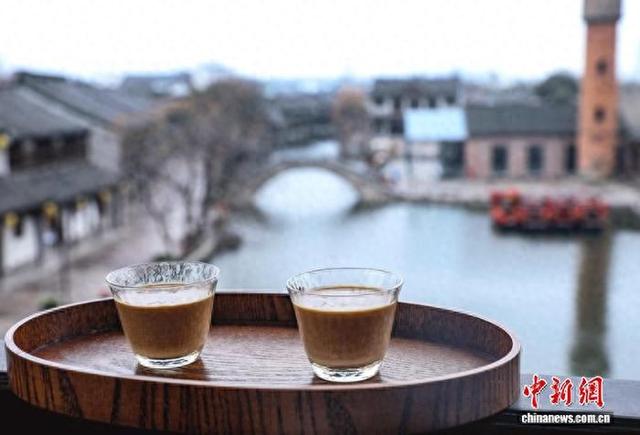
(新春走基层)绍兴黄酒推陈出新 创意调饮“醉”引年轻客
Xin Lang Cai Jing· 2026-02-04 14:18
Core Viewpoint - The article highlights the rising popularity of innovative yellow wine-based drinks among young consumers in Shaoxing, blending traditional culture with modern creativity, thereby enhancing the appeal of Shaoxing yellow wine [1][3]. Group 1: Innovative Products - New drinks such as yellow wine coffee, yellow wine milk tea, and customized yellow wine cocktails are becoming trendy among young people, showcasing the versatility of yellow wine [3][5]. - The introduction of "blind box cocktails" allows customers to create personalized drinks, attracting a younger audience while maintaining the essence of yellow wine culture [5]. Group 2: Cultural Engagement - Many shops incorporate cultural experience areas, enabling customers to learn about the brewing techniques and history of yellow wine, fostering a deeper appreciation for the traditional beverage [5]. - The innovative drinks serve as a gateway for young consumers to connect with Shaoxing's cultural heritage, transforming their perception of yellow wine from unfamiliar to beloved [5]. Group 3: Tourism Enhancement - The trend of yellow wine drinks contributes to immersive tourism experiences in Shaoxing, where visitors can enjoy historical boat rides and modern interactive exhibits related to the brewing process [5]. - The fusion of ancient and contemporary elements in yellow wine drinks revitalizes the traditional beverage, making it more accessible and appealing to the younger demographic [5].