信息技术

Search documents
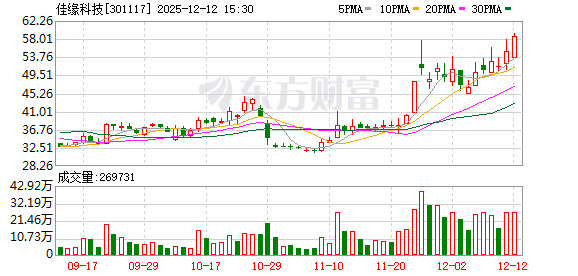
佳缘科技龙虎榜数据(12月12日)
Zheng Quan Shi Bao Wang· 2025-12-12 09:29
Core Viewpoint - Jiarun Technology's stock rose by 6.14% with a turnover rate of 33.95%, indicating significant trading activity and interest from investors [2]. Trading Activity - The total trading volume for Jiarun Technology reached 1.514 billion yuan, with a price fluctuation of 10.67% throughout the day [2]. - Institutional investors net sold 36.89 million yuan, while retail trading desks collectively net bought 12.47 million yuan [2]. - The stock was listed on the Shenzhen Stock Exchange's "Dragon and Tiger List" due to its high turnover rate [2]. Institutional Participation - Among the top five trading desks, the total transaction volume was 324 million yuan, with buying amounting to 150 million yuan and selling at 174 million yuan, resulting in a net sell of 24.42 million yuan [2]. - Four institutional trading desks were involved, with total buying of 86.48 million yuan and selling of 123 million yuan, leading to a net sell of 36.89 million yuan [2]. Recent Performance - Over the past six months, Jiarun Technology has appeared on the "Dragon and Tiger List" nine times, with an average price increase of 2.10% the day after being listed and an average increase of 0.80% over the following five days [2]. - Today, the stock saw a net inflow of 21.64 million yuan from major funds, including a net inflow of 10.48 million yuan from large orders [2]. - In the last five days, the net inflow of major funds totaled 172 million yuan [2].

南方中证A500ETF,一键布局中国优质资产
East Money Securities· 2025-12-12 09:08
Group 1 - The report highlights that the recent rise of the Shanghai Composite Index above 4000 points is significantly different from previous instances, characterized by a prolonged period of over one year for this breakthrough, indicating a healthy slow bull market driven primarily by new productive forces represented by information technology [9][10] - The report emphasizes that the current economic transformation in China, marked by the acceleration of the engineer dividend, continuous R&D investment, and enhanced innovation capabilities, serves as a foundation for long-term high-quality economic development and supports the ongoing asset revaluation and slow bull market [21][22] - The report notes that the A-share market is undergoing a structural transformation, with new policies aimed at stabilizing the stock market and promoting long-term capital inflows, which are expected to elevate the equity market's operational baseline [36][37] Group 2 - The report identifies the CSI A500 Index as a key asset in the Chinese market, being the second-largest broad-based index in terms of ETF tracking scale, providing a balanced industry and market capitalization distribution that closely reflects the entire A-share market [49][54] - The CSI A500 Index is noted for its significant allocation to emerging industries such as electronics and defense, showcasing characteristics of new productive forces, and its internationalization attributes are highlighted through its high proportion of overseas revenue [54][56] - The report suggests that the Southern CSI A500 ETF offers investors a convenient opportunity to access quality Chinese assets, with its low tracking error and significant excess return rates, making it an attractive option for long-term investment [49][56]
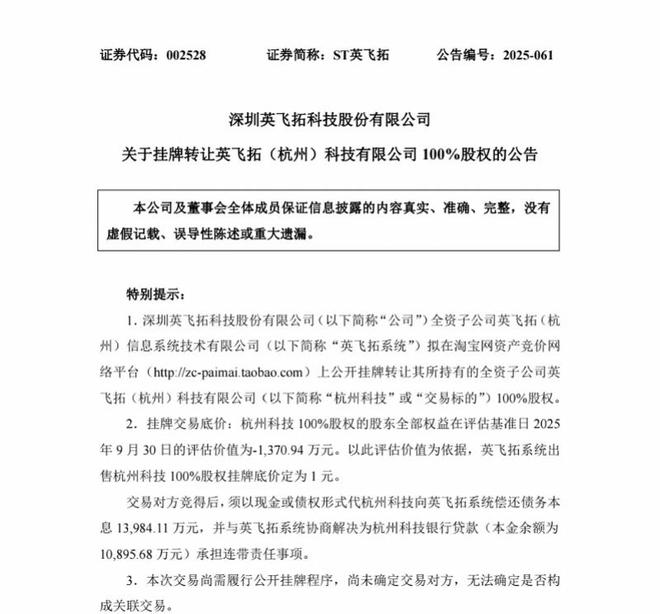
ST英飞拓“断臂”1元甩卖子公司,接盘方需扛1.4亿债务
Nan Fang Du Shi Bao· 2025-12-12 08:57
12月10日,深圳国资背景的ST英飞拓(002528.SZ)抛出一则资产处置公告,公司全资子公司英飞拓 (杭州)信息系统技术有限公司(下称"英飞拓系统")拟在淘宝网资产竞价平台挂牌转让英飞拓(杭 州)科技有限公司(下称"杭州科技")100%股权,挂牌底价仅为1元。 从交易方案来看,此次股权转让的核心条款颇具特殊性。据ST英飞拓公告披露,以2025年9月30日为评 估基准日,杭州科技100%股权对应的股东全部权益评估价值为-1370.94万元,已处于资不抵债状态,这 也是其股权挂牌底价定为1元的核心依据。 截至2025年三季度末,杭州科技净资产已跌至-850.34万元,较评估基准日的-1371万元虽有小幅修复, 但仍未脱离资不抵债的困境。持续的亏损不仅拖累了英飞拓系统的业绩,其1.4亿元的欠款和1.09亿元的 贷款担保,更成为压在ST英飞拓身上的沉重包袱。 此次资产剥离的背后,是ST英飞拓近年来持续恶化的业绩基本面和高企的财务压力。财报数据显示, 2021年至2024年,公司已连续四年归母净利润亏损,累计亏损额高达35.63亿元,其中2021年亏损14.19 亿元、2022年亏损9.69亿元、2023年亏损7. ...

赴美上市决策指南:OTC中小企业跨境优选方案
Sou Hu Cai Jing· 2025-12-12 07:07
Core Viewpoint - The regulatory framework of the US and China capital markets is continuously adjusting, creating both opportunities and challenges for Chinese companies seeking cross-border financing. The increasing entry barriers for traditional IPOs and the evolving SPAC landscape are pushing smaller enterprises towards the OTC market as a pragmatic entry point into international capital markets [1]. Group 1: Direct IPO (NYSE/NASDAQ) - The traditional IPO route offers significant advantages such as large fundraising potential (with a proposed minimum of $25 million), strong liquidity, and notable brand endorsement, making it suitable for mature tech or manufacturing firms [2]. - However, the disadvantages are considerable, including a lengthy SEC review process of 12-24 months, underwriting fees of 7%-10% of the raised amount, and stringent financial criteria, particularly with the anticipated increase in market capitalization requirements by NASDAQ [2]. - Post-2025, while the resumption of filing windows is expected, compliance issues related to VIE structures and data security reviews remain significant obstacles [2]. Group 2: SPAC Merger Listing - The SPAC model allows for rapid listing through a "shell company fundraising - merger injection" approach, reducing the timeline to 6-9 months and imposing no strict profitability requirements [3]. - Nonetheless, with tightening regulations expected in 2025, SPACs face challenges such as high redemption rates (averaging over 97%) and rising PIPE financing costs (5%-7% of the raised amount), making it more suitable for companies in AI and renewable energy sectors that can effectively communicate their value [3]. Group 3: OTC Market Listing - The OTC market represents the lowest entry barrier, characterized by its "stepping stone" attribute, making it an optimal choice for small and medium-sized enterprises [4]. - For example, the OTCQB listing process typically spans 6-9 months, involving foundational setup (2-3 weeks), issuance and listing (3-6 weeks), requiring 50-100 shareholders and a minimum share price of $1 [5]. - Companies can transition to NASDAQ by meeting specific criteria, such as net assets of at least $5 million or a two-year cumulative net profit of $750,000 alongside net assets of $4 million, with additional requirements including 1 million shares in circulation and a share price of at least $4 [6]. Group 4: Compliance Preparation - The compliance preparation phase for OTC listing takes approximately 4-5 weeks, involving DTC custody applications and drafting the S-1 prospectus [7]. - Following this, the SEC review process lasts about 4 weeks, during which the application is submitted, inquiries are addressed, and a stock code is obtained [7].
GDP的顶梁柱:房地产之后下一个是什么?
Bank of China Securities· 2025-12-12 05:33
Economic Structure - The main contributors to China's GDP in 2024 are consumption (56.55%), investment (40.61%), and net exports (2.84%) [10] - The contribution rates to GDP growth are 44.47% from consumption, 25.22% from investment, and 30.31% from net exports [11] Real Estate Sector - The real estate sector's GDP share peaked above 8% between 2018 and 2020, but has since declined to 6.27% in 2024 [25][29] - The real estate industry's nominal GDP growth has been consistently lower than the overall economic growth since 2019, indicating a significant shift [27] Future Growth Drivers - Future economic growth is expected to be supported by technology-driven sectors such as information technology and leasing services, as well as industries benefiting from productivity improvements like wholesale retail and manufacturing [2] - Key areas for future growth include the modernization of the industrial system, driven by government policies and technological advancements [1] Policy Implications - Long-term national policies, such as the five-year plan, are crucial for ensuring sustainable economic development and balancing sectoral growth [2] - The macroeconomic policy environment is expected to maintain a positive fiscal stance and moderately loose monetary policy, with potential innovations in monetary tools [2] Risks - Potential risks include a resurgence of global inflation, rapid economic downturns in developed economies, and increasing international geopolitical complexities [2]
20cm速递|创业板50ETF国泰(159375)涨超0.7%,科技成长领域估值引关注
Mei Ri Jing Ji Xin Wen· 2025-12-12 04:50
Group 1 - The core viewpoint is that the ChiNext 50 Index constituents are primarily concentrated in the technology growth sector, with valuations at a relatively low level [1] - The AI computing power and its supporting industrial chain are experiencing strong growth, with a significant increase in demand leading to a rise in both volume and price for high-end PCBs, which now account for over 50% of the global PCB industry [1] - The CPO optical module is expected to see non-linear growth in the computing cluster construction, with an anticipated annual growth rate of 15% to 20% from 2027 to 2030 [1] Group 2 - The domestic computing chip replacement is accelerating, with market share expected to rise to 55% by 2027 [1] - The energy storage chain is benefiting from increased AI computing power consumption, with strong overseas demand driving lithium battery material prices up, including a nearly 60% increase in lithium carbonate prices from their low point earlier in the year [1] - The technology sector, including robotics, gaming, and software applications, is gradually revealing industrial opportunities, with the gaming industry experiencing its first revenue growth inflection point since 2014, and AI-enabled software development potentially reducing transaction costs by 20% [1] Group 3 - The Guotai ChiNext 50 ETF (159375) tracks the ChiNext 50 Index (399673), which has a daily fluctuation of up to 20%, selecting 50 securities with excellent liquidity and leading market capitalization from the ChiNext market [1] - The index primarily covers high-tech and emerging industries such as new energy, biomedicine, and electronic information technology, reflecting the overall performance of core quality enterprises in the ChiNext market [1] - The constituents of the index are mainly distributed across industries with strong growth potential, such as power equipment, biomedicine, and information technology, showcasing innovation-driven characteristics and high elasticity in returns [1]

核心指数样本股定期调整落地:动态适配市场趋势,企业价值回归基本面本质
Cai Jing Wang· 2025-12-12 03:01
Group 1 - The Shanghai Stock Exchange, Shenzhen Stock Exchange, and China Securities Index Co., Ltd. announced a periodic adjustment of several core A-share index sample stocks, effective after market close on December 12 for indices like the SSE 50 and after December 15 for others like the Shenzhen Component Index [1] - The SSE 50 index replaced four sample stocks, including SAIC Motor, Northern Rare Earth, Huadian New Energy, and Zhongke Shuguang, while removing Poly Development, China Mobile, China Aluminum, and CRRC, indicating a shift towards high-end manufacturing, strategic resources, new energy, and computing technology [1] - The adjustment reflects a bias towards industries related to new productive forces, as the removed stocks primarily belong to real estate, traditional communication, and cyclical industries [1] Group 2 - The removed companies, such as Poly Development, are industry leaders with strong fundamentals and competitive advantages, evidenced by their financial performance, including a revenue of 173.7 billion yuan and a net profit of 1.928 billion yuan for the first three quarters of 2025 [2] - The adjustments to other indices like the Sci-Tech 50 and CSI 300 also involve sample optimization across various sectors, including information technology and new energy, aligning the index structure with the direction of China's economic transformation [2]
12月12日收盘后正式生效!沪深300、科创50等多个重要指数即将调整样本
Xin Lang Cai Jing· 2025-12-12 01:56
Group 1 - The sample adjustment for major indices such as CSI 300 and STAR 50 will be completed after the market closes on December 12, based on established criteria like market capitalization and liquidity [1][2] - The CSI 300 index will replace 11 stocks, including Shenghong Technology, Dongshan Precision, and Ruixin Microelectronics, while removing Foster, Fulete, and TCL Zhonghuan [1] - The adjustments will increase the number of samples in the information technology and communication services sectors by 4 and 2 respectively, with weightings rising by 1.46% and 0.75%, reflecting a shift towards emerging industries [1] Group 2 - The STAR 50 index will replace 2 stocks, adding Aojie Technology and Shengke Communication while removing Huaxi Biological and Hangcai Co [2] - Other indices such as CSI 500, CSI 1000, and CSI A500 will also undergo sample adjustments on the same day, changing 50, 100, and 20 stocks respectively [2] - Adjustments for indices like Shenzhen Component Index and ChiNext Index will take effect on December 15 [3] Group 3 - ETFs tracking these indices will also adjust their portfolios accordingly, with the largest total scale for CSI 300 ETFs exceeding 1.16 trillion yuan [4] - The Huaxia CSI 300 ETF (510330.SH) has a low management fee rate of 0.15% per year and has a fund size exceeding 220 billion yuan as of December 11, with an average daily trading volume of over 500 million yuan [4]
今日看点|沪深300等指数样本将调整
Jing Ji Guan Cha Wang· 2025-12-12 01:51
4、德国11月CPI、加拿大10月批发销售月率等数据将公布。 12月12日,共有6家公司限售股解禁,合计解禁量为2.12亿股,按最新收盘价计算,合计解禁市值为83.31亿元。 从解禁量来看,4家公司解禁股数超千万股。炜冈科技、先锋精科、长盈通解禁量居前,解禁股数分别为1.0亿股、6787.57万股、2785.18万股。从解禁市值 来看,4家公司解禁股数超亿元。先锋精科、炜冈科技、长盈通解禁市值居前,解禁市值分别为41.14亿元、21.72亿元、12.71亿元。 3、8家公司披露回购进展 12月12日,8家公司共发布8个股票回购相关进展。其中,2家公司回购方案获股东大会通过,3家公司披露股票回购实施进展,3家公司回购方案已实施完 毕。 从股东大会通过回购预案来看,当日共1家公司回购预案超千万。航材股份、天地数码回购金额最高,分别拟回购不超1.0亿元、17.81万元。从回购实施进展 来看,顺丰控股、惠泰医疗、东方创业回购金额最高,分别回购15.42亿元、1182.0万元、273.06万元。 今日看点 12月12日重点关注的财经要闻与资本市场大事: 1、沪深300等指数样本将调整 近日,中证指数有限公司宣布将调整沪 ...

国资证券化潮涌 战新产业聚势而强
Zhong Guo Zheng Quan Bao· 2025-12-11 20:17
Group 1 - The core viewpoint of the articles highlights a surge in state-owned enterprises (SOEs) entering the capital market, driven by a focus on core business and strategic emerging industries, indicating a clear path towards high-quality development of state capital [1][2][3] - The recent trend of asset securitization among central enterprises is not only for financing but also serves as a strategic tool for deepening reforms, aiming to upgrade core businesses and develop strategic emerging industries [1][2] - The capital operations are particularly concentrated in strategic emerging industries, with expectations that fields such as new materials, biomanufacturing, and digital economy will continue to be focal points for capital operations [3] Group 2 - The listing activities of state-owned automotive companies, such as Avita and Lantu, are seen as a significant window into the reform of state capital, driven by the State-owned Assets Supervision and Administration Commission's separate assessment policy for SOE electric vehicle businesses [2] - The high-end equipment sector is also actively pursuing listings, with China Railway Rolling Stock Corporation planning to spin off its subsidiary for an independent listing focused on high-end equipment components and solutions [2] - Local state-owned enterprises are accelerating their asset securitization efforts, with provinces like Hubei and Sichuan implementing plans to enhance the management and market utilization of state-owned assets [3][4] Group 3 - There is a notable trend of local state-owned enterprises seeking to expand their financing channels internationally while also utilizing domestic markets, as seen in cases like Zhejiang Medicine and Shandong Gold [4] - The urgency to activate large volumes of state-owned assets and improve fiscal revenue sources is driving local SOEs to pursue various methods of securitization, including IPOs and REITs [4]