
投资银行

Search documents
从AI交易、美联储新主席到铜,这是高盛列出的“2026年最重要的五大交易主题”
Hua Er Jie Jian Wen· 2025-12-13 03:03
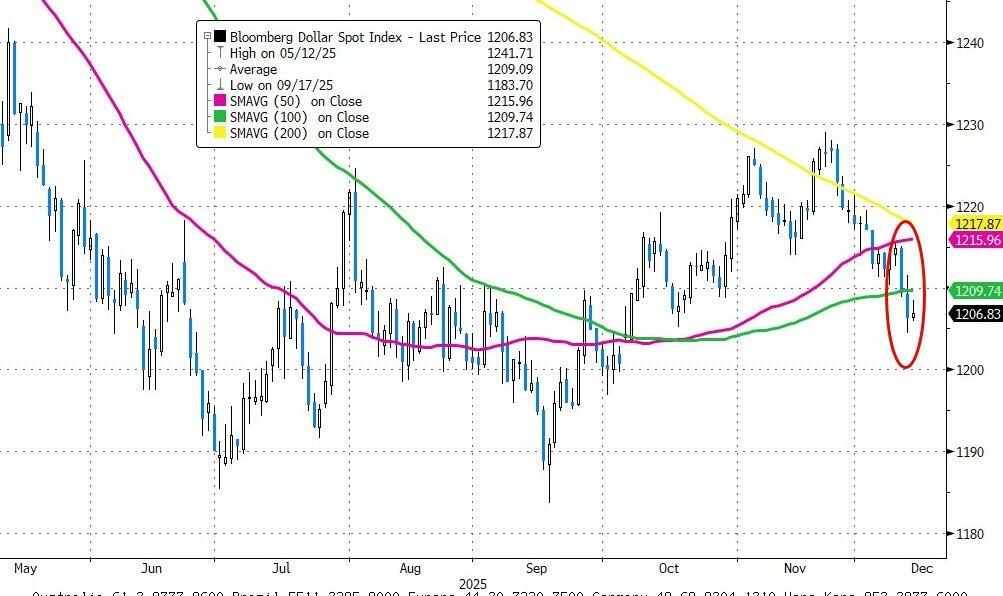
Group 1: Key Investment Themes for 2026 - Goldman Sachs identifies five key investment themes for 2026, including the turning point in the AI investment cycle, the impact of the Federal Reserve leadership change on the dollar, the strategic reassessment of commodities, the necessity of portfolio diversification, and structural changes in the European market [1] Group 2: AI Investment Cycle - Goldman Sachs compares the current AI investment cycle to a modern "space race," suggesting that the era of broad optimism around AI-related assets may be ending [2] - Companies providing infrastructure for AI, such as computing hardware and data centers, are expected to remain attractive investments, while the market will become more discerning in identifying true beneficiaries of AI [2] Group 3: Federal Reserve Leadership and Dollar Weakness - The anticipated appointment of Hassett as the next Federal Reserve Chair could lead to a scenario where the economy is allowed to "run hot," resulting in a weaker dollar [3] - Goldman Sachs' foreign exchange team predicts significant depreciation of the dollar by 2026, with the dollar index already showing signs of weakness [3][7] Group 4: Commodities and Copper - The performance of precious metals underscores the necessity of investing in "hard assets," with copper emerging as a particularly attractive option due to tightening supply and increasing demand [8] - Goldman Sachs forecasts that over 60% of copper demand growth by 2030 will be driven by power grid and infrastructure needs, equating to an additional demand level comparable to that of the United States [8] Group 5: Importance of Diversification - Given the high valuation of the U.S. stock market relative to global markets, diversification is emphasized as essential for investors to maintain exposure to equities [9] - Strong performance in non-U.S. markets has been observed, with European and emerging market assets gaining traction as investors shift away from U.S. equities [9] Group 6: European Market Opportunities - The year 2025 is described as a "global inflection point," with significant changes anticipated in the European market [10] - Despite challenges, Europe is seen as having strong industries and research capabilities, making it an important area for diversified investment [12][13]


老牌保代突击入股翻车,非法获利410万换10年牢狱
Feng Huang Wang· 2025-12-12 23:19
Core Viewpoint - A recent court ruling has significant implications for the investment banking sector, marking a shift in how violations by key personnel in state-owned securities firms are prosecuted, particularly regarding the classification of such individuals as "state workers" under criminal law [1][9]. Group 1: Case Overview - Du Pengfei, former executive general manager of CITIC Securities' investment banking division, was sentenced to 10 years and 2 months in prison for bribery, with a fine of 600,000 yuan and the confiscation of illegal gains totaling 4.1064 million yuan [1][9]. - The case centers around Du's involvement in the IPO of Zhenhua New Materials, where he engaged in illegal stockholding practices through a third party, leading to substantial profits after the stock's lock-up period ended [1][2]. Group 2: Regulatory Implications - The court's ruling establishes that key personnel in state-owned securities firms can be classified as "state workers," which alters the legal landscape for similar cases, previously often resulting in lighter penalties [1][9]. - This case sends a strong signal regarding increased regulatory scrutiny and stricter legal boundaries for investment banking professionals, redefining the risks associated with their roles [1][9]. Group 3: Details of the Violation - Du Pengfei was involved in a scheme where he used a third party to hold shares in Zhenhua New Materials, despite clear prohibitions in the Securities Law against such actions by securities professionals [3][8]. - The IPO of Zhenhua New Materials was initially under financial pressure, prompting the company to allow Du to participate in a private placement through a third party, which ultimately led to his illegal gains [3][4]. Group 4: Legal Proceedings - The case was uncovered during a routine audit by the National Audit Office, which identified irregularities in Du's stock transactions, leading to an investigation by the local supervisory committee [5][6]. - The court's decision emphasized the importance of Du's role in managing state assets, thus justifying the classification of his actions as a serious criminal offense [7][8].
高盛:看好美股2026市场表现 六大科技公司将贡献近半增长
Sou Hu Cai Jing· 2025-12-12 15:05
格隆汇12月12日丨高盛预计2026年市场将持续走强,并将标普500指数的目标设定为7,600点。高盛首席 美国股票策略师Ben Snider表示,人工智能驱动的生产力将推高收益,预计标普500指数的每股收益 (EPS)将增长12%至305美元,其中六家主要科技公司将贡献近一半的增长。虽然大型科技公司仍是 主要驱动力,但Snider也预计该指数其他成分股的收益将有所改善。他指出,前方的风险包括美联储放 缓宽松步伐以及利润率面临压力,但他整体上仍保持积极的展望。 来源:格隆汇APP ...
重返增长轨道:富国银行(WFC.US)扩招加码投行,并购排名首次跻身前十
智通财经网· 2025-12-12 13:29
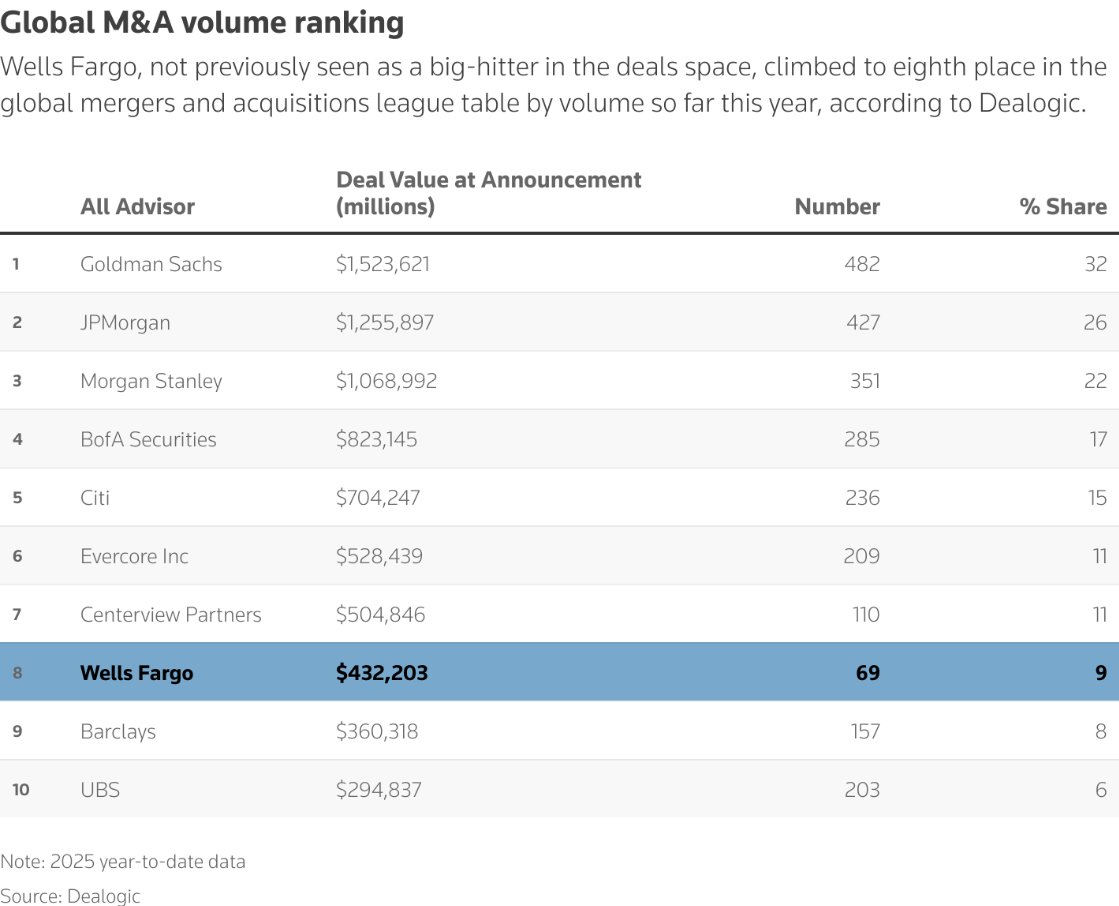
Core Viewpoint - Wells Fargo (WFC.US), the fourth-largest bank in the U.S., is planning to expand its investment banking operations significantly, having already improved its ranking in the mergers and acquisitions (M&A) sector due to recent hiring and market share efforts [1][4]. Group 1: Investment Banking Expansion - Wells Fargo has seen a notable rise in its M&A ranking, moving to eighth place globally in terms of transaction volume as of this year, up from 17th place in 2024 [1][2]. - This marks the first time Wells Fargo has entered the top ten of the M&A rankings since Dealogic began collecting data in 1995, indicating a significant shift in its market position [3]. - The bank's CEO, Charlie Scharf, aims to position Wells Fargo among the top five investment banks globally, with the current ranking being eighth in the world and sixth in the U.S. by revenue [5][6]. Group 2: Market Conditions and Strategic Moves - The optimistic outlook among Wall Street executives regarding transaction prospects is supported by the resilience of the U.S. economy, which benefits Wells Fargo's investment banking ambitions [1][3]. - The lifting of a seven-year punitive asset cap by regulators has allowed Wells Fargo to pursue larger domestic business mandates, enhancing its competitive edge against smaller boutique firms [5][6]. - The bank's investment banking division has been actively recruiting, with over 125 managing directors hired since 2019, indicating a commitment to strengthening its market presence [8]. Group 3: Recent Transactions and Revenue Potential - Wells Fargo has participated in high-profile M&A transactions, including advising Netflix on a $72 billion acquisition of Warner Bros. Discovery, which is expected to yield $37 million in advisory fees [4]. - The bank is also advising Union Pacific on an $85 billion acquisition of Norfolk Southern, with anticipated revenue of $52.5 million from this deal [5]. - The bank's advisory fee income has been on the rise, although it still ranks 20th in M&A transaction revenue [5].

下周欧洲央行会议在即 与美联储政策分歧料推高欧元
智通财经网· 2025-12-12 11:24
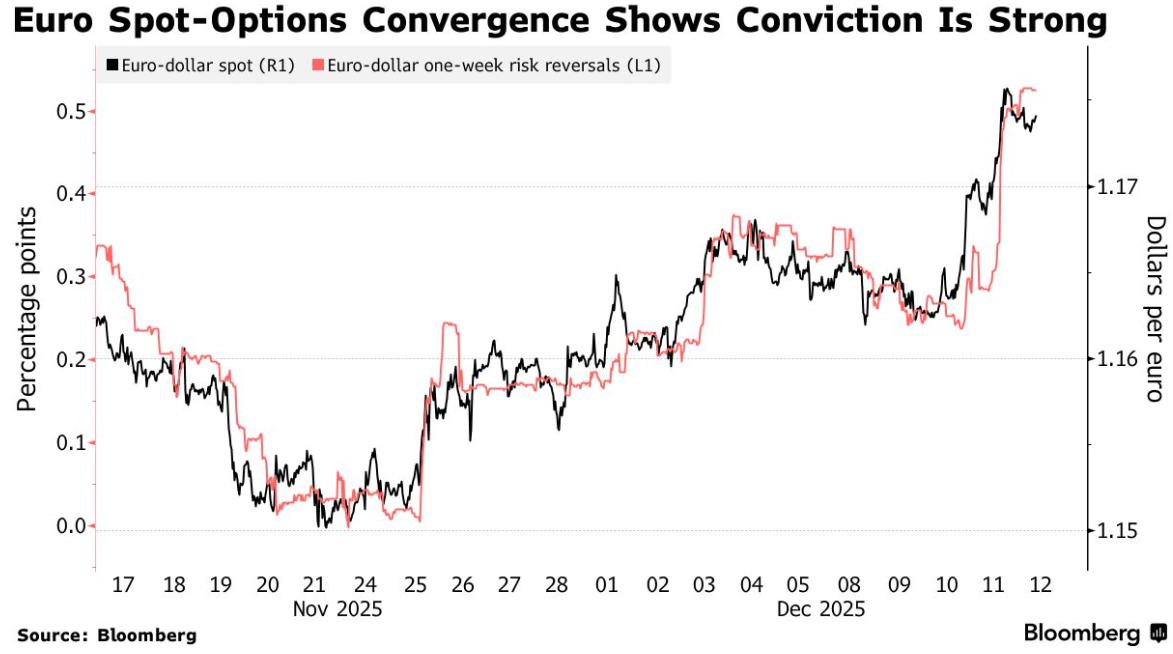
Group 1 - The core viewpoint indicates that options traders expect the euro's upward momentum to gain new strength next week due to the European Central Bank's (ECB) interest rate decision, which is anticipated to highlight the policy divergence with the Federal Reserve [1] - According to the Depository Trust & Clearing Corporation (DTCC), the most active strike price this month is at 1.18 USD per euro, with a significant portion of the underlying value concentrated in contracts expiring around the ECB's decision window on December 18-19 [1] - The euro is hovering near a two-month high following the Federal Reserve's third consecutive rate cut and hawkish comments from ECB Executive Board member Isabel Schnabel, with the options sentiment for the ECB's December decision being the most bullish in three months [1] Group 2 - The cost of buying volatility ahead of the decision is the highest in three months, attributed to Schnabel's remarks, and Morgan Stanley strategists expect the euro to rise to 1.30 USD by the second quarter of 2026, even if the ECB does not raise rates next year [4] - Hedge funds are identified as the main drivers of the bullish price action for the euro this week, actively purchasing both vanilla and exotic options that will profit from a strengthening euro [4]
美联储“向左”欧央行“向右”:欧洲明年加息预期重燃,下周会议聚焦五大信号
Hua Er Jie Jian Wen· 2025-12-12 06:36
随着欧洲央行决策者愈发坚定地认为当前货币政策处于"良好位置",市场情绪出现显著逆转,交易员已 开始通过定价反映该行在2026年重启加息的可能性,这与此前普遍的降息预期形成鲜明对比。 下周四的欧洲央行会议将成为市场验证这一逻辑的关键节点。据路透12日报道,尽管市场普遍预计欧洲 央行将连续第四次将关键利率维持在2%不变,但投资者关注的焦点已从降息转向未来的紧缩路径。据 彭博的一项调查,超过60%的受访经济学家现在预测欧央行的下一次利率调整将是向上的,而此前持有 这一观点的比例仅为三分之一。 与此同时,大西洋彼岸的美联储刚刚宣布降息25个基点。据华尔街见闻此前文章,高盛及华尔街多家投 行警告称,这种政策分化——美联储"向左"宽松,欧央行"向右"紧缩——预计将在2026年前后通过汇率 市场显现关键影响。由于其他央行维持紧缩倾向,美元面临的贬值压力正成为市场焦点,这可能导致欧 元被动升值,进而成为影响欧洲央行未来决策的外部变量。 投资者正密切关注下周会议释放的信号,以寻找是否有理由维持加息押注。路透指出,除利率决议外, 本次会议还面临关于通胀预测、政策路径、地缘政治影响及人事变动等五大关键问题。 关于明年及更长远的政策 ...
香港新股申报质量引关注 瑞银:监管意在“提醒” 而非“警告”
智通财经网· 2025-12-12 06:16
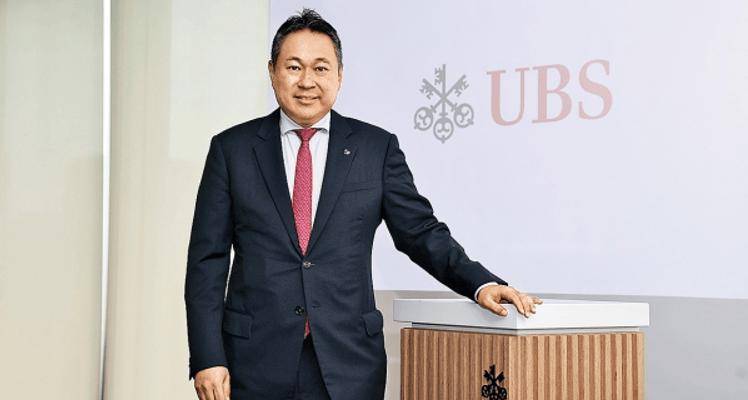
李镇国表示,为应对预期中激增的上市项目,瑞银在过去一年已相应增加了人手,并进行了内部资源调 配,以全力配合IPO项目的顺利推进。 他提到,今年港股IPO市场募集资金已达到2024年全年总额的2.1倍,并预计港交所将在2025年重新获得 排行第一的IPO融资规模,料明年IPO集资额可逾3000亿港元。 智通财经APP获悉,港股IPO市场回暖态势下,新股申报质量问题也引发监管层高度关注。据报道,香 港证监会与香港交易所联合于上周五联名致函IPO保荐人,针对近期新上市申请中出现的质量下滑及部 分不合规行为表达明确关切。对此,瑞银全球投资银行部副主席及亚洲企业客户部联席主管李镇国解读 称,此举更多是监管机构的一种提醒,而非市场所言的"警告"。 他指出,目前已有超过三百家企业提交上市申请,监管层希望在业务繁忙之际,市场各方仍能确保上市 的整体质量,避免出现敷衍了事或降低标准的情况。 ...

瑞银:监管发函意在「提醒」,瑞银增加人手「不怕IPO多,最怕无IPO」
Sou Hu Cai Jing· 2025-12-12 06:12
Core Viewpoint - The Hong Kong IPO market is thriving, with fundraising exceeding HKD 270 billion, ranking first globally, and over 300 companies are currently in line to go public [2] Group 1: IPO Market Outlook - UBS expects the Hang Seng Index to rebound to 30,000 points next year, which will further drive new IPOs to reach a record high, with an estimated 150 to 200 IPOs and total fundraising exceeding HKD 300 billion [2][9] - The current low rejection rate of IPO applications, with only one case being withdrawn, indicates a healthy market environment [3][4] Group 2: Regulatory Environment - The Hong Kong Securities and Futures Commission and the Hong Kong Stock Exchange issued a joint letter to IPO sponsors, emphasizing the importance of maintaining high-quality application documents [2] - The letter is viewed as a reminder rather than a warning, aimed at ensuring that both sponsors and issuers uphold the quality standards of the Hong Kong market [2] Group 3: Market Dynamics - Despite recent softening in stock prices post-IPO, this is considered a cyclical phenomenon, with expectations of increased foreign investment in Hong Kong and Greater China markets due to attractive valuations [7] - The continuous reduction in interest rates is expected to benefit the stock market, alongside the ongoing recovery of the mainland economy [8] Group 4: Future IPO Themes - Upcoming IPOs are anticipated to focus on themes such as consumption, high technology, and artificial intelligence, with potential for large-scale fundraising similar to CATL's HKD 40 billion IPO [10] - Discussions are ongoing with several Middle Eastern companies regarding potential listings [11]
华泰联合证券:发挥资本市场服务科技创新作用 助力打造前沿力量
Zheng Quan Ri Bao Wang· 2025-12-12 05:54
12月10日至11日,中央经济工作会议在北京举行,全面总结2025年经济工作,深刻分析当前经济形势,并部署2026年经济 工作。会议立足"十四五"收官与"十五五"开局的关键节点,明确了"坚持创新驱动,加紧培育壮大新动能"的核心导向,为资本 市场服务科技创新指明了清晰路径。 本报记者 周尚伃 "作为连接资本市场与实体经济的核心枢纽,投行深感使命在肩、责任重大。"对此,华泰联合证券在接受《证券日报》记 者采访时表示,此次会议释放的积极信号,既让我们对中国经济长期向好的基本趋势充满信心,更坚定了以专业金融服务赋能 科技自立自强的战略立场。 会议指出,"我国经济顶压前行、向新向优发展,现代化产业体系建设持续推进""我国经济发展中老问题、新挑战仍然不 少,外部环境变化影响加深,国内供强需弱矛盾突出,重点领域风险隐患较多"。 理念的落地,最终体现在服务实体经济的成效上。数据显示,近五年来,华泰联合证券已成功保荐34家硬科技企业于科创 板发行上市,募资规模超400亿元。多年来,我们服务科技创新企业总市值已超10万亿元。依托对行业的深入理解和趋势研 判,公司为资本市场输送了众多科技领域排头兵,这些企业不仅代表了各自细分领域的 ...
鲍威尔发布会“最重要的信息”不是降息、也不是扩表,而是“就业系统性高估”,美联储预计“就业负增长”
Sou Hu Cai Jing· 2025-12-12 02:03
该行首席经济学家David Mericle在报告中说道:"今天最重要的新信息是,鲍威尔主席以及美联储工作 人员估计,目前公布的就业增长数据(即非农就业数据,Payroll growth)每月被高估了6万个工作岗 位。" 在刚刚结束的12月FOMC会议上,美联储降息又扩表:如期降息25个基点,并提前宣布了"储备管理购 债"的计划,首轮购买约400亿美元的短期国债。 然而,在高盛看来,震撼市场的并非货币政策本身的调整,而是美联储主席鲍威尔亲口承认,官方的就 业增长数据可能存在"严重的系统性高估",其实际情况甚至可能已陷入负增长。 高盛直言,这本次会议"最重要的新信息"。 这意味着支撑美国经济的关键支柱——劳动力市场,远比其表面看起来的要脆弱。这一发现不仅解释了 美联储在通胀仍高于目标时坚持降息的部分原因,更重要的是,它为未来进一步的货币宽松政策打开了 想象空间,可能导致美联储的政策路径比市场此前预期的更为鸽派。 就业数据"幻象":从月增4万到月减2万 据高盛分析,本次12月议息会议虽然表面上波澜不惊——联邦公开市场委员会(FOMC)将联邦基金利 率目标区间下调25个基点至3.5%-3.75%,但这并非故事的全貌。 ...