央行政策分歧

Search documents
澳元开年走强 通胀数据成关键锚点
Jin Tou Wang· 2026-01-07 02:46
Core Viewpoint - The Australian dollar (AUD) is strengthening against the US dollar (USD), driven by diverging monetary policies between the Reserve Bank of Australia (RBA) and the Federal Reserve (Fed) [1] Group 1: Monetary Policy Divergence - The RBA maintained its interest rate at 3.60% in December, signaling the end of its rate-cutting cycle, while the Fed has lowered rates three times to a range of 3.5%-3.75% in 2025 [1] - Market expectations suggest that the RBA may raise rates nearly twice in 2026, while the Fed is anticipated to lower rates only twice [1] - The divergence in monetary policy is expected to support the AUD as capital flows towards AUD-denominated assets [1] Group 2: Inflation and Economic Outlook - The RBA has raised its inflation forecast, predicting a CPI of 3.7% by June 2026, with the governor indicating no further easing, which sends a hawkish signal [1] - The Australian government has revised its GDP growth forecast upward, indicating improvements in non-mining investment and marginally better fiscal conditions [1] - However, the AUD remains vulnerable to fluctuations in commodity prices, particularly iron ore, which is a key export [1] Group 3: Short-term Volatility and Predictions - Short-term volatility in the AUD is expected due to Australian inflation data and US non-farm payroll reports, with potential for significant fluctuations [2] - Institutions are optimistic about the AUD, with forecasts suggesting it could rise to 0.75 by year-end according to the National Australia Bank, and to 0.70 according to Westpac [2] - Key resistance and support levels for the AUD are identified at 0.6750 and 0.6710, respectively, with long-term trends dependent on the RBA's rate hike pace and commodity prices [2]
“川普2.0”第一年,美元贬值近10%,跌幅十年最大
Hua Er Jie Jian Wen· 2025-12-31 00:14
Core Viewpoint - The US dollar is experiencing its worst annual sell-off since 2017, primarily due to economic concerns stemming from the trade war and expectations of a loose monetary policy from the Federal Reserve [1] Group 1: Dollar Performance - The dollar has depreciated by 9.5% against a basket of major currencies this year, marking the largest annual decline in nearly a decade [1] - The euro has appreciated nearly 14% against the dollar, reaching its highest level since 2021 [1] Group 2: Monetary Policy Divergence - The divergence in monetary policy between the Federal Reserve and other major central banks is a key driver of currency fluctuations, with traders expecting two to three rate cuts by the Fed by the end of 2026 [2] - The European Central Bank has adopted a more hawkish stance, which is expected to further weaken the dollar's attractiveness [2] Group 3: Federal Reserve Leadership Uncertainty - Uncertainty regarding the next Federal Reserve chair is contributing to the pressure on the dollar, with concerns that a new appointee may yield to political pressure for more aggressive rate cuts [3] - Investors are preparing for a potentially more interventionist Fed under new leadership, which could lead to further dollar depreciation [3] Group 4: Trade War and Investment Behavior - Despite a recent 2.5% rebound from September's lows, the dollar's overall downward trend remains intact, influenced by the trade war and economic forecasts [4] - Structural changes in investor behavior have emerged, with foreign investors increasingly hedging their dollar exposure due to market volatility following tariff announcements [5]
英镑维持窄幅震荡央行政策分歧
Jin Tou Wang· 2025-12-19 02:48
Group 1 - The core focus is on the divergence in interest rate expectations between the Bank of England and the Federal Reserve, impacting GBP/USD exchange rate movements [1][2] - The market is pricing in a 90% probability of a 25 basis point rate cut by the Bank of England this month, with expectations of a total cut of 61 basis points by the end of 2026 [1] - Morgan Stanley predicts three rate cuts by the Bank of England between February and June next year, bringing the terminal rate down to 3% [1] Group 2 - The UK’s November CPI showed a year-on-year decline of 3.2%, providing room for rate cuts, but high unemployment and slowing GDP growth weaken support for the GBP [2] - The autumn budget provided a fiscal buffer of £22 billion, alleviating short-term debt concerns, but long-term growth expectations remain under pressure [2] - Technically, GBP/USD is consolidating in the 1.3310-1.3380 range, with potential movements depending on breaking key support or resistance levels [2]
下周欧洲央行会议在即 与美联储政策分歧料推高欧元
智通财经网· 2025-12-12 11:24
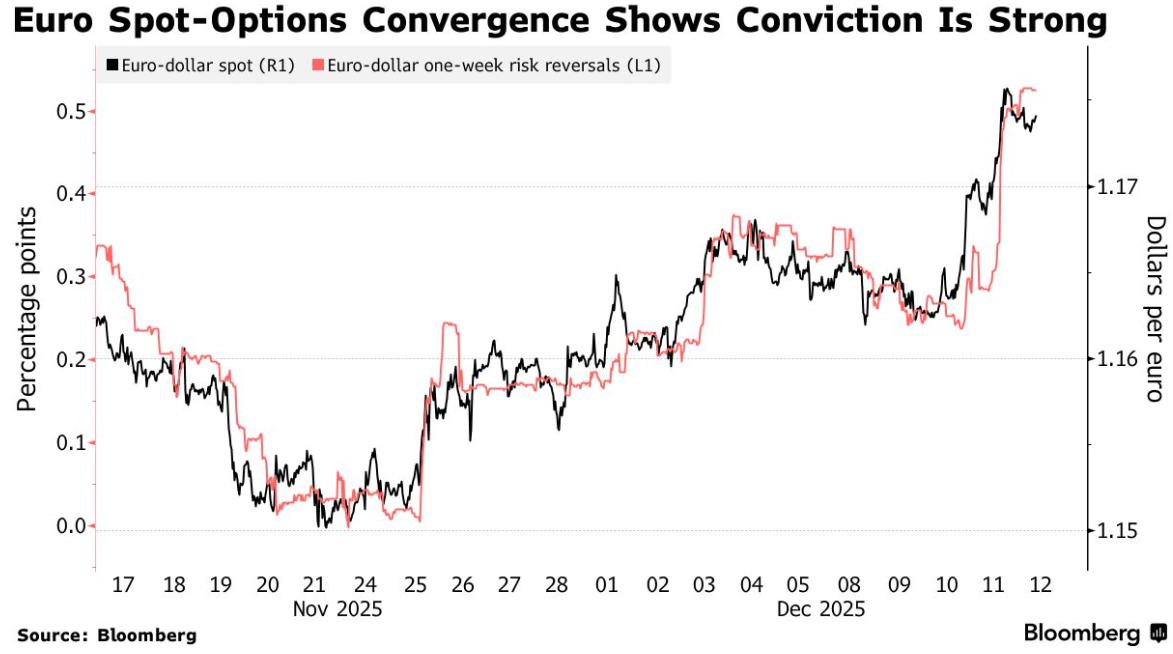
Group 1 - The core viewpoint indicates that options traders expect the euro's upward momentum to gain new strength next week due to the European Central Bank's (ECB) interest rate decision, which is anticipated to highlight the policy divergence with the Federal Reserve [1] - According to the Depository Trust & Clearing Corporation (DTCC), the most active strike price this month is at 1.18 USD per euro, with a significant portion of the underlying value concentrated in contracts expiring around the ECB's decision window on December 18-19 [1] - The euro is hovering near a two-month high following the Federal Reserve's third consecutive rate cut and hawkish comments from ECB Executive Board member Isabel Schnabel, with the options sentiment for the ECB's December decision being the most bullish in three months [1] Group 2 - The cost of buying volatility ahead of the decision is the highest in three months, attributed to Schnabel's remarks, and Morgan Stanley strategists expect the euro to rise to 1.30 USD by the second quarter of 2026, even if the ECB does not raise rates next year [4] - Hedge funds are identified as the main drivers of the bullish price action for the euro this week, actively purchasing both vanilla and exotic options that will profit from a strengthening euro [4]

市场风声鹤唳?基金经理Q4集体“踩刹车”,紧盯三大风险
Jin Shi Shu Ju· 2025-10-24 09:30
Group 1 - Fund managers are adopting a cautious stance, reducing exposure to risk assets and favoring low-volatility defensive investments as the fourth quarter begins [2] - Concerns about private credit markets have intensified following the bankruptcies of Tricolor and First Brands, leading to fears of credit issues spreading to other markets [2][3] - The potential for stagflation is being closely monitored, with tariffs and political interventions raising concerns about unexpected inflation increases in the U.S. [3][4] Group 2 - The credibility of the Federal Reserve is under scrutiny due to political pressures, which could impact its ability to manage inflation effectively [4][5] - Divergence in global central bank policies is seen as both a challenge and an opportunity, with significant internal volatility across various asset classes [5][6] - The European Central Bank is expected to maintain interest rates in October, with a more optimistic growth forecast for 2025 driven by stable growth in member countries [5][6]
Ultima Markets欧元/美元价格预测:进一步上涨似乎很可能
Sou Hu Cai Jing· 2025-07-24 08:51
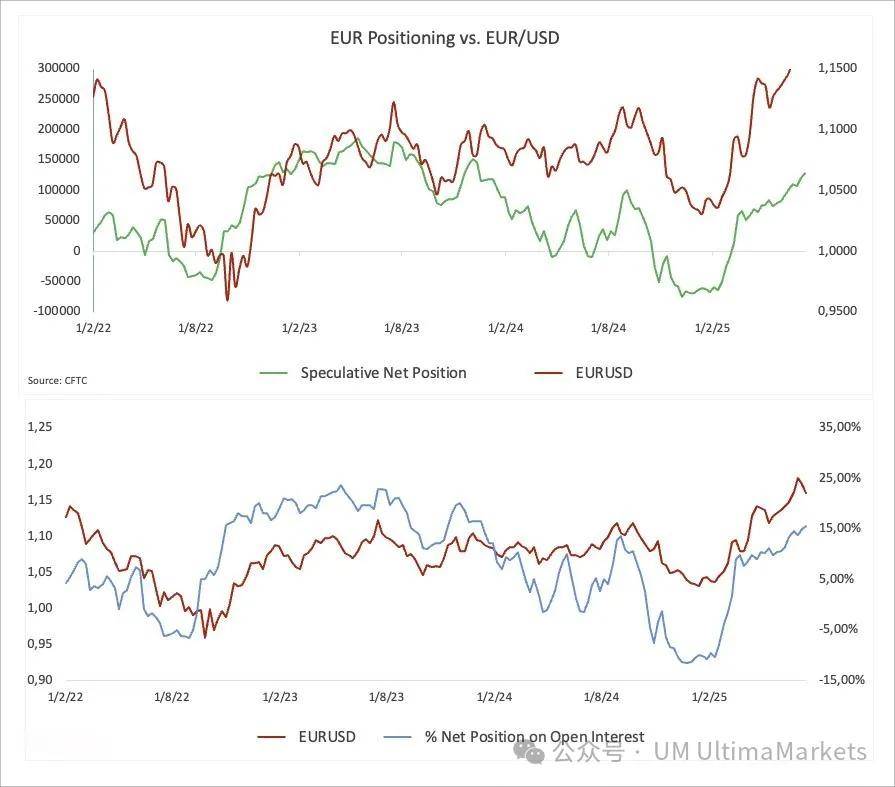
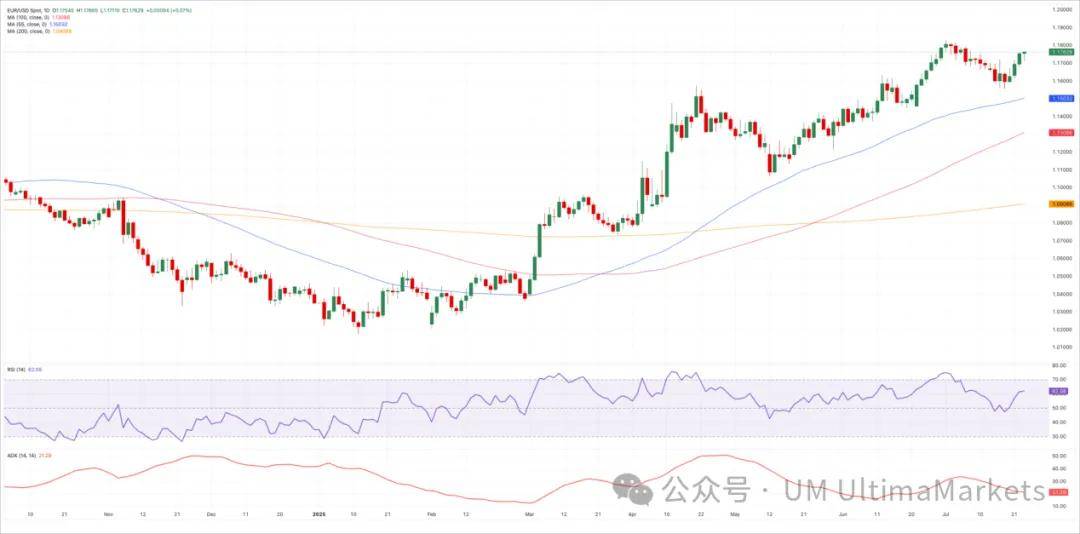
Core Insights - The Euro/USD has risen to a two-week high, approaching 1.1770 amid volatile trading conditions [2] - Improved trade sentiment has led to a slight retreat of the US dollar [3] - The European Central Bank (ECB) is expected to maintain interest rates during its upcoming meeting [4][10] Trade and Economic Sentiment - The slight increase in the Euro reflects a mild pullback in the Dollar Index (DXY), driven by improved trade prospects [5] - Recent US-Japan trade agreements have provided some relief to global markets, while potential US-EU agreements are boosting risk sentiment [7] - The ECB's cautious stance is influenced by external demand signals, with a recent cut in deposit rates to 2.00% [9] Market Positioning - As of July 15, speculators have increased their long positions in the Euro to approximately 128.2K contracts, the largest bet since December 2023 [11] - Conversely, commercial participants have expanded their short positions to nearly 184.2K contracts, marking the largest hedge in months [11] Technical Analysis - A breakthrough above the 2025 high of 1.1830 could pave the way for testing the June 2018 high of 1.1852 [12] - Conversely, a drop below the July low of 1.1556 may lead the currency pair towards the transitional 55-day SMA of 1.1501 [13] Momentum Indicators - Momentum has improved but remains unstable, with the Relative Strength Index (RSI) exceeding 62 and the Average Directional Index (ADX) around 22 [14] Influencing Factors - The Euro's rebound occurs against a backdrop of tariff tensions and widening policy gaps between the Federal Reserve and the ECB [17]
欧元/美元价格预测:短期内可能出现进一步波动交易
Sou Hu Cai Jing· 2025-07-22 09:55
Core Viewpoint - The Euro/USD pair continues to rise, breaking the 1.1700 level, driven by recent positive sentiment towards the Euro amidst trade tensions affecting the US dollar [1][2]. Group 1: Trade Tensions - Ongoing trade instability has put selling pressure on the US dollar, with the market closely watching upcoming speeches from Jerome Powell and the European Central Bank (ECB) [2]. - The worsening trade situation has led to concerns over global trade conflicts, with potential tariffs on European exports and imports from Japan and South Korea, prompting investors to seek safety in the dollar [3]. - The EU is considering broad "counter-coercion" measures in response to US tariffs, which could target US services or limit access to public tenders if no agreement is reached by the August 1 deadline [3]. Group 2: Central Bank Divergence - The minutes from the June Federal Reserve meeting revealed a split among committee members regarding immediate rate cuts, with some advocating for caution until the inflation impact of new tariffs is clearer [4]. - The rise in US consumer prices in June has reinforced Powell's cautious stance, while the ECB has lowered its deposit rate and indicated that new stimulus measures will depend on clearer signs of weak external demand [5]. Group 3: Market Positioning - As of July 15, speculators have increased bullish bets on the Euro, raising net long positions to approximately 128.2K contracts, the highest level since December 2023 [6]. - Commercial traders have increased their net short positions to about 184.2K contracts, marking the highest level in several months, with open interest rising for the fourth consecutive week to over 820K contracts, the highest since March 2023 [6]. Group 4: Technical Analysis - For the Euro/USD to continue its upward trajectory, it needs to break above the July 1 high of 1.1830, targeting the peak of 1.1852 from June 2018 [8]. - Conversely, a drop below the July low of 1.1556 could lead to a decline towards the transitional 55-day moving average of 1.1485, followed by the weekly low of 1.1210 from May 29, and ultimately the psychologically significant level of 1.1000 [8]. Group 5: Momentum Indicators - Current momentum indicators show a moderate trend, with the Relative Strength Index (RSI) rising close to 57, while the Average Directional Index (ADX) remains around 22, indicating a lack of strong confidence in the current trend [9]. Group 6: Considerations - The uncertainty surrounding US tariff policies, combined with the growing divergence between the Federal Reserve and ECB policies, suggests that the Euro may face challenges in regaining its previous strength [12].