锂电材料

Search documents
投资大家谈 | 9月鹏华基金基本面投资专家观点启示录
Sou Hu Cai Jing· 2025-09-14 11:39
Group 1 - The A-share market is experiencing a divergence in sentiment, with optimism for technological innovation and concerns about market volatility [1] - The macroeconomic environment in China is showing signs of recovery, with expectations for a gradual economic rebound and a potential end to deflationary pressures [4][5] - The AI and robotics sectors are highlighted as key areas for investment, with a global resonance in the AI industry cycle expected to create significant market opportunities [5][8] Group 2 - The government has introduced supportive policies for the AI industry, establishing a long-term development direction, making technology the primary investment theme in the A-share market [8] - Investment opportunities in the AI sector are categorized into four segments: overseas computing power, domestic computing power, edge AI hardware, and AI application software, each with different investment dynamics [8][9] - The domestic computing power segment is particularly promising, focusing on AI-GPU and AI-ASIC chips, which are expected to see significant value growth [9] Group 3 - The basic chemical industry is viewed positively, especially in the agricultural and fine chemical sectors, with signs of fundamental improvement and a shift towards larger market capitalizations [12][13] - The current market cycle is characterized as a "Kondratiev depression," suggesting a potential bull market for gold and a new technological revolution [12][13] Group 4 - The bond market is currently in a phase of adjustment rather than reversal, with potential buying opportunities expected later in the year [15][16] - The bond market's weakness is attributed to risk appetite and the low absolute yield of bonds, with a focus on maintaining a defensive position in the portfolio [19] Group 5 - The Hong Kong stock market, particularly the consumer sector, is expected to provide excess returns due to increased policy support and liquidity [23][24] - New consumer brands are creating differentiated products that meet emerging demands, contributing to strong growth in the consumer sector [24] Group 6 - The market is transitioning from passive destocking to active restocking, with expectations for external demand recovery supported by anticipated interest rate cuts in the U.S. [26] - The technology sector and industries benefiting from anti-involution policies are recommended for continued focus, including solar energy, lithium battery materials, and chemical manufacturing [26] Group 7 - The market is expected to experience structural fluctuations and overall volatility, but the long-term upward trend remains intact [30][31] - Investors are advised to adjust their portfolios rather than reduce positions in response to market volatility, focusing on high-risk-reward opportunities [31] Group 8 - The current bull market is believed to be just beginning, driven by the certainty of the AI era and the emergence of new economic engines in China [32] - Asset allocation strategies should favor new productive forces while reducing exposure to traditional economies [32]


穿透监管红线下的资本突围,华友钴业溢价143%高位变现BCM股权,换来准入美国市场门票
Hua Xia Shi Bao· 2025-09-14 04:00
Core Viewpoint - The article discusses the strategic shift of Chinese lithium battery material companies, particularly Huayou Cobalt, in response to U.S. policies aimed at reducing reliance on Chinese manufacturing in the renewable energy sector [2][6]. Group 1: Transaction Details - Huayou Cobalt announced the transfer of 25% of its stake in LG-HYBCM, Co., Ltd. (BCM) to Toyota Tsusho for a total of $121 million, equivalent to approximately 861 million RMB [2]. - The transaction is expected to yield an investment return of about 472 million RMB for Huayou Cobalt [2]. - The sale is part of Huayou's strategy to comply with the U.S. "One Big Beautiful Bill Act" and the EU's Critical Raw Materials Act, which impose restrictions on battery material imports [2][6]. Group 2: Historical Context and Partnerships - Huayou Cobalt has been collaborating with LG since 2018, establishing a long-term strategic partnership that includes joint ventures in lithium battery materials [4]. - The partnership has expanded from cathode materials to upstream resources, with Huayou participating in the K Battery Alliance led by LG in Indonesia [4]. - The joint venture BCM is set to produce high-quality ternary cathode materials, with a planned annual capacity of 66,000 tons starting in 2024 [4]. Group 3: Financial Implications - The book value of Huayou's 49% stake in BCM was 694 million RMB as of August, while the sale price reflects a premium of 143.28% [5]. - Post-transaction, the ownership structure of BCM will be 51% by LG Chem, 25% by Toyota Tsusho, and 24% by Huayou Cobalt, transitioning from a Sino-Korean joint venture to a Sino-Japanese-Korean partnership [5]. - Despite the reduction in ownership, Huayou's resource supply and smelting advantages remain critical in the value chain [5]. Group 4: Market Dynamics and Strategic Adjustments - The transaction reflects a broader trend of Chinese companies adapting to increasing geopolitical pressures and trade barriers, particularly from the U.S. [6][9]. - Huayou's international revenue share has shifted from 30% to 60% over recent years, indicating a growing reliance on overseas markets [7]. - The company aims to leverage its partnerships to enhance market access and customer loyalty, particularly in Japan and Southeast Asia [8]. Group 5: Future Outlook - The entry of Toyota Tsusho is expected to enhance BCM's strategic position within the global automotive supply chain and improve customer trust [5][8]. - Huayou Cobalt's future strategy will focus on optimizing its resource, technology, and capital alliances to capture a larger market share in the growing demand for electric vehicles [8][9]. - The company faces challenges in maintaining influence over BCM's operations and profitability due to the reduced stake, which could impact its decision-making power in the joint venture [9].

天华新能:9月12日召开董事会会议
Mei Ri Jing Ji Xin Wen· 2025-09-12 11:26
Group 1 - The core viewpoint of the article highlights that Tianhua New Energy (SZ 300390) held its 27th meeting of the sixth board of directors on September 12, 2025, where it reviewed the proposal for the third extraordinary general meeting of shareholders in 2025 [1] - For the first half of 2025, Tianhua New Energy's revenue composition was 88.08% from the lithium battery materials industry and 11.92% from other businesses [1] - As of the report date, Tianhua New Energy's market capitalization was 19 billion yuan [1]

2025H1锂电财报点评:新周期有望开启,关注固态电池等新技术
Minmetals Securities· 2025-09-12 03:20
Investment Rating - The investment rating for the electric equipment industry is optimistic [2] Core Insights - The lithium battery materials industry is expected to enter a new cycle as the profitability low point may have been surpassed, driven by demand growth in energy storage and other sectors [6][10] - The report highlights significant improvements in profitability, cash flow, and capital expenditure across the lithium battery materials sector [9][10] Summary by Sections Supply Side Analysis - The industry's net profit growth rate for Q2 2025 is +27% year-on-year, marking two consecutive quarters of positive growth, indicating a marginal improvement in profitability [5][13] - Capital expenditure has shown continuous growth for two consecutive quarters since Q1 2025, particularly in the battery sector [5] - Cash flow turned positive for the first time in Q2 2025, with a year-on-year growth rate of +22% [20][23] - The current inventory level is deemed reasonable, with a positive year-on-year growth rate in inventory/total assets for three consecutive quarters since Q4 2024 [5][37] Demand Side Analysis - From January to July 2025, the cumulative sales of power and other batteries in China reached 786.2 GWh, reflecting a year-on-year growth of 60.6% [5] - The report anticipates continued demand growth as the economic viability of energy storage reaches a turning point [5] Market Opportunities - The report suggests focusing on opportunities within the lithium battery sector, particularly: 1. Battery sector: Favorable market structure, with energy storage batteries being more advantageous [5] 2. Solid-state industry: Key areas include equipment and solid-state electrolytes, with the establishment of solid-state battery production lines expected to boost equipment manufacturers' shipments [5] 3. Anode sector: With the reduction in costs for silicon-carbon anodes, attention is drawn to their increasing penetration in the consumer battery market [5] Financial Performance - The report provides detailed performance metrics for various segments within the lithium battery materials industry, indicating a mixed performance across different sectors [41][42][44]

中伟股份:锚定四氧化三钴全球领先优势 共赴钴酸锂产业链增长红利
Zheng Quan Ri Bao· 2025-09-10 13:13
Group 1 - The core viewpoint of the articles highlights a significant surge in cobalt prices in 2025, driven by the demand for lithium cobalt oxide materials due to the upgrade in consumer electronics and the rise of AI devices, with prices increasing from 164,000 CNY/ton in January to 265,000 CNY/ton by August, marking a rise of over 60% [2] - Xiamen Tungsten New Energy Materials Co., Ltd. achieved a lithium cobalt oxide shipment volume of 28,800 tons in the first half of 2025, reflecting a year-on-year increase of 57% and capturing over 50% of the global market share [2] - The supply side remains tight, particularly due to the Democratic Republic of the Congo's (DRC) export restrictions, which could significantly impact global cobalt supply, as the DRC accounts for over 75% of global cobalt supply [3] Group 2 - The demand for cobalt is expected to continue growing, with projections indicating that global cobalt demand will reach approximately 222,000 tons in 2024, a year-on-year increase of 13.7%, and domestic cobalt lithium battery production is expected to grow by 23% in the first half of 2025 [3] - The close relationship between lithium cobalt oxide and cobalt tetraoxide enhances the collaborative effect within the industry chain, with Zhongwei New Materials Co., Ltd. leading the market with a nearly 30% share in cobalt tetraoxide [4] - The competitive advantage of leading companies is reinforced by their ability to pass on raw material price increases to downstream customers and their effective inventory management, which allows them to benefit from rising cobalt prices [5]
瑞泰新材取消监事会,原监事长郭军任副总裁回归核心,高管薪酬朱晓新280万最高
Xin Lang Cai Jing· 2025-09-10 11:43
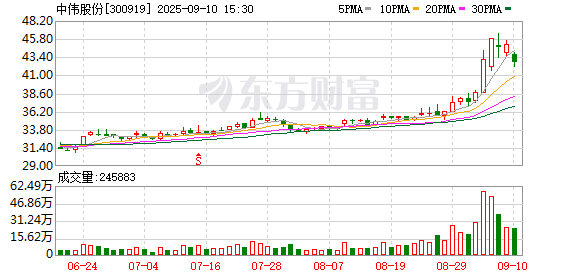
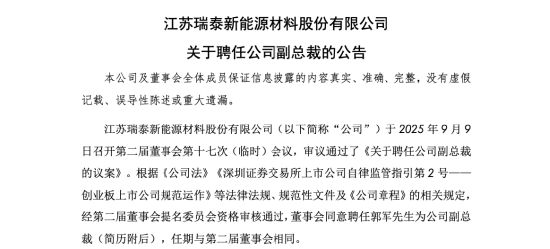
Group 1 - The core point of the article is the significant personnel changes at Ruitai New Materials, including the appointment of Guo Jun as Vice President and the cancellation of the Supervisory Board, indicating a major adjustment in the company's governance structure [1][2] - Guo Jun, who previously served as Executive Vice President from 2017 to 2020, has a strong background in key industry companies, which may enhance the company's management stability during a challenging performance period [1][2] - The company reported a revenue of 975 million yuan for the first half of 2025, a year-on-year decrease of 7.36%, and a net profit attributable to shareholders of 82 million yuan, down 24.19% year-on-year [1][2] Group 2 - RuTai New Materials' stock price closed at 22.67 yuan per share on September 10, 2025, reflecting a year-to-date increase of 45.60%, with a total market capitalization of 16.625 billion yuan [2] - The company has three Vice Presidents, with Guo Jun, Wang Xiaobin, and Wang Yiming forming the core management team, while the highest-paid executive is Assistant President Zhu Xiaoxin, earning 2.8 million yuan annually [2]
瑞泰新材取消监事会,原监事长郭军任副总裁回归核心,去年薪酬160万是朱晓新的六成
Xin Lang Zheng Quan· 2025-09-10 11:16
炒股就看金麒麟分析师研报,权威,专业,及时,全面,助您挖掘潜力主题机会! 文/新浪财经上海站时行工作室 郭军曾于2017年至2020年担任瑞泰新材常务副总裁,彼时即是公司管理层核心人物。其职业履历跨越江 苏国泰、华荣化工、锂宝新材、超威新材等多家产业链关键企业,在锂电材料、进出口贸易及化工领域 积累了深厚经验。 2024年报显示,郭军仍兼任江苏国泰监事、超威新材董事长、广州锂宝监事等多个职务,并持有江苏国 泰73000股股份及3500张可转债。尽管并未直接持有瑞泰新材股份,但其产业与资本纽带深植其中。 值得注意的是,此番人事变动并非简单的岗位轮换,而是伴随着公司治理结构的重大调整——根据2025 年第二次临时股东大会审议通过的议案,公司监事会已被正式取消,郭军亦随之完成从监事会主席向高 管层的身份转换。 郭军的回归并非新人事,而是老面孔再度走向台前。 瑞泰新材(301238.SZ)的人事版图再度迎来关键调整。9月9日,公司公告披露,监事会主席郭军正式 被聘任为公司副总裁。 | | | | | | | | | - 1 - | | --- | --- | --- | --- | --- | --- | --- | ...
六氟磷酸锂的近况更新及未来展望
2025-09-08 04:11
Summary of Lithium Hexafluorophosphate Conference Call Industry Overview - The lithium hexafluorophosphate market is experiencing tight supply and demand, with leading manufacturers operating at full capacity and gradually depleting inventory, leading to price increases to 58,000 CNY/ton [1][3][27] - The global battery production is expected to reach approximately 10,095 GWh in 2025, indicating a balance between demand and supply [1][4] - The lithium hexafluorophosphate industry has a high concentration, with the top three companies holding over 60% market share [1][6] Key Insights and Arguments - **Price Trends**: Prices for lithium hexafluorophosphate have risen significantly from around 55,000 CNY/ton to 58,000 CNY/ton, with some quotes nearing 60,000 CNY/ton due to tight supply-demand dynamics and increased processing fees [3][11][27] - **Future Projections**: Prices are expected to reach 70,000 to 80,000 CNY/ton by 2026, with leading companies potentially achieving net profits of 20,000 to 30,000 CNY per ton [1][12][28] - **Market Dynamics**: The market is anticipated to remain in a tight balance in October and November 2025, with potential shortages leading to further price increases [1][10][19] Production and Capacity - Leading manufacturers have minimal inventory, with some maintaining only 1-2 weeks' worth of stock [1][7][8] - Companies like Yongtai are not planning to activate their idle capacity of 10,000 tons, maintaining their 8,000-ton production line at full capacity [9][13] - The production capacity of companies like Shilei is fully utilized, with no immediate plans for expansion due to long construction cycles [15][17] Supply Chain and Market Impact - The supply chain for lithium hexafluorophosphate is expected to face upward pressure on prices, particularly in the midstream lithium battery and cell segments [2][25] - The quarterly bidding process by companies like BYD may influence market prices, as the overall bidding situation shows a trend of rising material costs [19][20] Additional Considerations - The industry is witnessing a trend where smaller manufacturers may struggle to survive due to price control strategies by larger firms, potentially leading to market consolidation [23] - Idle production capacities require significant time for adjustment and ramp-up, which may delay their contribution to market supply even if prices rise [14][22] Conclusion - The lithium hexafluorophosphate market is characterized by high demand, tight supply, and significant price increases, with leading companies well-positioned to capitalize on these trends while smaller players may face challenges in maintaining competitiveness.
57家材料及矿产企业H1业绩出炉:锂弱钴强,正负极/电解液/隔膜各有沉浮
高工锂电· 2025-09-05 08:55
Core Viewpoint - The article highlights the significant differentiation in performance among various sectors of the lithium battery supply chain in the first half of 2025, with notable trends in mineral resources, cathode materials, anode materials, electrolyte, and separator industries. Mineral Resources - The lithium market is experiencing a "weak lithium, strong cobalt" phenomenon, where lithium companies face dual pressures from capacity release and price declines, leading to revenue and profit impacts [2][4][6] - In contrast, cobalt companies benefit from supply-side policy changes and rising cobalt prices, resulting in improved performance for some, although others still face challenges from upstream and downstream price fluctuations [7] Cathode Materials - The cathode materials sector shows a clear divergence between lithium iron phosphate (LFP) and ternary materials, with LFP experiencing significant shipment growth but limited profit growth due to increased competition and cost fluctuations [8][10] - Ternary materials see a recovery in shipments driven by export increases and demand for power batteries, yet face declining market share and revenue pressures [11] Anode Materials - The anode materials sector performs well overall, with significant demand growth driven by policies and market recovery, leading to increased shipments and revenue for most companies [13][14] - However, some companies struggle due to operational issues, highlighting a trend towards industry concentration and product premiumization [15] Electrolyte - The electrolyte industry exhibits a bifurcation between leading companies and smaller firms, with top companies achieving revenue and profit growth due to their competitive advantages [17][19] - Price declines in lithium salts and competitive pressures have led to challenges for smaller firms, with some experiencing significant profit declines [20][21] Separators - The separator industry shows a trend of revenue growth but profit declines, as increased competition and cost pressures impact net profits despite rising shipment volumes [23][24] - The growth in demand for wet separators is driven by changes in downstream demand structures, yet many companies face profitability challenges as the industry moves towards average profit levels [26]
6F率先迎涨价拐点,锂电供需逆转中
高工锂电· 2025-09-05 08:55
Core Viewpoint - Substantial demand growth is the direct driver of the current price increase in lithium hexafluorophosphate (6F) [2] Supply Side - The price of 6F has entered a rising cycle, with recent spot quotes reaching 58,500 yuan/ton, rebounding over 8,500 yuan/ton from mid-year lows [3] - The current monthly effective production capacity in the industry is approximately 24,500 tons, while September demand is expected to exceed 23,000 tons, indicating a tight supply-demand balance [6] - Major companies account for over 70% of the production, and the price rebound is not solely driven by lithium carbonate, as the actual price increase of 6F has exceeded the cost increment of 3,000-5,000 yuan/ton associated with lithium carbonate [6] - Limited expansion in supply is noted, with leading companies operating at over 80% capacity utilization, and some second and third-tier companies facing significant losses and low willingness to restart operations [9] - If high-cost production capacity does not resume, there remains a potential upward space of 5,000 yuan/ton for 6F processing fees [9] Demand Side - The explosive growth in energy storage demand is a key factor driving the price increase, with domestic and international energy storage cell production reaching historical highs since July [7] - Major manufacturers are operating at full capacity, and medium-sized integrators are experiencing slight increases in procurement prices for energy storage cells, indicating a transmission of price increases [7] - As the fourth quarter approaches, both domestic and overseas automotive companies are expected to ramp up orders, further boosting demand for lithium materials and 6F [7] - Industry estimates suggest that demand for energy storage and power batteries will maintain over 20% growth through 2025, providing long-term support for 6F [7] Future Outlook - The supply of 6F is expected to enter a tight balance, with a projected supply gap emerging by Q4 2026, potentially leading to stronger price elasticity for 6F [10]