零售业

Search documents
毕马威:2025年第四季度中国经济观察报告
Sou Hu Cai Jing· 2025-11-21 00:32
Core Economic Performance - In the first three quarters of 2025, China's GDP grew by 5.2% year-on-year, exceeding the previous year's growth by 0.4 percentage points, indicating good progress towards the annual target of around 5% [12][24] - However, the growth rate showed a "front-high and back-low" trend, with the third quarter's growth slowing to 4.8% due to the impact of "anti-involution" policies [12][24] Consumption - Retail sales of consumer goods increased by 4.5% year-on-year in the first three quarters, but the growth rate slowed to 3.5% in the third quarter, primarily due to the diminishing effect of the old-for-new policy and a continuous slowdown in residents' income growth [15][24] - Service consumption remained resilient, with a 5.2% year-on-year increase in the first three quarters, outperforming goods retail growth of 4.6% [15][24] Investment - Fixed asset investment decreased by 0.5% year-on-year in the first three quarters, with a significant drop to -6.2% in the third quarter, driven by weak performance in real estate, infrastructure, and manufacturing investments [16][24] - Real estate investment saw a decline from -12.1% in the second quarter to -19.2% in the third quarter, remaining the largest drag on fixed asset investment growth [16][24] Export - Exports grew by 6.1% year-on-year in the first three quarters, with a slight increase to 6.5% in the third quarter, supported by non-US markets and key products like integrated circuits, electric vehicles, and lithium batteries [17][24] - The easing of US-China trade tensions, including a 10% reduction in average tariffs on Chinese goods, is expected to positively impact foreign trade performance and business expectations in the fourth quarter [25][24] Policy and External Environment - Domestic policies are focused on stabilizing demand, with fiscal measures including the issuance of 500 billion yuan in policy financial tools and an additional 500 billion yuan in local government debt quotas to support project construction and debt repayment [12][24] - Monetary policy has resumed bond purchase operations, emphasizing the use of structural tools to support the economy [20][24] Outlook for Q4 - Economic recovery is anticipated in the fourth quarter, supported by coordinated policy efforts and resilient export performance, making it likely to achieve the annual growth target of around 5% [4][25] - However, potential pressures from high base effects, insufficient internal consumption momentum, and high real estate inventory levels should be monitored [5][24]

大商股份筹划赴港IPO
Shen Zhen Shang Bao· 2025-11-20 23:30
大商股份在公告中表示,为提升公司国际化品牌形象,同时打造多元化资本运作平台,增强公司的境外 融资能力,进一步提升公司核心竞争力,公司拟在境外发行股份(H股)并在港交所主板挂牌上市,公 司董事会授权公司管理层启动本次H股上市的前期筹备工作。 【深圳商报讯】(记者 钟国斌)大商股份(600694)11月19日公告称,公司11月18日召开第十二届董 事会第五次会议,审议通过了授权公司管理层启动公司H股发行相关筹备工作的议案。 截至目前,公司正积极与相关中介机构就本次H股上市的相关工作进行筹备、商讨,关于本次H股上市 的细节尚未确定。本次H股上市能否通过审议、备案和审核程序并最终实施具有重大不确定性。 大商股份成立于1992年,母公司大商集团是国内最大的零售业集团之一。 ...

50 万张机票退订背后:中国退单戳破日本旅游泡沫
Xin Jing Bao· 2025-11-20 09:45
50万张赴日机票一朝退空,春节订单腰斩、零售股跌停——日方一句错话,让7.5%GDP依赖旅游、四 成消费靠中国游客的日本再遭"速冻"。政治挑衅,经济买单,合作共赢才是解药。 ...
高市早苗的闹剧,让日本经济先中了“回旋镖”
Xin Jing Bao· 2025-11-20 08:17
Core Viewpoint - The recent economic turmoil in Japan, marked by a 1.8% annualized decline in GDP for Q3, is attributed to a combination of internal economic stagnation and external geopolitical tensions, particularly involving China [1][6]. Economic Performance - Japan's Q3 GDP contracted by 1.8%, marking the first decline in six quarters [1]. - The Nikkei 225 index fell by 3.22%, and the yen depreciated to 155.38 against the dollar, the lowest since January [1]. - The 30-year government bond yield rose to 3.28%, the highest level since 1999 [1]. Market Reactions - The Japanese financial market experienced a "triple kill" in stocks, bonds, and currency, leading to significant sell-offs [1]. - The Tokyo stock market indices fell for four consecutive trading days, with a cumulative drop of over 2700 points [1]. Geopolitical Factors - The tensions between Japan and China, exacerbated by Prime Minister Kishi's provocative statements, have led to increased market volatility and investor caution [1][4]. - Japan's reliance on China for imports is significant, with over 50% of certain product categories sourced from China [4]. Investment Climate - The ongoing depreciation of the yen is seen as a result of high fiscal stimulus and military expansion policies under Kishi, which are viewed as contradictory and unsustainable [3]. - International investors have been shorting the yen, taking advantage of the interest rate differentials between Japan and the U.S. [2]. Economic Dependencies - Chinese tourists are crucial to Japan's economy, contributing approximately 30% to tourism revenue; a decline in their visits could significantly impact GDP [5]. - Japan's economic structure is heavily reliant on imports from China, with critical goods such as electronics and fertilizers being predominantly sourced from there [4]. Risk Mitigation - Analysts suggest that Kishi should retract her controversial statements to mitigate economic risks and stabilize market conditions [6]. - The potential for further economic decline in Japan is anticipated in Q4 due to existing structural issues and geopolitical uncertainties [6].
【环时深度】高市涉台挑衅言论引火烧身
Huan Qiu Shi Bao· 2025-11-19 22:44
Economic Impact - Japan's economy is facing potential recession due to deteriorating relations with China, which is Japan's largest trading partner [4][6][7] - The tourism sector is particularly vulnerable, with reports of significant cancellations from Chinese tourists leading to losses of approximately 20 to 30 million yen [4][6] - The retail sector is also at risk, as Chinese customers account for 60% of sales in certain duty-free stores, prompting businesses to closely monitor the situation [4][5] Stock Market Reaction - The Japanese stock market has reacted negatively, with the Nikkei index dropping by 165.28 points to 48,537.70 on November 19 [6] - Concerns over the impact of strained Sino-Japanese relations on foreign investment and corporate valuations are prevalent among investors [6][7] Broader Economic Concerns - The tourism industry contributes approximately 7% to Japan's GDP, making it a critical driver of economic growth [5][6] - Analysts estimate that the current measures taken by China could result in annual losses exceeding $14 billion for Japan [7] Diplomatic Isolation - Japan's recent diplomatic stance has led to increased isolation in the region, with deteriorating relations with neighboring countries such as South Korea and Russia [9][12] - High-profile statements from Japanese officials have raised concerns about a potential resurgence of militarism, which could further alienate Japan from its regional partners [11][12] Future Projections - If the current diplomatic tensions persist, Japan's GDP could be adversely affected, with potential long-term implications for economic stability [6][7] - The ongoing situation may lead to a military buildup in the region, exacerbating tensions and potentially triggering a broader arms race [12][13]
东京股市继续承压下跌
Xin Hua She· 2025-11-19 09:28
Market Performance - The Nikkei 225 index closed down by 0.34%, while the Tokyo Stock Exchange index fell by 0.17% on November 19 [1][2] - The Nikkei index has cumulatively dropped over 2500 points in the previous three trading days [1] Investor Sentiment - There was an increase in bargain-hunting among investors in the early session, leading to a slight opening rise for both indices [1] - Investor sentiment was heavily influenced by the overnight decline of major U.S. stock indices and the upcoming earnings report from Nvidia, resulting in a cautious outlook [1] Sector Performance - Semiconductor-related stocks faced significant pressure, contributing to the overall market's inability to gain momentum [1] - Among the 33 industry sectors on the Tokyo Stock Exchange, sectors such as machinery, metal products, fisheries, and agriculture saw notable declines, while oil and coal products, retail, and real estate sectors led the gains [2] Company-Specific Concerns - Concerns regarding deteriorating Sino-Japanese relations continued to impact the market, particularly affecting companies like Shiseido, Sushi Row, Sony Group, and Sanrio, which are linked to the Chinese market [1] - Analysts indicated that the uncertain performance outlook for these companies may lead investors to avoid their stocks [1]
广百股份(002187.SZ):公司暂无重组计划
Ge Long Hui· 2025-11-19 08:57
格隆汇11月19日丨广百股份(002187.SZ)在投资者互动平台表示,公司暂无重组计划。 ...

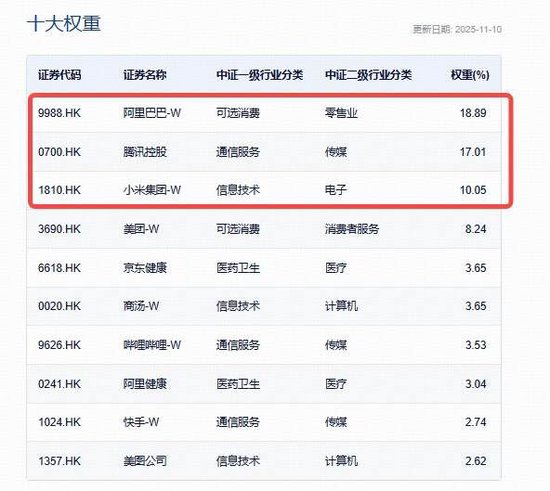
港股AI走势分化,小米集团绩后重挫3%,阿里巴巴涨超2%!百亿港股互联网ETF(513770)半年线下方溢价揽筹
Sou Hu Cai Jing· 2025-11-19 03:55
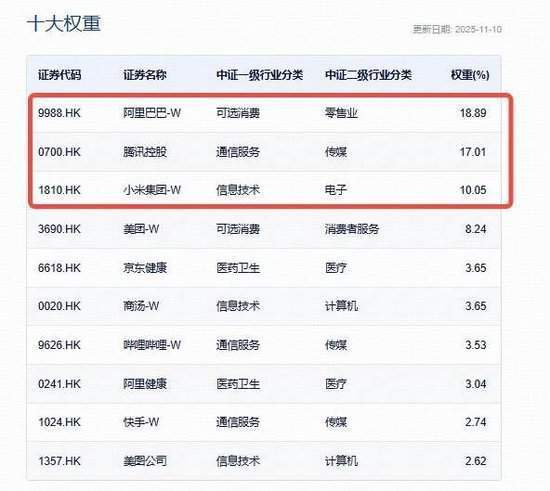
Group 1 - The core viewpoint of the articles highlights the strong performance of major Chinese tech companies, particularly in the AI sector, with significant revenue growth and market interest [1][2] - Alibaba's "Qianwen" app has gained popularity, ranking fifth in the Apple App Store's free applications shortly after its public beta launch, indicating strong user engagement and future potential for integration of various services [1] - Xiaomi Group reported impressive Q3 results with a revenue of 113.1 billion yuan, a year-on-year increase of 22.3%, and an adjusted net profit of 11.3 billion yuan, marking an 80.9% increase, showcasing the company's growth trajectory [1] Group 2 - The Chinese AI sector is expected to experience significant performance elasticity and potential, particularly in application areas that are rapidly developing, as noted by Citic Securities [2] - Minsheng Securities expresses optimism about the revaluation of Chinese AI companies, especially those with synergistic advantages in computing resources, model capabilities, and application scenarios, such as Tencent, Kuaishou, Alibaba, and Xiaomi [2] - The Hong Kong Internet ETF (513770) tracks the CSI Hong Kong Internet Index, which heavily weights leading internet companies, with Alibaba, Tencent, and Xiaomi being the top three holdings, collectively accounting for over 45% of the index [2][4] Group 3 - The valuation of the Hong Kong Internet sector remains low, with the CSI Hong Kong Internet Index trading at a PE ratio of 24.44, significantly lower than the NASDAQ-100 and S&P 500, indicating potential for future growth [5] - The Hong Kong Internet ETF has a substantial scale of over 11.6 billion yuan and an average daily trading volume exceeding 600 million yuan, reflecting strong liquidity [5] - The Hong Kong market has shown higher elasticity in the internet sector this year, with the CSI Hong Kong Internet Index outperforming the Hang Seng Technology Index [4][5]

港股AI走势分化,小米绩后重挫3%,阿里涨超2%!百亿港股互联网ETF(513770)半年线下方溢价揽筹
Xin Lang Ji Jin· 2025-11-19 03:13
Core Insights - The Hong Kong stock market showed mixed performance among tech giants, with Alibaba-W rising over 2% and Xiaomi Group-W dropping more than 3% after its earnings report [1] - The Hong Kong Internet ETF (513770) saw a price increase of 0.36%, indicating strong buying interest, with a net inflow of 23.77 million CNY over the last three days and a cumulative net inflow of 1.315 billion CNY over the past 20 days [1] Group 1: Company Performance - Xiaomi Group reported a strong Q3 earnings with revenue reaching 113.1 billion CNY, a year-on-year increase of 22.3%, and an adjusted net profit of 11.3 billion CNY, up 80.9% year-on-year, marking a historical high [2] - The company achieved profitability in its automotive and AI sectors for the first time, with a profit of 700 million CNY in the quarter [2] Group 2: AI and Internet Sector Outlook - The launch of Alibaba's Qianwen app has gained significant traction, ranking fifth in the Apple App Store's free apps category shortly after its public beta [3] - The Hong Kong Internet sector is expected to benefit from the acceleration of AI integration across various applications, with significant potential for growth in domestic AI companies [3] - Citic Securities highlighted the substantial earnings elasticity of domestic AI firms, suggesting that the model and application sectors may experience explosive growth opportunities [3] Group 3: ETF and Index Performance - The Hong Kong Internet ETF (513770) tracks the CSI Hong Kong Internet Index, which heavily weights leading internet companies like Alibaba-W, Tencent Holdings, and Xiaomi Group, accounting for over 73% of the top ten holdings [4] - The index has shown higher elasticity this year, outperforming the Hang Seng Tech Index, with a year-to-date increase of 40.81% compared to 32.23% for the Hang Seng Tech Index [6] - The current price-to-earnings ratio of the Hong Kong Internet Index is 24.44, significantly lower than that of the NASDAQ 100 and the ChiNext Index, indicating a potentially undervalued market [6]
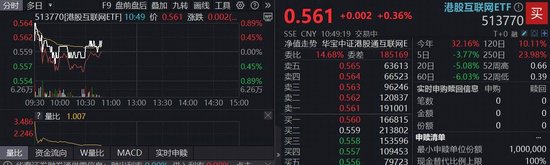
历史新高!小米三季度净利大增80%,汽车首次盈利,百亿港股互联网ETF(513770)近20日揽金13亿元
Xin Lang Ji Jin· 2025-11-19 01:34
Group 1 - Xiaomi Group reported a strong Q3 2025 financial performance with total revenue reaching 113.1 billion RMB, a year-on-year increase of 22.3%, marking the fourth consecutive quarter of exceeding 100 billion RMB [1] - Adjusted net profit for the quarter was 11.3 billion RMB, a significant year-on-year increase of 80.9%, achieving a historical high [1] - The automotive and AI innovation segments showed remarkable growth, with revenue soaring to 29 billion RMB, a year-on-year increase of 199.2%, and achieving operational profit of 700 million RMB for the first time in a single quarter [1] - Research and development investment for the first three quarters totaled 23.5 billion RMB, with a quarterly investment of 9.1 billion RMB, reflecting a year-on-year growth of 52.1% [1] - Morgan Stanley's report highlighted the strong long-term growth potential of Xiaomi's AIoT business as the synergy between smartphones, electric vehicles, and AIoT becomes more apparent [1] Group 2 - As of November 18, Xiaomi Group has seen net buying from southbound funds for 15 consecutive days, with a cumulative net buying amount of 10.66 billion HKD [1] - Guosen Securities indicated that under the dual catalysts of global liquidity easing and the upward cycle of the technology industry, growth styles are expected to become the core configuration theme [1] - The Hong Kong stock growth assets are benefiting from foreign capital inflow and can leverage policy dividends, with significant valuation recovery potential under high growth expectations [1] Group 3 - The Hong Kong Internet ETF (513770) has seen a recent decline due to external market disturbances, with a three-day consecutive net inflow of 23.77 million RMB and a cumulative net inflow of 1.315 billion RMB over the past 20 days [3] - The latest scale of the Hong Kong Internet ETF exceeds 11.3 billion RMB, with an average daily trading volume of over 600 million RMB, indicating good liquidity [5] - The ETF is designed to track the CSI Hong Kong Internet Index, with Xiaomi Group being the third-largest weighted stock at 10.05%, following Alibaba and Tencent [2]