
农产品加工

Search documents
一群农学生的“乡村商业实验”:种小麦卖面包,让农民也“上桌”
Xin Jing Bao· 2026-01-08 01:15
Core Insights - The article discusses a rural business experiment aimed at increasing farmers' income by extending the agricultural value chain, moving from merely producing crops to processing and selling them as higher-value products [1][2][11] Group 1: Agricultural Innovation - The Liu Zhuang Technology Courtyard in Hebei has shifted its focus from just increasing crop yields to enhancing the value of agricultural products through processing, such as turning wheat into flour and then into bread [1][2] - The courtyard has successfully sold over 3,000 bags of high-quality flour and more than 20,000 pieces of bread within six months of implementing this new model [1][12] Group 2: Educational and Community Engagement - Graduate students from agricultural programs across China are participating in this initiative, helping farmers increase both production and income through hands-on involvement [1][2] - The project emphasizes the importance of understanding market dynamics and consumer preferences to ensure that farmers benefit from their produce [11][12] Group 3: Market Challenges and Solutions - Initial attempts to sell flour faced challenges due to lack of market experience, leading to issues such as order confusion and product spoilage [9][10] - Collaboration with the Pinduoduo platform has provided essential support, including sales training and direct market access, which has significantly improved the project's viability [10][12] Group 4: Future Goals and Sustainability - The long-term objective is to create a replicable model that allows farmers to participate in the entire value chain, ensuring they benefit from both production and processing [12] - The courtyard aims to develop a standardized operational manual to facilitate the sharing of successful practices among farmers, promoting sustainable income growth [12]

金融如何助力农业提质和农民增收
Jin Rong Shi Bao· 2026-01-08 01:03
Core Insights - The Central Rural Work Conference held on December 29-30, 2025, in Beijing, analyzed the current challenges in the "three rural issues" and outlined the work for 2026, focusing on improving agricultural quality and increasing farmers' income [1] - Key initiatives include promoting integrated efficiency in agricultural resources, implementing a new round of grain production capacity enhancement actions, and establishing a mechanism to ensure farmers' income from grain production [1] Financial Support for Agriculture - Financial innovation is essential to support high-standard farmland construction, modern seed industry revitalization, advanced agricultural machinery development, and the promotion of green and efficient technologies [1] - A multi-faceted agricultural insurance system is needed to enhance risk management capabilities for grain farmers, focusing on precision insurance and expanding coverage to include both commodity and ecological values [2] Support for County-Level Industries - Financial institutions are encouraged to optimize credit resource allocation in counties, focusing on high-value industries such as agricultural processing, rural tourism, e-commerce, and cold chain logistics [3] - A supply chain finance model involving "core enterprises + cooperatives + farmers" is proposed to ensure farmers' deep participation and sharing of value-added benefits [3] Poverty Alleviation Mechanisms - Financial support for poverty alleviation should transition from "preferential" to "inclusive," maintaining targeted assistance for impoverished populations and underdeveloped regions [4] - A financial monitoring and early warning system for poverty prevention should integrate various data sources from rural digital transformation [4] Support for Agricultural Innovation - Financial support for cutting-edge agricultural technologies like bio-manufacturing, smart agriculture, and digital technologies requires a higher risk tolerance from financial organizations [4] - Innovative financing methods such as equity risk investment and technology loans are suggested to address the financing challenges faced by agricultural innovation enterprises [4] Diversified Food Production - Financial support for diversified food production systems should be tailored to local resources and market characteristics, with specialized financial products designed accordingly [6] - Local governments are encouraged to support the development of local industries and motivate local financial institutions to serve these industries effectively [6]
全国主要农产品加工转化率达到75%
Ren Min Ri Bao· 2026-01-08 01:01
Core Viewpoint - The agricultural and rural sectors in China are making significant progress in promoting high-quality rural industrial development through initiatives focused on local specialties, leading to substantial growth in the agricultural processing industry by 2025 [1] Group 1: Industry Growth and Projections - By 2025, there will be over 100,000 large-scale agricultural processing enterprises in China, with projected revenues of approximately 18 trillion yuan and total profits of about 1.2 trillion yuan, achieving a main agricultural product processing conversion rate of 75% [1] - The Ministry of Agriculture and Rural Affairs is implementing a three-year action plan to promote the development of the agricultural processing industry, supporting the establishment of over 1,600 agricultural processing parks [1] Group 2: Technological Innovation and Enterprise Development - The establishment of key laboratories, technology integration research bases, and R&D sub-centers is being accelerated to enhance technological innovation in agricultural processing [1] - There are currently 98,000 leading enterprises at the county level and above, including 2,250 national leading enterprises, fostering collaboration across the entire industry chain [1] Group 3: Regional Development and Specialization - The development of rural specialty resources is being systematically organized, optimizing industrial structure and regional layout, resulting in the emergence of specialized towns in areas such as specialty planting, breeding, food production, and handicrafts [1] - Over 180 industrial clusters with a production value exceeding 10 billion yuan have been cultivated, along with nearly 100 industrial parks and over 450 strong towns with production values exceeding 1 billion yuan, indicating a significant improvement in the quality and efficiency of rural specialty industries [1]

都市农业强市的活力和蓝图
Zheng Zhou Ri Bao· 2026-01-08 00:59
Core Viewpoint - Zhengzhou is focusing on building a modern agricultural city, emphasizing food security, technological innovation, and industrial upgrading to promote high-quality agricultural development [2][3][9] Group 1: Food Security - Zhengzhou's grain production capacity has steadily improved, maintaining an annual grain output of over 1.5 million tons, with a projected increase to 1.518 million tons in 2024, reflecting a 1.2% annual growth since 2020 [3] - The city has stabilized its grain planting area at approximately 4.46 million acres, ensuring a total grain output of over 2.9 billion pounds [3] - During the 14th Five-Year Plan, the supply of vegetables, fruits, and meat products has remained stable, with annual vegetable production around 2 million tons and meat, egg, and milk production around 250,000 tons [3] Group 2: Technological Empowerment - Zhengzhou is enhancing agricultural support through technology, focusing on smart agriculture, facility agriculture, and efficient agriculture, establishing a collaborative innovation framework [4][5] - The city has seen the widespread application of advanced technologies such as irrigation robots and drones, with over 50 agricultural technology enterprises and several research centers established [5] - The agricultural sales revenue is projected to reach 5 billion yuan in 2024, driven by the implementation of the seed industry revitalization plan [5] Group 3: Agricultural Industry Chain Extension - The Central Plains Modern Food Industry Park is set to boost the pig industry, with an expected annual output of 2.8 million pigs upon full completion [6] - Zhengzhou is promoting agricultural industrialization clusters, enhancing deep processing of agricultural products, and aiming for an agricultural processing output value exceeding 180 billion yuan in 2024 [6][7] - The city is implementing a plan to support the growth of leading agricultural enterprises, targeting the cultivation of over 100 key enterprises by 2030 with a combined revenue exceeding 350 billion yuan [7] Group 4: Strengthening Specialty Agriculture - Zhengzhou is optimizing its agricultural specialty layout, focusing on developing green and organic product brands, with significant contributions from strawberry farming in Zhongmu [8] - The city is promoting rural tourism and integrating agriculture with tourism, with plans to develop over 400 beautiful rural areas and 12 premium leisure tourism routes by the end of 2025 [8][9] - The agricultural development strategy includes creating a vibrant agricultural landscape that supports farmer income and enhances rural living conditions [9]

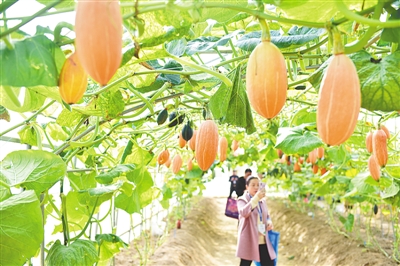
湖北5地入选乡村振兴示范县创建名单 扛起中部地区产业兴农富民惠民大旗
Chang Jiang Shang Bao· 2026-01-08 00:04
Core Viewpoint - The article highlights the successful inclusion of five regions in Hubei Province in the 2025 National Rural Revitalization Demonstration County list, showcasing the province's commitment to agricultural modernization and rural development [1][2][6]. Group 1: National Rural Revitalization Demonstration Counties - On January 6, the Ministry of Agriculture and Rural Affairs announced the inclusion of five areas in Hubei in the 2025 National Rural Revitalization Demonstration County list, contributing to a total of 14 areas since the initiative began in 2022 [1][2]. - The selected regions include Jiangxia District, Zhongxiang City, Wuxue City, Enshi City, and Xiantao City, which are recognized for their efforts in rural revitalization [1][2][6]. Group 2: Economic and Agricultural Development - Hubei aims to accelerate agricultural modernization and rural revitalization during the 14th Five-Year Plan, focusing on food security and poverty alleviation [1][7]. - The agricultural output value in Zhongxiang City is projected to reach 21.36 billion yuan by 2025, with a growth rate of 4%, leading the region [2][3]. - The total output value of the agricultural, forestry, animal husbandry, and fishery sectors in Hubei increased by 3.6% year-on-year in the first three quarters of 2025, maintaining the same growth rate as the first half of the year [7]. Group 3: Specific Initiatives and Projects - Wuxue City plans to invest 18.32 billion yuan in 53 key projects, including 8.675 billion yuan for industrial projects and 3.709 billion yuan for rural construction projects [3]. - Xiantao City has seen a 135% increase in key agricultural operating entities, reaching 7,924, with a total agricultural product processing output value of 39.783 billion yuan [3][4]. - Enshi City has developed a unique agricultural path by leveraging ecological and ethnic resources, with a projected tea production area of 387,000 acres and a total output value exceeding 10 billion yuan by 2025 [4]. Group 4: Strategic Goals and Future Outlook - Hubei's strategy emphasizes the importance of addressing agricultural and rural issues as a priority, aiming for a strong agricultural province and a modernized rural lifestyle [1][5][7]. - The province's goal is to contribute to the national rural revitalization efforts by providing a model for rural development in central China, focusing on industry integration, food security, and ecological sustainability [5][6].
因地制宜做强乡村特色产业
Xin Lang Cai Jing· 2026-01-07 21:21
Group 1 - The core viewpoint emphasizes the importance of rural特色产业 as a powerful engine for farmers' income growth and a crucial support for high-quality county economic development, with a goal to modernize agriculture into a large industry by 2025 [1] - By 2025, it is projected that there will be over 100,000 large-scale agricultural processing enterprises in China, achieving approximately 18 trillion yuan in revenue and 1.2 trillion yuan in profit, with a main agricultural product processing conversion rate reaching 75% [1] - The development of rural特色产业 must adhere to a differentiated approach, leveraging local resources and comparative advantages to avoid homogenization and blind competition [1] Group 2 - Strengthening key agricultural core technology and promoting agricultural new quality productivity through technological innovation is essential for refining rural特色产业 [2] - Focus areas include biological breeding, smart agriculture, and green agriculture, with an emphasis on integrating technology with the entire agricultural value chain [2] - The promotion of green development and the transformation of agricultural development methods are necessary to enhance product quality and meet consumer demand for high-quality agricultural products [2] Group 3 - A full industry chain development mindset is crucial for enhancing rural特色产业, promoting the integration of primary, secondary, and tertiary industries [3] - The strategy involves extending beyond traditional agricultural production to include deep processing of agricultural products and exploring various agricultural functions and values [3] - New business models such as leisure agriculture, rural tourism, and rural e-commerce should be developed to create a modern agricultural industry system [3] Group 4 - Resource aggregation and optimal factor allocation are vital for the development of rural特色产业, addressing current issues like insufficient rural infrastructure and inefficient factor allocation [4] - Infrastructure improvements, including high-standard farmland, rural roads, irrigation systems, and modern cold chain logistics, are necessary to support rural特色产业 [4] - Policies should be optimized to attract quality labor to agriculture and related industries, while also ensuring that farmers benefit from the development of rural特色产业 [4]
农产品加工板块1月7日跌0.73%,京粮控股领跌,主力资金净流出1.82亿元
Zheng Xing Xing Ye Ri Bao· 2026-01-07 08:58
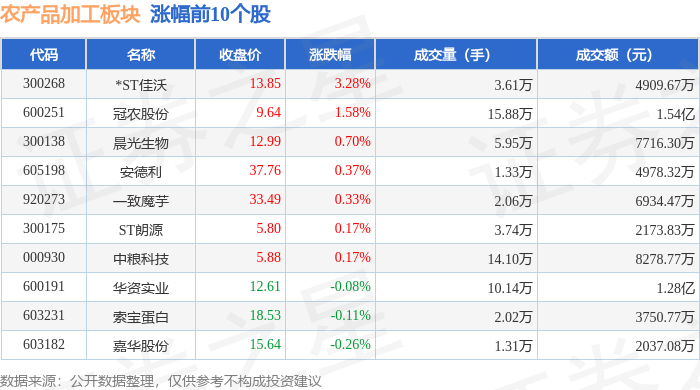
Market Overview - The agricultural processing sector experienced a decline of 0.73% on January 7, with Jingliang Holdings leading the drop [1] - The Shanghai Composite Index closed at 4085.77, up 0.05%, while the Shenzhen Component Index closed at 14030.56, up 0.06% [1] Stock Performance - Notable gainers in the agricultural processing sector included: - *ST Jiawo: Closed at 13.85, up 3.28% with a trading volume of 36,100 shares and a turnover of 49.10 million yuan [1] - Guanyin Co.: Closed at 9.64, up 1.58% with a trading volume of 158,800 shares and a turnover of 154 million yuan [1] - Major decliners included: - Jingliang Holdings: Closed at 7.75, down 2.88% with a trading volume of 469,800 shares and a turnover of 367 million yuan [2] - Guotou Zhonglu: Closed at 20.71, down 2.03% with a trading volume of 75,500 shares and a turnover of 157 million yuan [2] Capital Flow - The agricultural processing sector saw a net outflow of 182 million yuan from institutional investors, while retail investors contributed a net inflow of 127 million yuan [2] - The sector's capital flow indicates a mixed sentiment, with institutional investors withdrawing funds while retail investors increased their positions [2] Individual Stock Capital Flow - Guanyin Co. had a net inflow of 14.21 million yuan from institutional investors, but a net outflow of 3.99 million yuan from speculative funds [3] - *ST Jiawo experienced a net inflow of 3.71 million yuan from institutional investors, while speculative funds saw a net outflow of 4.32 million yuan [3] - Other notable stocks included: - Deep Grain Holdings with a net inflow of 0.89 million yuan from institutional investors [3] - Guangnong Sugar Industry with a net inflow of 0.88 million yuan from speculative funds [3]


2026“媒体+”广东年菜头一炮,粤沪年菜产业联盟成立吹响进军上海前哨
Nan Fang Nong Cun Bao· 2026-01-07 07:01
Core Viewpoint - The establishment of the "Guangdong-Shanghai New Year Dish Industry Alliance" marks a significant step in promoting Guangdong's New Year cuisine in Shanghai and the Yangtze River Delta, leveraging the "media+" strategy to enhance market presence and stimulate the festive economy [5][19][24]. Group 1: Industry Development - The Guangdong New Year dish market is projected to grow from 170.81 billion yuan in 2024 to 262.64 billion yuan in 2026, indicating a strong upward trend in consumer demand [15][16]. - The "media+" initiative aims to integrate media resources with agricultural development, enhancing the quality and marketability of Guangdong's agricultural products [24][27]. - The alliance is expected to facilitate the expansion of Guangdong's New Year dishes into Shanghai, tapping into a mature consumer market with over 20 million residents [34][36]. Group 2: Marketing Strategy - A three-step strategy will be implemented for the market entry: establishing quality standards, creating immersive consumer experiences, and deepening distribution channels [48][52][56]. - The launch of the "Guangdong New Year Dish Festival" in Shanghai will feature themed areas in key commercial districts and an online shopping platform to enhance consumer engagement [52][60]. - The alliance will utilize a cross-regional media matrix to promote Guangdong's New Year dishes, aiming for a comprehensive marketing approach that includes both online and offline channels [58][60]. Group 3: Collaborative Efforts - The alliance is a collaborative effort involving various stakeholders, including media organizations and local enterprises, to enhance the visibility and appeal of Guangdong's New Year cuisine [19][62]. - The initiative is seen as a model for regional cooperation, aiming to integrate cultural and economic resources between Guangdong and Shanghai [70][88]. - The focus on cultural resonance and culinary heritage aims to create a lasting impact on consumer preferences and regional identity [90][92].

新农开发股价涨5.22%,金元顺安基金旗下1只基金位居十大流通股东,持有192.65万股浮盈赚取73.21万元
Xin Lang Cai Jing· 2026-01-07 05:27
Group 1 - Xinjiang Talimu Agricultural Comprehensive Development Co., Ltd. (New Agricultural Development) experienced a stock price increase of 5.22%, reaching 7.66 CNY per share, with a trading volume of 83.13 million CNY and a turnover rate of 2.95%, resulting in a total market capitalization of 2.922 billion CNY [1] - The company was established on April 23, 1999, and listed on April 29, 1999. Its main business includes dairy product processing and sales, seed and by-product processing and sales, and licorice deep processing products [1] - The revenue composition of the company is as follows: 65.89% from services and others, 23.59% from agriculture, and 10.52% from industry [1] Group 2 - Jin Yuan Shun An Fund's flexible allocation mixed fund (004685) entered the top ten circulating shareholders of New Agricultural Development, holding 1.9265 million shares, which is 0.5% of the circulating shares, with an estimated floating profit of approximately 732,100 CNY [2] - The fund was established on November 14, 2017, with a current scale of 1.432 billion CNY. Year-to-date return is 1.04%, ranking 7102 out of 8823 in its category; the one-year return is 49.38%, ranking 2131 out of 8083; and the return since inception is 573.63% [2]

日度策略参考-20260107
Guo Mao Qi Huo· 2026-01-07 03:11
Report Industry Investment Ratings - The report does not provide an overall industry investment rating but gives specific ratings for some individual industries, such as "看多" (Bullish) for glass [1]. Core Viewpoints - The stock index is expected to continue its strong trend in the short - term and may rise further in 2026 due to macro - policy support, inflation recovery, and capital market reforms [1]. - The bond futures are favored by the asset shortage and weak economy, but the central bank has warned of interest rate risks in the short - term [1]. - Metal prices are generally affected by macro - sentiment and supply - demand fundamentals. Some metals like copper, aluminum, zinc, and nickel may show strong trends, while others like alumina may oscillate [1]. - Agricultural products' prices are influenced by factors such as seasonality, supply - demand, and policy. For example, corn is expected to be strong in the short - term [1]. - Energy and chemical product prices are affected by factors like geopolitical conflicts, supply - demand, and cost. For example, the price of crude oil has an upward risk due to geopolitical conflicts [1]. Summary by Industry Macro - Financial - Stock index: Expected to continue a strong trend in the short - term and rise in 2026 with policy support, inflation recovery, and capital inflow [1]. - Bond futures: Favored by asset shortage and weak economy, but short - term interest rate risks are warned [1]. Non - Ferrous Metals - Copper: Higher due to supply disruptions and improved macro - sentiment [1]. - Aluminum: Expected to remain strong with tight supply expectations and positive macro - sentiment [1]. - Alumina: Likely to oscillate as supply has room to release but the price is near the cost line [1]. - Zinc: Price has risen, but the upside space is limited due to fundamental pressure [1]. - Nickel: May be strong in the short - term due to supply concerns and policy uncertainties [1]. - Stainless steel: Expected to be strong in the short - term, with suggestions of short - term long positions [1]. - Tin: Strengthened due to positive macro - sentiment, but the follow - up is affected by market sentiment [1]. - Precious metals: Expected to be strong in the short - term due to geopolitical risks and safe - haven demand [1]. - Platinum and palladium: May have strong and wide - range fluctuations in the short - term, with platinum recommended for long - term long positions or arbitrage [1]. Industrial Metals - Industrial silicon: Capacity is expected to decline in the long - term, with high short - term speculative sentiment [1]. - Polysilicon: Terminal installation increases, and big manufacturers are reluctant to sell [1]. - Lithium carbonate: Rising rapidly in the short - term due to peak season and strong demand [1]. - Rebar and hot - rolled coil: Valuations are not high, and short - selling is not recommended [1]. - Iron ore: Near - month contracts are restricted, but far - month contracts have upward potential [1]. - Ferrous metals: Facing a situation of weak reality and strong expectations, price is under pressure in the short - term but may be affected by supply policies [1]. - Glass: Bullish, with supply - demand support and low valuation [1]. - Soda ash: Follows glass, with limited downside space [1]. - Coke and coking coal: Likely to oscillate widely, with attention on price drops during the price - cut implementation period [1]. Agricultural Products - Palm oil: May reverse due to seasonal factors and policies after the MPOB December data shows a possible short - term negative impact [1]. - Soybean oil: Recommended for long positions in the oil market, with a suggestion of long Y and short P spreads [1]. - Rapeseed oil: May decline due to global supply increase, but beware of short - term rebounds [1]. - Cotton: Currently in a situation of support but lack of drivers, with future attention on policies and weather [1]. - Sugar: Globally oversupplied, with cost support if the price drops further [1]. - Corn: Expected to be strong in the short - term due to low inventory and potential downstream restocking [1]. - Soybean meal: M03 - M05 is expected to be in a positive spread in the short - term, but operation should be cautious [1]. - Pulp: Expected to oscillate between 5400 - 5700 yuan/ton [1]. - Logs: Expected to oscillate between 760 - 790 yuan/m³ [1]. - Livestock: Demand is stable, but capacity needs further release [1]. Energy and Chemicals - Crude oil: Has an upward risk due to geopolitical conflicts, but supply may increase [1]. - Fuel oil: Follows crude oil, with short - term supply - demand contradictions not prominent [1]. - Asphalt: High profit, with supply and demand affected by various factors [1]. - BR rubber: High - inventory operation, with attention on price trends [1]. - PX and PTA: PX has a strong market, and PTA maintains high - level operation [1]. - Ethylene glycol: Rebounded due to supply - side news, with high downstream demand [1]. - Short - fiber: Follows cost fluctuations [1]. - Styrene: In a weak - balance state, with upward momentum depending on overseas markets [1]. - Urea: Limited upside space due to weak domestic demand, but supported by cost [1]. - Propylene: Supply pressure is large, but cost support is strong [1]. - PVC: Future expectations are mixed, with potential capacity reduction [1]. - LPG: Cost - supported, with short - term risk premiums rising [1].