
卫星通信

Search documents
“牛市”氛围下的两张“面孔”
Jing Ji Guan Cha Wang· 2025-09-11 09:19
Group 1 - The article discusses the contrasting dynamics in the Chinese A-share market amidst a global backdrop of long-term bond sell-offs in the US and UK, highlighting a narrative of structural revaluation and a healthy slow bull market [2][3] - The market is characterized by two faces: a broad fundamental driven by macro expectations, policy signals, technological waves, and valuation expansion, and a narrow fundamental that reflects corporate earnings and industry performance yet to fully materialize [3][4] - As of early September, the A-share market experienced a sharp adjustment, with the Shanghai Composite Index dropping 2.83% over three days, followed by a rebound where major indices saw gains and trading volumes approached 2 trillion yuan [3][4] Group 2 - Investor sentiment is mixed, questioning whether the market is experiencing a "breather in a bull market" or a decline in upward momentum, with the main board remaining stable while growth sectors face volatility [4][5] - The article notes that despite adjustments in the technology sector, the foundation for overall valuation expansion remains intact, with significant trading volumes and notable gains in small-cap indices and sectors like gold and robotics [5][6] - A defensive yet optimistic investment strategy is highlighted, where investors are taking profits on high positions while maintaining a long-term outlook, indicating a cautious approach amid market fluctuations [6][10] Group 3 - The article emphasizes that the current market rally is underpinned by a dual drive of declining risk premiums and industrial upgrades, with a focus on the sustainability of this trend through fiscal policy continuity and corporate earnings recovery [12][13] - The broad fundamental narrative is gaining prominence, suggesting that Chinese assets are becoming attractive to global financial capital seeking new anchors amid a restructured global monetary order [14][15] - The article also points out that the sell-off in Western long-term bonds indicates a systemic revaluation of core national debts, which could influence investor behavior towards emerging markets like China [15][16] Group 4 - The A-share market has seen significant inflows, with net purchases from southbound funds reaching 351.92 billion yuan, and a notable increase in hedge fund investments in Chinese stocks, indicating heightened risk appetite for emerging markets [16][17] - Despite some positive indicators in the real estate sector, the overall momentum remains insufficient, with mixed macroeconomic data suggesting a need for balance between short-term wealth effects and long-term income growth mechanisms [17][18] - The article concludes that the current structural market dynamics are primarily driven by broad fundamentals, with the need for narrow fundamentals to catch up to sustain the ongoing valuation-driven rally [21][22]


梅安森(300275.SZ):目前知与行与某移动通讯设备公司合作正在开展星上载荷相关产品的研发工作
Ge Long Hui· 2025-09-11 07:25
Core Viewpoint - The company Meian Sen (300275.SZ) is currently in the promotion stage of its satellite communication business through its subsidiary Zhi Yu Xing, which is collaborating with a mobile communication equipment company on the development of satellite payload-related products [1] Group 1: Business Development - Zhi Yu Xing is working on the research and development of satellite payload products, including satellite baseband processors, phased array antennas, and satellite power supplies, with the collaboration progressing in an orderly manner [1] - The company is also independently developing superior satellite communication terminal products, which have a broad market outlook [1]

马斯克的“星链”正在“接管”新兴市场的互联网
Hua Er Jie Jian Wen· 2025-09-11 06:07
Core Insights - Starlink, led by Elon Musk, is emerging as a disruptive force in emerging markets due to technological breakthroughs, user growth, and cost advantages [1][2] User Growth and Market Expansion - Starlink's global user base has increased from 5 million in April 2025 to over 6 million, covering 134 countries [1] - The company has acquired 50MHz of wireless and mobile satellite service spectrum to enhance its Direct to Cell (DTC) service, aiming to eliminate global mobile network dead zones [2] - Starlink has deployed approximately 8,400 low Earth orbit satellites and plans to expand its constellation to about 42,000 [2] Technological Advancements and Cost Reduction - The report indicates that Starlink's network capacity is expected to grow by 100 times, with marginal bandwidth costs potentially decreasing by up to 90% due to reusable rocket technology [1][4] - New satellite technologies, such as the Starlink V2 Mini, have quadrupled capacity compared to previous generations [4] - The cost of satellite launches is projected to drop from approximately $62 million to below $10 million with the maturation of fully reusable rockets [4] Challenges for Traditional Telecom Companies - Starlink's rise poses structural challenges to traditional telecom operators in emerging markets, particularly those relying on high-cost services and traditional infrastructure [1][5] - In regions like the Philippines and Indonesia, where fixed broadband penetration is low, Starlink's services fill a significant market gap [6] - Starlink has introduced more affordable "light residential" packages in markets like Malaysia and Indonesia, making its offerings competitive with local fiber broadband services [6] Strategic Partnerships and Service Offerings - Starlink has partnered with various telecom operators globally, including T-Mobile in the U.S. and KDDI in Japan, to promote DTC services [2] - T-Mobile has launched a $10 monthly "T-Satellite" subscription service, while KDDI offers compatible SMS services for free [2]
梅安森:公司参股子公司知与行卫星通信业务处于推广阶段
Mei Ri Jing Ji Xin Wen· 2025-09-11 05:28
Core Viewpoint - The company is actively promoting its satellite communication business through its subsidiary, Zhi Yu Xing, which holds three satellite internet licenses and is engaged in product development and collaboration with relevant clients in the satellite communication sector [1] Group 1: Company Developments - Zhi Yu Xing is currently in the promotion phase of its satellite communication business [1] - The company is collaborating with a mobile communication equipment company to develop satellite payload-related products, including onboard baseband processors, phased array antennas, and onboard power supplies [1] - Zhi Yu Xing is also independently developing superior satellite communication terminal products, which have a broad market outlook [1] Group 2: Market Outlook and Uncertainties - The progress of product development and market expansion for Zhi Yu Xing's offerings carries a degree of uncertainty [1]
梅安森:参股子公司知与行卫星通信业务处于推广阶段
Zheng Quan Shi Bao Wang· 2025-09-11 03:50
Group 1 - The core viewpoint of the article is that Meiansen (300275) is actively promoting its subsidiary Zhiyuxing's satellite communication business, which is currently in the development phase [1] - Zhiyuxing is collaborating with a mobile communication equipment company to develop satellite payload-related products, including satellite baseband processors, phased array antennas, and satellite power supplies [1] - The company is also independently developing superior satellite communication terminal products, which have a broad market outlook [1] Group 2 - There is a certain level of uncertainty regarding the future product development progress and market expansion effectiveness [1]
马斯克要做运营商?卫星直连手机两年后出货
3 6 Ke· 2025-09-11 01:13
Core Viewpoint - SpaceX's Starlink is advancing plans for high-bandwidth mobile direct satellite network services, aiming for commercial availability in two years [2] Group 1: Starlink's Developments - Elon Musk announced that Starlink is progressing towards a high-bandwidth mobile direct satellite network service, expected to be commercially available in two years [2] - SpaceX has agreed to purchase EchoStar's wireless spectrum resources for approximately $17 billion to enhance its satellite network capabilities [2] - The current mobile phones do not support the necessary frequency bands, requiring collaboration with manufacturers to modify hardware and chipsets, which is projected to take about two years [2] Group 2: Market Implications - Musk suggested that Starlink could potentially replace regional telecom operators, allowing users to sign up directly with Starlink for global coverage without needing traditional telecom accounts [3] - Traditional telecom operators are unlikely to go bankrupt due to their existing spectrum resources, but users may have the option to choose Starlink alongside other providers [3] - SpaceX has already deployed Starlink antennas in various countries, showing superior performance in remote areas compared to traditional telecom services [3] Group 3: Regulatory Developments in China - China's Ministry of Industry and Information Technology has issued guidelines to promote satellite communication, aiming for significant application of mobile direct satellite connections by 2030 [4] - China Unicom has been granted a license to operate satellite mobile communication services, enabling them to engage in mobile direct satellite services and enhance communication in emergency and remote scenarios [4] Group 4: Industry Trends - The satellite communication industry is evolving from traditional voice and emergency connections to a more integrated model combining communication, computing, and data services [5] - The development of the satellite industry chain in China is expected to support both consumer and business applications, laying a solid foundation for the long-term growth of integrated terrestrial and satellite networks [5]
跨界卫星通信,这家公司复牌涨停!
IPO日报· 2025-09-11 00:33
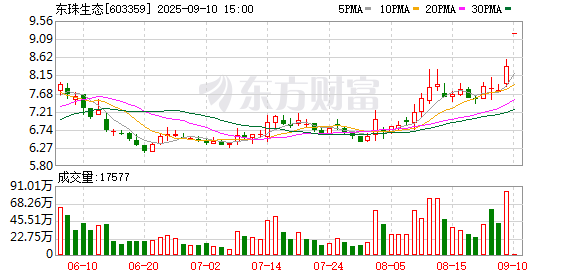
Core Viewpoint - Dongzhu Ecological is undergoing a significant asset restructuring by acquiring 89.49% of Kairuixingtong Information Technology (Nanjing) Co., Ltd, aiming to enter the satellite communication sector after experiencing declining performance in its core business [1][12]. Group 1: Acquisition Details - Dongzhu Ecological plans to acquire Kairuixingtong through a combination of issuing shares and cash payments, with the transaction expected to be a major asset restructuring [1][6]. - The share issuance price is set at 5.47 yuan per share, which is not less than 80% of the average trading price over the previous 120 trading days [7]. - The acquisition will not change the actual control of the company, which remains with Xi Huiming and Pu Jianfen [7]. Group 2: Financial Performance of Kairuixingtong - Kairuixingtong, established in October 2011, specializes in satellite communication technology and has shown rapid revenue growth, with projected revenues of 149 million yuan in 2023 and 258 million yuan in 2024 [9]. - The net profit for Kairuixingtong is forecasted to be 8.95 million yuan in 2023 and 41.5 million yuan in 2024, indicating a fluctuating net profit margin of 5.99%, 16.1%, and 7.13% over the specified periods [9][10]. Group 3: Dongzhu Ecological's Financial Challenges - Dongzhu Ecological has faced significant revenue and profit declines since 2022, with revenues dropping from 12.42 billion yuan in 2022 to an estimated 3.76 billion yuan in 2024 [12]. - The company reported a net loss of 326 million yuan in 2022 and is projected to continue facing losses in 2025, with a forecasted net profit of between -10 million and -5 million yuan for the first half of 2025 [12]. - The decline in performance is attributed to increased competition, macroeconomic factors, and delays in project payments, impacting the company's operational efficiency [12].


马斯克:正打造为直连手机设计的卫星;国产民机C909首条地区航线开通|数智早参
Mei Ri Jing Ji Xin Wen· 2025-09-10 23:12
Group 1 - SpaceX is advancing plans for a high-bandwidth satellite network service that allows direct connection to mobile phones, expected to be commercially available in two years [1] - The implementation requires hardware modifications in mobile phones to connect to Starlink frequencies, and SpaceX is collaborating with smartphone companies [1] - Challenges for mobile direct satellite services include network architecture differences, high construction costs, and performance gaps compared to terrestrial networks [1] Group 2 - Jiangsu Province's drug regulatory authority issued the first national production license for pharmaceuticals using 3D printing technology, marking a significant milestone in compliant production [2] - This license validates the feasibility of large-scale 3D printing in pharmaceuticals, offering new pathways for precise and personalized medication [2] - The development is expected to drive innovation in drug manufacturing processes and accelerate the research and development of new drugs [2] Group 3 - The first regional route operated by the domestically produced C909 aircraft was launched, connecting Nanchang and Macau with three flights per week [3] - The C909 is China's first self-developed regional aircraft with independent intellectual property rights, designed according to international civil aviation regulations [3] - The launch of this route represents a significant milestone for the C909 aircraft in regional aviation [3]
东珠生态拟收购凯睿星通跨界卫星通信领域
Zheng Quan Ri Bao· 2025-09-10 16:41
Core Viewpoint - Dongzhu Ecology is planning a strategic transformation by entering the satellite communication sector through the acquisition of 89.49% of Kairui Xingtong, aiming to create a second growth curve and enhance profitability [2][3]. Group 1: Company Performance - Dongzhu Ecology has faced declining performance, with revenues of 829 million yuan and 376 million yuan in 2023 and 2024 respectively, and net losses of 315 million yuan and 630 million yuan [2]. - In the first half of 2025, the company reported revenues of 208 million yuan, a year-on-year decrease of 23.04%, and a net loss of approximately 9.54 million yuan [2]. Group 2: Acquisition Details - The acquisition involves Dongzhu Ecology purchasing Kairui Xingtong, a high-tech company specializing in satellite communication technology, including products like satellite communication baseband products and terminal products [2][3]. - Kairui Xingtong has shown rapid growth, with revenues of 149 million yuan, 258 million yuan, and 110 million yuan for 2023, 2024, and the first half of 2025 respectively, alongside net profits of 8.95 million yuan, 41.50 million yuan, and 7.82 million yuan [3]. Group 3: Strategic Implications - The acquisition is expected to facilitate Dongzhu Ecology's transition into the satellite communication and space information technology sectors, potentially increasing its sustainable profitability [3]. - Experts suggest that for the transformation to be successful, Dongzhu Ecology must establish a reasonable organizational structure and collaborative mechanisms to ensure synergy between the two business areas [4].
联通获卫星移动通信牌照,卫星通信进程加速
Yin He Zheng Quan· 2025-09-10 13:46
Investment Rating - The report maintains a "Recommended" rating for the satellite communication industry [3]. Core Insights - The satellite communication sector is evolving from traditional voice and emergency connections to a composite infrastructure upgrade that integrates "communication + computing power + data" [6]. - The approval of mobile satellite communication licenses for major telecom operators like China Unicom accelerates the formation of the satellite communication landscape, enhancing service offerings in emergency, maritime, and remote area communications [5][6]. - The industry is expected to see significant market expansion, with both To C and To B models driving satellite applications [6]. Summary by Sections Industry Overview - The satellite industry encompasses manufacturing, launching, operational services, and ground equipment, forming a complete closed loop from spacecraft development to commercialization [5]. - According to SIA statistics, in 2024, the global revenue distribution for satellite industry segments is as follows: 3.2% for launching, 6.8% for manufacturing, 37.0% for operational services, and 53.0% for ground equipment manufacturing, indicating a shift towards downstream applications and terminal segments [5]. Business Models - The report identifies three main business directions for satellite operations: 1. Space computing power leasing services, acting as a "space data center" to provide edge computing capabilities [2]. 2. Space communication and the "Star Cable Plan," which aims to create a low-latency, high-security cross-domain transmission network [2]. 3. Monetization of intelligent data assets through applications in various industries, forming a "Data as a Service (DaaS)" model [2]. Investment Recommendations - The report suggests focusing on companies such as Putian Technology, Tongyu Communication, Zhenyou Technology, Jinxinno, Zongheng Communication, Zhenxin Technology, Shanghai Hantong, and Shunhao Co., Ltd. as potential investment opportunities in the satellite communication sector [6].
