茶饮

Search documents
港股消费热点解析
2025-11-24 01:46
Summary of Key Points from Conference Call Records Industry Overview - The conference call discusses the Hong Kong consumer sector, highlighting the rapid growth of instant retail, particularly in categories such as sports and outdoor, beauty, digital appliances, and pet products, which have outpaced the overall market growth. Traditional food and beverage categories are experiencing relatively weak growth [1][2]. Core Insights and Arguments - **Instant Retail Growth**: Instant retail has shown remarkable growth, with certain categories doubling their growth rates compared to the overall market. New consumption sectors are performing well both online and offline, with strong growth in new categories, demographics, and channels [1][2]. - **AI Technology Impact**: AI technology significantly enhances efficiency through precise marketing and consumer insights. Brands are encouraged to invest more in AI tools to capture consumer demand and predict product trends, thereby improving advertising conversion rates [1][4]. - **K-Shaped Market Recovery**: The market is experiencing a K-shaped recovery, where high-end products and cost-effective brands coexist. High-end products require value redefinition, while cost-effective brands leverage supply chain optimization to reduce prices [1][5][6]. - **Focus on Cash Flow and Shareholder Returns**: Essential consumer sectors emphasize certainty and shareholder returns, with a focus on companies with abundant free cash flow that can enhance shareholder returns through dividends or buybacks [1][7]. - **Potential in Health Supplements**: The health supplement industry is identified as a potential hidden champion due to the aging population and increasing health demands, with a strong growth outlook for anti-aging ingredients like ergothioneine [1][7]. Additional Important Insights - **Valuation of Consumer Sector**: The Hong Kong consumer sector is currently valued at historical lows, with the Hang Seng Consumer Index PE close to the 20th percentile over the past decade, indicating market pessimism [3][10]. - **Z Generation Consumer Behavior**: The Z generation is shifting from functional purchases to emotional and experiential ones, significantly impacting the essential consumer sector. This demographic is also price-sensitive, favoring high-cost-performance brands [3][15]. - **Risks in Essential Consumer Sector**: Despite its defensive nature, the essential consumer sector faces risks such as rising raw material costs and potential declines in consumer purchasing power during economic downturns [13][14]. - **Investment Strategy Recommendations**: Investors are advised to assess their risk profiles and consider funds that cover essential industries for stability, while more aggressive investors may explore high-volatility sectors like liquor [11]. This summary encapsulates the critical insights and trends discussed in the conference call, providing a comprehensive overview of the current state and future outlook of the Hong Kong consumer sector.
霸王茶姬创始人牵手“光伏女神” 资本市场添603亿豪门联姻新样本
Chang Jiang Shang Bao· 2025-11-24 00:33
Core Viewpoint - The marriage announcement between Zhang Junjie, founder of Bawang Chaji, and Gao Haichun, co-chairman of Trina Solar, reflects deeper trends in the integration of private enterprises in China, particularly in the context of generational succession and capital consolidation [1][3]. Group 1: Company Profiles - Bawang Chaji, founded by Zhang Junjie, went public on NASDAQ in April 2025, achieving a market value of approximately 178.18 billion yuan [9][30]. - Trina Solar, co-chaired by Gao Haichun, has a combined market value with Bawang Chaji exceeding 600 billion yuan [4]. - Gao Haichun, known as the "photovoltaic goddess," took on leadership roles in Trina Solar starting in early 2025, while Zhang Junjie has built Bawang Chaji into a significant player in the tea beverage market [3][9]. Group 2: Financial Performance - Bawang Chaji reported a net profit of 7.28 billion yuan in the first half of 2025, a year-on-year decline of approximately 38%, with a staggering 88.8% drop in net profit for the second quarter [11][31]. - Trina Solar faced significant losses, reporting a loss of about 42 billion yuan in the first three quarters of 2025, amid a challenging industry environment [12][25]. - Both companies are experiencing operational pressures, with Bawang Chaji's revenue growth slowing and Trina Solar's revenue declining by 20.87% year-on-year in the first three quarters of 2025 [25][31]. Group 3: Market Context and Trends - The marriage symbolizes a potential strategic alliance that could lead to new business opportunities and collaborations between the tea and photovoltaic industries, although no formal business ties currently exist [12][26]. - The trend of high-profile marriages in the business sector often leads to enhanced brand visibility and potential capital alliances, as seen in previous cases within the industry [15][16]. - The ongoing challenges in both the tea and photovoltaic markets highlight the need for innovative strategies and potential shifts in business models to adapt to changing market conditions [25][27].
霸王茶姬创始人迎娶“最美光伏二代”专家:豪门联姻规则改变
Sou Hu Cai Jing· 2025-11-23 16:57
Core Viewpoint - The recent marriage between executives from two publicly listed companies, Bawang Chaji and Trina Solar, is expected to create complementary and expansive brand effects for both companies, enhancing their public recognition and brand capital [2][6][8]. Group 1: Company Performance - Bawang Chaji's stock price increased by 4.51% to a market capitalization of approximately $2.507 billion (around 178 billion RMB) as of November 21 [2][3]. - Trina Solar's stock price has been declining, with a drop of over 5%, resulting in a market capitalization of 42.518 billion RMB [2][7]. - Bawang Chaji reported a total GMV of 8.103 billion RMB for Q2 2025, a year-on-year increase of 15.5%, with net income of 3.332 billion RMB, up 10.2% [6][8]. Group 2: Brand Impact - The marriage is seen as a strategic move that could enhance Trina Solar's brand visibility and public engagement, leveraging Bawang Chaji's strong consumer base [6][8]. - Trina Solar aims to address challenges in the photovoltaic industry through diversified business structures and strong brand influence, emphasizing the importance of brand in its latest annual report [8]. Group 3: Industry Trends - The trend of second-generation entrepreneurs from established companies marrying is becoming more common, reflecting a shift from traditional wealth matching to a focus on cognitive alignment and shared business philosophies [6][9][11]. - Such marriages are viewed as a means to strengthen brand image and instill confidence for long-term development, while maintaining business independence to mitigate risks associated with personal relationships [12][14].


茶饮霸总娶光伏女神,现在流行「董事长」终成眷属?
3 6 Ke· 2025-11-23 15:58
Group 1 - The marriage announcement between Gao Haichun, daughter of Gao Jifan (founder of Trina Solar), and Zhang Junjie (founder of Bawang Chaji) has been confirmed, highlighting a significant union in the business world [2][4][15] - Gao Haichun, a graduate of Brown University, is now the chairperson of Trina Solar, a company valued at 448 billion yuan, while Zhang Junjie has built Bawang Chaji into a tea beverage giant with a market cap of approximately 185 billion yuan [11][13][14] - The combined market capitalization of both companies exceeds 600 billion yuan, indicating a powerful alliance in the renewable energy and beverage sectors [14][15] Group 2 - Bawang Chaji has shown impressive growth, expanding from 1,087 stores in 2022 to 3,511 in 2023, with a projected total of 7,038 stores by mid-2025 [16] - The company reported a total GMV of 8.1031 billion yuan in Q2, with a year-on-year growth of 15.5%, although it faced challenges with a net profit decline [16][17] - Trina Solar is currently experiencing financial difficulties, reporting a net loss of 4.201 billion yuan in the first three quarters of the year, attributed to industry overcapacity and market policy changes [18][19] Group 3 - Gao Haichun is implementing reforms at Trina Solar, focusing on stabilizing the core business while exploring opportunities in the energy storage sector, with a target of achieving 8 GWh by 2025 [20] - The company is also aiming for a balanced market presence, with a 60% focus on overseas markets [20] - The potential for consolidation in the solar industry may lead to changes in market dynamics, with some stocks already showing signs of recovery [21]

茶饮霸总娶光伏女神,现在流行「董事长」终成眷属?
36氪· 2025-11-23 15:41
Core Viewpoint - The marriage between Gao Haichun, daughter of Gao Jifan (founder of Trina Solar), and Zhang Junjie (founder of Bawang Chaji) represents a significant cross-industry partnership, combining their respective companies' market values to over 63.3 billion yuan, showcasing a trend of powerful business alliances in the new generation of entrepreneurs [4][6][18]. Group 1: Company Backgrounds - Trina Solar, led by Gao Haichun, has a market capitalization of approximately 44.8 billion yuan and is currently undergoing a transformation phase amid industry challenges, including a reported net loss of 4.2 billion yuan in the first three quarters of the year [16][24]. - Bawang Chaji, founded by Zhang Junjie, has rapidly expanded from a single store to over 7,000 locations globally, achieving a market capitalization of about 26.1 billion USD (approximately 185 billion yuan) after its listing on NASDAQ [17][18]. Group 2: Financial Performance - Bawang Chaji reported a total GMV of 8.1 billion yuan in Q2, with a net income of 3.3 billion yuan, reflecting a year-on-year growth of 10.2% [22]. - Despite its growth, Bawang Chaji's revenue growth rate of 21.6% in the first half of the year was lower compared to competitors like Mixue Ice City and Gu Ming, which saw increases of 39.3% and 41.2% respectively [23]. - Trina Solar's financial struggles are attributed to overcapacity in the photovoltaic industry and competitive pricing pressures, leading to a significant net loss [25]. Group 3: Strategic Directions - Gao Haichun is implementing reforms at Trina Solar, focusing on stabilizing core business operations while exploring opportunities in the energy storage sector, with a target of achieving 8 GWh of capacity by 2025 [26]. - Bawang Chaji is diversifying its product offerings and has attempted to introduce new merchandise, although some products have been removed from their flagship store due to market response [24]. Group 4: Market Trends - The marriage of Gao Haichun and Zhang Junjie is seen as a potential catalyst for future collaborations between their companies, with expectations of creating synergistic effects that could exceed the sum of their individual strengths [19][27]. - The trend of "business couples" is emerging, where both partners are equally matched in capability and resources, reflecting a shift in how the next generation of entrepreneurs approach partnerships and family businesses [41].

俞敏洪深夜再发全员信,向员工道歉;霸王茶姬创始人辟谣:此前从未有过婚姻;特斯拉因致命车祸被起诉;哪吒2不参加奥斯卡竞逐丨邦早报
创业邦· 2025-11-23 01:09
Group 1 - Yu Minhong, the founder of New Oriental, issued an apology letter to all employees after a previous internal letter caused controversy, explaining that his use of Antarctic references was not meant to boast but to share his experiences sincerely [4][5] - The apology letter emphasized the importance of mutual support between employees and the company, encouraging staff to maintain the company's image and resolve grievances internally [4][5] Group 2 - Zhang Junjie, the founder of Bawang Tea, confirmed his marriage and refuted rumors about his past, stating that he had never been married before meeting his wife and addressing the impact of false narratives on his family and business [7][8] - Zhang expressed the need to protect his family's reputation and urged the public not to spread rumors, highlighting the emotional toll these stories have taken on him and his loved ones [7][8] Group 3 - Intel's CEO Chen Lifeng denied rumors regarding a former TSMC executive allegedly taking confidential 2nm technology to Intel, asserting that such claims are baseless and emphasizing respect for intellectual property [9] - TSMC is reportedly conducting an internal investigation into whether the former executive misappropriated company secrets before his retirement [9] Group 4 - Meituan announced a plan to invest 10 billion yuan over the next five years to enhance rider protection, including the establishment of "rider apartments" in major cities [10] - The initiative aims to address the welfare needs of riders and expand the coverage of existing support programs for their families [10] Group 5 - The Ministry of Industry and Information Technology of China projected that the output value of civil aviation products will exceed 160 billion yuan in 2024, representing a year-on-year growth of 23.6% [23] - The ministry plans to promote the development of the civil aircraft industry and low-altitude equipment, focusing on technological innovation and integration with emerging industries [23]



霸王茶姬创始人迎娶“最美光伏二代”,公司股价大涨,女方公司今年已亏超40亿元
Mei Ri Jing Ji Xin Wen· 2025-11-22 23:36
Core Viewpoint - The marriage between the founders of Bawang Chaji and Trina Solar is expected to create complementary and expansive effects for both brands, enhancing brand recognition and public attention for Trina Solar while providing brand capital endorsement for Bawang Chaji [6][8]. Group 1: Company Performance - Bawang Chaji reported a total GMV of 8.1031 billion yuan in Q2 2025, a year-on-year increase of 15.5%, with net income of 3.3319 billion yuan, up 10.2% [7]. - Trina Solar, established in 1997, has a current market value of 42.518 billion yuan, but has faced challenges, with a 20.87% year-on-year decline in revenue to 49.97 billion yuan and a net loss of 4.201 billion yuan in the first three quarters [7]. Group 2: Brand Impact - The marriage is seen as a strategic alliance that can enhance public awareness of Trina Solar, which has strong influence in its vertical field but limited public recognition [8]. - Bawang Chaji's high brand awareness can potentially elevate Trina Solar's visibility, while Trina Solar's established reputation can lend credibility to Bawang Chaji [8]. Group 3: Industry Trends - The trend of second-generation entrepreneurs marrying across industries is noted, reflecting a shift from traditional wealth matching to compatibility in cognitive levels, business philosophies, and social circles [6][10]. - Such unions are viewed as a means to strengthen brand image and instill confidence for long-term development, as seen in other successful partnerships [12].


霸王茶姬创始人迎娶“最美光伏二代”,公司股价大涨!女方公司今年已亏超40亿元!专家:豪门联姻规则改变,“门当户对”不只是财富匹配
Mei Ri Jing Ji Xin Wen· 2025-11-22 16:30
每经记者|徐肖逍 每经编辑|段炼 陈星 近日,关于霸王茶姬创始人张俊杰和天合光能创始人之女、公司联席董事长高海纯结婚的消息,引发广泛关注和热议。 左:张俊杰;右:高海纯。图片来源:红星资本局 11月20日,天合光能回应,双方相识于青年企业家学习活动,已登记结婚。此外双方公司均为上市公司,目前尚未有任何关联交易或商业合作。 11月21日,霸王茶姬股价大涨,截至收盘涨4.51%,总市值25.07亿美元(约合人民币178亿元)。与此同时,天合光能股价却迎来三连跌,截至收盘跌超 5%,总市值425.18亿元。 一位是茶饮"创一代",一位是光伏"创二代",两位的结合将会对双方品牌带来什么样的影响?品牌专家、瞻胜传播创始合伙人庞瑞接受《每日经济新闻》 记者采访时表示:"如果我们仅仅从对品牌客观影响的角度来看,此次联姻带来的效应具备互补性与扩展性。霸王茶姬或可借此增强品牌资本背书,而天 合光能则通过此事件获得更广泛的公众关注。" 记者观察到,近年来多个知名企业的二代们频频联姻。庞瑞告诉记者,企业二代联姻在当下呈现出新的趋势。"今天的'门当户对'已超越了单纯的财富匹 配,更演进为认知水平、经营理念乃至社会圈层的高度契合。" ...

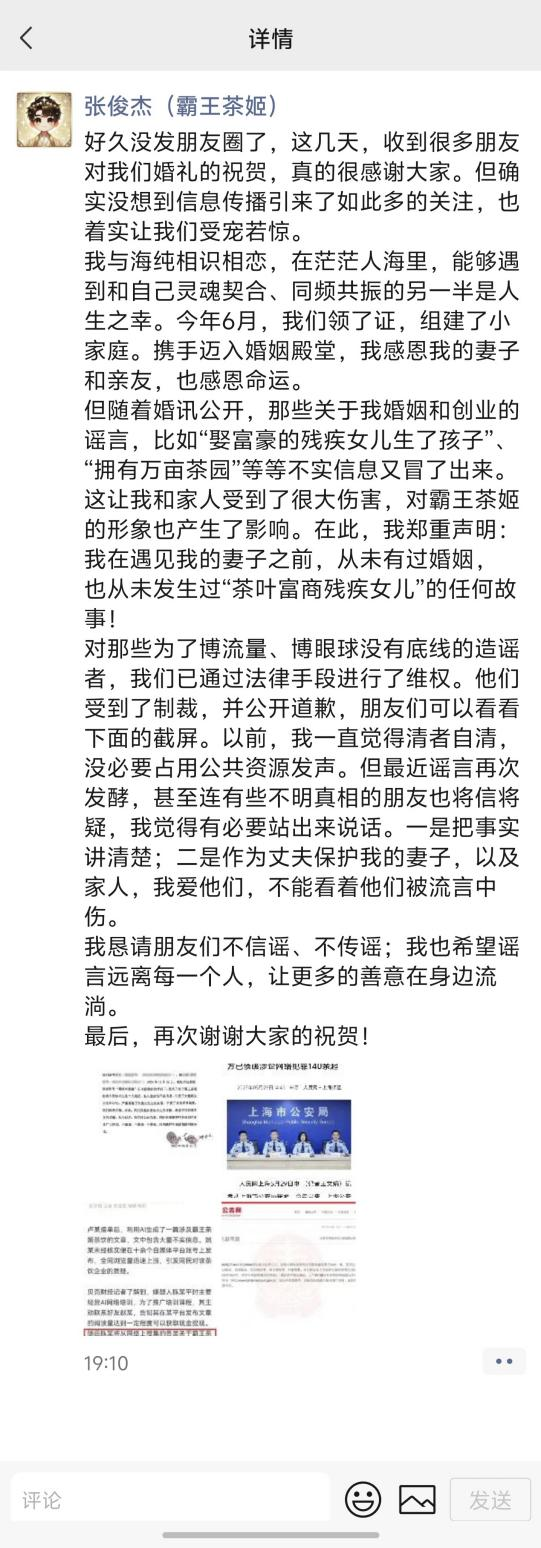
霸王茶姬创始人张俊杰辟谣:此前从未有过婚姻,也从未发生“茶叶富商残疾女儿”的任何故事
中国基金报· 2025-11-22 03:30
【导读】霸王茶姬创始人张俊杰更新微信朋友圈辟谣 中国基金报记者 郑俊婷 11 月 21 日晚间,霸王茶姬创始人张俊杰 更 新微信朋友 圈,在证实和天合光能联席 董 事 长 高 海 纯婚讯的同时,也对过往围绕其婚姻和创业的诸多谣言进行了辟谣。 " 我郑重声明:在我遇见我妻子(高海纯)前, 从未有过婚姻,也从未发生 ' 茶叶富商残疾 女儿 ' 的任何故事。 " 张俊杰表示。 之所以在这个时候辟谣,张俊杰表示,是因为以前一直觉得清者自清,没必要占用公共资源 发声,但最近谣言再次发酵,甚至有些不明真相的朋友也将信将疑,觉得有必要站出来,一 是把事实讲清楚,二是作为丈夫保护妻子以及家人。 张俊杰同时透露,其与 高海纯已于今年 6 月份领证。 " 对于那些博流量、博眼球,没有底线的造谣者,公司已通过法律手段进行了维权,相关责任 人也受到了制裁,并公开道歉。 " 张俊杰说。 据了解,自 2024 年 11 月起,网络上关于张俊杰的谣言层出不穷,诸如 " 娶富豪的残疾女 儿生了孩子 "" 拥有万亩茶园 " 等,尤其是在短视频平台被大量传播。 11 月 20 日,网络上大量流传张俊杰和高海纯的婚礼请柬,引发广泛关注。据网传请柬 ...

霸王茶姬创始人张俊杰辟谣:此前从未有过婚姻,也从未有“茶叶富商残疾女儿”的任何故事,家人受到很大伤害,有必要站出来说话
Mei Ri Jing Ji Xin Wen· 2025-11-22 01:29
Core Viewpoint - The wedding of Zhang Junjie, the founder of Bawang Tea Ji, has attracted significant public attention, leading to the need for him to address various rumors surrounding his marriage and business [1][2][5]. Group 1: Personal Background and Marriage - Zhang Junjie confirmed his marriage to Gao Haichun, stating they registered their marriage in June of this year and expressed gratitude for the public's blessings [2][6]. - Gao Haichun is the daughter of prominent figures in the photovoltaic industry and has held various leadership roles at Trina Solar, including co-chairman [9]. Group 2: Rumors and Legal Actions - Following the announcement of his marriage, numerous false rumors emerged, including claims about his wife's background and their financial status, which have caused distress to him and his family [2][5]. - Zhang Junjie has taken legal action against the spreaders of these rumors, resulting in penalties and public apologies from the offenders [5][6]. Group 3: Company Background - Bawang Tea Ji, founded in November 2017 in Yunnan, has rapidly expanded to over 6,000 stores [6]. - Zhang Junjie has a background in management and business development, having previously worked in various roles before establishing Bawang Tea Ji [6].