
量子科技

Search documents
“十五五”规划:促进中小企业专精特新发展,培育独角兽企业|快讯
Hua Xia Shi Bao· 2025-10-28 12:12
Core Insights - The "Suggestions" for the 15th Five-Year Plan emphasize innovative regulatory approaches and the development of venture capital to foster the growth of future industries and risk-sharing mechanisms [1] - The plan aims to promote the development of specialized and innovative small and medium-sized enterprises (SMEs) and cultivate unicorn companies [1] - It highlights the importance of forward-looking layouts for future industries, exploring diverse technological routes, typical application scenarios, feasible business models, and market regulatory rules [1] - Key sectors identified for economic growth include quantum technology, biomanufacturing, hydrogen energy, nuclear fusion energy, brain-computer interfaces, embodied intelligence, and sixth-generation mobile communication [1] - The plan also focuses on building emerging pillar industries and implementing industrial innovation projects to accelerate the development of strategic emerging industry clusters such as new energy, new materials, aerospace, and low-altitude economy [1] - It calls for the improvement of the industrial ecosystem and the implementation of large-scale application demonstration actions for new technologies, products, and scenarios to expedite the scaling of emerging industries [1]
谷歌芯片实现量子计算新突破,人工智能AIETF(515070)持仓股用友网络上涨超2%
Mei Ri Jing Ji Xin Wen· 2025-10-28 05:55
Group 1 - The A-share market saw a decline in major indices in the afternoon, with sectors such as quantum technology and AI showing initial strength before tapering off [1] - Google announced a significant breakthrough in quantum computing, achieving verifiable quantum advantage with its Willow module, running an algorithm 13,000 times faster than leading supercomputers, marking a step towards practical applications in fields like medicine and materials science [1] - Tianfeng Securities highlighted that "AI+" will usher in a new era of smart economy in China, with clear development directions for AI applications, suggesting that generative AI remains a focus due to its high commercialization value [1] Group 2 - The AI ETF (515070) tracks the CS AI Theme Index (930713), selecting stocks that provide technology, resources, and applications for AI, focusing on the midstream and upstream of the AI industry chain [2] - The top ten weighted stocks in the AI ETF include leading domestic tech companies such as Zhongji Xuchuang, Xinyisheng, and Hikvision, among others [2] - Related products include the AI ETF (515070), the Huaxia Growth Enterprise Software ETF (159256), and the Huaxia 200 ETF (159573) [2]

四大证券报精华摘要:10月28日
Zhong Guo Jin Rong Xin Xi Wang· 2025-10-28 00:04
Group 1: Monetary Policy and Market Reforms - The People's Bank of China announced the resumption of government bond trading operations after a pause due to market imbalances and accumulated risks earlier this year [1] - The China Securities Regulatory Commission (CSRC) plans to deepen the reform of the ChiNext board, introducing listing standards that better align with the characteristics of emerging industries and innovative enterprises [1] - The CSRC has issued a plan to optimize the Qualified Foreign Institutional Investor (QFII) system, aiming to enhance its attractiveness to long-term foreign capital over the next two years [2] Group 2: Capital Market Developments - The CSRC released opinions to strengthen the protection of small and medium investors in the capital market, introducing 23 practical measures to create a fair trading environment [3] - The first batch of three companies will be listed on the ChiNext Growth Layer, marking the implementation of the CSRC's recent reforms and highlighting support for hard technology enterprises [4] Group 3: Industry Performance and Trends - PCB industry leader Shenghong Technology reported a third-quarter revenue of 5.086 billion yuan, a year-on-year increase of 78.95%, with a net profit growth of 260.52% [5] - The copper futures market has seen significant capital inflow, with the Shanghai copper futures price surpassing 88,300 yuan per ton, driven by supply shortages and increased demand from sectors like AI and renewable energy [6] - The optical module industry is experiencing a recovery, with several companies reporting profit growth, driven by increased demand for high-end products [8] Group 4: Investment Opportunities - Despite market uncertainties, investment opportunities are emerging, particularly in technology growth sectors benefiting from AI and policy support [5] - The public fund issuance market is showing a unique trend of "reduced quantity but increased efficiency," with a notable rise in the average fundraising speed for new products [7]
量子科技加速走向商业化
Xin Lang Cai Jing· 2025-10-27 23:17
Group 1 - The first mass production of a four-channel ultra-low noise semiconductor single-photon detector in China marks a leading position in single-photon detection technology [1] - Future economic growth in quantum technology may arise from three paths: manufacturing of quantum devices, upgrading industries like medicine and finance, and the emergence of new business models such as quantum AI and quantum IoT [1] - The Ministry of Industry and Information Technology has initiated 17 key tasks to enhance the development of quantum technology across various sectors, including healthcare, transportation, energy, and finance [1] Group 2 - Quantum precision measurement instrument developer Guoyi Quantum Technology has completed a strategic financing round of 131 million yuan, aimed at upgrading research and design capabilities for quantum computing and related equipment [2] - China Telecom's quantum research team achieved significant progress in quantum communication, successfully conducting a real-world experiment with over 80 kilometers of transmission at speeds exceeding 10 Tb/s [2] - The development of quantum technology in China is characterized by a combination of policy guidance and market-driven innovation [2] Group 3 - Commercial applications of quantum technology have made substantial progress in finance and healthcare, demonstrating the feasibility of industry implementation [3] - Beijing Boson Quantum Technology will provide top-tier quantum optimization algorithms and computing power services for China Merchants Bank's "Libra AI" quantum computing project [3] - The quantum molecular docking platform developed by Benyuan Quantum Computing and WuXi AppTec significantly reduces the drug screening cycle for Alzheimer's disease from five years to eight months, cutting costs by 60% [3] - The quantum technology market in China is projected to reach $9.758 billion by 2029, with a compound annual growth rate of 37.45% from 2024 to 2029 [3]

21社论丨再造一个中国高技术产业,掌握全球科技竞争主动权
21世纪经济报道· 2025-10-27 23:10
Core Viewpoint - The article emphasizes the strategic goal of "recreating a Chinese high-tech industry," which aims to achieve significant growth in scale, value-added, and contribution to GDP over the next decade, effectively creating a new high-tech industrial landscape in China [1][2][3]. Group 1: Emerging and Future Industries - The strategy involves nurturing and expanding emerging industries that already have a foundation and are rapidly growing, such as new energy, new materials, aerospace, and low-altitude economy, which are expected to generate several trillion-level markets [1][2]. - Long-term strategies include forward-looking layouts for future industries like quantum technology, biomanufacturing, hydrogen energy, nuclear fusion, brain-computer interfaces, embodied intelligence, and sixth-generation mobile communication, which are anticipated to become new economic growth points [1][2]. Group 2: Economic Growth and Modernization - The recreation of the existing Chinese high-tech industry is seen as essential for achieving socialist modernization by 2035, with a target of reaching a per capita GDP comparable to that of moderately developed countries, supported primarily by high-tech industries [2][3]. - Traditional industries currently account for about 80% of the value-added in manufacturing, and through upgrading key industries like chemicals, machinery, and shipbuilding, an estimated market space of around 10 trillion yuan is expected to be added over the next five years [2]. Group 3: Technological Innovation and Global Competitiveness - The article highlights the need for deep integration of technological and industrial innovation to maintain a proactive position in the new round of technological revolution and industrial transformation, ensuring that innovation is supported by market and industrial foundations [3]. - The strategy aims to reshape the global industrial competitive landscape, providing a solid foundation for achieving socialist modernization and ensuring that China occupies a leading position in the new technological revolution and industrial transformation [3].


再造一个中国高技术产业,掌握全球科技竞争主动权
2 1 Shi Ji Jing Ji Bao Dao· 2025-10-27 22:11
Core Viewpoint - The Chinese government aims to "recreate a high-tech industry" over the next decade, which will significantly enhance the scale, value-added, and GDP contribution of the high-tech sector, injecting new momentum into the economy and high-quality development [1][2][3][4] Group 1: Emerging and Future Industries - The strategy involves nurturing emerging industries that already have a foundation and are rapidly expanding, including sectors like new energy, new materials, aerospace, and low-altitude economy, which are expected to create several trillion-level markets [1][2] - Long-term strategies focus on future industries such as quantum technology, biomanufacturing, hydrogen energy, nuclear fusion, brain-computer interfaces, embodied intelligence, and sixth-generation mobile communication, which will become new economic growth points [1][2] Group 2: Economic Growth and Modernization - The recreation of the high-tech industry is essential for achieving the goal of modernizing socialism and reaching a per capita GDP level of a moderately developed country by 2035, requiring sustained economic growth primarily driven by high-tech industries [2][3] - Traditional industries currently account for about 80% of the value added in manufacturing, and upgrading these industries is expected to create an additional market space of approximately 10 trillion yuan over the next five years [2] Group 3: Technological Innovation and Global Competitiveness - The initiative to recreate the high-tech industry is a response to the new round of technological revolution and industrial transformation, aiming to seize the high ground in technological development and continuously generate new productive forces [3][4] - The integration of technological innovation and industrial innovation is crucial for establishing a virtuous cycle between technology, industry, and market, ensuring that innovations are supported by market and industrial foundations [3][4] Group 4: Strategic Goals and Confidence - The strategic goal of recreating the high-tech industry is not only about scaling up but also about achieving a qualitative leap in the industry, providing strong momentum for high-quality economic development and laying a solid foundation for socialist modernization [4] - During the "14th Five-Year Plan" period, there is a need to focus on building a modern industrial system centered around advanced manufacturing and enhancing technological self-reliance to maintain strategic determination and confidence [4]
量子科技加速走向商业化 我国量子科技市场规模预计到2029年将增至97.58亿美元
Zheng Quan Ri Bao· 2025-10-27 17:12
Core Insights - China's first mass production of a four-channel ultra-low noise semiconductor single-photon detector marks a leading position in single-photon detection technology [1] - The future of quantum technology in China is expected to contribute to economic growth through three pathways: manufacturing quantum devices, empowering industries like medicine and finance, and fostering new business models such as quantum AI and quantum IoT [1] - The release of policy incentives is accelerating industry development, with the Ministry of Industry and Information Technology planning 17 key tasks focused on quantum computing, communication, and precision measurement [1] Industry Developments - The Yangtze River Delta region is developing a "superconducting quantum computing + cloud services" ecosystem, while the Guangdong-Hong Kong-Macau Greater Bay Area is promoting "quantum + AI" applications centered around Huawei's quantum cloud platform [1] - Quantum precision measurement instrument manufacturer Guoyi Quantum Technology has completed a strategic financing of 131 million yuan, aimed at upgrading research and design capabilities for quantum computing and magnetic resonance equipment [2] - China Telecom's quantum research team achieved significant progress in quantum communication, successfully conducting a real-world experiment with over 80 kilometers of transmission at speeds exceeding 10 Tb/s [2] Commercial Applications - The commercialization of quantum technology has made substantial progress in finance and healthcare, demonstrating the feasibility of industry applications [3] - Beijing Boson Quantum Technology is providing quantum computing services for China Merchants Bank's "Tianchen AI" project, addressing complex computational challenges in investment portfolio optimization and risk control [3] - Huaxia Bank is developing a "quantum financial cloud platform" that integrates various technologies to create core algorithms for applications in intelligent risk control [3] - A collaboration between Benyuan Quantum Computing and WuXi AppTec has reduced the drug screening cycle for Alzheimer's disease from five years to eight months, cutting costs by 60% [3] - The quantum technology market in China is projected to reach $9.758 billion by 2029, with a compound annual growth rate of 37.45% from 2024 to 2029 [3]
刚刚!证监会主席重磅表态!
摩尔投研精选· 2025-10-27 10:56
Core Viewpoint - The A-share market is experiencing a strong upward trend, with major indices rising over 1%, and the Shanghai Composite Index nearing the 4000-point mark, a level not seen since August 2015 [1][2]. Market Performance - The market is characterized by active hotspots, with over 3300 stocks closing in the green. The trading volume in the Shanghai and Shenzhen markets reached 2.34 trillion, an increase of 365.9 billion from the previous trading day [3]. - Key sectors showing significant gains include small metals, electronic chemicals, components, and semiconductors, with notable performance in concepts like storage chips, AI PCs, and Co-Packaged Optics (CPO) [3][4]. Storage Chip Sector - The storage chip sector continues to thrive, driven by exponential demand from AI servers for storage capacity and bandwidth [5]. - Prices for DRAM have surged, with a nearly 100% year-on-year increase in September, and certain DDR4 models seeing price increases of over 300% since April. Major players like Samsung and SK Hynix are expected to raise prices by 30% in Q4 [6]. High-Tech Industry Development - The Chinese government has set a goal to cultivate high-tech industries over the next decade, with projections indicating that the market size of seven key future industries could exceed 10 trillion yuan by 2030 [7]. - The focus is on emerging pillar industries, with the "Three New" economy expected to account for over 18% of GDP by 2024, particularly in sectors like new energy and aerospace [10]. Investment Directions - **Quantum Technology**: Emphasizes a gradient development approach, with quantum measurement leading in commercialization, followed by quantum communication and quantum computing [12]. - **Biomanufacturing**: Driven by technology substitution and scene expansion, with significant potential to replace 20%-30% of chemical products [13]. - **Hydrogen and Nuclear Fusion Energy**: Positioned as complementary forces in the energy revolution, focusing on industrial and transportation decarbonization [14]. - **Brain-Computer Interfaces**: Targeting medical applications first, with consumer applications expected to follow as technology matures [15]. - **Embodied Intelligence**: Focused on industrial applications initially, with consumer applications anticipated to explode later [16]. - **6G Technology**: Aiming for seamless global coverage and integration of AI, with commercial deployment expected by 2030 [17][19].

连板股追踪丨A股今日共64只个股涨停 这只芯片股4连板
Di Yi Cai Jing· 2025-10-27 08:36
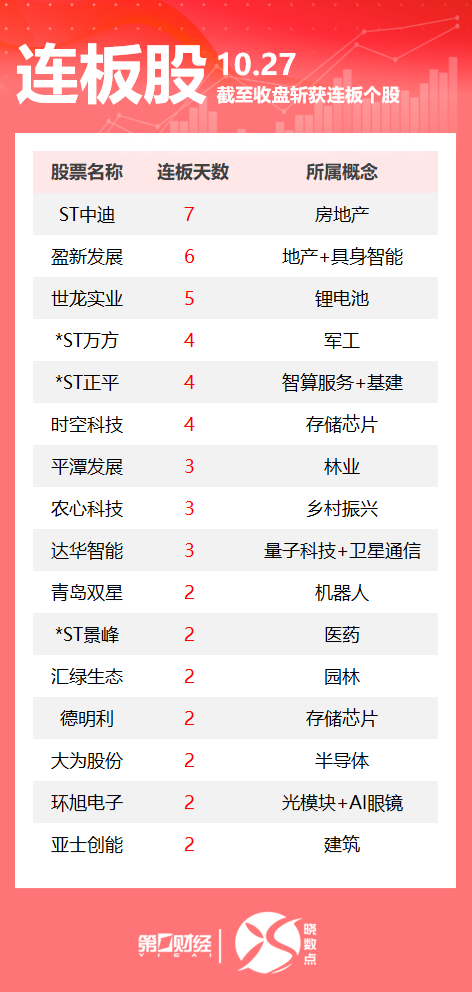
量子科技概念股达华智能3连板。一图速览今日连板股>> | 股票名称 | 连板天数 | 所属概念 | | --- | --- | --- | | ST中油 | 7 | 房地产 | | 帮新发展 | 6 | 地产+具身智能 | | 世龙实业 | 5 | 锂电池 | | *ST万方 | 4 | 载T | | *ST正平 | 4 | 智算服务+基建 | | 时空科技 | 4 | 存储芯片 | | 平潭发展 | 3 | 林业 | | 农心科技 | 3 | 乡村振兴 | | 达华智能 | 3 | 量子科技+卫星通信 | | 青岛双星 | 2 | 机器人 | | *ST블降 | 2 | 矢药 | | 汇绿生态 | 2 | 同杯 | | 德明利 | 2 | 存储芯片 | | 大为股份 | 2 | 半导体 | | 环旭电子 | 2 | 光模块+AI眼镜 | | 亚于创能 | 2 | 建筑 | 第 刚经 10月27日,Wind数据显示,A股市场共计64只个股涨停。其中存储芯片板块时空科技4连板,量子科技 概念股达华智能3连板。一图速览今日连板股>> FE | 7 | 10 载到了新联 ...
“十五五”锚定六大未来产业,青年科学家何为?
Nan Fang Du Shi Bao· 2025-10-27 08:08
Group 1: Future Industries and Policy Initiatives - The core focus of the news is on the strategic layout of future industries such as quantum technology, brain-computer interfaces, and hydrogen energy as new economic growth points as proposed in the 15th Five-Year Plan [1] - The 2025 World Youth Scientist Summit serves as a platform for young researchers to share their latest scientific achievements in fields like brain-computer interfaces and quantum technology [1] - The Ministry of Industry and Information Technology and other departments have issued implementation opinions to promote innovation and development in the brain-computer interface industry, emphasizing the need for technological breakthroughs and application of results [3] Group 2: Brain-Computer Interface Technology - Brain-computer interface technology focuses on two main aspects: the collection of brain signals and the decoding of these signals to understand underlying intentions and needs [2] - There are challenges in data collection, with invasive methods providing high precision but limited sample sizes, while non-invasive methods are safer but have lower signal quality [2] - The medical field is currently the largest driver for the brain-computer interface market, with applications in treating conditions like epilepsy and depression [2] Group 3: Quantum Technology Developments - Quantum technology is divided into three main areas: quantum computing, quantum communication, and quantum precision measurement, with quantum computing being particularly noteworthy for its potential to overcome computational limitations [4] - Current advancements in quantum computing have led to the development of specialized quantum computers that outperform classical supercomputers for specific tasks, although universal quantum computers are still in exploratory stages [5] - Major tech companies like Google and IBM are actively investing in quantum computing, with Google recently demonstrating a quantum algorithm that significantly outperforms existing supercomputers [5] Group 4: Challenges Faced by Young Scientists - Young scientists face significant challenges in their early careers, including insufficient funding, administrative burdens, and pressures related to short-term evaluations and job stability [6][7] - A report highlighted that nearly 70% of early-career scientists reported funding shortages, and a similar percentage faced challenges with time allocation due to non-research tasks [6][7] - There is a call for improved research environments that provide not only financial support but also advanced research facilities and the freedom to explore academic inquiries [6][7] Group 5: Market Transformation of Research Outcomes - Discussions at the summit emphasized the importance of aligning research outcomes with market needs, particularly in emerging fields where laboratory work is closely tied to market demand [8] - A successful model from Austria involves significant corporate funding for research projects, ensuring that industry needs are integrated from the outset [8] - Young scientists are encouraged to engage with the market by sharing their research on social media to receive feedback and foster connections with potential investors [8]