小金属

Search documents
小金属板块冲高,东方钽业、中钨高新均涨超8%
Mei Ri Jing Ji Xin Wen· 2025-10-27 02:05
Group 1 - The small metal sector experienced a significant rise, with companies like Dongfang Tantalum Industry and Zhongtung High-tech both increasing by over 8% [1] - Other companies such as Xiamen Tungsten Industry, Zhangyuan Tungsten Industry, Xianglu Tungsten Industry, and Baowu Magnesium Industry also saw gains [1]



小金属板块走高,东方钽业涨停创新高
2 1 Shi Ji Jing Ji Bao Dao· 2025-10-27 01:44
Group 1 - The small metals sector experienced an initial rise, with Dongfang Tantalum Industry hitting a limit-up and reaching a new high [1] - Other companies such as Zhongtung High-tech, Xiamen Tungsten Industry, Zhangyuan Tungsten Industry, and Baowu Magnesium Industry also saw increases in their stock prices [1]
有色金属:对有色要有信心,景气向好
2025-10-27 00:31
Summary of Conference Call on Non-Ferrous Metals Industry Industry Overview - The non-ferrous metals industry, including gold, copper, aluminum, and small metals like tungsten and lithium, is experiencing a positive outlook with strong market confidence despite some concerns regarding price fluctuations and supply-demand dynamics [2][14]. Key Points and Arguments Gold Market - Gold prices are expected to find strong support between $3,900 and $4,000, with an adjustment period of 2 to 4 weeks, potentially leading to consolidation until early next year. Inflation may drive future price increases [1][4][15]. - Companies involved in gold production are projected to have a compound annual growth rate (CAGR) of gold output between 10% to 20% from 2026 to 2029, indicating strong investment potential despite price fluctuations [1][5]. Copper Market - The price of copper is anticipated to be influenced more by supply-demand fundamentals rather than movements in gold prices. A significant price increase is expected in 2026, potentially exceeding $11,000, driven by global liquidity easing [1][7][15]. - Supply shortages are projected for copper due to production guidance reductions from several mines, which could lead to a supply shortfall of approximately 2% in 2026 [8]. Aluminum Market - The electrolytic aluminum sector has outperformed expectations, with domestic production peaking and no significant increases in overseas supply. The demand for aluminum alloys and rods is improving, leading to a favorable supply-demand balance [1][9][10]. - Aluminum is characterized by low absolute and relative valuations, with a strong dividend trend, making it a valuable investment opportunity [16]. Small Metals Market - Recent price increases have been observed in small metals such as tungsten, lithium carbonate, and magnesium. Cobalt prices may rise above 400,000 yuan due to supportive supply-demand fundamentals [1][11]. - Tungsten is experiencing a strategic shortage, while lithium's demand is currently strong but supply has not yet caught up, indicating potential for future price increases [11][17]. Steel Market - The steel market faces short-term export pressures but is not expected to collapse. Profit margins for steel companies remain around 55%, although many are operating at minimal profits [3][13]. - Strategic investments in low-valuation, high-dividend steel companies are recommended, especially as some regions begin to reduce production to maintain prices [3][13]. Additional Important Insights - The overall sentiment in the non-ferrous metals sector remains optimistic, with concerns primarily focused on gold price volatility and potential unexpected changes in aluminum supply [2][14]. - The market dynamics for copper and aluminum are largely independent of gold price movements, emphasizing the importance of individual supply-demand fundamentals [6][14]. This summary encapsulates the key insights from the conference call regarding the non-ferrous metals industry, highlighting the positive outlook and investment opportunities across various segments.
稀土价格震荡调整,钨价迎来反弹:——小金属&新材料双周报(2025/10/13-2025/10/25)-20251026
Hua Yuan Zheng Quan· 2025-10-26 02:02
Investment Rating - The investment rating for the small metals and new materials sector is "Positive" (maintained) [4] Core Views - Rare earth prices have experienced fluctuations, with a notable decline in praseodymium and neodymium oxide by 10.22% to 500,500 CNY/ton, while tungsten prices have rebounded due to supply constraints and price adjustments [5][6] - The controlled fusion new materials sector is accelerating towards commercialization, with significant advancements in technology and international collaborations [6] Summary by Sections Rare Earths - Recent price adjustments include a 10.22% drop in praseodymium and neodymium oxide to 500,500 CNY/ton, a 5.25% drop in dysprosium oxide to 1,535,000 CNY/ton, and a 4.06% drop in terbium oxide to 6,740,000 CNY/ton [5][12] - The demand side shows weakening terminal demand, with major manufacturers primarily purchasing based on essential needs [5] Molybdenum - Molybdenum concentrate prices increased by 0.46% to 4,395 CNY/ton, while molybdenum iron (Mo60) prices decreased by 0.18% to 275,500 CNY/ton [24] Tungsten - Black tungsten concentrate prices rose by 3.73% to 278,000 CNY/ton, and ammonium paratungstate prices increased by 3.70% to 406,000 CNY/ton [29] Tin - SHFE tin prices fell by 0.72% to 284,300 CNY/ton, and LME tin prices decreased by 1.58% to 35,925 USD/ton [34] Antimony - Antimony ingot prices declined by 4.78% to 159,500 CNY/ton, and antimony concentrate prices fell by 5.35% to 141,500 CNY/ton [45] Controlled Fusion New Materials - The domestic controlled fusion industry is witnessing rapid commercialization, with significant breakthroughs in energy extraction technology and international collaborations [6]
大曝光!这些基金“擒牛”
天天基金网· 2025-10-25 06:27
Core Viewpoints - The current bull market in A-shares is likely to continue, with market valuations remaining reasonable despite significant gains this year [3][7][10] Group 1: Fund Performance and Holdings - The performance of several funds, including融通产业趋势, 平安核心优势, and 万家趋势领先, has been notable, with year-to-date net value increases of 93.69%, 88.95%, and nearly 80% respectively [5][10][12] - Key holdings in融通产业趋势 include海博思创, 工业富联, and 中际旭创, with significant year-to-date price increases of 313.46%, 218.92%, and 301.99% respectively [5][6] - 平安核心优势 has focused on innovative pharmaceuticals, with major holdings like 康方生物 and 信达生物 showing year-to-date gains of 89% and 133.74% [8][10] Group 2: Investment Trends and Strategies - Investment managers are optimistic about sectors such as artificial intelligence, energy storage, and the internet, indicating a shift from pessimistic to reasonable valuations in the tech growth sector [4][7] - 万家趋势领先's strategy for the fourth quarter includes focusing on industrial non-ferrous metals and precious metals, anticipating price increases due to global economic shifts and supply chain restructuring [12][13] - The report highlights a trend towards innovative drugs entering the performance release cycle, with a significant portion of these companies expected to achieve profitability this year [10]





10月24日晚间重要公告一览
Xi Niu Cai Jing· 2025-10-24 10:34
Group 1 - Southern Media reported a net profit of 850 million yuan for the first three quarters, a year-on-year increase of 60.73% [1] - China Shipbuilding Special Gas achieved a net profit of 245 million yuan, up 3.98% year-on-year [1] - Taihe Intelligent's net profit increased by 46.28% year-on-year, reaching approximately 28.78 million yuan [2] Group 2 - Oriental Cable's net profit decreased by 1.95% year-on-year, totaling 914 million yuan [2][3] - Wanliyang reported a net profit of 341 million yuan, a year-on-year increase of 32.58% [4] - Xiamen Tungsten's net profit grew by 27.05% year-on-year, reaching 1.78 billion yuan [5] Group 3 - Shapuaisi received a drug registration certificate for its hydrochloride obucaine eye drops [6] - Yinfeng Storage's net profit fell by 41.19% year-on-year, totaling approximately 6.24 million yuan [8] - Quartz Co. reported a net profit decline of 56.81%, amounting to 135 million yuan [9] Group 4 - Haya Pharmaceutical's net profit decreased by 35.35% year-on-year, totaling 329 million yuan [10][11] - Xinjiang Torch achieved a net profit of 158 million yuan, a year-on-year increase of 20.49% [12][13] - Xue Tian Salt Industry's net profit plummeted by 90.37%, resulting in a loss of approximately 3.78 million yuan [14] Group 5 - Qisheng Technology's net profit decreased by 2.74% year-on-year, totaling 147 million yuan [16] - Xinjiang Tianye's net profit fell by 28.79%, amounting to approximately 718,000 yuan [18] - Kailong Co. reported a net profit increase of 20.64%, reaching 135 million yuan [20] Group 6 - Electric Media's net profit surged by 116.61% year-on-year, totaling approximately 132 million yuan [21][22] - Zinc Industry's net profit skyrocketed by 1110.26%, reaching 514.2 million yuan [23][24] - Guorui Technology's net profit increased by 1.15%, totaling approximately 37.3 million yuan [25] Group 7 - AVIC High-Tech's net profit decreased by 11.59%, amounting to 806 million yuan [26] - Glinda's net profit fell by 16.81%, totaling approximately 9229.24 million yuan [27] - Baodi Mining's net profit decreased by 32%, totaling approximately 1.16 billion yuan [29] Group 8 - Hangzhou Steel reported a net profit of 101 million yuan, turning from loss to profit [31] - Xiangshan Co. received acceptance for its application to issue shares to specific targets [33] - Electric Investment Energy's net profit decreased by 6.4%, totaling approximately 4.12 billion yuan [50][51] Group 9 - Deshi Co. reported a net profit increase of 50.13%, reaching approximately 50.5 million yuan [52][53] - Huagong Technology's net profit increased by 40.92%, totaling approximately 1.32 billion yuan [54] - Huitian Technology's net profit increased by 50.99%, reaching approximately 6.77 billion yuan [55]
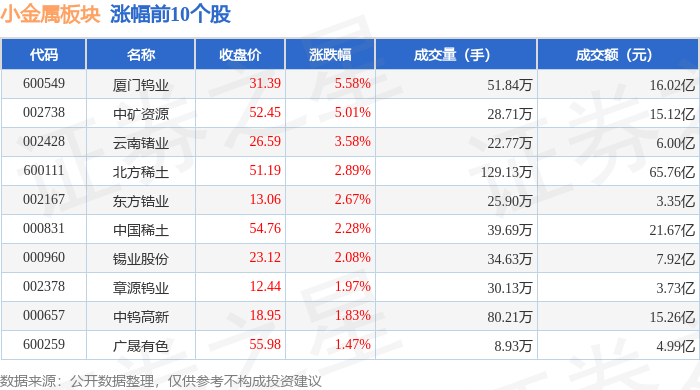
小金属板块10月24日涨2.32%,厦门钨业领涨,主力资金净流入5.35亿元
Zheng Xing Xing Ye Ri Bao· 2025-10-24 08:21
Core Insights - The small metals sector experienced a rise of 2.32% on October 24, with Xiamen Tungsten leading the gains [1] - The Shanghai Composite Index closed at 3950.31, up 0.71%, while the Shenzhen Component Index closed at 13289.18, up 2.02% [1] Small Metals Sector Performance - Xiamen Tungsten (600549) closed at 31.39, up 5.58%, with a trading volume of 518,400 shares and a transaction value of 1.602 billion [1] - Zhongkuang Resources (002738) closed at 52.45, up 5.01%, with a transaction value of 1.512 billion [1] - Yunnan Tin (002428) closed at 26.59, up 3.58%, with a transaction value of 600 million [1] - Northern Rare Earth (600111) closed at 51.19, up 2.89%, with a transaction value of 6.576 billion [1] - Other notable performers include China Rare Earth (000831) and Xiyang Co. (600259), with increases of 2.28% and 1.47% respectively [1] Capital Flow Analysis - The small metals sector saw a net inflow of 535 million from main funds, while retail funds experienced a net outflow of 216 million [2] - Main funds showed significant net inflows in Northern Rare Earth (2.68 million) and Xiamen Tungsten (1.35 million) [3] - Retail funds had notable outflows in Xiamen Tungsten and China Rare Earth, indicating a shift in investor sentiment [3]


中国稀土涨2.17%,成交额7.21亿元,主力资金净流入885.22万元
Xin Lang Cai Jing· 2025-10-24 02:26
Core Viewpoint - China Rare Earth's stock price has shown significant volatility, with a year-to-date increase of 95.01%, but a recent decline of 2.67% over the last five trading days [1] Company Overview - China Rare Earth Group Resources Technology Co., Ltd. is located in Jiangxi Province and was established on June 17, 1998, with its listing date on September 11, 1998. The company specializes in rare earth smelting separation and technology research and services [1] - The main revenue composition includes rare earth oxides (63.51%), rare earth metals and alloys (35.95%), other (0.35%), and technology service income (0.18%) [1] Financial Performance - For the first half of 2025, China Rare Earth achieved operating revenue of 1.875 billion yuan, a year-on-year increase of 62.38%, and a net profit attributable to shareholders of 162 million yuan, reflecting a growth of 166.16% [2] - Cumulative cash dividends since the A-share listing amount to 346 million yuan, with 124 million yuan distributed over the past three years [3] Shareholder Information - As of September 19, 2025, the number of shareholders for China Rare Earth reached 230,000, an increase of 6.66% from the previous period, with an average of 4,614 circulating shares per person, a decrease of 6.25% [2] - The top ten circulating shareholders include Hong Kong Central Clearing Limited and Southern CSI 500 ETF, with notable increases in their holdings [3] Market Activity - On October 24, the stock price rose by 2.17% to 54.70 yuan per share, with a trading volume of 721 million yuan and a turnover rate of 1.25%, resulting in a total market capitalization of 58.049 billion yuan [1] - The stock has appeared on the "Dragon and Tiger List" six times this year, with the most recent instance on October 13, where net purchases amounted to 267 million yuan [1]
中钨高新涨2.21%,成交额4.03亿元,主力资金净流入611.57万元
Xin Lang Cai Jing· 2025-10-23 02:20
Core Viewpoint - Zhongtung High-tech has shown significant stock performance with a year-to-date increase of 104.86%, indicating strong market interest and potential growth in the tungsten industry [1][2]. Financial Performance - For the first half of 2025, Zhongtung High-tech achieved operating revenue of 7.849 billion yuan, representing a year-on-year growth of 15.31% [2]. - The net profit attributable to shareholders for the same period was 510 million yuan, marking a substantial increase of 247.28% year-on-year [2]. Stock Market Activity - As of October 23, Zhongtung High-tech's stock price was 18.54 yuan per share, with a market capitalization of 42.252 billion yuan [1]. - The stock has experienced a trading volume of 403 million yuan on the same day, with a turnover rate of 1.52% [1]. - The stock has been active on the leaderboard twice this year, with the most recent instance on July 30, where it recorded a net buy of -353 million yuan [1]. Shareholder Information - As of June 30, 2025, the number of shareholders for Zhongtung High-tech was 46,800, a decrease of 8.15% from the previous period [2]. - The top ten circulating shareholders include significant institutional investors, with Hong Kong Central Clearing Limited being the third-largest shareholder, increasing its holdings by 4.6167 million shares [3].
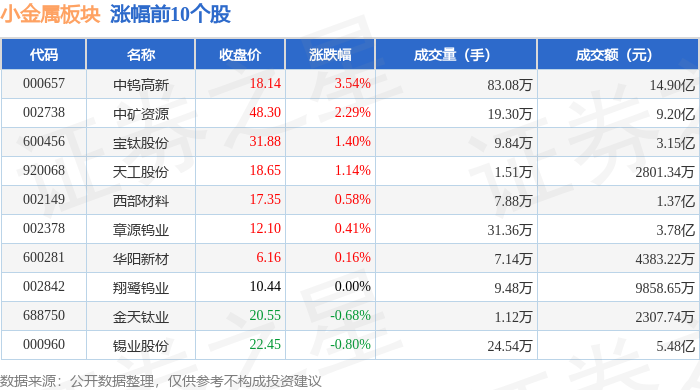
小金属板块10月22日跌1.71%,盛和资源领跌,主力资金净流出14.09亿元
Zheng Xing Xing Ye Ri Bao· 2025-10-22 08:19
Market Overview - The small metals sector experienced a decline of 1.71% on October 22, with Shenghe Resources leading the drop [1] - The Shanghai Composite Index closed at 3913.76, down 0.07%, while the Shenzhen Component Index closed at 12996.61, down 0.62% [1] Individual Stock Performance - Notable gainers included: - Zhongtung High-tech (000657) with a closing price of 18.14, up 3.54% and a trading volume of 830,800 shares, totaling 1.49 billion yuan [1] - Zhongkuang Resources (002738) closed at 48.30, up 2.29% with a trading volume of 193,000 shares, totaling 920 million yuan [1] - Major decliners included: - Shenghe Resources (600392) closed at 22.97, down 4.21% with a trading volume of 787,300 shares, totaling 1.81 billion yuan [2] - Northern Rare Earth (600111) closed at 50.79, down 2.98% with a trading volume of 1,443,800 shares, totaling 731.5 million yuan [2] Capital Flow Analysis - The small metals sector saw a net outflow of 1.409 billion yuan from major funds, while retail investors contributed a net inflow of 1.378 billion yuan [2] - The table of capital flow indicates that Zhongtung High-tech had a net inflow of 1.11 billion yuan from major funds, while it faced a net outflow of 96.99 million yuan from retail investors [3] - Zhongkuang Resources had a net inflow of 31.17 million yuan from major funds, but a net outflow of 72.16 million yuan from retail investors [3]