私募

Search documents
量化指增多头保护策略悄然走红
Zhong Guo Zheng Quan Bao· 2025-09-21 20:17
Core Insights - The A-share market has seen active performance in technology growth and small-cap stocks, highlighting the high volatility and potential risks associated with high returns [1] - A new quantitative strategy focusing on "quantitative enhancement with downside protection" has gained popularity among private equity firms, utilizing stock selection and derivatives for risk management [1][2] Strategy Innovation - The increasing market volatility and demand for stable returns have led to the innovation of quantitative long protection strategies, differentiating from traditional quantitative neutral strategies [1][2] - Various private equity firms are employing different methods for options hedging and risk exposure management, leading to the evolution of these strategies [1][3] Competitive Landscape - FOF institutions and quantitative private equity firms are competing in the quantitative long protection strategy space, each exploring unique implementation paths based on their strengths [3][4] - Mainstream approaches include using off-market options for lower-cost protection and subjective timing for on-market options to hedge risks [3][4] Market Demand - There has been a noticeable increase in inquiries for quantitative long protection strategy products, particularly from high-net-worth clients seeking to balance market participation with risk control [4][6] - The introduction of new strategies reflects an upgrade in management capabilities, transitioning from pure alpha chasing to a comprehensive management approach [5][6] Future Outlook - The development of quantitative long protection strategies is seen as having significant value and potential, aligning with the trend of providing absolute returns to investors [6] - The strategies are expected to gain further traction as more index options become available and market activity increases, optimizing hedging costs [6]
量化私募超额收益“熄火”:进化归来还是重蹈覆辙?
Shang Hai Zheng Quan Bao· 2025-09-21 18:07
Core Viewpoint - The article discusses the recent recovery of quantitative private equity and raises questions about its sustainability, governance, and role in the capital market, suggesting a need for rational reference for industry regulation and sustainable development [1] Group 1: Performance and Market Trends - In the first half of the year, quantitative strategies showed significant excess returns, with over 40 private equity firms managing over 10 billion yuan, and the average new issuance scale exceeding 3 billion yuan [2][5] - However, by August, the performance of quantitative private equity began to decline, with only 19.9% of index-enhanced private equity products achieving positive excess returns [3][4] - The market style switch and the concentration of funds in small-cap stocks contributed to the negative excess returns observed in quantitative strategies [4][3] Group 2: Industry Adjustments and Strategies - Following the lessons from 2024, quantitative private equity firms are reducing leverage and limiting style exposure to avoid repeating past mistakes [2][7] - Many firms are enhancing their risk management systems, implementing multi-dimensional restrictions to ensure proper risk thresholds and real-time monitoring of market conditions [8] - The industry is increasingly focusing on long-term strategy stability, with a shift towards AI and machine learning to improve the efficiency of alpha factor extraction and optimize trading execution [10][11] Group 3: Future Outlook - The ongoing active trading volume in the market is seen as a crucial support for the current recovery of quantitative private equity, with expectations that liquidity shocks will not reoccur [9] - Firms are diversifying their strategies and assets to enhance portfolio stability, exploring multi-strategy approaches and utilizing derivatives to ensure steady asset appreciation [11] - The competition in the quantitative space is expected to shift from short-term performance to long-term adaptability of strategies, emphasizing patience and thoroughness [11]
私募仓位攀至年内最高主观策略强势回归
Zheng Quan Shi Bao· 2025-09-21 17:42
Group 1: Market Sentiment and Positioning - Private equity firms in China are showing increasing optimism, with stock private equity institutions' average positions rising to the highest level of the year at 78.04% as of September 12, up 2.96 percentage points from the previous week [1] - The proportion of private equity firms with heavy or full positions (over 80%) has significantly increased to 60.02%, a rise of 5.81 percentage points week-on-week, while the proportion of firms with no positions has decreased to 5.08%, down 0.77 percentage points [1] - Different scales of private equity firms are maintaining high positions, with those managing over 10 billion yuan averaging 78.22%, and those between 5 billion to 10 billion yuan averaging 86.49%, the highest among all categories [1] Group 2: Performance and Market Trends - The top 100 subjective private equity firms have achieved an average return of 37.43% year-to-date, while the top quantitative firms have an average return of 26.69% [2] - The "Dai Shui Quan Growth Phase I" product from the leading private equity firm Dai Shui Quan has reported a return exceeding 50% [2] - The market is exhibiting a "slow bull" characteristic, with investor risk appetite remaining high, driven by liquidity, fundamentals, and external factors [2] Group 3: Sector Performance and Strategy - There is a clear market stratification, with significant gains in sectors like telecommunications, electronics, and non-ferrous metals, while coal and steel sectors have seen minimal increases [3] - The firm "Jia Gu Capital" emphasizes the importance of understanding one's capability circle and leveraging comparative advantages in familiar areas to maximize returns [3] - The firm suggests using industry ETFs or other tools to adjust investment allocations in response to macroeconomic changes, rather than strictly focusing on bottom-up stock selection [3]
私募仓位攀至年内最高 主观策略强势回归
Zheng Quan Shi Bao· 2025-09-21 16:57
Group 1 - The overall sentiment among private equity institutions remains optimistic despite market fluctuations, with stock private equity institutions' average positions reaching a year-to-date high of 78.04% as of September 12 [1] - The proportion of private equity institutions with heavy or full positions (over 80%) has significantly increased to 60.02%, up by 5.81 percentage points from the previous week, while the proportion of those with no positions has decreased to 5.08% [1] - Different scales of private equity institutions show high average positions, with large-scale institutions (over 10 billion) averaging 78.22%, and those between 5 billion to 10 billion averaging 86.49%, indicating a general trend of maintaining high positions across various sizes [1] Group 2 - The top 100 subjective private equity firms have achieved an average return of 37.43% year-to-date, while the top quantitative private equity firms have an average return of 26.69% [2] - The market is exhibiting a "slow bull" characteristic, with investor risk appetite remaining high, driven by liquidity, fundamentals, and external factors, leading to a shift from "certainty priority" to "growth priority" [2] - Emerging growth opportunities, such as new consumption, innovative pharmaceuticals, robotics, and AI hardware, are becoming significant market drivers, reflecting a renewed focus on fundamental growth rather than just certainty [2] Group 3 - Large private equity institutions, such as Jiangju Capital, observe a clear market stratification, with significant gains in sectors like telecommunications and electronics, while coal and steel sectors show minimal increases [3] - Jiangju Capital emphasizes the importance of understanding one's capability circle and leveraging comparative advantages in familiar areas to maximize expected returns [3] - The firm suggests using industry ETFs or other tools to adjust investment allocations in response to macroeconomic changes, rather than strictly adhering to bottom-up stock selection [3]
A股:再刷新历史纪录!
Sou Hu Cai Jing· 2025-09-21 05:44
另一方面,很多高净值客户也是这轮行情主力。7月私募备案规模为793亿元,环比上升164%,同比上升407%,回到2020~2021年高位水平,而且平均备 案规模远超当时。说明高净值客户已经通过私募入市。 二是估值仍比较合理。沪深300指数中位数股票市盈率约为18倍,基本处于历史均值。而美股市盈率是23倍左右。 三是尽管两融余额创历史新高,但是两融余额占市值的比例实际上远低于2015年水平,没有过热。 这一点券商板块倒是说明了一些信息,尽管A股成交量在高位,指数一直突破阶段性新高,但券商板块表现一直不给力。说明市场远没到疯牛的地步。在 行情上涨之余我们感受到的信息是,很多人还在抱怨牛市赚不到钱,这点恰恰说明还没到大叔大妈跑步进场的过热地步。 另外,有几个迹象也很重要: 数据显示:自今年8月13日以来,A股市场成交额已连续28个交易日超过2万亿元,再刷新历史纪录。 另外,今年8月以来,两融余额已经连续突破2万亿元、2.1万亿元、2.2万亿元、2.3万亿元、2.4万亿元等多个整数关口,并不断创出历史新高。 目前A股在3800-3900点附近止步不前,大家对后市走向有分歧。 不过,高盛在这时候仍然坚定看好。高盛说这轮 ...


平方和投资:策略十年,十年长青,揭秘Alpha背后的投研+风控双引擎
私募排排网· 2025-09-21 00:00
本文首发于公众号"私募排排网"。 (点击↑↑ 上图查看详情 ) 2025年第三季度,A股市场迎来系统性慢牛,市场震荡上行。在此期间,量化私募基金成绩亮眼,据私募排排网数据,截至2025年8月底,在私 募排排网有3只以上产品有今年来业绩展示的量化私募共有173家,今年来收益均值约为22.36%,跑赢了同期的上证指数、深证成指(涨幅分别 为15.10%、21.91%)。其中,收益不低于10%的量化私募有148家。 | 排名 | 产品简称 | 公司简称 | 三级策略 | 實要经猛 | 8月超额 | 今年来超额 | | --- | --- | --- | --- | --- | --- | --- | | T | 磐松微盘股指数增强1号 额 | 磐松资产 | 其他指增 | 吴确 高云翔,曹靖康 | 应合规要求 | | | | 倍漾量化选股二期A类份 | 筒蒙量化 | 量化选股 | 蔡其志 | | | | | 正瀛骐骥指数增强17号 | 正演资产 | 其他指增 | | | | | | 大道崔苇 | 大道投资 | 量化选股 | 朱明强 | | | | ട് | 大岩量化选股1号B类份额 | 大岩资本 | 量化选股 | 黄 ...

喜娜AI速递:今日财经热点要闻回顾|2025年9月20日
Sou Hu Cai Jing· 2025-09-20 11:23
Group 1 - The ChiNext 50 index has seen a year-to-date increase of over 37%, but there has been a net outflow of approximately 67.97 billion yuan from the ChiNext 50 ETF, with over 40 billion yuan withdrawn this year [2] - The largest ChiNext 50 ETF has seen its share count drop below 50 billion, with a reduction of 39.528 billion shares year-to-date [2] - The A-share market shows a mixed trend, with the Shanghai Composite Index down 1.3% for the week, while the Shenzhen Component Index rose by 1.14% [2] Group 2 - Xiaomi announced a 10-year free repair service for its air conditioners, which has sparked a response from Gree's management, emphasizing the importance of product reliability [2] - Xiaomi's automotive division has recalled 116,887 units of its SU7 electric vehicle due to safety concerns related to its L2 autonomous driving feature, leading to a temporary drop of over 2% in its Hong Kong stock price [3] Group 3 - The China Securities Regulatory Commission is pushing for reforms in the capital market to better support the economic recovery, emphasizing the need for strict supervision and adherence to regulations [3] - A total of 51 stocks are facing a risk warning due to information disclosure violations, with a combined market value of 61.922 billion yuan set to be unlocked next week [4] Group 4 - U.S. stock indices reached new highs for the second consecutive day, while oil prices fell and gold prices increased by over 1% [5] - Goldman Sachs has upgraded its outlook on the Chinese stock market, citing favorable conditions from the recent interest rate cut by the Federal Reserve and a positive sentiment among long-term foreign investors [5]
股市“捉妖”!量化私募跑路真相曝光 利用FOF进行场外配资、操纵市场
Shang Hai Zheng Quan Bao· 2025-09-19 09:35
Core Viewpoint - The recent exposure of details regarding the "30 billion quantitative private equity fund run" incident reveals the manipulation of the securities market by the involved parties, leading to significant legal consequences for the perpetrators [1][3][5]. Group 1: Incident Overview - The involved parties, including the actual controllers Mao and Yao of Panjing Investment, utilized FOF funds and private equity funds to manipulate the stock market, specifically targeting a stock code-named "Penguin" [1][3]. - From November 2017 to July 2019, the perpetrators controlled 55 accounts to trade the "Penguin" stock, eventually becoming one of its major shareholders by September 2020 [3][4]. Group 2: Legal Proceedings - The Shanghai First Intermediate Court sentenced Mao, Yao, and another accomplice to prison terms ranging from three years and six months to seven years for manipulating the securities market, along with fines between 1.5 million to 2.5 million yuan [5][6]. - Despite their refusal to confess, the Supreme People's Procuratorate utilized advanced AI tools to analyze the structure and operations of the involved funds, leading to a thorough investigation and eventual convictions [5][6]. Group 3: Industry Implications - The case has highlighted a black and gray industrial chain involving illegal financing practices through FOF and private equity funds, indicating a need for stricter regulatory oversight in the private equity sector [6][7]. - Regulatory bodies have intensified their scrutiny of private equity fund operations, aiming to eliminate illegal practices and promote healthy development within the industry [7][8].
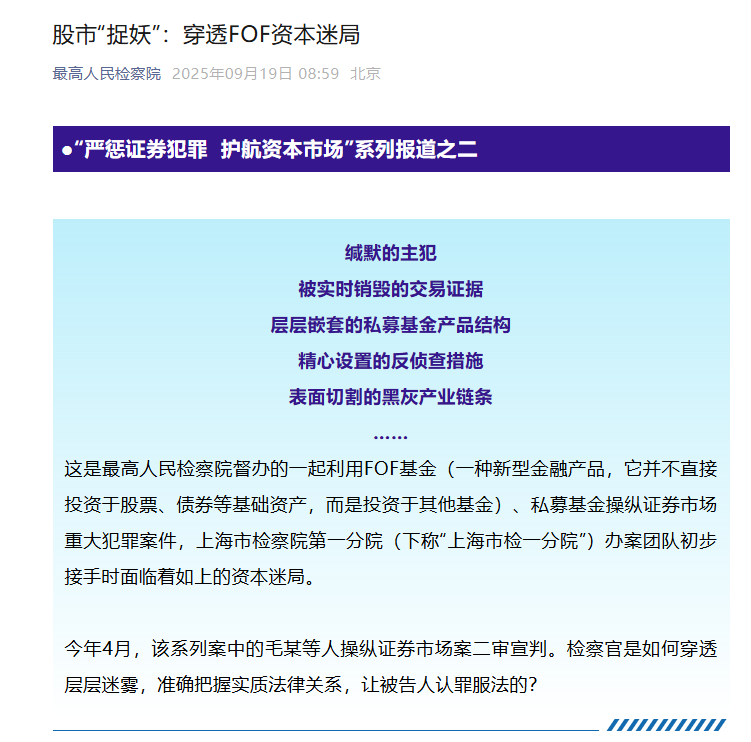
股市“捉妖”!量化私募跑路真相曝光
Shang Hai Zheng Quan Bao· 2025-09-19 09:16
Core Insights - The recent exposure of the "30 billion quantitative private equity run" incident reveals the manipulation of the securities market by the actual controllers of Panjing Investment, leading to significant legal consequences for the involved parties [1][3][5]. Group 1: Company Actions - The actual controllers of Panjing Investment, Mao and Yao, utilized FOF and private equity funds to manipulate the stock price of a company referred to as "Penguin" through a network of 55 accounts [3][4]. - Mao and Yao formed trading teams across multiple cities to maintain the stock price of "Penguin" after it faced consecutive trading halts, indicating a coordinated effort to manipulate the market [3][4]. - The investigation revealed that Mao and Yao had previously been penalized 15 million yuan for illegal stock purchases, highlighting a history of regulatory violations [4]. Group 2: Legal Proceedings - The Shanghai First Intermediate Court sentenced Mao, Yao, and another individual to prison terms ranging from three years and six months to seven years for market manipulation, along with fines between 1.5 million and 2.5 million yuan [5]. - Despite their refusal to admit guilt during the investigation, the Supreme People's Procuratorate utilized advanced AI tools to uncover the manipulation scheme, demonstrating the effectiveness of modern investigative techniques [4][6]. Group 3: Industry Implications - The case has exposed a black and gray industrial chain involving illegal financing practices through FOF and private equity funds, prompting increased scrutiny from regulatory bodies [6][7]. - Regulatory agencies have intensified their oversight of private equity funds, implementing new rules to prevent illegal activities and ensure compliance with investment regulations [7]. - The private equity industry is urged to move towards legitimate practices, as only compliant firms will thrive in the long term, while fraudulent entities will face elimination [7].
报!私募山庄惊现七把绝世神兵
雪球· 2025-09-19 08:37
Core Viewpoint - The article presents a metaphorical exploration of various investment strategies in the private equity space, likening them to legendary weapons, each with unique strengths and weaknesses, suitable for different market conditions and investor preferences [2][6]. Group 1: Investment Strategies - The first strategy, "Qinglong Yanyue Dao" (Subjective Long), relies heavily on the fund manager's ability to select stocks and time the market, performing well in bullish markets with clear themes [9][10][15]. - The second strategy, "Xuedizi" (Quantitative Long), utilizes complex algorithms to identify stocks based on specific metrics, excelling in active markets with high trading volumes [18][20][23]. - The third strategy, "Zhuge Lian" (Macro Hedging), involves top-down asset allocation across stocks, bonds, and commodities, generally effective in diverse market conditions but can fail during extreme events [26][30][31]. - The fourth strategy, "Fang Tian Hua Ji" (CTA Strategy), focuses on futures markets, capturing trends regardless of price direction, suitable for markets with significant price movements [33][35][39]. - The fifth strategy, "Taiji Shuang Jian" (Market Neutral), aims to generate absolute returns by hedging market risks, effective in bear and volatile markets but may underperform in bull markets [41][45][48]. - The sixth strategy, "Ruan Wei Jia" (Fixed Income +), combines high-quality bonds with a small allocation to riskier assets, providing stability but vulnerable to rising interest rates [50][53][56]. - The seventh strategy, "Xiu Hua Zhen" (Arbitrage), exploits price discrepancies across markets, generating small but cumulative profits, effective in volatile conditions but reliant on market efficiency [58][61][63]. Group 2: Strategy Suitability - Each strategy is designed for specific market conditions, with subjective long strategies thriving in bullish environments, while quantitative strategies excel in active trading scenarios [15][23]. - Macro hedging strategies are versatile but can falter during extreme market events, while CTA strategies benefit from significant price trends [31][39]. - Market neutral strategies provide a buffer against market downturns, whereas fixed income plus strategies are contingent on interest rate movements [48][56]. - Arbitrage strategies are most effective in volatile markets but depend on the quick correction of price discrepancies [63]. Group 3: Conclusion - The article concludes by encouraging investors to choose strategies that align with their risk preferences, highlighting the importance of understanding each strategy's unique attributes and market applicability [67][69].