
创新药

Search documents
多家外资银行发布2026年经济展望 普遍看好中国经济前景
Zheng Quan Ri Bao· 2026-01-12 17:18
Group 1 - Foreign banks are optimistic about China's economic outlook for 2026, particularly favoring the technology and healthcare sectors [1][2] - HSBC forecasts stable global economic growth in 2026, with a focus on boosting domestic demand in China and ongoing structural reforms [1] - Deutsche Bank highlights 2025 as a pivotal year for reshaping China's long-term economic prospects, emphasizing the importance of technological strength [1] Group 2 - DBS Bank emphasizes the need to invest in critical industries and quality core assets amidst global challenges, with technology and healthcare as key investment areas for 2026 [2] - HSBC's chief economist for Greater China notes that innovation-driven growth in China is accelerating, particularly in AI and innovative pharmaceuticals, which are expected to attract foreign investment [2] - Standard Chartered Bank maintains an overweight position on Chinese stocks, focusing on technology, healthcare, and telecommunications sectors [3]

A股收评:沪指17连阳,成交额超过3.6万亿!这些信号决定周二走势
Sou Hu Cai Jing· 2026-01-12 16:30
Core Viewpoint - The A-share market has experienced a historic surge, with the Shanghai Composite Index achieving a record 17 consecutive gains, breaking a 33-year record, and trading volume exceeding 3.6 trillion yuan, marking a historical high [1][3]. Group 1: Market Dynamics - The core driving force behind this historic rally is the explosive growth of technology sectors, particularly AI applications, brain-computer interfaces, and commercial aerospace stocks, with some stocks in the commercial aerospace sector seeing annual gains exceeding 350% [3][8]. - The trading volume on January 12 surged by 4.787 trillion yuan, reaching a total of 3.6 trillion yuan, significantly surpassing the peak of the 2015 "924 market" [3][8]. - The number of new A-share accounts opened in December 2025 increased by 30.55% year-on-year, indicating a strong influx of retail investors into the market [3][8]. Group 2: Sector Performance - The market has shifted from a "two-eight" distribution to a "broad-based rally," with previously undervalued sectors like insurance and securities also experiencing gains [4][5]. - The performance of various sectors has shown significant divergence, with the non-ferrous metals sector leading with a 94.73% increase, while the food and beverage sector saw a decline of 9.69% [8][9]. Group 3: Investment Sentiment - Investor sentiment has been significantly boosted by the continuous rise in stock prices, leading to increased participation from both institutional and individual investors [5][11]. - The current market environment has led to a notable increase in the willingness of retail investors to enter the market, with discussions about stocks becoming commonplace among the public [5][11]. Group 4: Financial Indicators - The financing balance has surpassed 2.6 trillion yuan, reaching a historical high, indicating that leveraged funds are entering the market at an accelerated pace [3][11]. - The capital market's ecosystem is improving, with insurance funds holding equity assets exceeding 4.7 trillion yuan, and the total scale of stock ETFs surpassing 3.7 trillion yuan, reflecting a 35.5% year-on-year growth [11][12]. Group 5: Economic Context - The current market rally is supported by substantial improvements in the underlying economy, with the CPI rising by 0.8% year-on-year and the PPI's decline narrowing to -1.9% [7][11]. - The government's fiscal policy is expected to maintain a deficit rate of around 4%, with anticipated monetary policy easing, including a potential 10 basis point interest rate cut and a 50 basis point reserve requirement ratio reduction [11][12].


宽松交易临近,创新药延续反弹
Sou Hu Cai Jing· 2026-01-12 12:30
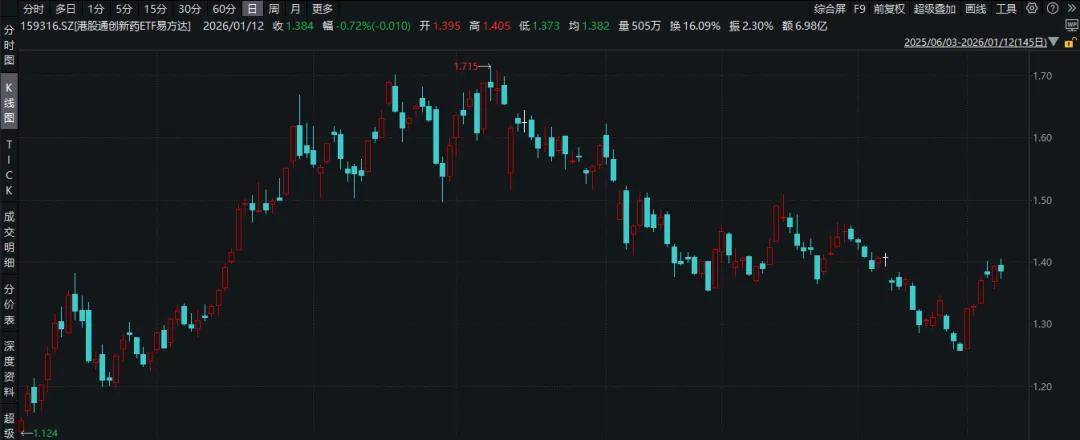
Core Viewpoint - The Hong Kong innovative drug sector has emerged as the best-performing segment in the market during the first week of trading this year, with several companies rebounding over 10% [1][3]. Group 1: Market Performance and Trends - The primary reasons for the strong performance include a significant rise in global markets, with the US biotech ETF XBI outperforming the market by 25% since Q4 2025, while Hong Kong innovative drugs are beginning to recover the gap [1][3]. - The market's risk appetite has improved, with ongoing interest in AI themes and innovative drugs, leading to new highs in US biotech stocks [1][3]. - Anticipation for the upcoming JPM Healthcare Conference is high, as Chinese innovative drug companies are expected to present data that could facilitate more business development (BD) transactions [1][9]. Group 2: Business Development Opportunities - The innovative drug sector is expected to benefit from a surge in BD transactions, with projections indicating that by 2025, the total value of BD deals involving Chinese innovative drug companies could reach $135.6 billion, with 157 transactions expected [9][11]. - Recent notable BD transactions include a $2 billion licensing deal for a prostate cancer drug and a $1.06 billion deal for an ADC drug, highlighting the growing interest from multinational pharmaceutical companies [9][11]. Group 3: Economic Factors and Valuation - The expectation of US interest rate cuts is rising, with a 40.7% probability of a rate cut in March, which could serve as a catalyst for the innovative drug sector throughout the year [11][12]. - The valuation of the innovative drug sector has adjusted significantly, with current static valuations being much lower compared to September 2025, indicating potential for future growth as the sector continues to attract BD transactions [12][13]. Group 4: Investment Strategy - Given the current market conditions, investing in innovative drugs through ETFs is recommended as a stable approach, particularly with the anticipated increase in BD transactions and the potential for significant returns [15].
同样是牛市,为什么2025年赚钱比2020年难?
雪球· 2026-01-12 08:39
Group 1 - The core viewpoint of the article emphasizes that the A-share market is more sensitive to liquidity than to macro fundamentals, indicating a structural bull market driven by capital influx rather than corporate performance [3][4][5] - The overall revenue and net profit growth of non-financial listed companies in the first three quarters was only 0.7% and 1.92% respectively, contrasting with the over 20% growth expected for the entire year, highlighting a disconnect between market performance and corporate earnings [4] - The article identifies two types of capital influencing the market: one based on fundamental performance expectations and the other driven by momentum effects, leading to a "stronger gets stronger" dynamic in stock performance [5][6] Group 2 - True momentum sectors are characterized by sustainable growth logic and broad industry trends, supported by measurable performance variables, while pseudo-momentum sectors rely on speculative assumptions and are often driven by market sentiment [10][11] - The article discusses the distinction between true and pseudo momentum, noting that true momentum sectors have strong institutional participation and consistent earnings growth, while pseudo momentum sectors often lack fundamental backing and are more volatile [12][13] - The performance of momentum strategies in the A-share market has been inconsistent, with cross-sectional momentum strategies underperforming due to rapid sector rotations and frequent policy changes [17][18] Group 3 - The article suggests that the market dynamics in 2025 will be more challenging for investors compared to the 2019-2021 period, where both cross-sectional and time-series momentum strategies were effective due to strong macro fundamentals and diverse sector performance [20][21] - It highlights that the lack of counterbalancing sectors in the A-share market has led to extreme price movements, where strong sectors experience rapid increases followed by sharp declines [24] - The article provides four recommendations for investors to navigate the current momentum-driven market, emphasizing the importance of recognizing sector differentiation, maintaining confidence in fundamentally strong stocks, and being sensitive to trend reversal signals [27][30]

手术机器人行业或进入商业化和政策加速期,关注天智航、微创机器人-B
China Post Securities· 2026-01-12 06:40
Industry Investment Rating - The industry investment rating is "Outperform the Market" and is maintained [2] Core Viewpoints - The surgical robot industry is entering a commercialization and policy acceleration phase, with significant growth potential driven by new policies and market demand [5][6][25] - The overall performance of the pharmaceutical and biotechnology sector has improved, with a notable increase in stock prices and market activity [7][29] - The innovation drug sector is experiencing a recovery, supported by advancements in technology and upcoming industry events [31][32] Summary by Relevant Sections Surgical Robot Industry - In the first eleven months of 2025, surgical robot sales reached 332 units, a slight increase of 3.75% year-on-year, with total sales amounting to 2.973 billion yuan, a minor decline of 0.87% [16] - The laparoscopic surgical robot segment accounted for 35.8% of total sales volume and 61.3% of sales revenue, while orthopedic surgical robots saw a 17.81% increase in sales volume and a 21.62% increase in sales revenue [16][17] - The national pricing framework for robotic surgeries is expected to enhance the clinical value and drive market growth [22][24] Beneficiary Companies - MicroPort MedBot has a strong global strategy and is expected to achieve breakeven in 2026, benefiting from favorable domestic policies and increasing market penetration [6][25][27] - Tianzhihang holds over 40% market share in the domestic orthopedic surgical robot market and is positioned as a leader with significant growth potential in service and consumable revenues [6][25][27] Market Performance - The A-share pharmaceutical and biotechnology sector rose by 7.81% from January 5 to January 9, 2026, outperforming the CSI 300 index by 5.03 percentage points [7][29] - The hospital sector within the pharmaceutical sub-industry saw the highest increase, with a rise of 13.92% [7][29] Innovation Drugs and Industry Chain - The innovation drug sector is expected to see continued growth, driven by new technologies and upcoming clinical data updates at the JPM conference [31][32] - The demand for R&D outsourcing is stabilizing, and the supply side is expected to recover as pricing levels reach a bottom [32] Medical Devices - The medical device sector is anticipated to gradually recover profitability, aided by policy adjustments and market corrections [34][35] - Key players in the high-value consumables market are expected to benefit from reduced competition and improved pricing strategies [35] Pharmaceutical Commerce - The number of drugstores in China has been declining, with a significant reduction in the number of stores, indicating a consolidation phase in the industry [40] - Leading drugstore chains are expected to improve profit margins in 2026 through operational optimizations and strategic adjustments [40]
市场情绪积极,机构建议关注有业绩验证的高景气、以及具备政策支持确定性的方向
Mei Ri Jing Ji Xin Wen· 2026-01-12 05:49
Group 1 - The core viewpoint of the articles indicates a strong market performance in the A-share market, particularly in AI applications and healthcare sectors, signaling positive investor sentiment and a favorable funding environment [1] - The analysis from Ping An Securities suggests that the A-share market's "opening red" is a positive signal, with short-term indices expected to consolidate at high levels and limited room for correction [1] - Key sectors to focus on include technology growth driven by domestic and international demand, advanced manufacturing benefiting from industry recovery and technological upgrades, cyclical sectors supported by commodity price increases, and dividend assets that still hold investment value [1] Group 2 - Relevant investment products include a Free Cash Flow ETF (159201) and its linked funds, which are characterized by high index quality and strong risk resistance, suitable for long-term investment [2] - The Petrochemical ETF (159731) and its linked funds are guided by top-level design to shift the industry from "quantity increase" to "quality improvement," with ongoing supply-demand improvements expected to sustain upward momentum [2] - The ChiNext New Energy ETF (159368) covers the new energy and electric vehicle sectors, involving multiple sub-sectors such as batteries and photovoltaics [2] - The Hang Seng Internet ETF (513330) focuses on software applications and internet media, with major holdings in Alibaba, Tencent, and Meituan, accounting for nearly 40% of the total weight [2]
西部证券港股“三重门”
Western Securities· 2026-01-12 02:05
Group 1: Market Overview - In 2025, Hong Kong stocks outperformed A-shares overall, but weakened in the second half due to a stronger USD, slowing southbound capital inflow, and deteriorating fundamentals[6] - In 2026, three factors are expected to drive a rebound in Hong Kong stocks: a weaker USD, appreciation of the RMB attracting overseas Chinese capital, and a recovery in inflation and potential debt reduction policies[6][8] Group 2: Capital Flows - The first gate: A weaker USD in 2026 is likely to drive international capital to allocate more to Hong Kong stocks[8] - The second gate: RMB appreciation in 2026 is expected to attract a significant amount of overseas Chinese capital into Hong Kong stocks, which will be smoother than southbound capital that faces opportunity costs and exchange rate risks[11][60] - The third gate: Recovery in cash flow statements and balance sheets of the real economy in 2026 will mark the beginning of economic prosperity in China[12] Group 3: Investment Opportunities - The "Davis Triple Play" is anticipated for the Hang Seng Technology Index in 2026, with structural opportunities in innovative drugs and new consumption continuing[14][95] - Hong Kong stocks' dividend yield is expected to continue outperforming A-shares, with a long-term higher dividend rate attracting absolute return funds[120] - The innovative drug sector in Hong Kong is expected to see significant growth as Chinese companies improve their R&D capabilities and close the valuation gap with U.S. counterparts[126] Group 4: Risks - Risks include changes in international situations, unexpected increases in U.S. Treasury yields, and shifts in industrial policies[13][141]
中金:港股和A股谁“错”了?
Xin Lang Cai Jing· 2026-01-12 01:18
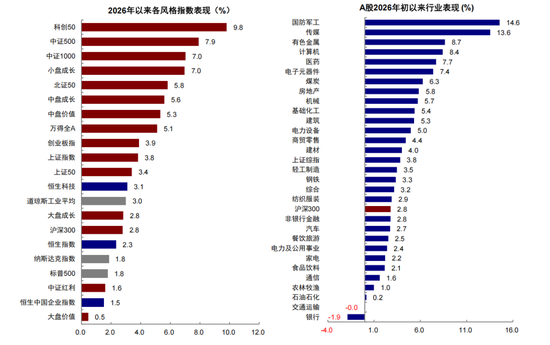
Group 1 - The core driver of the A-share market's strong performance at the beginning of 2026 is the "excess liquidity" chasing "scarce return assets," rather than significant changes in the macroeconomic fundamentals [2][11] - The A-share market has shown a clear structural preference for sectors like commercial aerospace, non-ferrous metals, and brain-computer interfaces, with small-cap stocks outperforming large-cap stocks [2][3] - The A-share market's gains have primarily been driven by valuation expansion, while traditional consumer stocks have lagged behind due to their closer correlation with domestic demand fundamentals [2][5] Group 2 - The Hong Kong stock market has underperformed due to a lack of attractive structural opportunities and a weaker funding environment, reflecting a deteriorating fundamental backdrop [10][13] - The absence of significant inflows from southbound capital has been noted, with December's average daily inflow dropping to 10.9 million HKD, significantly lower than the 60 million HKD average for the entire year [18][20] - The Hong Kong IPO market remains active, with a total of 2,858 million HKD raised in 2025, but the overall market performance has been muted compared to A-shares [20][21] Group 3 - Historical analysis indicates that the "spring market" effect is more pronounced in A-shares than in Hong Kong stocks, with A-share indices showing an average increase of 4.6% during the period from early December to early March, compared to only 0.5% for Hong Kong stocks [23][24] - The A-share market has consistently outperformed the Hong Kong market in terms of sector performance, particularly in technology, military, and home appliance sectors, which have shown average gains around 10% [23][24] Group 4 - The structural differences between A-shares and Hong Kong stocks lead to varying earnings growth rates, with A-shares expected to see a growth rate of 4%-5% in 2026 compared to 3% for Hong Kong stocks [30] - A-shares benefit from a more favorable micro liquidity environment, while Hong Kong stocks face multiple constraints, including potential declines in southbound capital inflows [33][34] - The unique structural opportunities in Hong Kong, such as high dividend yields and sectors like internet and innovative pharmaceuticals, provide a complementary investment avenue despite the overall market underperformance [35][36]
解构2026开年行情:寻找共识 拥抱趋势 警惕泡沫
Zhong Guo Zheng Quan Bao· 2026-01-12 01:17
Group 1 - The core of the recent A-share market rally is driven by a combination of policy expectations, industry trends, capital flow, and market sentiment, indicating a multi-dimensional resonance [2][3] - The influx of capital is evident, with significant net inflows from northbound funds and daily trading volumes increasing from 1.7 trillion yuan to over 3 trillion yuan, creating a positive feedback loop in the market [2][3] - Institutional investors are adopting a dual strategy of offensive and defensive positions, focusing on sectors like AI and cyclical industries while also ensuring safety margins in their portfolios [5][6][7] Group 2 - The market outlook remains optimistic as institutions expect the spring rally to continue, with a focus on high-growth areas such as AI applications, commercial aerospace, and innovative pharmaceuticals [8][9] - Personal investors are advised to rely on professional management, focus on long-term trends, and utilize standardized investment tools like ETFs to mitigate selection difficulties [9][10] - The current market environment emphasizes the importance of maintaining investment discipline and avoiding emotional trading, with a call for investors to set clear profit and loss thresholds [9][10][11]
四大证券报精华摘要:1月12日
Zhong Guo Jin Rong Xin Xi Wang· 2026-01-12 00:43
Group 1: Capital Market Developments - The 30th China Capital Market Forum highlighted the importance of the 14th Five-Year Plan for advancing China's modernization and building a strong financial nation, with a focus on risk prevention, strong regulation, and high-quality development [1] - As of January 11, 2026, 108 A-share companies disclosed their 2025 earnings forecasts, with 60 companies showing positive expectations, resulting in a positive growth trend overall [1] - The China Securities Regulatory Commission (CSRC) announced that A-share companies are expected to distribute a record cash dividend of 2.55 trillion yuan in 2025, reflecting improved profitability and cash flow [2] Group 2: Pharmaceutical Innovations - Zai Lab announced the approval of its innovative product, a human thyroid-stimulating hormone beta injection, marking a significant milestone in China's domestic innovative drug development [3] - The National Medical Products Administration (NMPA) plans to enhance support for innovative drugs, focusing on new mechanisms and targets to facilitate their approval and market entry [3] Group 3: Stock Market Performance - The A-share market has seen a significant upward trend since December 17, 2025, with the Shanghai Composite Index surpassing 4100 points, the highest since July 2015 [4] - The market's strong performance is attributed to multiple factors, including policy support, capital influx, and industry trends, with a notable increase in trading volume [5] - Public funds have seen substantial inflows, with over 450 billion yuan entering the market since the beginning of 2026, indicating a shift in investment strategies [6] Group 4: Foreign Investment Trends - There is a growing enthusiasm among global investors for Chinese assets, driven by stable fundamentals, attractive valuations, and ongoing market liberalization [8] - Foreign capital is increasingly focusing on companies with strong R&D capabilities and global presence, particularly in the technology sector [8] Group 5: ETF Market Dynamics - The theme-based ETFs have gained significant traction, with a net inflow of 9.519 billion yuan and an average net value growth rate of 6.6% since the start of 2026 [9] - The public fund industry is moving towards differentiated product offerings, aiming to provide investors with more precise asset allocation tools [9]