运动服饰

Search documents
优衣库大中华区同店销售回暖;耐克CEO承认中国市场存在挑战;宗馥莉二度辞职哇哈哈|品牌周报
36氪未来消费· 2025-10-12 11:14
Group 1: Uniqlo's Performance - Uniqlo's parent company, Fast Retailing, reported a record operating profit of 564.27 billion yen for the fiscal year ending August 2025, marking the fourth consecutive year of growth [3] - The Southeast Asia, India, and Australia regions showed significant sales performance, with North America and Europe also achieving double-digit growth in both revenue and profit [3] - In North America, revenue increased by 24.5% year-on-year, while profit rose by 35.1%; Europe saw revenue growth of 33.6% and profit growth of 23.7% [3] - Despite the overall decline in revenue in Greater China by 4.0% to 650.2 billion yen, the recovery in same-store sales in Japan and Greater China contributed to profit growth [3] - Uniqlo's success in the U.S. market was driven by a combination of price increases (approximately 5% on core items) and cost control measures, leading to a same-store sales growth of 3% [3] Group 2: Nike's Challenges in China - Nike's CEO acknowledged structural challenges in the Chinese market, which has seen a decline in performance for five consecutive quarters [5][6] - In the first quarter of fiscal year 2026, Nike's revenue in Greater China was $1.512 billion, down from $1.735 billion and $1.666 billion in the previous two fiscal years [5] - The company is focusing on improving sales trends through store updates, enhancing brand differentiation, and reducing inventory buildup among partners [5][6] Group 3: Wahaha's Leadership Changes - Zong Fuli has resigned from her positions at Wahaha Group, transitioning to focus on her own brand, "Wah Xiao Zong," while retaining a 29.4% stake as the second-largest shareholder [7] - The resignation is linked to compliance issues regarding the use of the "Wahaha" trademark, prompting her to shift her focus to her new brand [7] - Recent family disputes have negatively impacted Wahaha's sales and market confidence, with reported declines in daily sales and live-streaming events [8] Group 4: H&M and Designer Collaborations - H&M announced a collaboration with Chinese designer Jacuques Wei for the upcoming Year of the Horse Spring Festival, marking the second designer partnership in a long-term project with Shanghai Fashion Week [10] Group 5: Lululemon and Erewhon Collaboration - Lululemon partnered with Erewhon, a high-end organic supermarket, to launch a collection of apparel and accessories, set to debut in Shanghai [11] Group 6: Gucci's Increased Foot Traffic - Following the debut of Demna's collection, Gucci experienced a significant increase in store traffic, with a 53% rise in weekly visits at the Rodeo Drive location in Los Angeles [14] Group 7: Blue Bottle Coffee Expansion - Blue Bottle Coffee opened its third store in Shenzhen, continuing its slow but steady expansion in China, with a total of 15 stores across major cities [15] Group 8: Anker's New COO Appointment - Anker appointed a new Chief Operating Officer to enhance its market share, with plans to expand the use of its innovative manufacturing technology [16] Group 9: Zhou Dasheng's Acquisition of MBL - Zhou Dasheng Jewelry Group acquired the high-end audio brand MBL, which recently emerged from bankruptcy, aiming to expand its global sales network, particularly in the growing Chinese high-end audio market [17]



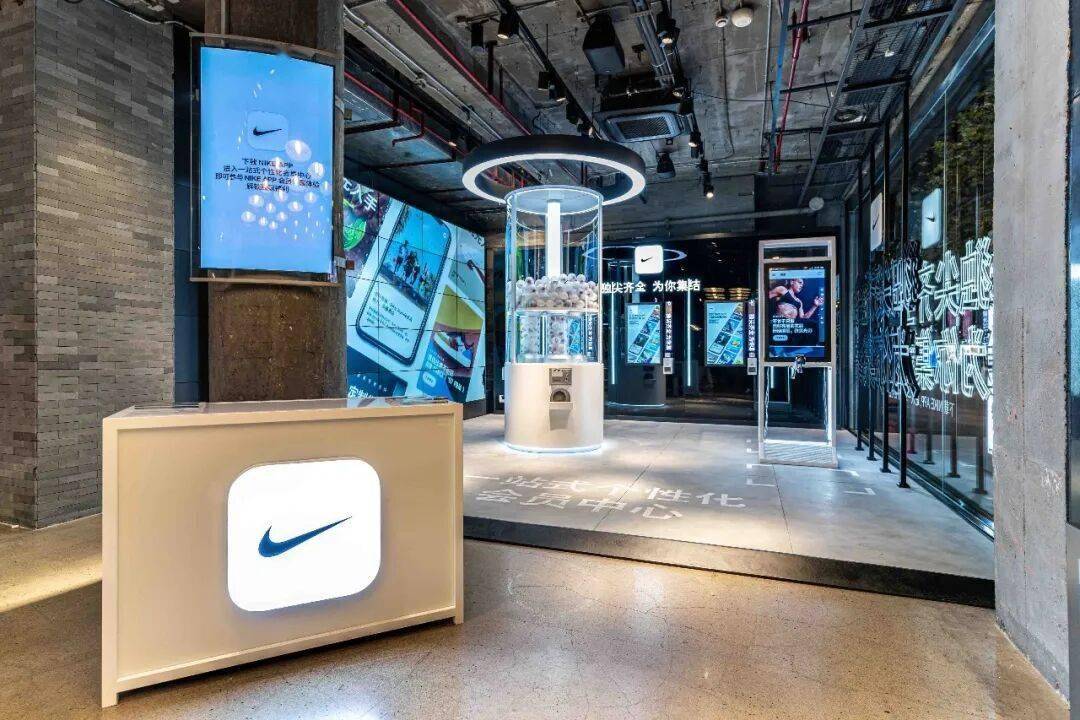
耐克大中华区营收下滑10%,CEO表示复苏还需时间
Sou Hu Cai Jing· 2025-10-12 11:05
Group 1 - Nike reported Q1 FY2026 financial data with total revenue of $11.7 billion, a 1% year-over-year increase, exceeding market expectations of $11 billion [2] - Net profit decreased by 31% to $700 million, but this figure was nearly double the average analyst estimate from Visible Alpha [2] - The company emphasized its strategic focus on the 'Win Now' plan to strengthen core areas such as North America, wholesale, and running, while managing external challenges [2] Group 2 - Revenue growth was observed in all regions except Greater China, where revenue declined by 10% to $1.5 billion [2] - CEO Elliott Hill acknowledged "structural challenges" in the market but expressed confidence in long-term opportunities in China, particularly in running, training, basketball, and soccer apparel [2] - The estimated annual tariff cost was raised to $1.5 billion, a 50% increase from the previous estimate of $1 billion, representing about 3% of Nike's $46.3 billion revenue from last year [2] Group 3 - CEO Elliott Hill indicated that the company's turnaround plan is showing initial signs of progress, but restoring profit growth will take time [3] - Hill mentioned that the company is considering three brands across various sports and 190 countries, each at different development stages [3] - The path to achieving mid to high single-digit revenue growth and strong profit margins will require time and is not linear, but the company has a strategy to achieve these goals [3]
为什么跑鞋,是运动品牌的必争之地?
3 6 Ke· 2025-10-12 05:07
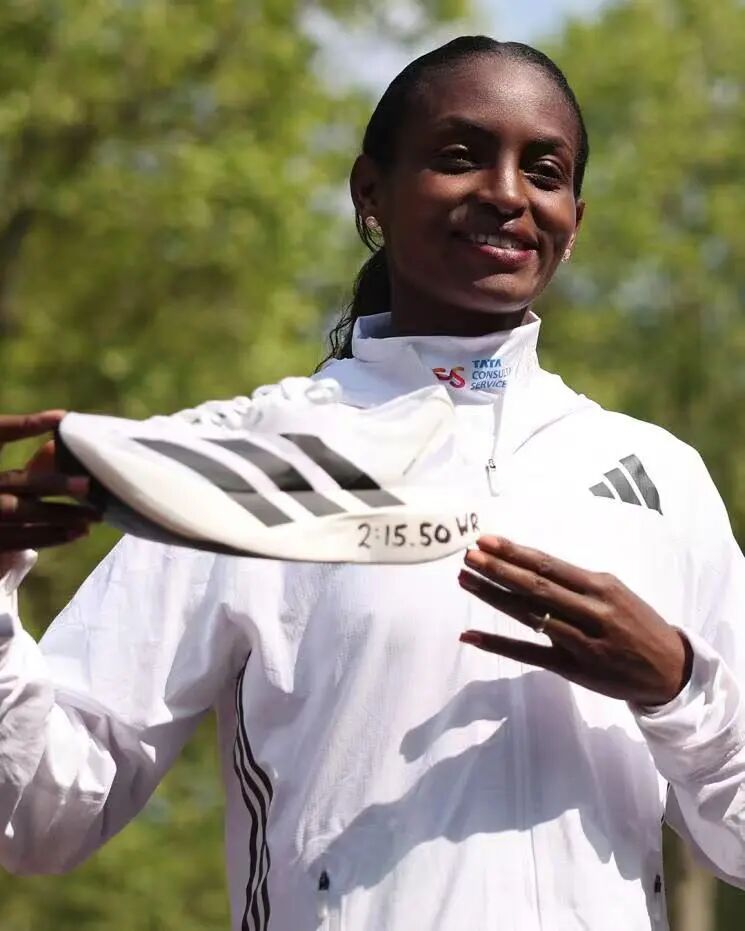
Core Insights - The running shoe segment has become a focal point for both emerging and traditional sports brands, with significant growth driven by consumer interest in health and fitness post-pandemic [1][2][6] Group 1: Market Performance - Nike's running business achieved a 20% global growth in Q1 of FY2026, with strong consumer response to new products like the top-tier Flyknit and React Infinity [2] - Salomon's footwear segment saw a 35% year-on-year revenue increase to $414 million in Q2 2025, marking it as the fastest-growing segment among its three main categories [2] - On's net sales rose by 32% to 749 million Swiss francs in Q2 2025, with the Asia-Pacific market showing a remarkable 114.8% sales increase [4] Group 2: Consumer Trends - The rise in running shoe popularity is linked to a broader trend of health consciousness among middle-class consumers, with running being an accessible form of exercise [1][6] - High-priced running shoes are becoming status symbols, akin to luxury items, as consumers seek to showcase their commitment to health and fitness on social media [6][9] Group 3: Competitive Landscape - Brands like Lululemon and Arc'teryx are diversifying into running shoes, indicating that capturing the running market is essential for growth across various sports categories [7][11] - High profit margins in the running shoe market are evident, with On achieving a gross margin of 61.5%, significantly above the industry average [9] Group 4: Product Innovation - The competitive edge in the running shoe market is increasingly driven by technological advancements in shoe design, particularly in midsole technology, which affects performance metrics like cushioning and energy return [9][12] - There is a growing demand for diverse running shoe options tailored to different consumer needs, such as casual runners and those with specific foot conditions [14][15]

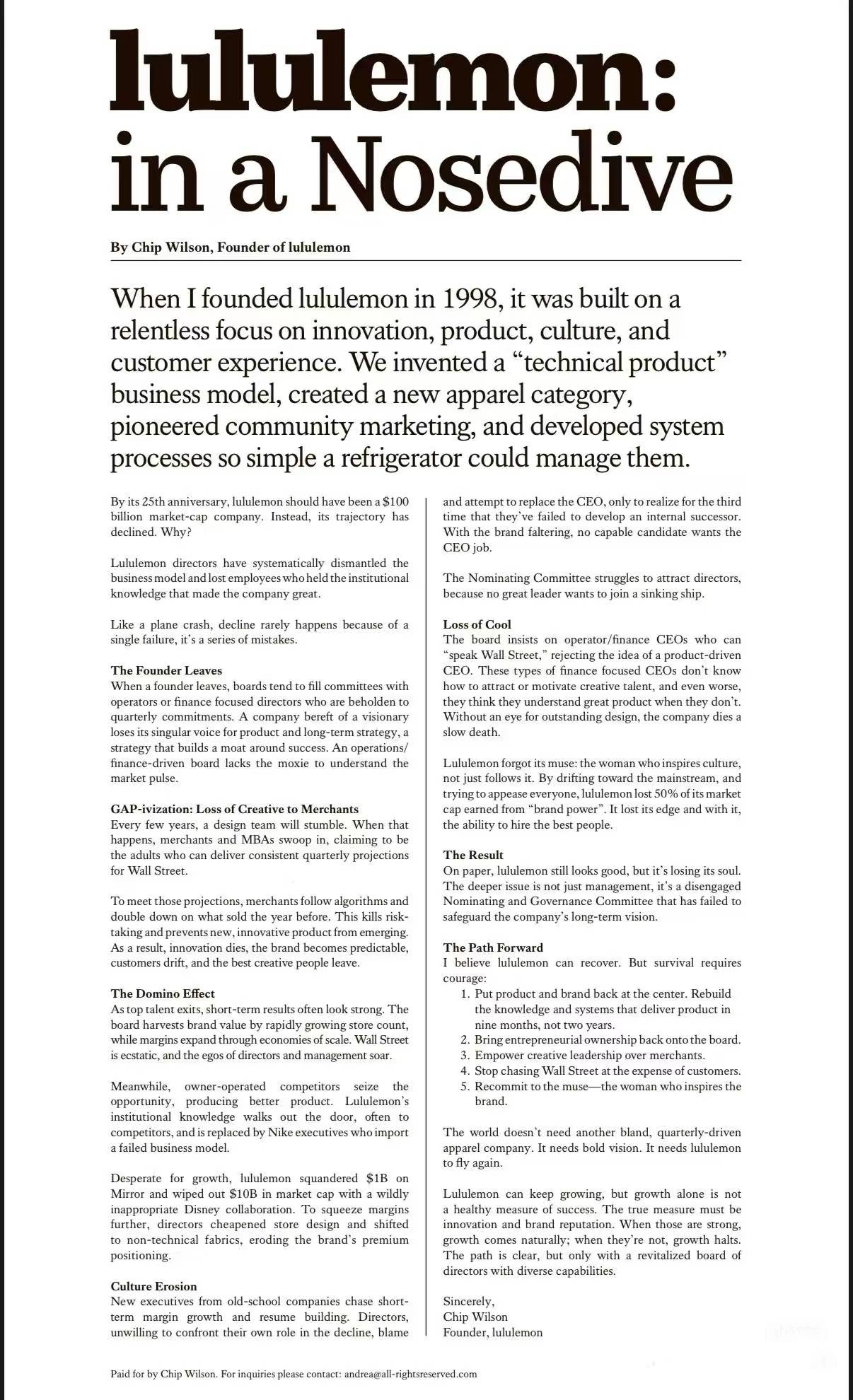
lululemon何以被创始人炮轰“五宗罪”
凤凰网财经· 2025-10-11 12:37
Core Viewpoint - Chip Wilson, the founder of lululemon, expresses deep concern over the company's declining growth trajectory and criticizes the management for losing sight of the brand's core values and innovation [6][8][25]. Group 1: Issues Identified by Chip Wilson - The decline of lululemon is attributed to a systematic dismantling of its business model, leading to a loss of essential expertise and innovation [3][9]. - Wilson identifies five critical mistakes that have contributed to the brand's decline, including a management focus on short-term financial performance over long-term strategic vision [9][11]. - The management's shift towards a more commercial approach has led to a dilution of creativity and innovation, resulting in a predictable and mediocre product line [11][12]. Group 2: Financial Performance and Market Dynamics - lululemon's financial data indicates a troubling trend, with a decline in net profit for the first quarter of fiscal year 2025, marking the first drop in four years [19]. - The company's growth is heavily reliant on the Chinese market, which has shown strong performance, while North American sales have stagnated [19][20]. - The brand's expansion into new product categories, such as running shoes, faces challenges due to intense competition and potential dilution of brand identity [17][18]. Group 3: Recommendations for Revival - Wilson proposes a five-point plan for lululemon's revival, emphasizing the need to refocus on product innovation, reintroduce entrepreneurial spirit into the board, and prioritize customer experience over Wall Street's demands [21][22]. - The company must reclaim its brand identity and core values to avoid becoming another generic apparel brand [26][27]. - A diverse and visionary board is essential for steering lululemon back to its roots and ensuring sustainable growth [22][26].
探店|“男版lululemon”长啥样?Vuori北京首店落地,中国的中产不够用了
Mei Ri Jing Ji Xin Wen· 2025-10-11 01:12
Core Insights - Vuori, known as the "male version of Lululemon," has opened its first store in Beijing's Sanlitun, attracting a large number of fitness enthusiasts [1] - The brand aims to expand its presence in China, which is expected to become its largest market outside of its home country [1] - Vuori's valuation reached 40 billion RMB after securing $825 million in funding, with one of the investors being the Atlantic Pacific Group [1] Company Overview - Vuori was founded in 2015 after its creator Joe identified a gap in the market for men's yoga apparel [1] - The brand launched women's clothing in 2018 and aims to reduce the "male-exclusive" label in China, with sales of men's and women's apparel now approximately equal at 50% each [1] - Vuori currently does not have its own factories in China and relies on partnerships with OEMs for production [1] Market Context - The rise of the new middle class in China has led to increased demand for high-priced functional items like yoga pants, which have become staples among this demographic [2] - Competitors such as Lululemon and Alo are already established in the Chinese market, with Alo planning to formally enter this year [2] - Vuori's entry into the Chinese market is motivated by the potential of the middle-class consumer segment, but it faces challenges in brand differentiation, local supply chain integration, and consumer education [2]
lululemon何以被创始人炮轰“五宗罪”
虎嗅APP· 2025-10-10 13:43
Core Viewpoint - Chip Wilson, the founder of lululemon, expresses deep concerns about the company's declining growth and innovation, attributing it to a series of systemic failures within the management and board of directors [9][11][21]. Group 1: Systematic Issues Identified - The decline of lululemon is seen as a result of a "systematic dismantling" of its core values and expertise, leading to a loss of innovation and brand identity [13][11]. - The management, primarily composed of financial and operational experts, prioritizes short-term performance over long-term strategic vision, resulting in a lack of passion for product innovation [15][11]. - The brand has experienced a "GAP-ification," where creative leadership has been replaced by business-oriented management, stifling innovation and leading to a predictable and mediocre product line [15][11]. Group 2: Consequences of Talent Loss - The loss of top talent has created a domino effect, where the company appears to perform well in the short term but loses critical internal knowledge and expertise, which often flows to competitors [15][11]. - The pursuit of growth has led to significant financial missteps, such as the costly investment in the Mirror brand, which resulted in a substantial loss of market value [15][11]. - The dilution of lululemon's premium brand positioning has occurred due to cost-cutting measures that compromised product quality [15][11]. Group 3: Cultural and Leadership Challenges - A cultural erosion has taken place as new executives from traditional companies focus on short-term gains, failing to address underlying issues and leading to repeated unsuccessful attempts to find a suitable CEO [16][11]. - The board's preference for financially-driven leadership has resulted in a disconnect from the brand's creative roots, leading to a loss of its unique identity and appeal [17][11]. Group 4: Financial Performance and Market Dynamics - lululemon's financial performance is showing signs of strain, with a notable decline in net profits for the first quarter of the 2025 fiscal year, while international markets, particularly China, continue to show growth [25][26]. - The company is facing challenges in balancing high-end positioning with consumer purchasing power in lower-tier markets, indicating potential market saturation and pressure [26][25]. Group 5: Path to Revival - Chip Wilson outlines five critical steps for lululemon's revival, emphasizing the need to refocus on product innovation, reintroduce entrepreneurial spirit into the board, and prioritize customer experience over Wall Street's demands [28][29]. - The company must rediscover its brand essence and ensure that its leadership understands and fosters creativity, rather than merely focusing on financial metrics [29][28].
lululemon何以被创始人炮轰“五宗罪”
Hu Xiu· 2025-10-10 12:35
Core Viewpoint - The founder of lululemon, Chip Wilson, criticizes the company's management for losing its innovative spirit and long-term vision, leading to a decline in growth despite a seemingly successful surface [7][9][10]. Group 1: Management Critique - Chip Wilson's open letter highlights a systematic dismantling of lululemon's business model, attributing the decline to a series of missteps rather than a single failure [1][9]. - The management, composed mainly of financial and operational experts, prioritizes short-term performance over long-term strategy, resulting in a lack of market insight and passion for product innovation [10][11]. - The board's focus on immediate financial returns has led to a dilution of the brand's creative essence, with a shift towards a more commercial approach that stifles innovation [10][12]. Group 2: Five Key Failures - The first failure is the board's composition, which lacks visionary leadership and is overly focused on quarterly results [10]. - The second failure is the "GAP-ification" of the brand, where creative vision is sacrificed for commercial success, leading to predictable and uninspired products [10][11]. - The third failure involves a domino effect of talent loss, where the departure of top talent has weakened the company's internal knowledge base, allowing competitors to capitalize on lululemon's weaknesses [11][12]. - The fourth failure is the erosion of company culture, as new executives prioritize short-term gains and fail to nurture internal leadership [11][12]. - The fifth failure is the loss of the brand's "cool" factor, as the board seeks financially-driven leaders who do not understand the creative process [12]. Group 3: Financial Performance - lululemon's financial data indicates a troubling trend, with a decline in net profit for the first quarter of fiscal year 2025, marking the first drop in four years [19]. - The company's revenue growth is heavily reliant on the Chinese market, which has shown strong performance compared to the stagnation in North America [19][20]. - Despite efforts to expand into new product categories, such as running shoes, the brand faces challenges in maintaining its core identity and competitive edge [18][19]. Group 4: Path to Revival - Chip Wilson proposes a five-point plan for lululemon's revival, emphasizing the need to refocus on product and brand, reintegrate entrepreneurial spirit into the board, empower creative leaders, stop catering to Wall Street at the expense of customer experience, and rediscover the brand's original inspiration [21][22]. - The company must prioritize innovation and brand reputation over forced growth, ensuring that its leadership is diverse and forward-thinking [22][25]. - The ongoing struggle between short-term performance and long-term vision is a common challenge in the sportswear industry, with lululemon's situation reflecting broader industry trends [25].
焕新驱动复苏,耐克回归运动主场
华尔街见闻· 2025-10-10 10:41
Core Viewpoint - Nike's revenue for Q1 FY2026 reached $11.7 billion, a 1% year-over-year increase, surpassing market expectations of $10.99 billion [1][3] Strategic Deployment - The growth is attributed to a strategic initiative centered around "returning to sports" known as the "Win Now" plan, which has been fully implemented since Elliott Hill became CEO in October last year [2][3] Business Performance - Nike's global revenue showed positive year-over-year growth, with the running segment experiencing approximately 20% growth, serving as a key driver for recovery [4][17] - Inventory issues have significantly improved, with inventory assets at $8.1 billion, a 2% decrease year-over-year, optimizing inventory structure for future performance rebounds [5] Brand Renewal - Nike is undergoing a brand renewal process, resonating with contemporary themes through the reinterpretation of its classic slogan "Just Do It" to "Why Do It?" [6][7] - This shift aims to address the anxieties of the younger generation by emphasizing the significance of action rather than perfection [8] Product Innovation - Nike's unique development model, "built by athletes," focuses on listening to athlete feedback to drive product innovation [11] - The company has strategically restructured its running shoe lineup, introducing the Vomero series, which integrates advanced cushioning technology to enhance the running experience [16] Market Performance - In the North American market, revenue grew by 4% to $5.02 billion, with apparel and equipment categories showing significant growth of 11% and 16% respectively [31] - The Greater China region reported revenue of $1.512 billion, with inventory levels decreasing by 11%, indicating improved overall inventory conditions [37] Strategic Integration - Nike has restructured its organizational model to focus on sports categories rather than traditional divisions, aiming to enhance brand positioning and better serve diverse consumer groups [38] - The company is also expanding its market presence through collaborations, such as the partnership with SKIMS to enhance its offerings in the women's market [41] Market Expectations - Analysts have raised their expectations for Nike, with 17 giving a "buy" rating and another 17 maintaining a "hold" recommendation, reflecting confidence in the company's strategic direction [42]

纺织服装海外跟踪系列六十五:耐克一季度展现良好复苏势头,收入和毛利率均好于管理层指引
Guoxin Securities· 2025-10-10 09:18
Investment Rating - The investment rating for the industry is "Outperform the Market" (maintained) [1][5]. Core Insights - The report indicates that Nike's Q1 FY2026 performance shows a strong recovery momentum, with revenue and gross margin exceeding management guidance and Bloomberg consensus expectations. The revenue for Q1 was $11.7 billion, representing a year-on-year increase of 1%, while on a constant currency basis, it declined by 1% [2][4][7]. - The report highlights that while short-term adjustments and tariff impacts persist, certain regions and product categories are showing signs of recovery. North America led the growth, while the Greater China market and Converse brand continue to face pressure [3][4][7]. Summary by Sections Performance and Guidance - FY2026 Q1 revenue and gross margin were better than management's previous guidance and Bloomberg consensus expectations. The Q2 revenue guidance is expected to decline in the low single digits. Short-term adjustments and tariff impacts are ongoing, but some regions and categories are showing recovery signs [3][4][7]. - The revenue for FY2026 Q1 was $11.7 billion, with a year-on-year increase of 1% and a constant currency decline of 1%. North America and wholesale channels drove growth, while the Greater China market and Converse brand faced ongoing pressure [2][4][7]. Regional Performance - North America showed strong performance with a revenue increase of 4% year-on-year. The Greater China region experienced a significant decline of 10%, impacted by reduced foot traffic and a highly promotional environment [4][16][17]. - The EMEA region's revenue grew by 1%, while the Asia-Pacific and Latin America regions saw a 1% increase in revenue [4][16][17]. Product and Channel Performance - The report notes that the running category performed well, with growth exceeding 20%, while classic shoe models continued to decline. Overall shoe revenue saw a reduced decline of 2%, and apparel revenue turned positive with a growth rate of 7% [9][8]. - In terms of channels, the direct-to-consumer (DTC) revenue declined by 5%, primarily due to a 12% drop in digital sales, while wholesale revenue increased by 5% [8][9]. Management Guidance - For Q2 FY2026, management expects wholesale revenue to recover modestly, while direct-to-consumer revenue is not anticipated to recover. The Greater China region and Converse brand are expected to continue exerting pressure on revenue and gross margin throughout the fiscal year [31][32]. - The gross margin is projected to decline by approximately 300 to 375 basis points, with new tariffs contributing about 175 basis points to this decline [31][33]. Investment Recommendations - The report recommends focusing on high-quality suppliers and retailers within the industry chain, particularly Shenzhou International and Huayi Group, as well as core retailer Taobo, which is expected to benefit from Nike's recovery and increased new product ratios [34].
耐克CEO称扭亏为盈初现曙光,但中国市场“跌跌不休”仍是痛点
Xi Niu Cai Jing· 2025-10-10 04:23
Core Insights - Nike is on a mixed recovery path, with CEO Elliott Hill indicating initial progress in the company's turnaround plan, but cautioning that restoring profit growth will take time [2] - In Q1 of FY2026, Nike reported revenue of $11.72 billion, exceeding market expectations, driven by a recovery in the North American market and a rebound in wholesale channels [2] - However, the Greater China market, Nike's second-largest, saw a significant revenue decline of 21% in Q4 of FY2025 and a 13% drop for the entire fiscal year, equating to a loss of approximately 7 billion RMB [2] Market Challenges - Nike faces intense competition in China from local brands like Anta and emerging brands such as On, which are capturing market share with competitive products and pricing [3] - The company is also engaged in aggressive price wars, exemplified by its "more than 50% off" slogan during the recent 618 shopping festival, which, while boosting sales, has negatively impacted profit margins, with the latest fiscal quarter's gross margin shrinking to 42.2% [3] Strategic Initiatives - To address these challenges, Nike has appointed veteran Dong Wei as Chairman and CEO of Greater China and Global CEO of the ACG outdoor brand, aiming to enhance local decision-making and deepen market engagement [3] - The company is advancing its "Win Now" strategy, centered on a return to sports, and is promoting its professional sports image through exclusive sponsorships, such as the Chongli 168 Super Trail Race [3] - The success of Nike's turnaround plan will be tested in the critical Chinese market, where reversing the current trend is essential for overall recovery [3]